Category Archives: 3rd grade and up

Lailah’s Lunchbox: A Ramadan Story by Reem Faruqi illustrated by Lea Lyon

Standard

Lailah's Lunchbox

Another standout in a crowded field of Ramadan picture books, mashaAllah, Lailah’s Lunchbox works well even outside of Ramadan for Muslim and Muslim children alike.  In 32 pages, the reader gets to know Lailah and understand how hard it has been for her to move to America from Abu Dhabi, make new friends, how nerovus she is to be identified as different, as well as how excited she is that her mother has finally agreed to let her fast this Ramadan.

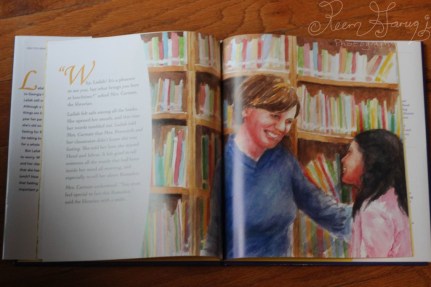
Lailah is excited to wake up and have sehri with her family before heading to her new school, fasting for the first time.  Her mother has written a note for her teacher, but on the bus, Lailah reads the note and suddenly worries if her teacher will even know what Ramadan is ,and decides not to give it to her teacher.  Lunchtime arrives, and when the teacher asks Lailah if she forgot her lunch, her voice fails her, and her classmates offer to share their lunch with her.  Lailah decides to leave the cafeteria and finds herself in the library spilling all her worries and stresses and fears to a kind librarian.  (Yes the librarian is the hero, and really no one should be surprised, right!?) With the librarian’s urging and Lailah’s determination, she writes a note to the teacher explaining that she is Muslim, and fasting, and even includes a poem.  She leaves the note on her teacher’s desk at the end of the day.  The following day, the teacher has written her back and the reader, along with Lailah, know that having courage and staying true to one’s self can often be scary, but also wonderful too.

lilah inside

While the story is billed a Ramadan Story, it really just is the back drop for a lot of really good messages.  I think 2nd and 3rd graders to early middle schoolers could really benefit from the book.  It is semi autobiographical and I think the authenticity of the emotion woven in, makes the book very relatable and powerful.  I plan to discuss it with my daughter going in to 5th grade, who is also a bit shy on occasion: the way Lailah worked out the problem, the way she found someone to trust and talk to that was patient with her, to point out to her that the kids in her class were very kind and that most of her fear and anxiety was with herself, not them.  I also really like the message that she was so excited to fast, and how her nerves took that excitement away, but having the courage to face her fear, brought back her happiness and enthusiasm.

The end of the book has an Author’s note, telling how the story came about and a bit more about Ramadan. It also tells the definition of Sehri and Iftar, the only two “foreign” words in the book.  I found it interesting that the word Sehri, an Urdu word, was used instead of Suhoor, if they are coming from Abu Dhabi, but perhaps the author is of subcontinent heritage.  The illustrations are colorful and realistic, complementing the story and tying in the range of emotions and events Lailah is experiencing.

I was pleasantly surprised at the book, and even more excited to see that it is available in the public library system.  Here is the link to the author’s blog I hope she plans to write more, as her style and message resonate with Muslim American kids, and their parents, alhumdulillah.


The Elephant from Baghdad by Mary Tavener Holmes and John Harris illustrated by Jon Cannell

Standard

the elephant from baghdad cover

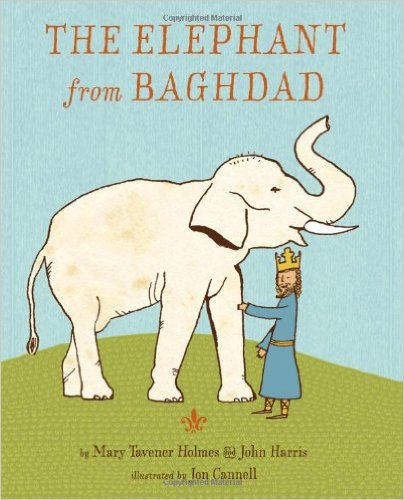
This fun and informative picture book written on a 4th grade 8th month AR level retells a historical event through a fictionalized narrator.  A great retelling of a West meets East event with an albino elephant thrown in, makes for a story that is hard to believe is true.

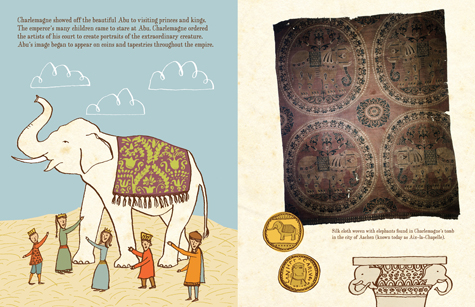
Charlemagne, the medieval ruler of most of Europe, sent ambassadors to meet the Caliph of Baghdad, Harun al-Rashid.  Charlemagne was curious to learn more about the amazing ruler he had heard so much about.  When the Europeans arrived they were astounded at the buildings, libraries, organization and cleanliness of the city.  For months, Harun “introduced the men to artists, musicians, scholars, mathematicians, architects and poets” and taught them about “science, medicine, engineering, and art.”  Harun al-Rashid’s generosity however did not stop there.  “He loaded a caravan with presents fit for a fellow emperor.”  He sent a saber and scabbard, a precious water jug, and a magnificent clock that he had commissioned his artisans to create.  A mechanical water clock, that unfortunately, has been lost in history, but was detailed in the 807 CE Annles regain Francium, a journal that chronicled the daily life in Charlemagne’s court as well as in a book written 400 years after Harun by Al-Jazazi in Istanbul, Turkey.  Even this, however, was not enough for the great emperor of the West, and Harun gave Charlemagne the rarest treasure of his court, an albino Elephant named Abu.the elephant from baghdad

Abu even had his own keeper, a Jewish man named Isaac, and when they returned back to Europe both were invited to live in the palace.  “Once or twice a day Charlemagne would visit his immense guest.” Abu’s image was preserved in portraits and began to appear on coins and tapestries in the empire.  Even in Charlemagne’s tomb is a silk cloth woven with elephants.  Abu was taken into battle against the Danes and when he got old, Charlemagne had a house built for him and Isaac near a river.  In 810 Abu died and when Charlemagne learned of his death, “he wept.”

The story shows the amazing respect the two leaders had for one another, for animals, and the tolerance of people of different faiths.   At 40 pages it works for story time and for older students learning about the Middle Ages.  Obviously they would take away drastically  different points from the story, but both groups would enjoy it.  I learned a lot, so I recommend it to adults as well.  The pictures are beautiful water colors and pencil, supplemented with actual photos of artifacts, that all combine to make the story and book a wonderful addition to your library to be read and enjoyed again and again. elephant from baghdad 2


The Red Pencil by Andrea Davis Pinkney illustrated by Shane W. Evans

Standard

The Red Pencil.jpg

I didn’t realize the book was written in prose until I opened it up to read, and immediately taken-aback I rechecked the AR level and sure enough, this 309 page book that is written in prose and covers the genocide in Darfur, is written on a 4.2 level. And it is amazing. I forced myself to stop reading at one point so as to not rush the depth and soul of the simple words from being lost in haste.  It is truly, in my opinion, a beautifully remarkable feat to convey such horrific atrocities with such hope and integrity to young adults in a palatable and inspiring way.

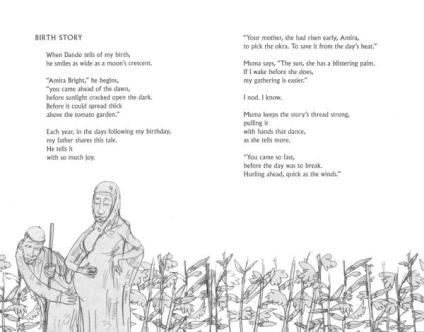
“Allah is the light,” he says.

I ask,

“How do you find Allah’s light?”

Old Anwar says,

“Take the path that shines the brightest.”

SUMMARY:

Amira’s life on her family’s farm is by no means easy, but she has loving parents, a little sister, her beloved sheep, and a dream of going to school.  Her father advocates for her, but her mother, steeped in tradition, sees education only as a waste of time.  The illustrations and sparse words manage to convey fairly solid understanding of Amira’s life, optimism, and relationships with those closest to her.  Although warned of the dangers the Janjaweed could cause, Amira remains fairly unconcerned about the mounting political unrest around her, until it is too late.  When death and the destruction of her home force the surviving members of her family and neighbors to seek refuge in a camp many miles away, the reader sees how truly horrific her experiences have been.  She refuses to speak or rather cannot, when a chance encounter with an aid worker brings her the prospect of getting her voice back, through the empowerment of a red pencil.  With restored determination she convinces an elder neighbor to teach her, but it is not enough for Amira Bright.  Her sparrow needs to soar free.

WHY I LIKE IT:

You expect a book written in verse to have a lot of imagery and symbolism, and The Red Pencil does a good job of balancing the story and the description, to keep the book on track.  The linear story line remains focused on telling the story at hand, making it attainable for elementary and middle school children.  The Darfur conflict is complicated at best, and using verse to convey it from a young girl’s voice allows a lot of the politics and dirtiness of war to be side-stepped without dismissing it.  Amira’s optimism and hope is at times naive, but more as a reflection of her personality then out of ignorance. She sees things, and feels things, and must deal with things, no child should, but her spirit shines through and keeps the book from being depressing, while still being sad.

Today the red pencil does more

than beg for my hand.

It makes me a promise.

It tells me to try.

The characters are Muslim and they rely on Allah, and pray, yet Amira’s thirst for knowledge includes that of learning the Koran (Qur’an) as that knowledge too, has not been readily available to her  There is a lot to discuss in the book, both what is written and what the reader brings to it.  I look forward to teaching the book, and re-reading it once again to savor in the rich images.

Here,

Muma stoops.

Here,

she has nothing to reach for.

FLAGS:

Their is violence when the Janjaweed attack her family.  But I think it is conveyed in a manner suitable for 3rd grade and up.  It is not celebrated or glorified, it is traumatic and has repercussions that are respectfully conveyed.  There is also mention of a child bride, but not in so many words, that in all honesty I doubt most young readers will be as bothered by it as perhaps they should.

TOOLS FOR LEADING THE DISCUSSION:

There is a discussion guide in the back of the book along with an Author’s Note, Acknowledgements, Glossary/Pronunciation Guide, Character/Location Pronunciations, and Important Terms that Appear in the Book.

An Educators Guide: http://media.hdp.hbgusa.com/titles/assets/reading_group_guide/9780316247801/EG_9780316247801.pdf

A study guide and quiz: http://www.bookrags.com/studyguide-the-red-pencil/free-quiz.html#gsc.tab=0
The Red Pencil 1

The Hijab Boutique by Michelle Khan

Standard

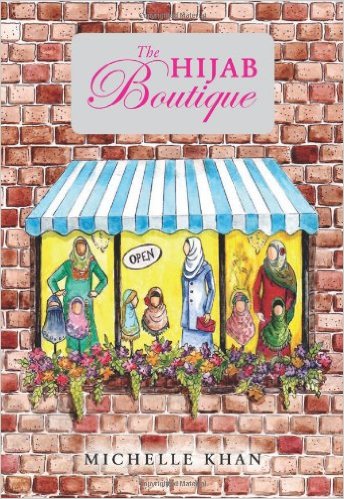
The Hijab Boutique

I was really hoping this book would help out the sparsely populated early chapter book section.  And it should, at just 52 pages with beautiful full page pencil style drawings, it just somehow seemed confused instead.  The content is much more young adult in story line, but because of the short length, the characters seem flat and underdeveloped.  My fourth grader read it in less than a half an hour. Yet, I don’t think a 1st or 2nd grader would get much out of the book.  I don’t know what kind of editing process the Islamic Foundation puts its books through, but back when I was a teacher, I would have told the student they have a wonderful, wonderful rough draft with so much potential, they just need to flesh it out and add more detail so the reader connects with the characters. The back of the  book suggests the book for ages 10 and up and content wise that is fine, but it also has a list price of $7.95 and for something that can be read in less than a half an hour, it seems a little steep. If it didn’t have so much potential, perhaps I wouldn’t be so bothered, I just feel like if she stretched it out to being 200 pages, it could be so powerful.

Farah is a fifth grader at an all girls art school.  She has a best friend, who’s mom is a soap opera star, but some popular girls still make  her nervous.  When her Social Studies teacher assigns the girls to bring in something representing her mother, she can’t find anything to share about her mother that she doesn’t think is boring.  Farah’s father passed away two years prior and with money tight, Farah’s mom is opening up a Hijab Boutique.  No real details are given about her family life with her father or the impact his death had on her, which is unfortunate.  The story discusses why the mom started wearing hijab and why it is important, but makes it seem like Farah knows so little about her mother.  Again a hole that if explored would make the book that much more interesting. Not to mention that it could prod young girls to talk to their own mothers about such things.  To no one’s surprise Farah brings in some hijabs to represent her mother and Alhumdulillah the book ends on a positive note with little fanfare, catharsis or drama.

Farah and her mom are practicing Muslims who are an active part of their western community.  It would seem Farah is the only Muslim in her school and it doesn’t seem to be an issue.  They are all upper class and a bit snobbish, but there are no flags.  If your library has the book, reading it is by no means a waste of time.  I don’t know that you’d read it more than once if you purchased it, but 4th through 6th graders might enjoy the short read, and be inspired by fashionably fabulous hijabs while furthering their understanding about why Muslimah’s are required to cover.


The Turtle of Oman by Naomi Shihab Nye

Standard

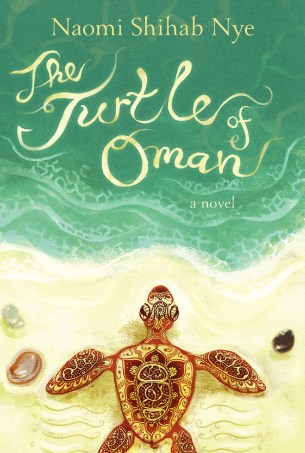
The Turtle of Oman

This slow, aimless, subtle, quiet prose-like book, is unexpectedly charming and endearing, and so not like most every young adult book out there.   I truly want to make all 4th through 8th graders read it, absorb it and ruminate in the love shared between a nine-year-old boy, his grandfather, and their home.  The easy 299 pages flow by on a 4.6 reading level and make you long for a kind grandfather to help you see the amazing in the ordinary, and provide you with gentle strength when facing life changing events .  The Turtle of Oman has no climax and no conclusion, yet it offers hope and warmth in a reassuring manner that makes you feel better for having read it.

SUMMARY:

Aref is moving from Oman to Ann Arbor Michigan for three years while his parents pursue their education.  To say he is dreading the move is an understatement.  Lucky for him, and the reader, Aref’s grandfather Sidi, helps him create some memories to take with him to America.  While they spend time together, travel around the country, and talk, the reader is drawn into a world where Aref and Sidi, finish each other’s sentences, and blur the lines of fact and make believe with their stories.  Their love and ease with one another is so seamless that not only are they best friends, and relatives, but they are so intertwined the thought of their separation is heartbreaking.

“Aref kept thinking that no matter what you say, there is something more inside that you can’t say.  You talk around it in a circle, like stirring water with a stick, when ripples swirl out from the center.  You say something that isn’t quite right and that’s worse.  Then you want to say, sorry!  But no one knows what you mean.

He wished he could tell Sidi, you are the king of my heart forever, I don’t care who else I meet, I don’t care about traveling and new friends and different flavored yogurts, I only care about how nice you are and how much I cannot stand the thought of being far from you, ever, ever, ever.

But he could never say this.”

Sidi has passed his love of rocks on to Aref and each adventure involves Sidi slipping a rock to Aref as a token for him to remember their adventures and each other.  From exploring the beach, camping in the deserts, sleeping on the roof, and going out on a fishing boat, the duo relishes in the details of everyday life that make life worth living.  Along the way Aref keeps lists of interesting facts and the reader learns about animals, Oman, Michigan and so much more.  But no matter how much prodding and reassurance Sidi and Aref’s mom try and impart on him ,the book pivots around the inevitable need for Aref to pack his suitcase.  As much as packing a suitcase can be a climax or a conclusion, that is what the author gives, and the reader must be content to understand that like Aref’s beloved turtles, he will have to find his way to the ocean only to return once more to Oman.

WHY I LIKE IT:

I love that it meanders and cannot be rushed.  I love the cultural warmth and the emotional depth.  While the setting is Islamic, there is no religion mentioned other than the call to prayer heard in the market place.  Quiet books usually border on boring for young adult readers, but I feel like this one doesn’t.  I am leaning toward doing it for the Junior Book Club to see if it has the emotional appeal that I think it will.  The main character is scared and unsure about the big move, feelings many children have felt.  But his way of handling it, while childish and whiny in his stubbornness to pack, also offers nuanced hope.  Aref is allowed to work through his thoughts and feelings, and while some characters rush him, his time with Sidi doesn’t feel rushed and forced.  His time with Sidi is reassuring and patient, a fictional soft place for the scary unknown.

“Talking with Sidi felt like a sky of floating words,” Aref explains. “You could say anything.”

FLAGS:

None, the book is completely clean.

TOOLS FOR LEADING THE DISCUSSION:

Interview with the author:  http://www.hbook.com/2014/12/talks-with-roger/naomi-shihab-nye-talks-with-roger/#_

https://www.readingtokids.org/Books/BookView.php?pag=5&bookID=00001192


Invincible Abdullah: The Car Theft Kidnapping by Haji Uthman Hutchinson

Standard

invincible

 I don’t usually post a review of the second book in a series so close to the original, but I wanted to read this one and see if it would be a better fit for Book Club being it takes place in England.  Nothing against  Invincible Abdullah and the Deadly Mountain Revenge, but we’ve done a lot of books for Book Club set in Pakistan and Afghanistan, and I want to make sure that the students see Muslims in a variety of settings. This book has the same main character, but is not dependent on the first book for understanding in any way.  Writing style is about a fourth grade level and it is just 152 pages, with sporadic pictures and a glossary of terms at the back.

SUMMARY:

Abdullah and his Malaysian friend Zaki are karate buddies that train and worship together while attending college.  The book opens with the two sparring and Abdullah going home to a letter from an old karate friend, John, who got mixed up with drugs and stealing cars and is now in prison.  John asks Abdullah to come visit him to answer some questions he has about Islam.  After a few visits John takes shahada and changes his name to Abd ur-Rahman. When Abd ur-Rahman gets out Abdullah and his family support him and the sensei even lets him back in to the dojo.  However, things don’t stay calm for long and when Zaki’s car gets stolen, and Abdullah is kidnapped, the boys friendship, loyalty and faith is tested.

WHY I LIKE IT:

The story is face paced and action filled, it also never waivers from being a strong Islamically based book.  The characters balance religion, and day-to-day living in a realistic and inspiring way that engages the reader and makes the character’s morality seamless and believable.  I love that the characters forgive a convict in words and actions and that the friends are from a variety of ethnicities that again, seem realistic and not preachy and forced.  The twists and turns in the story keep the reader’s interest and although you know things will end up alright, the author does keep you curious.

FLAGS:

Obviously there is an element of criminals and drugs that while presented in a negative light is central to the story.  There are not a lot of details about the drug use, but there is some violence that the characters go through, and mention of guns.   There is also brief mention of a bar in the book that is visited to make a few phone calls from.  The only concern that I have, was that it could be perceived that John had to change his name when he takes shahada and I don’t know if I agree that, that is mandatory.  In the book it weaves a little bit of a side story and is presented very positively, but it is something to be aware of none-the-less.

TOOLS FOR LEADING THE DISCUSSION:

I will probably use this book for the 3rd to 5th grade Book Club selection later this school year, because I think there is a lot to talk about. Topics of rehabilitation, taking shahada, and being a good friend are prevalent through out and something I think kids can wrap their heads around and have opinions about.  There doesn’t seem to be a lot of information about the book online and I’ve heard from one distributor that the book is out of print, but on some sites there are still copies available and there is also a workbook.

The Visitors by Linda Delgado (Book #1 of Islamic Rose Books)

Standard

Islamic Rose Books The Visitors

I first read this book in 2004 and it was pretty much my first introduction to what elementary aged/young adult Islamic fiction could and should be.  It set the standard and I think subconsciously I’ve held every other Islamic fiction book up to this series as a comparison.  I’ve taught it to 4th graders and 5th graders, I’ve purchased the series and left it for the students at every school I’ve ever been a part of, I’ve even exchanged emails with the author with students’ questions and been impressed by her responses.  So, after reading so many other books in putting this blog together, I thought it is finally time to revisit a book and series that is dear to my heart, and see if my memories are accurate.

Alhumdulillah, they are.

The book is a bit bumpy at first with the chattiness of the main character Rose, but either like real children, you grow accustomed to her and find her endearing, or the author pulls back as the story progresses and the book finds a more readable and engaging rhythm.  Either way, I still felt a pull to keep reading the book, and feel confident that those that read it, and the entire series (I haven’t read the latest book, “Reunion”) are better for it, alhumdulillah.

SUMMARY:

Nine-year-old Rose is excited that her grandparents, who live next door, are going to be hosting two Saudi Arabian Police Officers who are coming to America to learn English and train with the Arizona Police Department.  In anticipation of their arrival Rose and Grandma do what they can to learn about the food, culture and religion.  Rose’s dad however, is not comfortable with Abdul and Fahd being so close to his family, and for Rose to be so curious about Islam.  Rose works on PLAN after PLAN to try and help her dad and the officers connect, but will it be enough?

WHY I LIKE IT:

The book actually addresses some harsh realities of how Muslims are perceived, yet does so in a tender way.  When Rose wants to go to the Islamic Center and her father objects, or she talks about Muslims at school and her teachers get mad, it opens the discussion for why people may have negative views of Muslims, how to deal with such negativity and how to move past stereotypes.  The book also does a really good job of introducing Islam and Saudi culture to its readers in a fairly non preachy manner.  The inner workings of Rose’s family are also surprising raw and relatable.  Her Mom is not in the picture and Rose must deal with the stresses of a single parent home, luckily her grandparents are next door, but even then, there are stresses and issues that arise.  Rose also deals with a friend moving away, teasing at school, and disappointment.

FLAGS:

None, just some of the stereotypes from Rose’s Dad that may introduce some negative views non Muslims have of Muslims, such as: Muslims as terrorists, Muslim’s being abusive and controlling to women, etc.

TOOLS FOR LEADING THE DISCUSSION:

There are a few different versions of the book, mainly just cover changes depending on the publisher, but this version:

The Visitorshas appendixes in the back that include a glossary and recipes and facts about Islam as well as Arizona.  The newer version (as pictured at the top of the post) doesn’t include everything and refers those looking for more to see a website.  That website however and all other links to online study guides and reader guides are no longer available or now have different owners.  I’m not sure what happened to Linda Delgado, and if anyone knows how to contact her, I’m hoping you will let me know.
So as of now there are no links to suggest for teaching the book unfortunately.

How to Get Hijab Ready: A Guide for Muslim Girls Ages 8 to 11 by Aisha Elwan & Megan Wyatt illustrated by Sarah Hafeez

Standard

How-to-get-Hijab-Ready

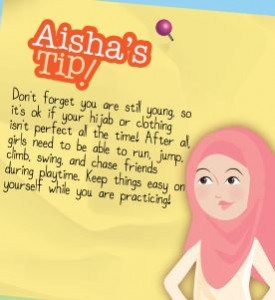
Yes I know it isn’t fiction, but How to Get Hijab Ready is such a fabulous and much needed book that any positive attention I can direct toward it, I feel is effort well spent, Alhumdulillah.  The book is obviously meant for 8 to 11 year old girls contemplating hijab.  The beauty of this how-to book is that it answers everything from how to accessorize one’s hijab to dealing with bullies in a beautiful manner.  Not only are the pictures bright and colorful, but the presentation is clear, precise and inspiring.  The authors do not talk down to the readers, nor do they make it seem like a burden as they discuss hadith, ayats from the Qur’an, challenges and fashion sense.  The book is divided into sections: The Basics, Getting Started, Having Conversations,  Worries and Concerns, and finally Your Reward for Good Deeds. Each section addresses different topics and “Aisha’s Tips” are scattered throughout to give 12-and-a-half-year-old Aisha’s tips on the subject at hand.

Aishas-Tip-275x300

Truly this book is a gift to moms and daughters alike.  I plan to let my daughter look through it for a few days and then sit down with her to discuss.  It functions as both a how-to manual as well as a reference guide and I can see it being looked at A LOT.  Additionally I can see my daughter discussing it with both Muslim and non-Muslim peers.  I think the book offers confidence, direction, and pride as young girls will find inspiration from young Aisha while having many of their concerns about hijab answered in a fun, hip way.

My only criticism is that it wasn’t around when I was a young girl.  For some hijab is an unknown, for some it is a stress, and for some it is a natural expression of faith, and subhanAllah this book in just 51 colorful pages manages to convey information, smiles, and excitement irregardless of your background.

project-708-body-Screen_Shot_2015-02-21_at_11.49_.38_AM_

The Great Race to Sycamore Street by J. Samia Mair

Standard

the great race to sycamore street

A fun book for elementary aged children looking for a fast paced, energetic read, with Islamic morals and lessons.  Overall a great book about character, being a good neighbor, and never giving up, The Great Race to Sycamore Street is not in the AR database, but I estimate it at about a 4.3 level and think even for higher readers there is plenty to learn about archery and peach trees, and plenty to enjoy as Amani and Hude take on bullies, grumpy neighbors, dogs, and making the most of a summer with their grandma in the country.  There are 180 pages followed by acknowledgements, references, and glossaries explaining archery terms, Islamic terms, and where the hadith and Quranic ayats come from, theoretically making the book accessible to Muslim and non Muslims alike.  I however, think the book would be a bit preachy to non Muslims or to those unfamiliar with Islam.

SUMMARY:

Siblings Amani and Hude arrive in Fairfax County, Maryland to spend the summer with their Grandma Hana in the quiet town of Cherry Hill, for what they think will be a slow laid back summer of reading, swimming in the lake, and preparing for the County Fair.  Grandma Hana has the undisputed best peach tree in the county and makes the best pies to enter in the pie competition at the fair, and this year Amani gets to help.  Hude is a budding archer and with his recently deceased grandfather’s journal and old archery regalia he is determined to compete and win the archery competition.  But their simple plans quickly meet twist after twist: from bullies on the train, to swarms of cicadas greeting them on arrival, to a new neighbor who discovers the beloved peach tree is actually on his property and he wants it gone, to the bullies on the train ruling over the lake and proving to be great archers themselves.  Can the  peach tree be saved? Can they be victorious at the fair? With lots of stories about Prophet Muhammad (Peace be upon Him) woven in, and ayats from the Quran used to emphasize points, not only is the book a quick action packed story, but it is also poignant, educational, and memorable as well.

WHY I LIKE IT:

I love that it is clean and requires the brother and sister duo to work together to do something that is bigger than themselves.  I also love the way that Islam is given practical uses for the children, it isn’t taught in the abstract they must pull on their understanding of their deen to decide what to do, how to act and what the next step should be.  I also like how the fast paced story is set in contrast to the slow thematic ideas of a peach tree, baking, archery, and a stereotypical summer with grandma.  Most readers I would assume don’t know that much about fruit trees and county fairs and archery, and I think the author does a good job of introducing the audience to these concepts and weaving Islam into it while keeping the story exciting and moving along.

FLAGS:

Clean, alhumdulillah.

TOOLS FOR LEADING THE DISCUSSION:

The plot is pretty linear, and a quick discussion of what every one liked and perhaps what surprised them would be a sufficient review of the story. From there I would probably go through the reference of hadith and ayats from the Quran to guide the discussion, you can get the online reference of that here:

http://www.kubepublishing.com/the-great-race-to-sycamore-street-free-reference-sheet/

scroll to the bottom and click on the link to download the text.

Magid Fasts for Ramadan by Mary Matthews illustrated by E. B. Lewis

Standard
Magid Fasts for Ramadan by Mary Matthews illustrated by E. B. Lewis

Magid Fasts for Ramadan

The intent of this 48 page chapter book is good, however, a few things rubbed me the wrong way about how Ramadan and Islam are presented.

Nearly eight-year-old Magid wants to fast on the first day of Ramadan, but everyone says he is much to young.  He decides to deceive everyone and fast anyway.  I’m actually okay with this main story line, as I could genuinely see a child wanting to do it so much they would lie about it.  The author even has the family sit down after the truth comes out and discuss how honesty is important and this is not how Ramadan should be celebrated.  Lesson learned for Magid and the reader, right? Nope, the author kind of blows it and takes it to the other extreme.

Magid’s sister Aisha is twelve and is “forced” to fast so she isn’t the only girl not fasting at her all girl’s school in Egypt.  What a sad reason to fast, The whole reason Magid wants to fast is to be a “truly obedient Muslim” which sounds great on the surface, but it get’s repeated so often that Magid at one point is judging a classmate who isn’t fasting and isn’t always at Jummah (Friday) prayers.  The parents decide at the end to let Aisha fast until school is out, hence shortening the day for appearance purposes, and Magid can fast til lunch.   He is told he can fast full days when the days are shorter.  Again a really odd reason to wait when fasting has been prescribed for us, to make it an issue of convenience.

So aside from the very negative view of Ramadan and the kids rejoicing at the end that they don’t “have” to fast, the lying, the disobeying your mother, and the judgmental laden diction of being truly obedient, the book does cover a lot of ground well.  The book shows the characters doing wudu and praying, it shows them trying to be kind to one another, it talks about how the Quran was revealed in the month of Ramadan and it does have a plot.

The water color illustrations are nice, and I also like how it showed a bit of Egyptian culture with the lanterns, singing, and food.  Interestingly the author says it is harder for Muslim’s in America to fast, but elsewhere says that Aisha has to watch the girls at school not fasting, eat lunch.

I really wouldn’t recommend this book, for the intended audience of 3rd through fifth graders I think it would do more harm than good in promoting Islamic values in Muslim children and in showing non-Muslims what Ramadan means to Muslims.