Category Archives: 2nd through 4th grade

Jannah Jewels by Umm Nura illustrated by Nayzak Al-Hilali

Standard

Strong muslim girls  (check)

Historical fiction (check)

Elementary level chapter book (check)

Beautifully illustrated (check)

Action, adventure, fun (check, check, check)

Really what more can you want from a book, or better yet a series of books?

The premise of Jannah Jewels is four Muslim girls each with specific skills that travel back in time to various places in the world to retrieve artifacts to save the world before the “villians” do.  Along the way they share knowledge of hadith, Quran, and Muslim achievements and advancements while meeting with influential Muslims.  I mean really, what is there not to like.  This is historical Islamic Fiction for 2nd through 5th grade at its finest, yay!

So far there are nine books in the series, and based on the premise that they must find 12 artifacts to put in a golden clock, I would assume there will be 12 books.  I decided to review only the first two as I think they set the stage and give the reader a good feel for the series’ standards, the tone, and direction the consequent books will follow.  The series is to be read in order and they range in length from 69 pages to 165.  Each book has a description of the main characters, a visual of the supporting characters and is followed after the story by a sneak peek at the next book, a glossary, and some manga anime of the heroines.  Some of the books are co authored (Ustadha S. Karim & Tayyaba Syed), but based on the website http://www.jannahjewels.com Umm Nura is the main author and creator of the series.

SYNOPSIS:

Hidayah sees a woman with a bow and arrow and watches her for many days until finally she musters the courage to meet her.  This meeting is the start of Hadiyah’s training in present day with the Master Archer.  The story however, starts with a prologue of the past and how different approaches to archery have lead to a rift between those entrusted to keeping evil at bay.   The collision of those actions and today occur as Hidayah and her friends Jaide, Sarah, and Iman are chosen to retrieve artifacts scattered around the world and throughout time.  They must bring these artifacts and place them in the golden clock before Jaffar and his son Khan do, to obtain a secret locked away inside.  Each girl has incredible skills and strength as well as fears and doubts.  The stories are action pact as well as enlightening and empowering.  The girls are smart, strong, and supportive of one another and they use team work to make for a smart inspiring read.

In the first book the foundation is laid and the details of time travel and the task are put forth, it is a tiny bit cumbersome, but is quickly believable and accepted as the action picks up.  The Jannah Jewels travel to Timbuktu and meet with Mansa Musa to rescue a lost manuscript.  In the second book they journey to China aboard the ships of Chinese Muslim Admiral Zheng He to recover a medicinal plant.  The recap of the first book and the premise of what has to be done is seamless and quick.  Thus allowing the story to move further below the surface to provide more insight into who the four girls are, and understanding into what occurred in the past that made the Jannah Jewel adventures necessary.

WHY I LIKE IT:

I love historical fiction, so Islamic historical fiction is like a gift, when done right.  To give young muslims a glimpse at some of the remarkable accomplishments and contributions Muslims have made throughout time, in a manner they don’t even know they are learning it, is so needed.  Our kids should know about Mansa Musa, Al-Kindi, Fatima Al-Fihri, Sultan Muhammad II, and more, and sadly many are not tempted to pick up a non fiction book to learn about them.

The Jannah Jewels are also admirable and have the ability to inspire our girls to be better Muslimah’s through their examples of intelligence, strength, and deen. Each book reveals more about their hobbies, passions, and past, and does a good job of giving them each their own personalities. That being said, these books are engaging for both boys and girls.  My own children have read the first four multiple times as have I.  Initially I didn’t think my son would be interested as it seems like a very “girl power” type read, but the story is strong enough and the characters have depth that they work well for all kids and their parents.

In addition to the stories, visually the books are absolutely gorgeous and appealing.  The manga anime style of art is bright and colorful on the covers, and detailed and complimentary throughout the text.


FLAGS:

None, alhumdulillah

TOOLS FOR LEADING THE DISCUSSION:

The website is engaging for those wanting to know about the characters and writing team.  The FAQ section is good background as well.  www.jannahjewels.com

The books aren’t complicated as they are for elementary aged children, that anything more than the story is not needed.  If your readers are like mine, however, you will need some reference books or google on hand for those that would like to learn more.  I think these books would be great in a classroom setting to get students reading.  I also think they would work well in 1st grade for read a loud story time.  I don’t know that they would be ideal for book club, but definitely could be used to compliment lessons in Language Arts and Social Studies.
Bedtime Ba-a-alk by Rukhsana Khan illustrated by Kristi Frost

Standard
Bedtime Ba-a-alk by Rukhsana Khan illustrated by Kristi Frost

bbaaalkcover

I know, I know another book by Rukhsana Khan, but really how great is she.  She writes books with religious references sometimes, cultural ties sometimes, and sometimes just fun books. I love that kids of all backgrounds associate her with good stories, and that she hasn’t limited herself to just one demographic.  img_1893

Bedtime Ba-a-a-lk has no religious or cultural connections and is just about a girl dealing with rogue sheep in her mind that don’t want to be counted.  The AR level is 2.6 but I don’t know that 2nd graders and below would really “get” the story.  The vocabulary is great, with a little assistance: balk, conjuring, deliberate, snub, mutiny, haunches, eider-down, furrowed, etc..  And the concept of a girl creating her imaginary dream world and conversing with the characters in it, is grand, but I look forward to testing out which age groups grasp it, and which ones just think it is a funny story with an obstinate ram.

img_1894

The book is 30 pages and beautifully, playfully illustrated.  The pictures are just “fuzzy” enough to give a sleepy feel, and bold enough to stretch the imagination.  The lines do not rhyme, but flow easily.  The font is large and inviting, and well placed on the page.  The book is clean, and the girl in her pleading with the sheep uses “please” and good manners in her firm demands.   It does use the word, stupidly and darn, once each, but overall a silly fun read.


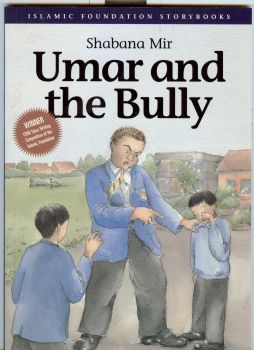
Umar and the Bully by Shabana Mir illustrated by Asiya Clarke

Standard

Umar and the Bully.jpg

With it being October and Bullying Prevention Month, I thought to review a book that has been on my bookshelf for a long, long time.  It won the Islamic Foundation Story Writing Competition in 1996 and is just as relevant today.  At 44 pages, the story, the layout, and writing style appeal to children on a second or third grade level.

SYNOPSIS:

Umar stumbles across some older kids plotting something covertly in the school yard and some money being exchanged.  He then encounters a younger student upset.  Being a kind person, Umar gets Asad to confide in him what the bullies, Harith and David, are up to, and vows to keep Asad safe.  While all that seems simple enough, the true battle begins within Umar,  as he has to figure out what is he going to do, and how is he going to stop the bullying.

WHY I LIKE IT:

I love the length and the target audience.  My six-year-old son summed it up perfectly when he finished.  “Woah, that was a good book, I didn’t expect it would give me so much to think about.”  The author follows the bullying strategy of telling an adult, or a teacher, but gives some depth when that teacher doesn’t care or take the time to help.  It also shows a variety of people that you can go to for help and characteristics you should look for when deciding who a good person to talk to would be.  Umar decides to talk to a good friend of his about what is happening to Asad and devise a plan to help.  Mohammad is kind and trustworthy.  He also gets some advice and encouragement to be brave from Mohammad’s older sister and brother.  All this is done within an Islamic context of asking Allah swt for help, of finding inspiration from stories of his namesake Syedina Umar Al-Farooq. It also, as we get in Umar’s head, reveals how he himself is scared of facing the bully.  This is great because it shows that it can be scary to confront someone even if you are not the victim.  Umar feels he shouldn’t be scared because he is a Muslim, which I really don’t understand, but he turns to Allah swt asking for bravery to do what is right and to be strong.  And beautifully, after it undoubtedly raps up in a happily ever after children’s story way, he does remember to thank Allah (swt) for being there for him and gives credit to Allah for giving him strength.  The book shows the responsibility we have to do what is right even if it isn’t being done directly to us.  It also shows one or two children can make a difference.  I really like that the point of view is from Umar, not the one doing the bullying or receiving it.  Allowing the reader to see how empathetic he is to another person is a wonderful lesson in and of itself.

The book also has mostly Muslim characters, but a few names sprinkled through out as victims and perpetrators could suggest non muslims as well. This is great in showing that bullies are everywhere and that perhaps being in an Islamic school or in a majority Muslim school does not mean bullying doesn’t exist.  Similarly it is good to see that bullying isn’t just non Muslims disliking Muslims, as often time books about bullying for Muslims would suggest.  I think the book could be for Muslims and non Muslims alike, but with the religious reliance, it is geared more for Muslim readers.

FLAGS:

The book is clean, it mentions that the bullies are violent, and possibly smoking.  The children being bullied obviously are lying but it is clear that it is done out of fear, not because they are deceitful by nature.

TOOLS FOR LEADING THE DISCUSSION:

There aren’t any reading guides or activities to accompany the book that I could find online, but I think the natural discussion that would follow make it a great option to read as a book club book, or in small groups.  There are a lot of very easy places to ask children what they would do, if Umar made a good decision, and how they would feel as the story unfolds.


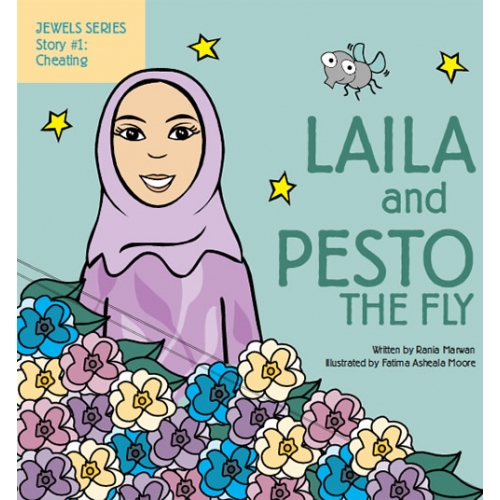
Laila and Pesto the Fly by Rania Marwan illustrated by Fatima Asheala Moore Jewel Series Story #1 Cheating

Standard

laila-and-pesto-the-fly

I ordered this book with the hopes that it would be the first book of a wonderful series teaching values in an Islamic context.   It says that it is book #1 in the Jewels Series and it focuses on cheating.  However, the book was published in 2009 and I can’t find any other books in the series.  Sadly, I can possibly see why.  The book is not great.  The illustrations make it so tempting even if all the girls are gorgeous and the illustrations simple, they would seemingly work well with a book aimed at 4 to 8 year olds, and just 24 pages long.

laila1

Unfortunately the text is lacking and doesn’t create a story worth reading more than once. The sentences are repetitive. And the same words are used over and over.  The first page alone says the word “play” four times in three sentences.  It is about 4th grade girls that play, watch cartoons and essentially hold lessons/ book clubs for each other once a week.  A lot going on for a book that on the second page says the word “flies” three times in three sentences.  Needless to say the repetition makes it hard for a story time selection, and the run on sentences hard for young readers.  The first page features a font that is probably about a size 20 and the next page it drops down to one that is about 11, the third page is about a 14 and the trend of the ever-changing font size continues throughout the book.

laila-text

Example of repetitiveness from Laila and Pesto the Fly

The story idea is a good one at its core.  A girl teaches her friends about flies.  Then the fly talks about Laila and how she is kind and honest. Then the next sections returns to Laila not being ready for a math test and she is tempted to cheat when Pesto, the fly, distracts her and writes a message for her in glitter.  I’m not sure how the glitter stays on the page, but, the message is received by Laila and emphasized by the author sharing a hadith, “He that deceives us is not one of us.” The last page of the book is a bulleted list emphasizing the harms of cheating, and how to overcome the temptation as the girls urge you to join their Cheat Deceit Foundation.

Overall, the book is awkward and doesn’t work for me.  There are a lot of better books out there.  That being said, if the author wrote another book, I may give her another chance, it isn’t hopeless. It just needs some tweaks. The fly is a silly likeable character, but the group of friends are a monolith and have no individual roles.  The message is clear and important, and we need books like this, but alhumdulillah the standards have gone up, way up, and the writing quality isn’t where it needs to be to attract Muslim children or their parents.


King For A Day by Rukhsana Khan illustrated by Christiane Krome

Standard

King-for-a-Day1.jpg

Its time for Basant, the Lahore, Pakistan kite flying festival, and Malik and his siblings are ready.  Ready to launch Falcon into the sky, ready to set other kites free, and ready to put the bully next door in his place.  While some kids have huge kites, and some have many, Malik has just Falcon, a speedy little kite that Malik prays can get the job done.

King for a day inside

Once again Rukhsana Khan does a remarkable job of taking a universal theme, adding some culture, and finding artists to empower minorities without making it an issue, all in a 32 page children’s book.  Written on an AR level of third grade ninth month, readers see characters handling a bully by beating him “on the court” so to speak, a character having confidence in his abilities, yet still asking Allah swt for help, and a boy in a wheel chair celebrating a fun spring time festival with his family.

king 1

The illustrations are rich with texture and angles, which contrasts the font and text presentation.  Little kids probably won’t be tempted to pick this book up, but as a read-a-loud first and second graders will enjoy the story and the kite flying action.  Third and fourth graders will enjoy reading the book independently, and find themselves cheering for Malik, appreciating his kindness, and wanting to pick up a kite and head out themselves.  The author includes a note at the back which provides more information about Basant and how it is celebrated.  Although it takes place in Pakistan and is a festival not celebrated in America, there isn’t a “foreign” feeling to the book, as kids can relate to bullies, wanting to be the best and the satisfaction of succeeding and feeling like a “king for a day.”

king2

The Secret Message: Based on a Poem by Rumi by Mina Javaherbin illustrated by Bruse Whatley

Standard

The Secret Message

Once again Mina Javaherbin retells a Rumi story in a fun, charming way to children that probably have never heard his stories before.  The illustrations bring this 32 page tale written on an AR 4.6 level to life.  While written for older elementary children, this book works well for kindergarteners and 1st graders in story time as well.  The pictures and descriptions make for an engaging story for all levels and the twist at the end make you want to go back and read it again and again.

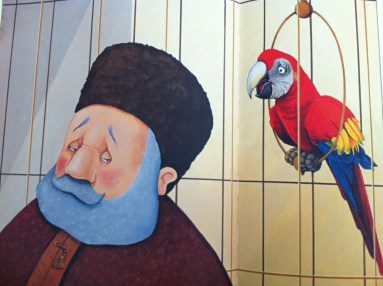
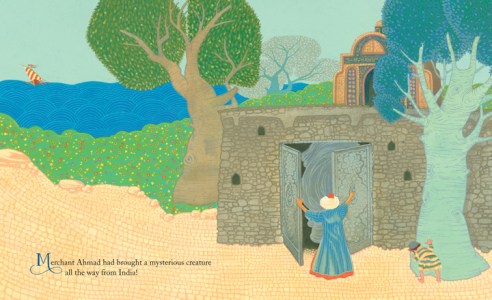
A wealthy Persian merchant brings a parrot from India to call and sing to those passing by to come in to the shop.  The parrot helps make the merchant famous and before long he has completely sold out of all his wares.  He plans to return to India and asks his family what they want him to bring back, he even asks the parrot.  The parrot asks for nothing but a message to be delivered to his friends about how he misses them and about his new home and cage.  The story follows the merchant to India and through it, showing and telling about the sites and goods.  On the way back the merchant stops in a tropical forest to deliver the parrot’s message.  The birds listen carefully and then one by one, fall off their branches with their backs on the ground and their feet in the air.  When the merchant returns he delivers the message and the same thing happens to his parrot.  (SPOILER). Sad that he has caused his parrot to die, he takes him out of the cage where in an instant the parrot flies out of the hole in the domed ceiling all the way home to his friends in India.

The-Secret-Message-2

Islam isn’t shown, and I debated including it, but culturally it is relevant with the character journeying from Iran to India and the author being from Iran.  Plus it is based on a Rumi poem.  There is nothing un Islamic in the book, and there is plenty of little places in the book to get kid’s opinion on the action, thus making it a book definitely worth your time.


Nadia’s Hands by Karen English illustrated by Jonathon Weiner

Standard

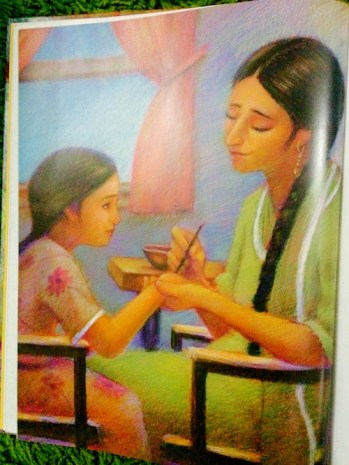
nadia's hands.jpegNadia’s aunt is getting married and she gets to be the flower girl in the Pakistani-American wedding.  She also will get mehndi put on her hands for the big event.  Her cousins warn her that she might mess up and even in the midst of her excitement she begins to worry what the kids at school will say when they see her hands on Monday.  As her aunt prepares the mehndi and the application process begins, various uncles peek in on her and her aunt gifts her a beautiful ring.  The mehndi has to sit on the skin for a while to set and as Nadia practices sabr, patience, I couldn’t help but think something seemed off in the story.  I’ve been at, in, and around a lot of Pakistani and Pakistani-American weddings, and this story didn’t seem to reflect the tone of such occasions.  The book doesn’t reflect the hustle and bustle and near chaos, it doesn’t sound like the tinkle of jewelry and laughter as the women sit around chatting and getting mehndi put on together, the pots on the stove are referenced but not described so that the reader can smell the sauces thickening and hear the pans crashing and taste the deep rich flavors.  It is lonely.  Nadia is lonely and filled with anxiety about Monday.  Durring the wedding she is walking down the aisle and suddenly freezes when she looks down and doesn’t recognize her hands.  Her cousins seem to show unsupportive “I-told-you-so” expressions as she searches for some comforting encouragement to continue on.  When she finishes her flower girl duties, her grandma asks if she understands why looking at her hands makes her feel like she is “looking at my past and future at the same time.” Nadia doesn’t understand and the author doesn’t explain.  At the end she is ready to embrace that her hands are in fact hers and that she will show her friends on Monday.  But the reader has no idea how it goes, or what exactly the significance of her painted hands are.  The book fails to give any insight or excitement for a culture bursting with tradition at a time of marriage.
 nadia's hands inside

There is a glossary at the beginning for the few Urdu words sprinkled in the book.  There is no further explanation however, of  mehndi, or weddings, of the brides clothes etc.  The illustrations are adequate, but because the text doesn’t offer much warmth or vibrance, they seem a little drab, and raise more questions about what some of the traditional items depicted are.  The book is a standard 32 page picture book and is written on an AR 3.8 level, which I think is a little high.  Granted my children are familiar with mehndi, but my first grader read it to me with little assistance.  There isn’t any mention of Islam and could probably be argued that the story reflects any wedding from the subcontinent background performed in the west.  The bride has a duputta on her head in the picture, but that is neither here nor there, and no one in the audience appears religiously covered.  I would assume they are Muslim because of the minor characters’ names: Omar, Saleha, Amina, Abdul Raheem.  Also, the word Sabr, an Arabic word, suggests that they are Muslim.  Plus they eat kabobs which the glossary defines as mincemeat, so probably not Hindu.  Overall the book is not, “bad” or “wrong,” I just wish there were more to it.


Elephant in the Dark: Based on a poem by Rumi retold by Mina Javaherbin illustrated by Eugene Yelchin

Standard

Elephant in the Dark

Rumi’s poem The Blind Men and the Elephant has been retold and transformed over time to emphasize many lessons: getting the whole story, defining truth, not being nosey, understanding points of view amongst others.  The basic story is that each person touches a part of the elephant in the dark and cannot fathom each other’s perspectives or what an elephant is, thus they take to bickering and proving that they and they alone are right.Elephant in the Dark inside

A big fan of the Karen Beckstein early reader version, that involves 6 blind men and is presented on a 2.6 level I was skeptical of this 32 page AR level 3.0 version.  The bright pictures and large picture format quickly won me over.  This book works so well for story time as the kids all know what an elephant looks like, they can all understand how the people are getting confused and all can see how their arguing isn’t helping.  All without much adult prompting.  The kids get so annoyed by the villagers not respecting Ahmad’s personal property and not listening to one another that when the illustrator has the children being the smart ones and enjoying the elephant at the end, the reader/listeners are giggling and feel like they are “in” on the truth.

elephant in the dark end

one translated version:

Some Hindus have an elephant to show.
No one here has ever seen an elephant.
They bring it at night to a dark room.
One by one, we go in the dark and come out
saying how we experience the animal.
One of us happens to touch the trunk.
A water-pipe kind of creature.
Another, the ear. A very strong, always moving
back and forth, fan-animal. Another, the leg.
I find it still, like a column on a temple.
Another touches the curved back.
A leathery throne. Another the cleverest,
feels the tusk. A rounded sword made of porcelain.
He is proud of his description.
Each of us touches one place
and understands the whole that way.
The palm and the fingers feeling in the dark
are how the senses explore the reality of the elephant.
If each of us held a candle there,
and if we went in together, we could see it.

Ruler of the Courtyard by Rukhsana Khan illustrated by R. Gregory Christie

Standard

RulerOfTheCourtyard

Set in Pakistan, Saba has to cross the courtyard to get to the bathhouse.  Fearful of the chickens that seem to have it in for her, she braves the distance in a dashing sprint and slams the door to relish in the safety of a chicken free patch of space.  However, today as she searches for courage to face the chickens after her shower she spots a snake near the door.  She is afraid, and wants to scream for her grandma, her Nani, but worries that the snake will bite anyone that comes through the door.  Realizing she must face this fear and solve the problem on her own, not only empowers her, but puts the chickens in to perspective.

This 32 page picture book written on an AR 2.6 level is a good book when discussing overcoming fear.  It reads aloud well, as the short sentences from Saba’s perspective convey her trembling fear, her determined resolve, and her elation and freedom after she faces the snake.  The illustrations on first glance, and even after the first reading seemed off.  They didn’t seem to compliment the story smoothly, however, after revisiting this book, I think I have grown to appreciate the exaggerated features of the girls face, and the simplistic blurred images of her surroundings.  I think it shows her focus and skewed view when faced with such a fear.

The Author’s website & teaching guide

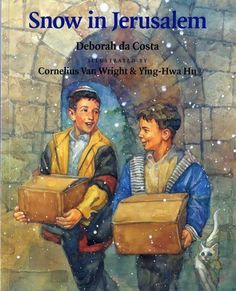
Snow in Jerusalem by Deborah da Costa illustrated by Cornelius Van Wright & Ying-Hwa Hu

Standard

Snow in Jerusalem

The world is always in need of kindness for animals and for one another, so when I saw this book written in 2001 about two boys who live in different quarters of Jerusalem coming together when they learn they are caring for the same stray cat, I was definitely excited to dive in.

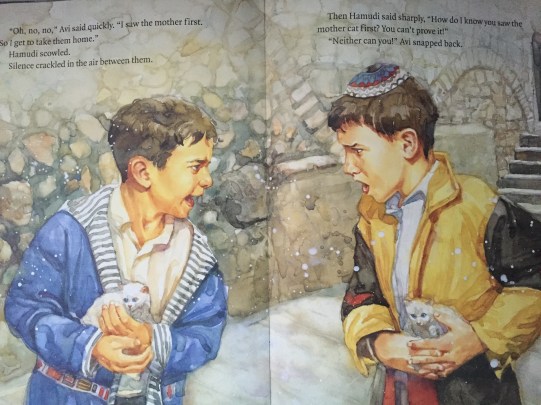
The book starts with a Jewish boy, Avi, caring for a fluffy white stray cat and his mom teasing him for caring for him.  He begins to wonder where the cat goes and resolves next time he comes around to follow him.  The reader then sees the cat journey through a market place and have the exact same interaction with Hamudi, a Muslim boy.  Both boys go days without seeing their beloved cat and when they begin to look for her, they find each other.  The boys fight over her as it begins to snow and the cat takes them to see where she has been, with her new kittens.

Again the boys fight and ultimately resolve to divide up the kittens to care for them and let the mama cat go back and forth to feed them.  Needless to say, I was a little let down by the book, I had hoped the boys would bond or see how similar they are. Instead they simply work out a solution for this one situation.  I can’t help but thinking the kitty family getting broken up and the poor mom having to go back in forth is rather selfish on the boys behalf.

IMG_0326

The book is 32 pages and written on an AR level 3.1.  Third grade and up can probably understand the similarities of the boys and how they come together to care for the cat and appreciate it with a simplistic understanding of Jerusalem’s complexities. Kindergarten and 1st graders could probably handle it as a story time selection, and understand working together to help a cat.  I’m sure fifth graders and up however, will be a little concerned for the mama cat and disappointed in the boys at a lost opportunity to provide hope in a troubled region.

There is an Author’s note and Glossary of Arabic and Hebrew words at the end, and a simple, yet valuable map of the Old City at the beginning.