Tag Archives: sikh

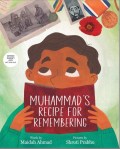
Muhammad’s Recipe for Remembering By Maidah Ahmad illustrated by Shruti Prabhu

Standard
Muhammad’s Recipe for Remembering By Maidah Ahmad illustrated by Shruti Prabhu

img_4274-1

I feel like the idea and heart of this 40 page picture book is decent, but the story, presentation and takeaway are just really poorly executed.  The pitch is a Muslim Desi kid feeling left out when all his friends are rehearsing for the upcoming veterans assembly because he doesn’t have anything to share.  He then starts asking his family, and the Muslims and non Muslims hanging out at the mosque to find out about Muslim and Indian involvement in the World Wars.  A rarely explored topic, considering in the West WWI and WWII are taught from a Western centric perspective, no doubt.  Unfortunately, most early elementary readers, the book’s target audience is 4-7, have limited knowledge of the World Wars, let alone about the subcontinents own politics and that they were occupied themselves under colonial rule at the time, and this book does nothing to explain any of it.  The inconsistencies, plot holes, vocabulary and ultimate lack of sharing a single story from a descendant of someone who fought, make the book rather pointless and forgettable.  Truly the take away is that there were Muslims among the Indian army, they made roti and prayed.  No real idea what they experienced, saw, endured, or gained in return for being forced to fight for Britain on the global stage.

img_4275-2-1

The book starts with Muhammad listening in to his classmates talk about their family members that are veterans and him feeling left out.  At recess they don’t let him battle in the reenactments and instead make him be the cook. When he gets home his dad is making rotis and Muhammad asks his dad if they have veterans in their family, they then go ask his grandfather if his great great grandfather fought in either World Wars.  Dada jaan recalls that “they sent my grandfather to France in World War One.”  But he never spoke about it except to mention that they shared rotis.  He suggests they go to the mosque the next night as that is where, “a kaleidoscope of people gather.” He learns from a Sikh uncle in a turban that whole villages went to fight and from Imam Rafiq that the soldiers fasted in Ramadan, prayed, and celebrated Eid.  No one has any visible tokens of their family’s service as they were lost over time.  Determined not to let the stories be lost, Muhammad shares roti at the assembly.

img_4277-1

Ok, buckle up, I have a lot to point out, but first the positive.  I like that the dad makes rotis.  Mom isn’t in the book, but there are a lot of pictures of a lady hanging on the walls of the house, so possibly she has passed and dad has to cook, no matter, it is nice seeing a Desi dad in the kitchen.  I also like that the mosque is central to the story, I wish it was called a masjid, and that it was explained why people that are not Muslim are hanging out there.  Brown people are generally lumped together and this seems to reinforce that stereotype, which makes me less than thrilled.  It seems like a social environment with ping pong tables and snacks happening, so why not say it is a social hall at the masjid where people of all faiths often gather.  A “kaleidoscope of people” does not explain people of different religions at a mosque to most four year olds.  The book claims the assembly is honoring veterans, so why is Muhammad only curious about WWI and WWII is never explained.  He is teased and forced to be the cook by his friends, with a very negative connotations and depiction in the illustration, but that notion is never pushed back upon, and is actually heightened with rotis being the thread that ties the entire book together.  A missed opportunity to be sure.

img_4279-1

I really struggle with the reality that the majority of Indians were forced to fight, and the book keeps it vague in the text with lines such as “joined the war effort,” and “they sent..” who is they? It sounds nice that Muhammad doesn’t want the stories, like the artifacts to be lost, but WHAT STORIES? If the book is about remembering, and stories are to be shared at the assembly, I feel short changed that the reader doesn’t get a single story about a Muslim or Indian that fought in one of the World Wars.  Isn’t that the point of the book? Yes the book has sources at the end, but it is fictionalized, make up a story, give the reader and Muhammad something to take pride in, to understand through, to imagine, what it was like for his great great grandfather.

img_4280-1

I struggled with the illustrations as well, Imam Rafiq looks off in the final image, I don’t get why Dada jaans memories seem to be on the TV either.  I also didn’t understand why rotis were the thread, but then it is paratha at breakfast that gives the idea, and who really is constantly spreading ghee on paratha or roti let alone at war, or at recess.
img_4278-1

War is not a trivial matter, and I kind of feel like this book reduced it to food, and allowed some racism, classism, and  Islamophobia, to go unchecked along the way.  I like that the backmatter has a recipe and an author’s note, but colonialism, service, war, are all heavy topics that are hard to bring down to an early elementary level picture book, and sadly this book is unable to connect and inform readers about this time in history.

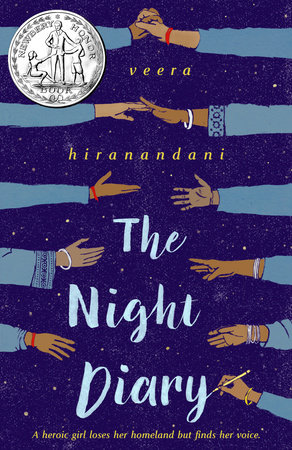
The Night Diary by Veera Hiranandani

Standard
The Night Diary by Veera Hiranandani

night diary

I was curious to see how partition would be presented in this book by an Indian Hindu author featuring characters who are half Hindu and half Muslim relocating to Hindu India.  Told in journal entries written by 12 year old Nisha to her deceased Muslim mother, the 264 page AR 4.5 book is wonderfully done, extremely compelling, and about so much more than the politics that birthed India and Pakistan.

SYNOPSIS:

Nisha and her twin brother Amil are opposites, yet they complete each other and care for each other in such a tangible and heart swelling way, that you can’t cheer for one while not rooting for the other one to find success and their place in the world as well.  As the twins turn 12 and Nisha is gifted with a journal from the families beloved cook Kazi, India and Pakistan too are about to come to fruition and Nisha’s journal entries detail her understanding of the larger events around her as well as her own struggles to come in to her own.

For Nisha words do not come easily.  She excels at school and loves to cook, but talking to people, or making friends eludes her and her longing for her deceased mother, make her a quiet reflective child.   She observes and  takes in so much around her, internalizes it, ruminates on it, and pieces it back together in a gifted way when she writes, that reading her entries, and the voice the author creates for her, is really amazing and fluid.  You feel like you really know Nisha and what makes her tick, what she fears, and how she thinks, you also get emotional attached to her and her world and find yourself surprised at how invested you are in not only her family’s successful migration across the new border, but also in her finding her voice and the confidence to use it.

Amil’s voice comes through Nisha, but her love for him and the way his strengths are her weaknesses and vice versa allows insight into the other family dynamics and attitudes to the two children.  Amil is an amazing artist, that suffers from dyslexia and does poorly in school.  He is weak and wiry, but fast, and he can talk and charm and ask all the questions that Nisha wants asked but can’t find the words for.  He and their physician father are rarely on good terms, as he isn’t the ideal strong boy with a medical degree in his future.

When it is decided that the family must leave their city where Muslims and Hindus and Sikhs live together and journey into Hindu India, the twins, their father, and their father’s mother, Dadi, must rely on each other to survive the riots and violence of the mass migration.  Nisha must also survive the understanding that with a Hindu father and Muslim mother there is so much about her own place in the world she doesn’t understand, and thus the journey is both an internal and external one, that will change Nisha forever.

WHY I LIKE IT:

I love that the protagonists voice is so steady and believable.  I truly fell in love with Nisha and felt her pain, happiness, anguish and overall got emotional for her, it was a rollercoaster.  The author does an amazing job of painting the politics of Jinnah, Nehru, Gandhi and Mountbatten in broad strokes, but believable ones to the understanding of a 12 year old.  She sees that one India held people of all faiths and that this breaking up of everything is leading to violence, upheaval, and horrors previously unimaginable.  She doesn’t understand why people had issues with her mother being of one faith and her father another, she loves her Muslim cook and loves listening to him pray five times a day as her paternal grandmother sings Hindu prayers in the other room.  She is both Hindu and Muslim and doesn’t see the contradiction within herself, suspending the reader’s own opinions on partition (if they have them), because how she sees it, does make sense for the story’s narrative.  The author takes Gandhi’s side of non violence and staying together, but balances very well and very intentionally that atrocities and humanity was seen from people of various faiths and political persuasions.  The role of British colonization and freedom from it, is slightly glossed over to the point of disservice, but again, being the target age of the reader and the age of the characters, I’m willing to over look it.  Families with Indian and Pakistani heritage will want to take the lacking information and help their children to fill in the blanks.

I love that the backdrop is the action of the story, but the relationship between the characters is truly the heart.  A lot of growth and compassion is conveyed very succinctly and powerfully.  Nisha wants so desperately to speak, but can’t, and her internal struggle and the pain she feels when she can’t speak up to help and participate in the world around her is gut wrenching.  As she confides in her diary, you realize that kids understand so much more than we adults often give them credit for.  The lesson is not lost on me.  I initially thought a book steeped in subcontinent history, with religious conflict and foreign words, wouldn’t appeal to a western elementary aged readers, after reading it, however, I now think this heartwarming story should be thrust upon them all.

FLAGS:

There is violence and death.  Not sensationalized, but detailed enough to set the tone of how serious the journeys were between the two countries when British rule stopped  There is some bullying and mention of the father smoking socially with friends.

TOOLS FOR LEADING THE DISCUSSION:

There is an Author’s Note, and a glossary at the back, and the inside covers have maps showing the journey the characters take.  I would absolutely do this as a Book Club selection for upper elementary, and will consider it even for middle school.  A lot of tools for teaching the book are available online, here are just a few:

Educator’s Guide: https://www.penguin.com/wp-content/uploads/2018/02/The-Night-Diary_Educator-GuideWEB.pdf

Children’s Discussion Questions: https://www.readbrightly.com/brightlys-book-club-for-kids-the-night-diary/

Classroom Bookshelf: http://www.theclassroombookshelf.com/2018/06/the-night-diary/


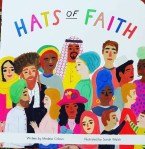
Hats of Faith by Medeia Cohan illustrated by Sarah Walsh

Standard
Hats of Faith by Medeia Cohan illustrated by Sarah Walsh

Hats_of_Faith_Sm_1024x1024

How fun to find similarities between groups that on the surface might seem so very different.  This 7×7, 14 page board book, keeps it simple and perfect for toddlers starting to notice people all the way through to early elementary children making connections around them.

Each page shows a portrait style illustration with a warm smiling face and the repetitive text of identifying what the name of the “hat” is followed by who wears it.

The opening page states that ” Many religious people share the custom of covering their heads to show their love for God.” And concludes by saying that “Learning about each other makes it easy to be more understanding.  Being understanding helps us spread love and peace.”

hats_of_faith_deensquare_04.jpg

Muslims are mentioned and depicted on the hijab page, the topi page, and on the head wrap page.  The book shows Muslims, Sikhs, Rastafarian, Jewish, and African Christians, it shows both men and women and offers phonetical pronunciations when necessary.