Tag Archives: islamophobia

An Emotion of Great Delight by Tahereh Mafi

Standard
An Emotion of Great Delight by Tahereh Mafi

emotion

This 256 page YA OWN voice book is a real and raw look at a character and the many layers of life weighing down on her.  At the center of it all is a strong Muslim teen dealing with post 9/11 bigotry, the shattering of her family, toxic friendships, and a broken heart.  It is a love story, but it is so much more, as the protagonist’s voice draws you in to her crumbling world from the very first page and has you begging for more when the last page is read.  So often in Muslim-lead-mainstream-romance-themed novels, I want there to be introspection at the choices that the character is making and the internal processing of navigating their wants with their beliefs, and this book surprisingly does it.  There are some kissing scenes, cigarette smoking, cosmo magazine headlines, and waiting for her father to die, but not without introspection. Shadi reflects on her smoking quite often, she questions the repercussions of her actions, and she analyzes her father’s faith and approach to Islam as she forges her own relationship with the deen.  There is mention of a Muslim character drinking, doing drugs, hooking up, and it mentions he had condoms in his car, just those exact phrases, nothing is detailed or glorified, just stated.  There are also threads of mental health, self harm, death, and grief.  The characters are genuinely Muslim and some of their experiences are universal, and some specific to the faith, culture, and time.  Muslims and non Muslims will enjoy the book, and I would imagine relate to different things, but find it overall memorable and lingering.  For my Islamic school teens, I’d suggest this book for 17/18 year olds to early twenties.  It isn’t that they haven’t read more graphic books, but to be honest, Shadi has a lot going on, and if being close to Ali can lighten her load and help her find hope and joy, I’m all for it.  I know it is “haram,” but it is fiction, and it will have readers rooting for them to be together, not a message you may want to pass on to your younger teens.  As the author says in her forward, “we, too, contain multitudes.”

SYNOPSIS:

The layout of the book bounces between December 2003 and the year before.  In a previous time, Shadi’s life was easier, her brother was alive, she had a best friend, her Iranian immigrant Muslim family may have had stresses and issues, but they were a family. In 2003, Shadi is largely forgotten by her parents, her brother is dead, her father is close to death, her mother is self harming, her older sister preoccupied, and as a high school student Shadi is both falling and being crushed by her heavy backpack both metaphorically and literally.

The story opens with Shadi being approached by a police officer wondering why she is laying in the sun, he thinks she is praying, and she doesn’t have the energy to be angry by this assumption, she is exhausted, and doesn’t want to cause any waves that might get back to her fragile mother and cause any more stress than necessary.  So she drags herself up, and begins the walk to her college level math class miles away.  The sun is short lived and the rain begins to pour, she knows no one will come to pick her up.  Her parents have long ago stop being present in her life.  She once had a best friend, but that relationship, as toxic as it was, also has ceased to exist.  So she walks, and she is drenched, and she falls, so she is now soaking wet and bloody.  A car slows down to presumably offer her a ride, but then he speeds off drenching her in a tidal-wave.  The scene is set for the tone of the book. Shadi is drowning, we don’t know all the reasons why, they unfold slowly, but we know that it is going to get worse, her phone is nearly dead and her sister has just called to let Shadi know her mother is in the hospital.

I don’t want to detail my summary as I often do, because the way the story unfolds, would really make any additional information given act as a spoiler.  The book is short and a fast read, but along the way the introspection to the chaos that is Shadi’s life, makes it impossible to put the book down.  Shadi will have to confront her crumbling life and find away to reach toward hope.  She will have to keep walking to avoid drowning and along the way cling to the few precious things that give her joy: an emotion of great delight.

WHY I LIKE IT:

I really enjoyed this book.  I loved the Islam and real approach to her volunteering at the mosque and calling out racism within the community and diving deep in to understanding is Islam more than just rules and toeing the line.  It was a great mirror for so many nuances in real life, that I will probably re-read the book again in the near future, to enjoy it all.  I absolutely love the unpacking of the toxic friendship.  When women tear each other down under the guise of caring it is brutal, and the acceptance and growth that Shadi is struggling with in regards to her best friend of six years, Zahra. who is also Ali’s sister, is a reminder that sometimes walking away is the only choice.  

The two criticisms I have of the book are: one-that the book is too short, I wanted, no, I needed more.  And two I didn’t understand why Ali’s family and Shadi’s family were no longer close.  I get that Shadi cut Ali out of her life and Zahra and Shadi had a break, but Ali/Zahra’s family still care for Shadi and she for them, so what happened between the parents? It seems that the death of a child would draw the friends out and make them protective, not push them to being aloof.  It seemed off to me and major plot hole.

FLAGS:

As I mentioned above: kissing, smoking, drugs, hooking up, referencing condoms, cosmo headlines, self harming, grief, death, alcohol.

TOOLS FOR LEADING THE DISCUSSION:

I don’t think even high school could do this as a book club selection, because you really want to ship Shadi and Ali.  If you had like an MSA book club then I think this would be a great choice.  I would love to hear teens’/young adults’ thoughts about Shadi’s view of religion, her fathers approach, and how they view passing the deen on to their children.  I think it offer great role-play scenarios in empathy and how you’d react in real life to finding your mother struggling, your best friend taking off her hijab and being so jealous of you, the bullying, the assumptions, understanding your father and where to assign the blame for such a traumatic event that claimed your brother’s life.  There is so much to discuss, and I hope at some point I find the right forum to chat about this book and listen to other’s perspectives about it.
Accused: My Story of Injustice (I, Witness Series Book 1) by Adama Bah

Standard
Accused: My Story of Injustice (I, Witness Series Book 1) by Adama Bah

adama

This is the first book in a new middle grades nonfiction series and is Adama Bah telling her own story about being detained as a 16 year old and falsely accused of being a suicide bomber.  A story that sounds like a movie plot is painfully real and terrifying and hearing it in her own words is powerful and impactful.  The writing is very basic in its linear format and straightforward presentation of the experience through her eyes.  It is not sensationalized or overly explanatory about how this situation came to be, how she got out of it, or what the family had to go to to find lawyers and pay for them, for example.  It is how she felt, what she understood at the time, and how the experience shaped her.  While the writing style is sufficient for middle grades, her story is intense.  A big part of her experience is being strip searched, exposed, and seeking asylum to avoid female circumcision.  The 128 page book is a great way to show the realities of our world.  It took place in the 2000, the recent past, to a New York teenager that enjoyed different colored sneakers, chatting with her friends, and spending time with her family, no different than the readers picking up her story to read.

SYNOPSIS:

Adama was born in Conakry, Guinea in 1988 and moved to America as a child.  She attended public school until high school when she was then sent to an Islamic boarding School in Buffalo, New York.  Her family was not particularly religious, but Adama become more visibly Muslim returning home after the attacks on September 11, wearing niqab and wondering why she was being treated with such hostility at the airport.  As she resumes her education in public school, she slowly makes the choice to take off her niqab, while maintaining her hijab and modest clothing.  In 2005 she and her father are taken in to custody early in the morning from their home and detained.  During the questioning at 16 years old, Adama learns that she is not a legal US citizen.  Her father is separated from her, to be deported, and she is moved to Pennsylvania as the youngest person swept up in a terrorist roundup.  She is being accused of being a potential suicide bomber and is detained for six weeks before a plea deal is brokered.  She will wear an ankle monitor for three years and have a nightly curfew.  During this time she is responsible to care for her family as her father has been returned to Guinea, her mother speaks very little english and she has four younger siblings.  Even after the bracelet is removed she finds herself still on no-fly lists and finally after one more time being denied and detained at the airport, she sues the Attorney General, FBI Director, and the Director of the Terrorist Screening Center. When they learn of this they offer to remove her from the no-fly list if she withdraws her case. She is granted asylum and while she had to drop out of school, she dreams of going back.  She has since married, her dad has been able to return to America, and she continues to study Islam and believe that things could have been worse.

WHY I LIKE IT:

I love that it is her story, from her eyes and perspective, but I worry that some of the details are misplaced.  She details enjoying talking bad about the government with a friend after she is released knowing that they are listening in, but maintains that she is constantly in fear of being returned to jail and that she considers America her home.  I’m not saying all of those things can’t be true and co exist, but some additional context would help the choppiness in this example and others.  I appreciated that the genital mutilation was clearly attributed to culture and not religion, I think when others tell stories about cultural and religious practices they often conflate the two.  I wish there was more information about where this mysterious list came from, what happened to the Bengali girl that was taken, how the Islamic community reacted.  The story is powerful and moving, and readers will be drawn in as they see themselves in her.  There are also questions at the end that help connect readers to her situation, and the reality that this is the unjust world we live in and can easily be consumed by as she nearly was.

FLAGS:

Detailing a strip search, detailing taking off her clothes, having orifices checked, and using the bathroom in the open.  There is talk of female circumcision although it doesn’t define it explicitly.

TOOLS FOR LEADING THE DISCUSSION:

I think in a high school Social Studies class or current events discussion this book would be a great topic to explore and voice to highlight.  The book is short and can be read very quickly.  It is an important story to know, to learn from, to sympathize with, and be acutely aware of for people of all ages.

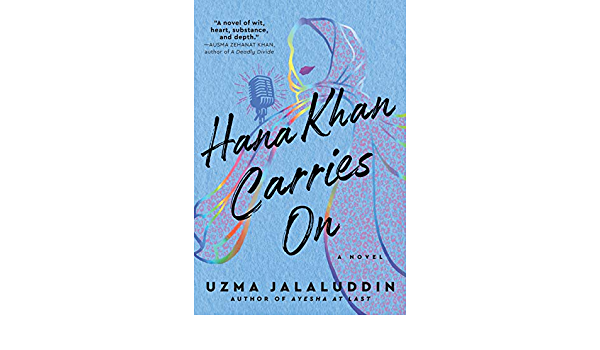
Hana Khan Carries On by Uzma Jalaluddin

Standard
Hana Khan Carries On by Uzma Jalaluddin

hana khanTechnically this book is adult fiction because the protagonist is 24 years old, but the halal rom-com is so sweet and considering the YA options that exist in the same genre, I think high school juniors and senior would do better to dive in to this light, enjoyable, albeit predictable, read over so many of the other options out there.  I read the 368 page book in two days, I was hooked and impressed with the strength of all the female characters, the step away from all the stereotypical tropes and the smooth writing style.  The book is for everyone and while packaged as a light read, there are some themes of immigration, family, choice, and OWN voice realizations that are presented and explored in a thoughtful and impactful manner.

SYNOPSIS:

Hana Khan’s mother owns and operates Three Sisters Biriyani Poutine in Toronto, there are not three sisters, biriyani poutine is not on the menu and business is bad, really bad.  The 15 year old restaurant that Hana named when she was nine is struggling even though it is the only halal option in the close-knit, diverse, golden crescent community.  When news hits that a new upscale halal restaurant is opening a few doors down, Hana chooses to ignore that the business was struggling and instead blames the new proprietors.  They are wealthy, corporate and insufferable.  Well, the dad is anyway, the son Aydin, he isn’t so easily defined.

Hana balances shifts at the restaurant, her internship at Radio Toronto and her own anonymous brown girl podcast.  Hana, real name Hanaan, comes from a supportive and close family.  Her dad was injured in a serious car accident, her older sister is pregnant, and her cousin from India along with a cousin-aunt have just arrived under suspicious circumstances.

As the new restaurant gets closer to opening, Hana finds herself stooping to all new lows to sabotage their success.  Encouraged by an anonymous podcast listener who she has been chatting with for quite a while, and inspired by her rebel cousin-aunt, Hana is determined to secure a permanent job in radio, save her family restaurant, and destroy the competition.  But, an attack downtown draws attention to growing Islamophobia and forces Aydin and Hana to work together.

In a fictional story where everyone knows everyone both in India and Toronto, crazy family members are endearing and loyal, it is no surprise that the main characters are more connected than they think.  As Hana finds her strength to carry on amidst change, she also figures out what direction to focus her energy, her talents, and voice.

WHY I LIKE IT:

I absolutely love the writing.  I was invested in many of the characters, not just the protagonist, and absolutely cheered as she gave a nod to so many assumptions so that she could move past them: forced marriage, hijab, acceptable professions, inclusion, etc.. The family is all about choice and not getting hung up on stereotypes show the power that OWN voices have in telling stories that resonate with everyone.  The book is full of religion, from waking up for fajr, to listening to the khutbah at jumah, going to the masjid to find peace, and believing in destiny.  It is not a preachy book by any means, but the characters are Muslim inside and out.  The traditional family does not pressure Hana to get married, her sister’s marriage was a love one.  She is often alone with her male cousin or brother in law, or best friend Yusuf.  She knows who she is and her family trusts her.

I love the food, the insight of immigrants and family.  I was particularly moved by her articulation of being told by outsiders what it means to be Muslim in Canada, or an immigrant and then not being listened to when pushed back upon. Her challenging a teacher on what the fourth pillar of Islam is and not being heard, resonated profoundly.

Within the first 100 pages or so the reader figures out who everyone is and how they are connected, save one surprise, but it is like watching a favorite movie, you keep going because it is fun, and enjoyable and the point isn’t to figure it out, but to enjoy the ride.

FLAGS:

There are relationship threads, but nothing more detailed than a hand touch after a funeral.  Her best friend Yusuf marries their best friend Lily an Agnostic, knowing that both families are against it.  There is music and racist talk and vandalism.

TOOLS FOR LEADING THE DISCUSSION:

The high school book club usually tries to include a halal romance novel for the loyal participants that clamor for it in the group and I plan to suggest this one to them.  For as light and straightforward as the book is, there is a lot to discuss when the surface is peeled back.  There would be lot to explore from her podcast, internship experience, and her hate crime experience, that the romance part will be seen as simply a vessel to more profound issues to explore.