Tag Archives: Historical Fiction

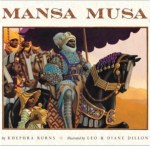
Mansa Musa: The Lion of Mali by Kephra Burns illustrated by Leo & Dianne Dillon

Standard
Mansa Musa: The Lion of Mali by Kephra Burns illustrated by Leo & Dianne Dillon

mansa8

This beautiful work of historical fiction/folklore is both moving and visually breathtaking.  The 56 page book presents as a picture book, but with an AR 6.4 and the amount of text, it reads like a chapter book.  Thus, I’m going to review it as a chapter book, but keep in mind that it is hard bound, 11 x 9, horizontal and while there are frequent small story breaks, there are no chapter breaks.  
IMG_3078

SYNOPSIS:

There is little historical fact about Mansa Musa as a child, thus this story while rooted in fact about the time, about Mansa Musa as an adult, and about what is known regarding Mali and the Malinke and Tuareg tribes, is a work of imagined fiction.  The story begins with premonitions and dreams from Kankan Musa of the Kaba Kangaba tribe.  Kankan and his two brothers live with their mother, and do not know who their father was, a source of stress and teasing for the young boys.  Having just turned 14, Kankan is treated as an adult, but because he has yet proved himself as a hunter, he may sit with the adults, but not yet join their conversations.  Mali in the years after the great King Sundiata had passed away has begun to fade, but their wealth and hospitality still prospers in the desert. 

One day a desert nomad from the Tuareg tribe dressed in flowing blue robes appears and is welcomed by the village elders.  That night he regales stories about jinns, and the sea, and time spent in the desert, and fears he has for their King, when slave raiders tear through the night and kidnap Kankan.  When Kankan awakens days later, enslaved, the same mysterious man, Tariq al-Aya, again appears and buys him from the raiders.  Tariq vows to accompany Musa on his journey to learn who he is and the two spend seven years together learning about the desert, about the larger world, about themselves, in trial and test and challenges.

When Musa journeys back to his home, and Tariq disappears as mysteriously as he appeared, Musa must make himself known to the new Mansa of Mali and see if his wisdom and knowledge can ensure the success of Mali in the future.
IMG_3079

WHY I LIKE IT:

I’m not from Africa and my heart was cheering Musa on as if, my own families success was rooted in his growth and understanding of the world.  As a Muslim, I was proud to know of the success Mali found in Mansa Musa and the historical significance of his rule throughout time.   I wish there was more Islam in the book, his Hajj is well documented and thus tidbits of Mecca and his understanding of it is sprinkled through the story.  There is no talk about prayer or what Islam is, just that he is Muslim and that most of the villagers “had converted to Islam, but at the same time, they had not given up their traditional religious practices or their belief in the ancestors.”  It mentions at the end that he built mosques wherever he went, but prior to this it never mentions him spending any time in a mosque or worshiping in any way. 

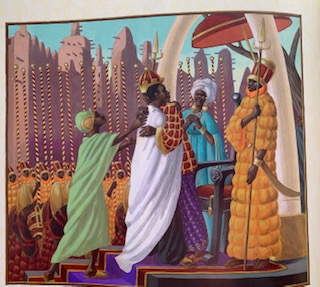
I love that the story is told like all great stories, it makes you want to settle in and drink up the details and imagery and got lost in the pictures.  The author weaves in cultural phrases and descriptions, that hopefully readers can unravel from the context as there is not a glossary.  There is a map at the beginning, and author’s note at the end that reveals what is fact and what is fiction in the story.

IMG_3080

FLAGS:

None

IMG_3081

TOOLS FOR LEADING THE DISCUSSION:

This book should be in every school library and used in classrooms to learn about West Africa, cultures, 14th Century, Islamic history, culture, you name it.  I think this book would work wonderfully in home school environments, where the child could dictate how much to supplement, how much to cover, and the wisdom shared could really be understood.  This isn’t a book that most kids would pick up and read, they would need prodding and guidance, but be better for it.  

IMG_3082

The Day of the Pelican by Katherine Paterson

Standard
The Day of the Pelican by Katherine Paterson

pelican.jpg

There is a lot to be grateful for in this 145 page AR 5.2 book before you even begin reading it.  The fact that Katherine Paterson, of Bridge to Teribithia fame, would write a middle school book about the horrors that took place in Kosovo in the late 90s and conclude with the events of 9/11 is both bold, and daring.  There isn’t a lot of mainstream YA literature about the events that happened in the Western Balkans and this book is much needed in shedding light on a history that cannot and should not be forgotten.  While the book doesn’t compel the reader to pick it up, I think as a novel study in school, or as suggested reading, kids 4-8th grade will benefit from the story and retain the humanity presented in the characters.

SYNOPSIS:

The story follows 13-year-old Meli Lleshi, an ethnic Albanian, and how her world changes as Serbian atrocities escalate. The story opens showing how while there is tension in the air, a lot of the Lleshi family’s life is relatable to today’s western readers.  The children go to school, they have a big family and help out at home.  The dad owns a grocery store under the house and the neighborhood is made up of Albanians and Serbs, Muslims and Christians.  Quickly, however, bad news of the Serbs kidnapping people and destroying homes becomes reality as Meli’s 14-year-old brother Mehmet, goes missing.  The police refuse to help and with no other recourse the family is left to wait and see if he returns.   Luckily he does, but as fears continue to grow the family leaves home to go live at the familial farm in the country.  This stop is temporary and the first of many as the family moves from one refugee camp to another.  Fighting to stay together and look forward, as that their homes, livelihood, and material goods have all been destroyed, the Lleshi’s end up in America, only to be faced with the discrimination following 9/11.

WHY I LIKE IT:

I had the priviledge of helping with a lot of Bosnian and later Albanian refugee families that came through Salt Lake City, Utah in 1998-2001.  Not in any official capacity but as outreach to help get them settled, enrolled in school, a friendly face to call on for help, and eventually a friend.  Later, I even interviewed many of them in a series I did for my journalism classes at the University of Utah.  This story rings incredibly true to what I recall hearing them speak about.  What they saw, what they had to sacrifice, what they hoped to achieve in America.  So I was almost giddy to learn about this book knowing that it wouldn’t be a “fun” read, but an important one bringing a fictionalized account of a historical horror to children that probably have never even heard about it.  I only wish so desperately that the book had a map in it.  There is a great historical note, but a map would have made it so much more impactful. 

I like that the family is Muslim, they do not practice, but they identify as Muslim and are thus tortured both in Kosovo and harassed in America.  They are served a ham at one point in America, and they eat it, noting that culturally they don’t eat it, but don’t really see the big deal in doing it.  I remember the first time my family went to meet a Bosnian family and there were no men in the house, all had been killed at the children’s elementary school at dismissal for being Muslim, and they served us beer.  The ham incident reminded me of that, that these are so often the religious rules we tell others and children about what it means to be Muslim, but in the grand scheme how important are they compared to belief in the oneness of God?  I don’t want to turn this literary blog into my theological thoughts, but its hard over the years to forget that these people died for being Muslim, but yet really didn’t know a lot about Islam.  In my safe sheltered world, I know a lot of people that know a lot about Islam, but would we be willing to die for being Muslim?  The Lleshi family don’t pray or go to the mosque, but they do sprinkle their talk with Arabic words like inshaAllah (God willing), and their names are Islamic in nature: Mehmet, Adil, Isuf, etc., they are forced to relocate because of both their nationality and their religion, where the line is between one identity and the other isn’t clear in the book, nor is it in real life.  

FLAGS:

There is a bit of articulated violence, but the book is clean for 4th grade and up.  

TOOLS FOR LEADING THE DISCUSSION:

I would absolutely do this for a Book Club selection, and if I was a upper elementary or middle school teacher for a novel study.  The book balances character narrative and historical context to the point that the book is not boring, sensationalized or easily dismissed.  I think kids will need the school environment and structure to compel them to pick up the book and finish it, but will not fight the actual reading of it.

A guide for book discussion: https://media.btsb.com/TitleLessonPlans/454.pdfTeacher’s Lesson Plan: http://mrscarafiello.weebly.com/day-of-the-pelican.html


Refugee by Alan Gratz

Standard
Refugee by Alan Gratz

refugee.jpg

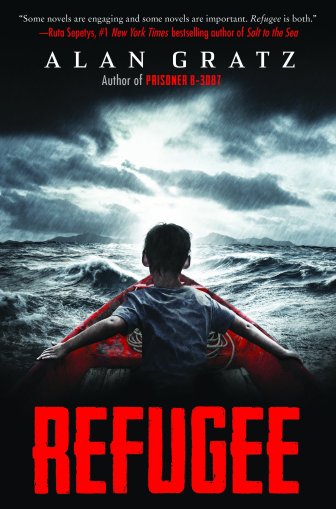
I debated whether I should read this book, or listen to it as an audio book with my children, ages 2,7,8,11.  The AR level is 5.3 and Common Sense Media suggests 10 and up because of the intensity, but knowing my kids are aware of some of the heartbreak the book discusses from other fictional works and the news, I decided to share this emotionally powerful book with them.  Tears were shed, discussion occurred, and the stories I pray will haunt and bother my children for years to come, inshaAllah resulting in compassion and action.  

The book is 338 pages with maps, references, ways to help, and acknowledgements at the end.  The audio book is just over seven and a half hours.

SYNOPSIS:

Three kids stories are told in pieces as they occur in different time periods, in different parts of the world, and for different reasons, but the heart of the stories are not the differences, but the similarities that all three share.  The real life parallels of each horrific event, and how small the world suddenly seems, is amplified by the ties that connect these fictional stories to one another.

Josef is a Jewish boy living in 1930 Nazi Germany.  When his father is released from a concentration camp; he, his mom, and younger sister Ruthie board the MS St. Louis headed for Cuba to try to find a new life.  However, Cuba refuses to let them in, and Josef’s father cannot escape the ghosts from his time in a concentration camp.  Returned to war in Europe, the family is once again on the run from Nazis and not all survive.

Isabel is a Cuban girl in 1994. Unrest is growing in Havana and when Fidel Castro says people can leave, her family: Grandfather, dad, and pregnant mom, join their neighbors in their makeshift boat to try to reach El Norte.  The shark filled waters, tankers, getting blown off course, and a temperamental boat engine, all pose as obstacles for the family trying to get on dry land to avoid being sent back to Cuba by the US Coast Guard.  

Mahmoud is a Syrian boy in 2015 who’s life has been altered by the civil war, but when their home is destroyed by explosians, they must leave right then.  His parents, younger brother Waleed, and baby sister Hana,  begin walking, their journey will travel through many countries as they seek the promised land of Germany.  Along the way they will be held at gun point, be forced into detention centers, walk for days and put their lives at the mercy of the Mediterreanean Sea in a flimsy rubber dinghy. 

WHY I LIKE IT:

I love that this book takes huge pivitol historic events in our life time and gives them a face.  Numbers are often numbing as they are difficult to grasp, and political motivations are often so hard to understand in their complexities, that this book does a marvelous job of making it about the person, about the humanity at stake.  I challange any one, especially those opposed to letting refugees in, to not cheer these three on, to not get irrated by those that willingly can help and chose not to, and those being relieved when people finally do see them and do help.  Its amazing how far a little kindness can go, and seeing it in tangible terms is powerful.  Yes, taking into your home a refugee is a huge kind step, but so was the giving of water and asprin to Isabel and her family, or giving of clean clothes and a ride to Mahmoud and his family, or removing the protrait of Hitler from the Social Hall during Josef’s Bar Mitzvah, all little kindnesses that hopefully we can rememember.

I love that the author got Mahmoud’s religion right.  They stop and pray, they make duas, their cell phone apps for salat times all ring at once, they are Muslim and their religion is mentioned as they practice it, not as a storyline.

Overall, I was impressed at the book.  Many reviews online found issue with the structure of the stories being broken up and seperated, but listening to it, atleast, made them feel incredibly connected.  I absolutely enjoyed seeing the parallels of each story and the humanity of each chacter shine through.

FLAGS:

The book has a lot death, and violence, and it is intense, but, it is not glorified and it isn’t too graphic.  It is done tastefully to make a point and keep it real, but not to overwhelm the audience or sensationalize the events, although I don’t know that any fiction, could be worse than the reality endured during these time periods.

TOOLS FOR LEADING THE DISCUSSION:

A map, would be awesome, a big one.  I like that the author gives some tips to help, but I think more on hand would be beneficial as the urge to help others is pretty intense after listening to/reading the book.  Especially ways to get involved in Syria, as the struggle is still ongoing.  

There are lots of tools online as the book is published through Scholastic. 

https://www.scholastic.com/teachers/lesson-plans/17-18/refugee-discussion-guide/

Book Unit Ideas: http://bookunitsteacher.com/wp/?p=5858

Author’s page: https://www.alangratz.com/writing/refugee/refugee-discussion-guide/


nine, ten: A September 11 Story by Nora Raleigh Baskin

Standard
nine, ten: A September 11 Story by Nora Raleigh Baskin

nine, ten.jpg

I still struggle with the fact that 9/11/2001 is taught as history, it seems so current and fresh in my mind, that I really struggle with how works of fiction (and non fiction too) try to tell me about the pulse and the mood and the impact of something that I lived through and recall so clearly.  I suppose this isn’t a unique predicament, but because of the magnitude, one that I still wrestle with.  The author of nine, ten glosses over the big picture and in a lot of ways, the events of 9/11, but instead tries to show the paradigm shift that occurred and the division drawn as life before and life after.  She attempts to do this on an AR 4.8 and in 197 pages.  No easy feat, but one that definitely has some hits, and for me at least,  a few misses too.

SYNOPSIS:

Told from four different perspectives that intersect at the opening and at the close, the reader meets the characters two days leading up to 9/11, spends some of September 11 with them, and then peeks in on them again a year later.  The characters all cross paths at Chicago’s O’Hare Airport.

The first character is Will.  A middle school boy struggling to come to terms with how his father died helping someone on the side of the road.  Often more responsible and mature for his age as he helps his mom with his younger siblings, he lives in Shanksville, Pennsylvania and finds healing with helping those affected by the plane that goes down there.

Next we meet Aimee, who has just moved to California and is starting a new school.  Her daily drama is more missing her mom who travels a lot to New York for business, but is relatable as she tries to make new friends, fit in, and find her place in a new environment.  Her mom is in New York during the duration of the book, and has a meeting in one of the Twin Towers on the 11th.

Sergio lives in Brooklyn, New York and is a math wiz who gets a special award and recognition for his achievements.  He lives with his loving grandma, but it is the stressful encounter with his deadbeat father that sets him on a fateful subway trip that introduces him to Gideon, a New York fire fighter.

Naheed is the fourth character, and is an Iranian American Muslim girl, who is struggling to handle friends, and new questions about the hijab she wears.  Her friend drama consumes her, until 9/11 happens and she has to now prove her love of America at every turn.

The characters each take chapters divided by dates and while short, they do form a connection in their snapshots.  You feel like you get to know the characters and you do feel a tinge of stress knowing how they are all related geographical to what will transpire on the 11th. But in the afterward, the author explains why she intentionally keeps the carnage at bay to show how connected we all are, especially children, at the forefront of her fictionally retelling, and to show how much we all were affected that day.

WHY I LIKE IT:

I like that breaking up of the story, it adds some dimension to the book.  I know some reviews feel it is over done, but I think it is deliberate, and highlights how we all are inter connected and for late elementary, early middle school readers, I think the choppiness it allows, keeps the book on their level.  I like that each character has their own struggles, it isn’t that life was rosy and then 9/11 ruined everything, these kids have their own issues and stresses and realistic personalities before and after.  I also like that the Muslim character is not from the Middle East, it further shows how groups get lumped together for different reasons giving the book a bit more for readers to consider.

There are however, some real issues in how they present Naheed, which seems odd, since the book is so politically correct, and given the topic, you’d think the author and editors would work overtime to get the islamic parts correct.  But alas at one point Naheed’s visiting Uncle wants to know why Naheed doesn’t pray the mid day prayer, thuhr, at school, to which the mom replies, “she makes up her prayers at third prayer.” What? Yes I laughed out loud, no one calls the prayers by their numbers! I have never used numbers to describe our prayers, they have names, and we use their timings to describe them to others, not numbers. At one point, Naheed is making wudu, ablution, and the author gets it wrong. “And lastly, feet.  Right foot with right hand. Left foot with left.  Toes to ankles.” Left hand for both feet.  I also take some issue with Naheed having to wear hijab at age nine.  Hijab becomes required at puberty, so yes it could have been when it became required of her, but it seems a little young for her, and it seemed a bit forced.

In terms of plot, I would have liked a day or two after 9/11 to juxtapose the differences in priorities and the lens of how we got to a year later, or two years later, or 15.  Also, how they all went to New York on the anniversary to tie the story together made for a nice ending, but why they all went was a bit of a stretch, ok a big stretch.

FLAGS:

For a book about 9/11 there is relatively no violence.  The only death is in talking about Will’s father and the only blood is when Sergio helps a man on the subway.  There is some hate speech at the end, but even that is minimal.  Will does kiss a girl he likes. And both Will and Sergio skip school.  Aimee worries if her mom is having an affair (implied) and if her parents are getting divorced, but it isn’t explicit.

TOOLS FOR LEADING THE DISCUSSION:

I think this would be a good book for a younger book club.  With its overt commitment to political correctness and breaking down stereotypes, it reinforces how similar we all are through strengthening bonds of humanity, rather than being divided by our skin color, or religion.  I think it would also lead so easily into faccilitating discussion of today’s kids putting themselves in the story.  What in their lives wouldn’t matter any more or what would matter more. There is a Reading Group Guide at the end of the book, along with an Author’s Note and Acknowledgement, that easily lend themselves to more discussion ideas.

Curriculum Guide: http://www.norabaskin.com/nine-ten-curriculum-guide/


Jannah Jewels by Umm Nura illustrated by Nayzak Al-Hilali

Standard

Strong muslim girls  (check)

Historical fiction (check)

Elementary level chapter book (check)

Beautifully illustrated (check)

Action, adventure, fun (check, check, check)

Really what more can you want from a book, or better yet a series of books?

The premise of Jannah Jewels is four Muslim girls each with specific skills that travel back in time to various places in the world to retrieve artifacts to save the world before the “villians” do.  Along the way they share knowledge of hadith, Quran, and Muslim achievements and advancements while meeting with influential Muslims.  I mean really, what is there not to like.  This is historical Islamic Fiction for 2nd through 5th grade at its finest, yay!

So far there are nine books in the series, and based on the premise that they must find 12 artifacts to put in a golden clock, I would assume there will be 12 books.  I decided to review only the first two as I think they set the stage and give the reader a good feel for the series’ standards, the tone, and direction the consequent books will follow.  The series is to be read in order and they range in length from 69 pages to 165.  Each book has a description of the main characters, a visual of the supporting characters and is followed after the story by a sneak peek at the next book, a glossary, and some manga anime of the heroines.  Some of the books are co authored (Ustadha S. Karim & Tayyaba Syed), but based on the website http://www.jannahjewels.com Umm Nura is the main author and creator of the series.

SYNOPSIS:

Hidayah sees a woman with a bow and arrow and watches her for many days until finally she musters the courage to meet her.  This meeting is the start of Hadiyah’s training in present day with the Master Archer.  The story however, starts with a prologue of the past and how different approaches to archery have lead to a rift between those entrusted to keeping evil at bay.   The collision of those actions and today occur as Hidayah and her friends Jaide, Sarah, and Iman are chosen to retrieve artifacts scattered around the world and throughout time.  They must bring these artifacts and place them in the golden clock before Jaffar and his son Khan do, to obtain a secret locked away inside.  Each girl has incredible skills and strength as well as fears and doubts.  The stories are action pact as well as enlightening and empowering.  The girls are smart, strong, and supportive of one another and they use team work to make for a smart inspiring read.

In the first book the foundation is laid and the details of time travel and the task are put forth, it is a tiny bit cumbersome, but is quickly believable and accepted as the action picks up.  The Jannah Jewels travel to Timbuktu and meet with Mansa Musa to rescue a lost manuscript.  In the second book they journey to China aboard the ships of Chinese Muslim Admiral Zheng He to recover a medicinal plant.  The recap of the first book and the premise of what has to be done is seamless and quick.  Thus allowing the story to move further below the surface to provide more insight into who the four girls are, and understanding into what occurred in the past that made the Jannah Jewel adventures necessary.

WHY I LIKE IT:

I love historical fiction, so Islamic historical fiction is like a gift, when done right.  To give young muslims a glimpse at some of the remarkable accomplishments and contributions Muslims have made throughout time, in a manner they don’t even know they are learning it, is so needed.  Our kids should know about Mansa Musa, Al-Kindi, Fatima Al-Fihri, Sultan Muhammad II, and more, and sadly many are not tempted to pick up a non fiction book to learn about them.

The Jannah Jewels are also admirable and have the ability to inspire our girls to be better Muslimah’s through their examples of intelligence, strength, and deen. Each book reveals more about their hobbies, passions, and past, and does a good job of giving them each their own personalities. That being said, these books are engaging for both boys and girls.  My own children have read the first four multiple times as have I.  Initially I didn’t think my son would be interested as it seems like a very “girl power” type read, but the story is strong enough and the characters have depth that they work well for all kids and their parents.

In addition to the stories, visually the books are absolutely gorgeous and appealing.  The manga anime style of art is bright and colorful on the covers, and detailed and complimentary throughout the text.


FLAGS:

None, alhumdulillah

TOOLS FOR LEADING THE DISCUSSION:

The website is engaging for those wanting to know about the characters and writing team.  The FAQ section is good background as well.  www.jannahjewels.com

The books aren’t complicated as they are for elementary aged children, that anything more than the story is not needed.  If your readers are like mine, however, you will need some reference books or google on hand for those that would like to learn more.  I think these books would be great in a classroom setting to get students reading.  I also think they would work well in 1st grade for read a loud story time.  I don’t know that they would be ideal for book club, but definitely could be used to compliment lessons in Language Arts and Social Studies.

The Elephant from Baghdad by Mary Tavener Holmes and John Harris illustrated by Jon Cannell

Standard

the elephant from baghdad cover

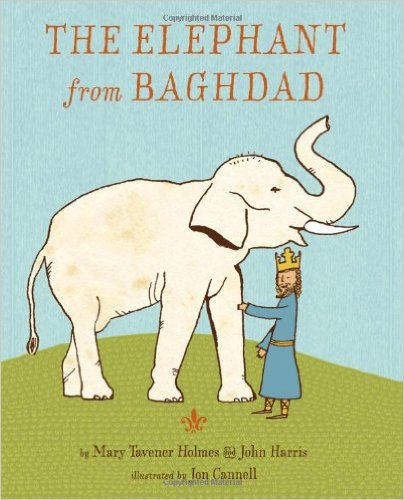
This fun and informative picture book written on a 4th grade 8th month AR level retells a historical event through a fictionalized narrator.  A great retelling of a West meets East event with an albino elephant thrown in, makes for a story that is hard to believe is true.

Charlemagne, the medieval ruler of most of Europe, sent ambassadors to meet the Caliph of Baghdad, Harun al-Rashid.  Charlemagne was curious to learn more about the amazing ruler he had heard so much about.  When the Europeans arrived they were astounded at the buildings, libraries, organization and cleanliness of the city.  For months, Harun “introduced the men to artists, musicians, scholars, mathematicians, architects and poets” and taught them about “science, medicine, engineering, and art.”  Harun al-Rashid’s generosity however did not stop there.  “He loaded a caravan with presents fit for a fellow emperor.”  He sent a saber and scabbard, a precious water jug, and a magnificent clock that he had commissioned his artisans to create.  A mechanical water clock, that unfortunately, has been lost in history, but was detailed in the 807 CE Annles regain Francium, a journal that chronicled the daily life in Charlemagne’s court as well as in a book written 400 years after Harun by Al-Jazazi in Istanbul, Turkey.  Even this, however, was not enough for the great emperor of the West, and Harun gave Charlemagne the rarest treasure of his court, an albino Elephant named Abu.the elephant from baghdad

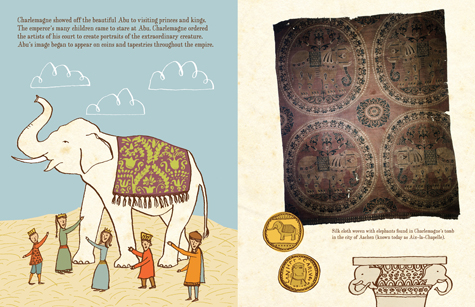
Abu even had his own keeper, a Jewish man named Isaac, and when they returned back to Europe both were invited to live in the palace.  “Once or twice a day Charlemagne would visit his immense guest.” Abu’s image was preserved in portraits and began to appear on coins and tapestries in the empire.  Even in Charlemagne’s tomb is a silk cloth woven with elephants.  Abu was taken into battle against the Danes and when he got old, Charlemagne had a house built for him and Isaac near a river.  In 810 Abu died and when Charlemagne learned of his death, “he wept.”

The story shows the amazing respect the two leaders had for one another, for animals, and the tolerance of people of different faiths.   At 40 pages it works for story time and for older students learning about the Middle Ages.  Obviously they would take away drastically  different points from the story, but both groups would enjoy it.  I learned a lot, so I recommend it to adults as well.  The pictures are beautiful water colors and pencil, supplemented with actual photos of artifacts, that all combine to make the story and book a wonderful addition to your library to be read and enjoyed again and again. elephant from baghdad 2


Sophia’s Journal by Najiyah Diana Maxfield

Standard

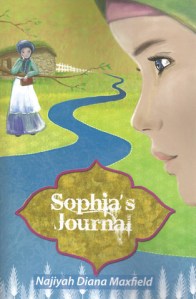
Sophia_s_Journal_Final_large

It is not terribly uncommon for my mind to remain stuck in books long after I have read the last page, but it has been a while since an Islamic young adult book has held me hostage.  This book was recommended to me by Anse Tamara Gray whose Daybreak Press published the book, and while I tried not to have any expectations, even if I had, the book would have blown them out of the water, mashaAllah.  The book is not in the Accelerated Reader database, but I added it to our school’s so that the students could read it, test on it, and then gather together during our next book club to discuss it.  I estimated it at about a sixth grade level fifth month, and would recommend it for middle school, high school students, and adults alike.

SUMMARY:

Sixteen year-old Sophia is on a family bike ride when she finds herself falling into the Missouri River and waking up in 1857 Kansas.  The acclamation of a 21st century Muslim girl in to what history will name Bleeding Kansas is both heart warming and inspiring in its details of every day life.  Sophia takes a hands-on active approach to helping the kind family, the Sampsons, that takes her in, and she learns everything from shooting to cooking to riding a horse.  As she learns the skills needed to survive, she truly becomes one of the family.  The beautiful way that Islam is woven in as such a seamless part of Sophia, whether she is in the present or the past, is inspirational for readers of all ages and made me at least question if I would be that strong.  Sophia’s relationships with the other characters is what makes the story so magical, getting to see the humanity and strength of people coupled with the same emotions of heartache, longing, and love we can relate to, in our own lives, draws the reader in and makes the story fascinating and hard to put down.  In addition to the story, the historical setting of slavery and relations with the native populations add depth that many students should already know about, and will enjoy seeing in a fictionalized account.  The twists and climax keep the reader engaged, and keep me from spoiling too many plot details in this admittedly vague summary.

WHY I LIKE IT:

I enjoy historical fiction and to blend that with a Muslim character is a great premise in my eyes.  Seeing a strong Muslimah lead in a quality entertaining book that is tactfully done is such a rare find.  Sophia’s strength is quiet, yet powerful, and the slower pace forces the reader to analyze themselves as they discover the characters.  It reminded me of Anne of Green Gables in its tone and style and I think that our middle schoolers need this change of pace and I can’t wait to see how Book Club goes.  I love how strong Sophia is with her deen, her convictions about slavery, her determination to help others, and to learn.  She easily could whine and complain that her cell phone is dead and she misses her family, but she doesn’t, she has a tenacity and attitude that elevates her to a status that you want the readers to look up to her and emulate her.

I also like that Sophia is respectful of other’s religions and they are respectful of hers, the author draws on similarities and discusses Islam in a way that shows it as a living breathing part of life, that is truly a breath of fresh air.  The climax and ending are not predictable and I appreciate that as well.

FLAGS:

There is referred to violence violence, slavery, racism, a tinge of  romance (in an 1857s kind of respectful way), but nothing overly graphic or sensationalized.  Overall nothing a middle school student and up could not handle.

TOOLS FOR LEADING THE DISCUSSION:

There are no reading guides or outlines to teach the book, however, I think there is PLENTY in the book to discuss and if you are like me and the few students I’ve already asked to read the book, not talking about it is harder than finding meaningful points to discuss.