Tag Archives: heart felt

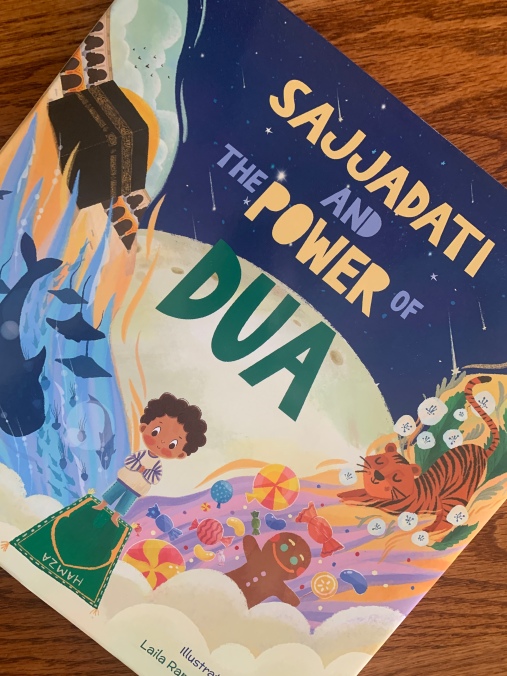
Sajjadati and the Power of Dua by Ayesha N. Rahmaan illustrated by Laila Ramadhani Ritonga

Standard
Sajjadati and the Power of Dua by Ayesha N. Rahmaan illustrated by Laila Ramadhani Ritonga

img_7520

This 38 page large hard back picture book is absolutely beautiful: the illustrations, the tone, the thickness of the pages, all come together to create a child’s wonderment about the power of salah and dua with grounding in the actual parts of prayer.  On my first reading the imaginative “magical” aspects of the prayer rug, “Sajjadati,” was sweet and endearing, but as I thought about the story and then reread it, I had some concerns.  I know the book is meant for children, I know I am a reviewer and thus am over analyzing it, so I point the following out as a “heads up” so to speak, and for you to make your own decisions if the literal text will be misleading or if the overall mood of the book will be taken as loving dua and the closeness prayer brings one to Allah swt.
img_7521

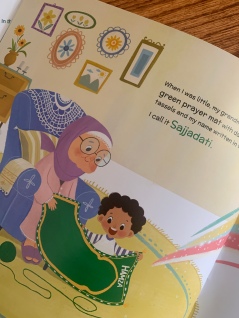
The book starts with a little boy recalling when he got his green prayer rug from his grandma, that has his name on the corner (in the illustration it is centered on the top, not in the corner) and him naming the prayer rug, “Sajjadati.” The following page, same spread, then says,  “When I have Sajjadati with me, I can pray anywhere.  And when I pray on Sajjadati, I can go anywhere.” These lines give me pause, because even if the prayer rug is lost or not with him as he grows up, he is still going to need to pray. The importance of the prayer rug seems over elevated, albeit sweet, religiously a little unsettling.  The second of the two lines, about going anywhere, is also a bit of a gateway to the rest of the book and almost encouraging one’s mind to wander during salah.
img_7522

The next page gets back on track saying that starting to pray and saying “Allahu Akbar” leaves this world behind, the little boy says surahs he has memorized, and knows Allah swt is watching him.  He asks Allah for what he wants, and his imagination takes him on adventures after each salah. He imagines flying, and being a superhero.
img_7524

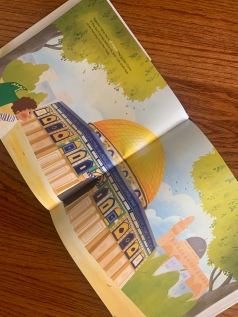
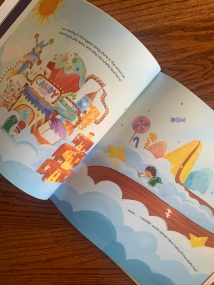
The story then returns to being in prayer, not after, and going in to ruku.  The text has him imagining he is in the “biggest candy store in the universe” wondering if Jannah has rivers of chocolate before standing up straight again saying “Sami Allahu liman hamidah,” and contemplating if there is a place where his prayers would be worth more and Sajjadati taking him to al-Aqsa.
img_7523

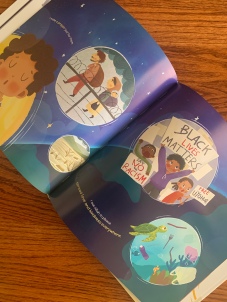
In sujud Sajjadati tickles his nose, but he doesn’t mind because he is closest to Allah swt in this position, and while he won’t let his “annoying little sister,” bother him, his mind does drift to being on a boat in the sea with seagulls squawking, “salaam.”

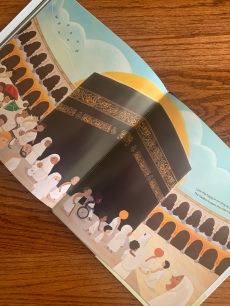
Hamza is then making dua for those suffering.  Since nothing is impossible when making dua, he is also asking for pets from the savanna, but knowing that Allah swt will provide what is best.  He makes duas to go for hajj and concludes his salah by folding up Sajjadati and finding peace in Allah swt being al-Mujeeb.
img_7525

I love the heartfelt framing of salah and the interweaving of both real and whimsical wants, as well as the sprinkling of facts about prayer into the story, but I honestly struggled a bit with the juxtaposition of the parts of prayer with the day dreaming elements.  I also struggled with the tenses, and find myself constantly rewording this review to reflect the book’s timeline.  Hamza is with his family, for example, hearing the current event news, while the next set of pages has him back making dua at the end of the prayer he started at the beginning of the book.  And the hearing the news and the praying for people is all being conveyed in the present tense, not clear if he recalled hearing about strife in the world and then made dua, or paused heard and resumed his prayer, it all seemingly happening at once, but that doesn’t really make sense. The title also says dua, not salah, and so much of the book is about prayer, that I feel like the two get conflated erroneously, and dreaming big during dua is different than having your mind wander during your salah.
img_7526

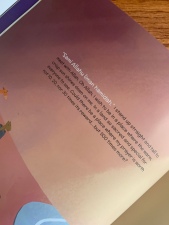
The book starts with an ayat from the Quran in Arabic text and meaning of the translation in English and concludes with a glossary and space to complete a Dua List.

If this book seems like a good fit for your young child, I ordered mine from Crescent Moon Store and you if you use my initials ISL (Islamic School Librarian) at checkout you’ll save 10%.

A Pocketful of Stars by Aisha Bushby

Standard
A Pocketful of Stars by Aisha Bushby

This middle grades magic realism novel draws you in and pulls on your heartstrings pausing only to offer pointed commentary on friendship, self-awareness, and self acceptance.  Oh sure there were parts that seemed a bit repetitive and parts I had to read again because the continuity was just off enough to have me confused, but the book has power, and especially for a debut novel I was blown away.  Well, actually I was in tears, and thats a pretty strong emotion to be felt in 246 pages, so be impressed.  I don’t know if the author identifies as Muslim, she was born in Bahrain and has lived in Kuwait amongst other places.  The main character, Safiya,  experiences her mother’s memories in Kuwait where Eid and the Athan are briefly mentioned and a few characters wear scarves.  There are culture rich Arabic names, but no religion is mentioned outright.  Saff has Christmas money, eats pepperoni, a side character has a boyfriend and they kiss, and there is just a touch of magic to tie it all together.

SYNOPSIS:
Safiya’s parents have been divorced for a few years, and when she chose to live with her dad, her Saturdays became one-on-one time with her mom.  Her mom, Aminah, is a lawyer from Kuwait who can chat with anyone and everyone about anything and everything.  The complete opposite of video game loving Saff who struggles to find her voice, and has nothing in common with her articulate, headstrong, independent, theater loving mother.  The two rarely get along and after a particularly intense fight, Safiya decides to not spend Saturday with her mom, but rather head out with her best friend Elle and new year eight friends at the mall.  When her dad tells her to come home asap, she knows something is up, but could never have imagined how life altering the days events are about to become.

Aminah is in a coma, and Safiya is full of regret and fear.  As she sits next to her mother’s hospital bed and drinks in her perfume, she is drifted to a far away land filled with a crumbling house and a magic like quality.  Approaching this oddity like her favorite video game, she explores her mother’s memories, and finds a girl not so different from herself.  As reality and magic merge in young Saff, she begins to sort through her feelings toward her mother and come to peace with what she has to do and endure and overcome.

In the process of handling her life-changing home situation, Saff, also finds the strength to call out cruel acts from classmates, find her voice, and cut out toxic friendships while cultivating supportive ones.  The journey on both fronts will have readers cheering for Saff while wiping away tears.

WHY I LIKE IT:

I love the quick pace and rawness of the characters.  Grandma, mom, and Safiya all say and do things they regret while hot and angry and have to learn the consequences and humbling that needs to occur to fix what their words have broken.  No character is completely good, nor completely bad, and in a middle grade book that is powerful. Each one has relatable qualities that really make the book memorable.  

Safiya has to really work out what is going on with her best friend, Elle, and what she is willing to accept and what lines she is not willing to cross.  The character’s maturity is inspiring, and I love it.  She doesn’t fancy boys (yet), and doesn’t see liking boys a sign of maturity.  She doesn’t want it forced on her, and she doesn’t want to give up things that she enjoys just to “fit in.” The fact that she can articulate how Elle is a chameleon blending in to her surroundings where she is just a plain old lizard is wonderful.

I enjoy the magical trips to Kuwait.  They don’t show much of the culture, but what is revealed is lovingly conveyed.  I like that it did acknowledge that Aisha knows Arabic, but struggles a bit to read it.  I would have loved more Arabic words sprinkled in, but at least it accounted for the linguistic abilities as it jumped between countries.  The book is set in England, so some of the concepts or phrases might need a bit of explanation for younger American readers.

I wanted more information about the backstories just beneath the main story line.  How did Safiya’s parents meet? Was the divorce amicable? Did her dad have any family around? How did Aminah leave for England at such a young age alone? How come Saff never visited Kuwait? How come Saff didn’t know about Aminah’s friends? How did the friends take Aminah leaving? Why didn’t they just email her the invitation? Why did they still have it? How did the girls meet in the middle of the night? I know that the book is middle grades, but just a bit more would have helped some of the holes feel shallower, and the overall story details more polished.

FLAGS:

Teasing, death, boyfriend, kissing, illness, verbal fighting. Nothing middle graders can’t handle, although the mom is kind of terrible to Aminah at the beginning.

TOOLS FOR LEADING THE DISCUSSION:

I think this would be an awesome fourth or fifth grade book to read and discuss. I don’t do a book club for that age, nor do I have children in that age group at the moment, but I am planning to suggest it to teacher friends I know.  The book would appeal to boys and girls, but I think girls especially those going through friend dramas and girls butting heads with their moms will really benefit from this quick memorable read.