Tag Archives: force

Sitti’s Key by Sahar Khader Ali illustrated by Noor Alshalabi

Standard
Sitti’s Key by Sahar Khader Ali illustrated by Noor Alshalabi

sitti key

I try and buy, read, and review every children’s book about Palestine that is published, it is the least I can do.  I also try not to compare them to each other as they present different aspects of oppression, perspectives of strength, examples of joy, and messages of hope, even among many similar themes of food, keys, traditions, and culture.  I really appreciate that this book though is incredibly blunt.  It isn’t lyrical, it isn’t poetic, and as Israel is bombing Jenin as I write this I’m glad it doesn’t mince words about the Nakba. I do think caregivers though, should probably read it first as it might be a little triggering for sensitive children.  The story is OWN voice and probably best suited for middle elementary aged children.  It is perhaps also worth noting that the book could be seen as making Jews synonymous with Zionists.  The characters are Muslim, Islamic phrases and Arabic terms are sprinkled throughout, and even despite the pain the family has endured, the book stays hopeful and proud.

Sitti is coming and Amal is excited, it has been two years since she last saw her.  She loves how excited her mom and grandma are to unpack gifts of olive oil, dates, and zataar from friends.  Amal isn’t sure what to do with the “old lady thoub” she has been gifted, but she smiles in appreciation none-the-less.  When Sitti pulls out an old key, Amal starts to ask her about it, but her mother shuffles her off to bed.

The next day at school, Amal has to work on a presentation about “culture,” but there are no Palestinian books in her school library, so she just watches the other kids.  At home they eat and listen to Sitti’s stories of long ago in Haifa, and Amal asks her why she left Palestine.  Despite her mother trying to redirect, Sitti says it is time she knew about the Nakba.

Sitti tells about living on the land for generations and how the Jews believed the land belonged to them.  In 1948 the British decided Palestine would be the homeland for the Jews.  Armed men came and arrested anyone who tried to stay in their homes. Sitti’s brother was handcuffed and never seen again.  The family grabbed what they could including the key to their home as they made their way to a refugee camp in Lebanon.  They stayed for three years, before making their way to America.

When Sitti concludes her story she hands the key to Amal and her hope that she will return to their home inshaAllah.  Feeling the pride and warmth of home, Amal has a determination to reclaim her heritage and share her “culture” with her classmates.

The illustrations are sweet, the mom and Sitti wear hijab even in the home, and the inshaAllahs and salams come naturally. The book does not stop to define zataar or marimya, which helps the flow. I also like how it shows that there aren’t books about Palestine in the school library, it is strong and important detail.  I don’t understand where Sitti is coming from though, it would seem Palestine as she is bringing gifts from friends, but in the story it says after Lebanon they made their way to America, so I’m not sure where Sitti lives, and how the logistics of the family work to be honest.  I also kind of wish there was a  recipe for zataar in the book and lyrics with translation for the song the family sings.

Book is available on Kindle or can be ordered from www.littlehibba.com
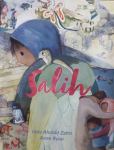
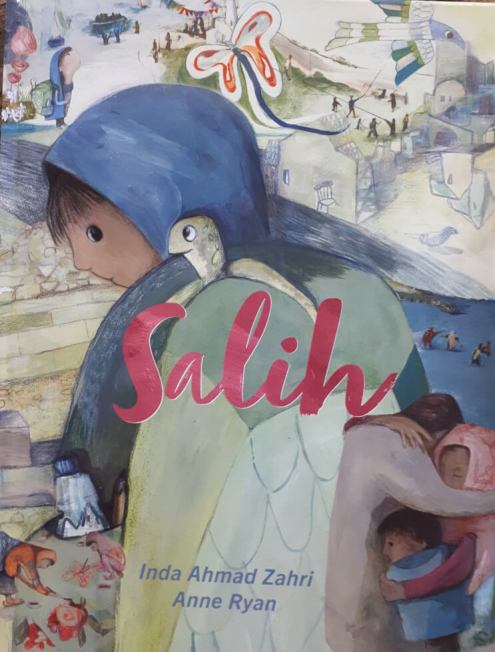
Salih by Inda Ahmad Zahri illustrated by Anne Ryan

Standard
Salih by Inda Ahmad Zahri illustrated by Anne Ryan

salih

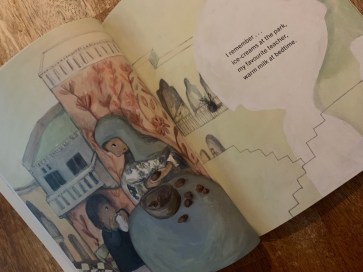
This is an example of a picture book that should not be categorized as being only for children.  The passages of short simple text and the expansive illustrations that pull the reader in, combine to set a powerfully moving tone that holds you in it’s grips until the final page.  The names and hijab clad women could make this book a refugee tale with #muslimsintheillustrations, but because the author is Muslim, and the book so beautiful, I wanted to do a full review.  Some of the vocabulary is a bit advanced for younger children, so I think the best application of this book is not to hand it to a small child to read independently, but rather to read it to a child and let the words tickle their hearts while they immerse themselves in the pictures.  I look forward to sharing this book at story time to kindergarten through third grade.  I think the imagery, concepts, and emotion will resonate and open minds and hearts.

img_2168

Salih is like a turtle, he carries his home on his back. He and others are heading to the sea.  He tries to remember when things were better, and forget the bad times.

An old man shows him how to paint.  Salih shares this creativity with others.  Then he slips all the paintings into bottles and when he is on the rough sea, the bottles float away.

The storm rages, but then it calms, and land is seen, and hopes and dreams return.

We, collectively, have become numb, apathetic even, to the plight of refugees.  I have been trying for a while to get this book from Australia, and even though I am over a year late since its publication, it is still timely.  It will always be timely.

img_2170

We cannot be so arrogant to dismiss the plights and challenges faced by those in our world.  That is why I say, yes it is a children’s book, but people of all ages, need to be reminded.  It isn’t the worst of the worst incidents that need to only be shared, or the over the top happy stories.  We need to not let our hearts grow so hard. And this gentle book, with a sweet boy and turtle shell imagery has a lot of potential to remind us of the human element of global conflict.

Available to purchase in the USA here

img_2172

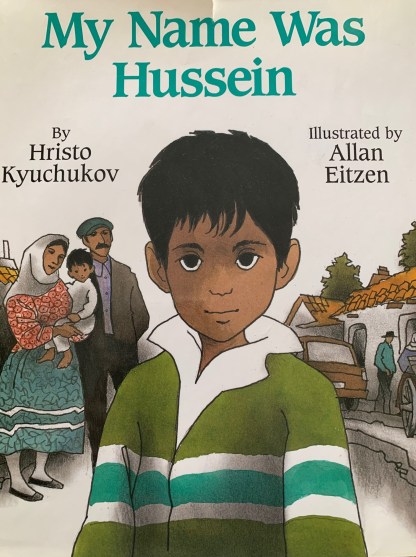
My Name was Hussein by Hristo Kyuchukov illustrated by Allan Eitzen

Standard
My Name was Hussein by Hristo Kyuchukov illustrated by Allan Eitzen

IMG_3215

It isn’t often that a 32 page AR 2.4 picture book will haunt you after you read the last page.  Especially a book with short simple sentences, that is poorly organized and reads like two separate nearly disjointed stories, but alas this book has stayed with me for months and upon rereading it to write this review, the images and empathy and reflections stirred have not lessened.  This is an important book to read, to think about, and to return to sporadically as your children and their understanding of the larger world grows and evolves.

IMG_3217

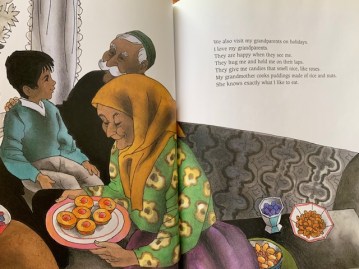
Hussein is a Roma, or a gypsy living in a small village in Bulgaria.  Their ancestors migrated many years ago from India and they are Muslim.  Hussein and his family love Ramadan and the delicious smells of food and warmth of grandparents and family all year round, but particularly during the blessed month.  

IMG_3218

Eid is the best, with family and fun and new clothes.  Hussein loves his life and his name.  It was his grandfather’s name and his grandfather’s grandfather’s name.  But then one day all that changes.

IMG_3219

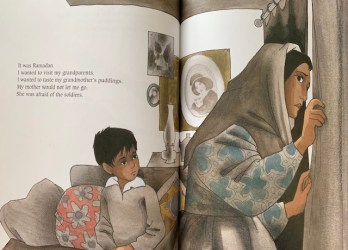
Tanks and soldiers with guns come to their village and close that mosque and tear up their identity cards and tell all the minorities that they must choose Christian names and give up their culture and identities.

IMG_3220

Hussein and his family do not want to give up Islam and their names and their traditions, but they don’t know what to do.  Feeling like they have no choice they change their names and Hussein asks the reader at the end if you would call him Hussein or Harry?  

IMG_3221

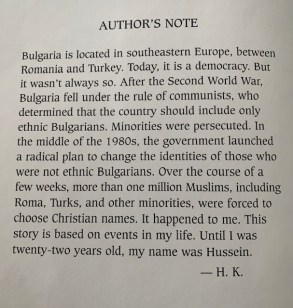
The last page of the book is an author’s note, and tells that this is based on his own life story.  That in the 1980s Bulgarian minorities were forced to change their identities.  That more than one million Muslims, including Roma, Turks and other minorities were forced to choose Christian names and that until he was 22 years old, his name was Hussein.

The illustrations are illuminating to the images that the simple words discuss.  Truly they are a powerful and integral part of the story.  The women wear hijab and the use of color to set the tone is spot on.  The book is hardbound and the 8×10 size allow the pictures to be enjoyed fully.

IMG_3222

The book published in 2004, was not easy to find which is unfortunate as it really sheds light on a recent history not known in the US at all, and one that should be known and remembered.  The first part of the book reads like a Ramadan story detailing iftaar and Eid and how Ramadan is celebrated by this culture, but the second half goes back to Ramadan and how it is different with the soldiers and the pressure to give up who they are.  There aren’t a lot of details about who the soldiers are or why they have come or what they are going to do to the Romas, but the fact that in recent history and this was what people were faced with, should be a powerful reminder to us all at how fragile this world is and make us appreciate that we aren’t forced to make such a decision.