Tag Archives: fiction

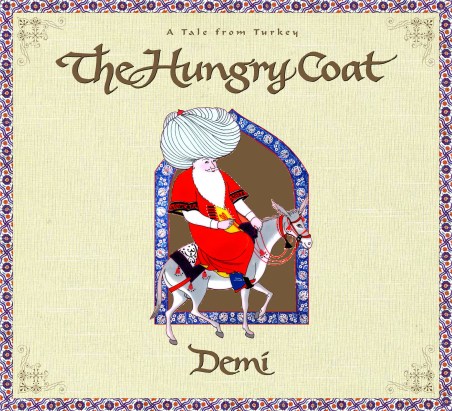
A Tale from Turkey The Hungry Coat by Demi

Standard
A Tale from Turkey The Hungry Coat by Demi

the hunger coat.jpg

It really bothered me that I didn’t love the version I read of  The Parrot and the Turkey about Nasreddin Hodja, especially after finding out how entwined he is in Turkish culture, and reading some of his tales online.  So, when I found that Demi had also rewritten and illustrated a tale from his collection I was anxious to check it out.
hungry-coat

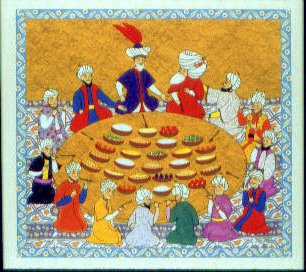
The  Hungry Coat is a charming story and Demi does a great job of bringing it to life with her pictures and storytelling abilities.  The book is 36 pages and a 4.1 on AR.  The text isn’t overwhelming in volume, but to read it definitely requires a bit of an older child’s vocabulary.  Words like caravansary, hostel, banquet, frisky, and commotion are scattered through out.  However, to listen to the story and to understand the message Nasrettin Hoca (an alternate spelling) is conveying, is easily enjoyed by children four and up.  The story flows very smoothly and the catch line of “Eat, coat! Eat!” makes the story absolutely delightful.

hungry-coat1

Nasrettin Hoca always keeps an apple in his pocket for any goats he might pass while he is out and about.  One day he helps round-up a goat that has gotten lost, and in all the commotion had become quite a mess and lost too much time to go home and change his clothes before heading to a friend’s house for dinner.  Deciding to go in his patchy, smelly clothes, Nasrettin soon finds that none at the dinner party will sit by him, or even sit facing him.  He slips out quietly from the gathering and has an idea.  He goes home and preens himself, and returns to the party where he is greeted with attention and kindness.  At dinner he begins placing the food in his coat, rather than eating it.  Each time he opens his coat he commands it to eat.  After he fills his coat he pats his belly to the bemusement of all around him as they ask him what he is doing.  He makes his point that when he came in his old coat he wasn’t fed, but when he came dressed so beautifully he was, and thus clearly the coat was invited to dinner, not him.  Everyone cheered and learned the lesson.

“A coat may be fine, but a coat does not make a man.”

The illustrations are rich and detailed, but I did find myself a little put off when Nasrettin seemed to go from looking like an old little man, to being very effeminate.  The inconsistency bothered me a bit, which surprised me for a Demi illustration.  Also, it is worth noting that there is mention of wine in the story, that many may find off for a children’s book, particularly one about Muslims (Nasrettin was an Imam and a Dervish, so he may have drunk, I’m just saying it surprised me).  The last two pages of the book are an afterword about Nasrettin Hoca in real life and the influence of his folk tales and lessons.

Snow White: An Islamic tale by Fawzia Gilani illustrated by Shireen Adams

Standard
Snow White: An Islamic tale by Fawzia Gilani illustrated by Shireen Adams

snow-white_cov

A lot of the twists that I was surprised by and endeared to in Fawzia Gilani’s Cinderella, seemed lacking in her re-telling of Snow White.  Perhaps it is the mere fact that Cinderella has a legacy of being re-told from different cultural perspectives and in different time periods, where Snow White doesn’t, that made this book stumble where her other sailed much more smoothly.

The basic premise of this Snow White version is naturally the classic tale.  Snow White is the envy of her stepmother, in this case however, it isn’t a magic mirror, but a jinn who answers her questions. Once the huntsman is convinced not to kill her, and a boar’s heart and liver are taken instead,  Snow White finds the companionship and shelter of the dwarves.  In this re-telling, it is a female crew with countless skills that they are happy to pass on to their newest friend.  When the evil stepmother finds out Snow White still lives she concocts poisonous dates to present in disguise to Snow White who is awaiting the appointed iftaar time.  The dwarves arrive home too late to save Snow, but see who has done the evil deed.  The Prince makes his brief appearance as he arrives at the cottage, makes dua’a for Snow and then sends his mother to nurse her back to health.  In fairy tale tradition a wedding soon follows, but the evil step mother has one more trick up her sleeve, she poisons a comb that Snow is surely to use as she prepares for the big day.  The dwarves cannot thwart the stepmother and Snow is only saved when the stepmother in all her vanity accidentally picks up the comb to fix her own hair.  Over time she recovers and Snow forgives her and they all presumably live happily ever after.

snowwhiteanislamictalepage2

Perhaps it isn’t fair to compare the two books, but I would imagine they are often purchased together and I feel like there are some notable differences that are worth mentioning.  In Cinderella, the setting is Andalusia and they are all about the same skin tone.  Snow White seems to resort back to old stereotypes and the stepmother seems to be the only one with a darker complexion with all the others being more fair.  Granted her name is Snow White, but it is established on the first page that her mother prays for a child with a “heart as pure as snow,” so really that doesn’t hold up.  Also, where I felt that Cinderella could work for Muslims and non Muslims alike, I think this one would be a hard sell for non Muslims.  There are a lot of references to dua’as of Noah and Job, there is Ramadan, the role of the jinn, she even does tayammum at one point and readers may be confused why sometimes she is in hijab, and when home with the women she is not.

Like Gilani’s Cinderella, the book is very thorough in being Islamically appropriate.  The sisterhood is a nice twist and the Prince has a really small part.

snow-white-1-300x286

The illustrator is the same, yet for some reason the pictures seem a bit dull in this book.  The bottle of poison is shimmery, but the other illustrations seem muted and almost rushed.  The book is 41 pages with a glossary and Reference for Quran in the back, and is very text heavy.  Probably 3rd or 4th grade level with some assistance on the Islamic concepts.

Cinderella: An Islamic Tale by Fawzia Gilani illustrated by Shireen Adams

Standard

cinderella

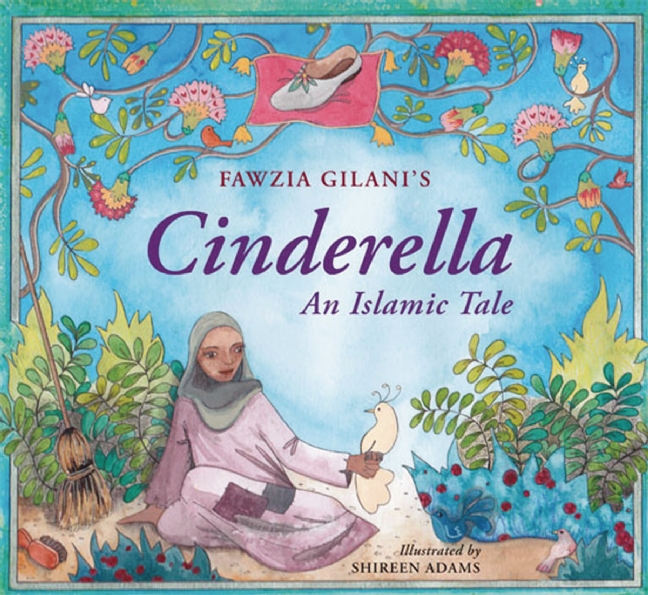
I’ve seen this book countless times online and honestly have never given it a second glance.  I mean Cinderella is a classic fairytale and I have a few different versions from around the world, but an Islamic one? It seemed like it would be awkward or overly preachy and forced.  I should have given Fawzia Gilani’s version a chance though, she has surprised me with her other re-tellings of Eid Kareem Ameer Saab and Nabeel’s New Pants. And, mashaAllah, to her credit she manages to weave a decent story full of Islamic tenants, void of magic, and more feminist than the Disney or Grimm versions.

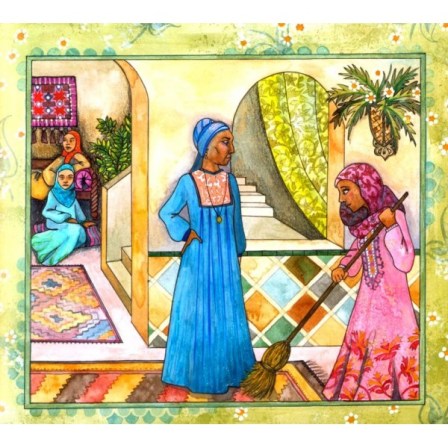
I’m not going to summarize such a familiar tale, but I will point out major twists.  Zahra is a practicing Muslim who is very devout in her prayers, fasting, and reading of the Quran. Her step-sisters nickname her Cinderella after some cinders from the fire burn holes in her clothes.  A bit of a stretch, from Zahra, but I think even the youngest readers will know the original Cinderella story and be ok with it.

cinderella3.jpg

Cinderella is constantly remembering to be patient despite the treatment of her step family through various duaas, ayats in the quran, and fasting on the day of Arafah.  When an invitation to an Eid Party at the palace comes, she naturally is forbidden from going unless she completes all her chores.  Luckily her Grandmother returns from Hajj with servants to help clean the house and a new abaya to wear to the party.  At the palace the women and men are in different rooms, but Cinderella catches the King, the Queen, and Prince Bilal’s attention when passing in the hallway for being in full hijab.  She continues to impress the Queen, when she remains quiet during the athan, prays in jammat, and shows grace in her manners and speech. After winning over the mom, the slipper and happily ever after follow the traditional script, however, like the story of Yusuf (as) and how he forgives his brothers, Zahra forgives her step-family as well.

cinderella-text

The 41 page story is heavy on the text and is not AR.  I would imagine that it would be on a third grade level for Muslim children familiar with the vocabulary, and fourth grade for those that are not.  There is a glossary at the back, but not all of the Arabic words are included, and I’m not sure that the context would allow for them in some cases to be understood.  This book would be hard to do in a story time setting because of the length, at bedtime, however, the pictures are detailed and rich enough that one-on-one could hold a five or six year olds’ attention.

Overall the story doesn’t feel forced, and you’ll find your self smiling at some of the “islamicifaction” of the plot.  Most of it flows really well.  I love that it isn’t focused on her appearance alone.  I also like that she isn’t helplessly waiting to be saved or alleviated from her burdens.  By and large it doesn’t feel like a love story, Prince Bilal is pretty much a minor story point.  The book works for Muslims and non-Muslims alike.  It isn’t preachy, but it definitely is strong in it’s moral messages. I think non Muslims will find the Islamic version just as fun as the hundreds of other “twists” on Cinderella and Muslim children will love to see someone like them living happily ever after as well, inshaAllah.


The Sky of Afghanistan by Ana A. de Eulate illustrated by Sonja Wimmer

Standard

sky-of-afghanistan_book-cover

An Afghani girl dreams of peace in this illustrated 24 page poem.  She soars and flies like the kites against the wind and giggles and learns and hopes with her feet on the ground.  The book is written on a third grade sixth month AR level, but even at that the poem is hard to follow for elementary age children.  The voice doesn’t sound like a child’s, it is far more reflective and mature for how she is presented.  The text, not really a story, wanders and alludes to what obstacles face Afghani’s but doesn’t detail them.  The author assumes the reader knows that Afghanistan has been under war for decades, that war is painful and gloomy and gruesome.  Adults maybe can find the hope for peace and the struggles inspiring, but I don’t think children will really have a clue as to what the text is about. Luckily the pictures are AMAZING.


The illustrator does an amazing job in keeping the story light and hopeful and showing the culture without judgement or despair.  The domes of the masjids, the hijabs, the mendhi on the hands and even the smiling faces beneath the niqabs are done with lightness, kindness and beauty.  There is even a touch of whimsy that reminds the reader that this is supposed to be from a child’s perspective.

The sky can be full of kites, I think to myself,

but it can also be full of dreams…

And mine flies up high, high into the sky,

towards the stars…

The book overall is poetic and artistic.  I can see children enjoying the illustrations and maybe falling asleep to the melodious words, even if they can’t really make sense of them. The book says that profits go to charity, and that the book was translated from Spanish.   For the illustrations alone, the book has merit and older children may be inspired to take something difficult and turn it into something beautiful with their words.


Sitti’s Secrets by Naomi Shihab Nye illustrated by Nancy Carpenter

Standard
Sitti’s Secrets by Naomi Shihab Nye illustrated by Nancy Carpenter

sitti

Sitti’s Secret was published in 1994 and given the events of the week, I’d say it is more relevant today than it was when written.  And if by some chance the events of the week haven’t affected your children, then the poetry and soul of the book still makes it an amazingly powerful story.

Mona travels from America to Palestine to visit her grandma, her Sitti.  Without the ease of speaking the same language, Sitti and Mona learn to communicate and build a tight bond cut too short by a vacation coming to an end.  When Mona returns she sees the news and writes a letter to the President, telling her Sitti’s secrets, telling him they would be great friends, and telling him they only want peace.

Truly Nye is a poet, even in Turtle of Oman her words transport you to a place where time slows down and the connection between a child and a grandparent make you nostalgically yearn for a simpler time.  Having spent my summer’s abroad visiting my grandma I could relate to so much of this book and truly had to still my heart.  The little things, like examining your grandma’s hand, or hanging out laundry, or brushing her hair. Even that dreaded final hug as you prepare to leave,  I could relate and it was enchanting.

No where in the book does it mention the Middle East or Islam, only at the beginning does she hint at it by dedicating the book to her 105 -year-old Sitti in Palestine, it mentions that she speaks Arabic and a few words are sprinkled in. And the Grandma does wear a scarf.  Other than that the book is by and large not political.  If you know that Nye has a Palestinian father and American mother and often writes semi auto biographical pieces, the book can take a bit of a different role to the reader.  Many reviews criticize the activism upon her return (the letter to the President), and found it disjointed to the rest of the story.  But in today’s climate I found it empowering and hopeful.  The world will only find peace when we put a face to those that are different to us, and even children can change our stereotypes.  I love that my children are seeing that they can make a change in the world today, and to see it reinforced in literature was gratifying.

The book is 32 pages and written on an AR 3.9 level.  The illustrations are beautiful.  They bring the words to life in a tender and heartfelt way.  The detail is subtle but deep and i have found myself thumbing back through the pages to get lost in the illustrations multiple times.  I think the book works on different levels for different age groups.  If you have a family that has to overcome great distances to be together, even younger readers will be able to identify with the story’s tenderness.  If you are in 3rd-6th grade and are aware of what is happening in the world you will be inspired.  If you just are looking for a sweet book, subhanAllah it manages to fulfill that category too.

Umar and the Bully by Shabana Mir illustrated by Asiya Clarke

Standard

Umar and the Bully.jpg

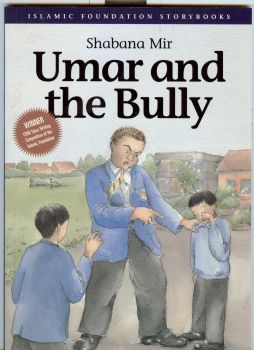
With it being October and Bullying Prevention Month, I thought to review a book that has been on my bookshelf for a long, long time.  It won the Islamic Foundation Story Writing Competition in 1996 and is just as relevant today.  At 44 pages, the story, the layout, and writing style appeal to children on a second or third grade level.

SYNOPSIS:

Umar stumbles across some older kids plotting something covertly in the school yard and some money being exchanged.  He then encounters a younger student upset.  Being a kind person, Umar gets Asad to confide in him what the bullies, Harith and David, are up to, and vows to keep Asad safe.  While all that seems simple enough, the true battle begins within Umar,  as he has to figure out what is he going to do, and how is he going to stop the bullying.

WHY I LIKE IT:

I love the length and the target audience.  My six-year-old son summed it up perfectly when he finished.  “Woah, that was a good book, I didn’t expect it would give me so much to think about.”  The author follows the bullying strategy of telling an adult, or a teacher, but gives some depth when that teacher doesn’t care or take the time to help.  It also shows a variety of people that you can go to for help and characteristics you should look for when deciding who a good person to talk to would be.  Umar decides to talk to a good friend of his about what is happening to Asad and devise a plan to help.  Mohammad is kind and trustworthy.  He also gets some advice and encouragement to be brave from Mohammad’s older sister and brother.  All this is done within an Islamic context of asking Allah swt for help, of finding inspiration from stories of his namesake Syedina Umar Al-Farooq. It also, as we get in Umar’s head, reveals how he himself is scared of facing the bully.  This is great because it shows that it can be scary to confront someone even if you are not the victim.  Umar feels he shouldn’t be scared because he is a Muslim, which I really don’t understand, but he turns to Allah swt asking for bravery to do what is right and to be strong.  And beautifully, after it undoubtedly raps up in a happily ever after children’s story way, he does remember to thank Allah (swt) for being there for him and gives credit to Allah for giving him strength.  The book shows the responsibility we have to do what is right even if it isn’t being done directly to us.  It also shows one or two children can make a difference.  I really like that the point of view is from Umar, not the one doing the bullying or receiving it.  Allowing the reader to see how empathetic he is to another person is a wonderful lesson in and of itself.

The book also has mostly Muslim characters, but a few names sprinkled through out as victims and perpetrators could suggest non muslims as well. This is great in showing that bullies are everywhere and that perhaps being in an Islamic school or in a majority Muslim school does not mean bullying doesn’t exist.  Similarly it is good to see that bullying isn’t just non Muslims disliking Muslims, as often time books about bullying for Muslims would suggest.  I think the book could be for Muslims and non Muslims alike, but with the religious reliance, it is geared more for Muslim readers.

FLAGS:

The book is clean, it mentions that the bullies are violent, and possibly smoking.  The children being bullied obviously are lying but it is clear that it is done out of fear, not because they are deceitful by nature.

TOOLS FOR LEADING THE DISCUSSION:

There aren’t any reading guides or activities to accompany the book that I could find online, but I think the natural discussion that would follow make it a great option to read as a book club book, or in small groups.  There are a lot of very easy places to ask children what they would do, if Umar made a good decision, and how they would feel as the story unfolds.


The Roses in My Carpet by Rukhsana Khan illustrated by Ronald Himler

Standard

roses-cover

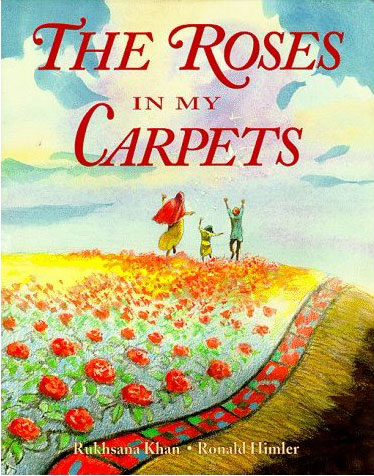
The concept of “refugees” is not a new one, but with the pervasiveness of the term in the news right now, children are starting to need some understanding of what it means to be a refugee, and how to empathize with what their classmates and friends may have endured.  Books like One Green Apple, The Red Pencil, and Four Feet Two Sandals are great, and I excitedly hoped this one would be a great addition to the theme.

roses-2

The book is leveled as an AR 3.2, but I don’t know that many eight and nine year olds would be able to grasp some of the content unassisted.  This is a good example of the limitations of Accelerated Reader.  Yes, diction and sentence length are third grade level, but content is a bit heavy in this 32 page water-color illustrated book.

roses-1

A young boy is telling the story of his life in a refugee camp in Pakistan.  The nightmares of jets dropping bombs opens the story and sets the tone of a very frightening reality that this boy, his mom, and his sister Maha face.  His father, a farmer, had been killed, and I think the author does a good job of showing readers that although the characters are now in a refugee camp, food and safety are still not a given.  I think we as westerners tend to think, ok they had to leave their home, and that is sad, but now they are taken care of, and this book clearly shows that, that is not the case. The boy mentions that someone has sponsored him and helps them with money, something his father wouldn’t have accepted, and I’m not sure why this is included.  Perhaps to show that people still can help and need to, or to show that affluent people donate as a way to ease their conscious without working to fix what caused the problem in the first place? I don’t know. It would lead to some good discussions with older children, perhaps fifth grade and up, as the author doesn’t make it a good or a bad thing, but does introduce it none the less.

The environment is drab, “Here, the walls are mud, the floor is mud, the courtyard is mud, too” and the day-to-day chores monotonous, lining up for water, for food, going to the mosque to pray, and going to school.  For some reason, not sufficiently explained in my mind, the little boy hates school.  A sharp contrast to stories that show how appreciative many children in other parts of the world are at the opportunity to study and learn. The boy rather, loves weaving.  He looks forward to escaping his reality and getting lost daydreaming in the weaving of beautiful colorful images where the bombs can not get him.

The characters are clearly Muslim, as they pray and wear hijab and go to the mosque.  They trust Allah when they are faced with challenges, but no details of belief are conveyed and it simply describes the characters. The book does not come across as whiney to me, and while there is some hope that radiates through when the boy is weaving, it really is a sad book.  It is made more depressing when Maha is hit by a truck, she thankfully survives with broken legs, and by the thought that although the boy wants to use his weaving to provide for his family, the future doesn’t seem bright.  In the end perhaps running free on a rose filled carpet where the bombs cannot get them only exists in his dreams, a sobbering thought for the characters and readers alike.

roses_in_my_carpet_p30-31

The Tyrant’s Daughter by J.C. Carleson

Standard

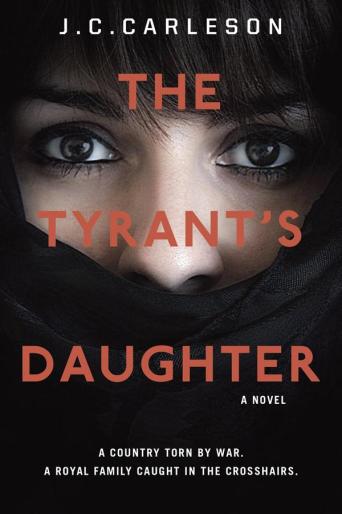
the tyrant's daughterI was intrigued to see this book offered by Scholastic in the teen Reading Club Catalog as it sounded both action packed and cultural.  The jacket cover summary was vague in describing the characters as being from an “unnamed Middle Eastern country,” but with the slightly veiled girl on front, I figured they probably are Muslim, and I should at the very least how they/we are being portrayed.  The book is 295 pages long and that includes the story, the Author’s Note, and a  Truth in Fiction section.  The author is a former undercover CIA officer and the intense action, intertwined with cultural  understandings, leave the reader second guessing and on the edge until the end.  The AR level is 5.1, but with the profanity, sexual situations, and violence I would recommend the book to those in high school and up (15+).

SYNOPSIS:

Fifteen-year-old Laila flees her homeland, when her father, the head of the county, is killed.  Trying to fit in, in Washington, D.C. is not easy for a girl raised like a princess.  She has to navigate not only the social norms and high school drama that most kids her age do, but she also has to examine what type of ruler her father was and what price her privilege came at.   There are a lot of plot twists, and her mother’s efforts to broker deals with rebel fractions and CIA operatives, keep the plot moving forward.  The interpersonal relationships in the background give the characters some depth and memorable traits by contrasting the intensity of a country on edge with the daily dramas of daily life.  Surprisingly with so much going on, I thought the book was well written, my only major critique being,  I wish i knew more about Laila, the main character telling the story.

WHY I LIKE IT:

It’s a fun story, simple as that. The plausible political plot, the young adult characters with their own heightened sense of self worth, is well crafted by-in-large and the book was engaging.  I read it quickly because I wanted to see how it unraveled and it kept my interest.  Will I remember it a month from now? Probably not, but often books like this as YA or adult fiction are delicious empty calories and nothing more-or-less than that.

FLAGS:

The “royal” family is “Muslim.” Yes, the quotes are intentional, because they don’t identify as Muslim, yet those in America identify them as such.  A teacher asks her if she is ok with dissecting a fetal pig and she seems confused as to why that would be a problem.  A boyfriend is nervous to make a move, and again she seems taken aback that there would be a religious reason not to, as she sees it as a cultural one only.  Even at the end when she is discussing going back to her country her mother remarks that she hates wearing a veil and Leila says she never really minded it.  Laila’s mom drinks alcohol and always has, as many heads-of-states of Muslim countries are assumed to do. There is violence, some crude language, and some relationship situations.  Again I would not recommend it for younger teens.

One aspect that is worth noting is how the “bad guy,” Laila’s uncle, is painted as being “religious.”   I would hope that readers would realize that he is an extremist, an exception to the mainstream followers of Islam.  But I don’t know if they would.  He is harshly critical of how Laila and her mom dress calling them “whores,”  he uses religion as a means of power to oppress and condemn others and is just generally awful.  I think the author by largely leaving religion and the name of the country out of the book, isn’t making a judgement on the faith or region, as much as providing plausible pieces to craft an interesting story.  That is just my opinion though, and it could probably be changed.

TOOLS FOR LEADING THE DISCUSSION:

I wouldn’t teach this book, or use it for Book Club, but the supplemental information in the back of the book is definitely interesting, and I think among friends, good discussions about the story’s origins would be fruitful, speculative and engaging.

In a high school setting you could definitely connect it to a Social Studies unit or the Arab Spring.


Where the Streets had a Name By Randa Abdel-Fattah

Standard

streets

This is the second book I have read by Randa Abdel-Fattah, and I still don’t know if I love her as an author, but I did enjoy the content of Where the Streets had a Name, much more so than I did with Does My Head Look Big in This?  The timeliness of this book is also as apparent as ever with the genocide and occupation occurring in Palestine, had I read it years ago I don’t know if it would have had the pull that it had on me, reading in now.  With all the images on social media and the news, this book really does a remarkable job of showing the daily struggles for Palestinians in terms of settlements and check points and just basic day-to-day living that is hard to imagine from anywhere outside of Palestine.  While some may find it slow moving I enjoyed the detail and childlike perspective of the world as seen through the 13 year-old characters in the book.  Despite all the material for it to be a preachy, political, and gruesome, it is not, it is undoubtedly told from a Palestinian Muslim perspective, but the supporting characters come from all backgrounds and focus on the humanity contained with in us all: Muslim, Christian, Jew, and even Israeli.

SYNOPSIS:

Hayaat’s family has been kicked out of their home by Israeli soldiers and are living cramped up in Bethlehem, struggling with no jobs, curfews, and the impending wedding of Hayaat’s sister to a boy on the other side of the checkpoint.  When Hayaat’s beloved, albeit farting, grandama, Sitti Zeynab, falls ill Hayaat believes that she needs to touch her ancestral land to recover.  With a curfew free day, her best friend Samy at her side, and an empty hummus jar, the kids sneak out from school to try and bring back a handful of dirt.  The journey is only a few miles, but with checkpoints, a protest, soldiers and documents, the chances that Hayaat and Samy will retrieve the dirt is minimal, as their priority becomes to make it out safe.  The book is fiction, but from all reviews that I’ve read, it very well could be real, it’s accuracy of the struggles endured and the hope that still remains are not completely fabricated.

WHY I LIKE IT:

I like that Hayaat is a Muslim Palestinian, Samy is a Christian Palestinian, along their journey they meet kind Israeli’s fighting for Palestine, they meet horrible people and soldier’s too, but it is never a black and white issue.  Zionism is what makes life so painstakingly difficult for Samy and Hayaat and all those around them, all the while tourists are flocking around as if walls and checkpoints are the norm.  The first 50 pages of the book are a mess, I don’t know if it is because it is translated from Arabic or if it is just the author’s style to overload and stuff everything in at the beginning that might possibly be interesting or funny to hook the reader. Either way, it doesn’t work and once you get through those 50 pages and the adventure with Samy and Haayat begins and Sitti Zeynab’s story starts to be woven through and we learn more about how Hayaat’s face was scarred, the story starts getting good.  Similarly the book is about 50 pages too long, after the adventure I was ready for the story to end, but I suppose the wedding of Hayaat’s sister, Jihan, has to take place.  Even though it is critical to see the logistical nightmare of having a West Bank girl marrying an Israeli Arab from Lod, the story gets muddled and loses its flow both at the beginning and end with the details of living in Ramallah and figuring out what roads to take to have the ceremony.  Adults may appreciate it, but with an AR reading level of 4.8, the target audience gains a better appreciation for the struggles of the Palestinians through the main story.  In total with the glossary and acknowledgement the book is 313 pages.

FLAGS:

The book is remarkably clean, there is a slight joke about birth control pills, but Hayaat doesn’t understand it, and her companions on the service (bus) don’t explain it to her, so I doubt the young readers will get it either.  (Hayaat thinks her sister shouldn’t get married if it is making her sick and she can’t understand why every day at the same time her mother makes her take a tiny pill.)

There is some violence, but it is not explicit, it is more emotional when Hayaat’s friend is killed and Hayaat’s face marred.  Similarly she blacks out during the protest, so there isn’t much description

TOOLS FOR LEADING THE DISCUSSION:

I do plan to do this as a book club book, I think the students are well aware of the situation and it might be a good place to let them voice their thoughts and emotions.  I may also have a Palestinian sit in on the discussion, to help keep it accurate.

Discussion questions:  www.panmacmillan.com.au/resources/RA-WhereTheStreetsHadAName.pdf

Author’s website: http://www.randaabdelfattah.com/