Tag Archives: Emma Halim

Sameer and Snazzy: Kindness Counts by Emma L. Halim illustrated by Herry Prihamdni

Standard
Sameer and Snazzy: Kindness Counts by Emma L. Halim illustrated by Herry Prihamdni

The 32 page faceless picture book for toddlers and up, is set in Australia and follows Sameer and his cat Snazzy on a bushwalk.  At first I felt like it might be a little bit like the classic, “And to Think that I Saw it on Mulberry Street,” but the structured story with a repetitive refrain adds in Islamic phrases, silly encounters, and examples of kindness that make it unique.  Add in a fun surprise at the end, and like many other books by the author, be prepared to have it memorized as your little ones ask for it over and over again.

The book starts with Sameer look forward to his grandpa coming to visit, but wishing he had something exciting to share with him.  Snazzy suggests he shares that he can talk to animals, but Sameer knows no one would ever believe that, so the two set off on a bushwalk to find something exciting.

When they hear an “A-choooooo!” in the trees, the fun is just getting started with Miss Koala sneezing and making eucalyptus leaves fall. The duo finds a way to help, but the fallen leaves mean ants are stuck in their home and can’t get out.  Once again, Sameer and Snazzy, find a way to help.  After each episode the refrain of, “‘Imagine if I told Grandpa this!”‘ I say to Snazzy.  ‘He’d never believe you! he smiles.  ‘NO-ONE WOULD!’ We laugh together and continue along the path, when suddenly…”

The book ends with a surprise, that I won’t spoil. The backmatter has a reference to Surah An-Naml and explains that Prophet Sulayman peace be upon him, really could speak to animals.  There is also a glossary of the Islamic phrases and a QR code to continue to the fun after the story ends.

The book is a bit more text heavy than some of her others, but the illustrations are fun, and will keep kid’s attention.  It does not rhyme, but has a cadence that makes reading it aloud easy. The small size makes the book better suited to bed time, but could work in a story time, and would be wonderful tuned into a story board/felt board read aloud.  The book is a universal story, but at some point in Islamic fiction self published and small published books, I think we will need to have open dialogue and discussions if having characters that are not the same race as the author or illustrator is appropriate and beneficial, or is misleading and better to avoid.

***EDIT: The author reached out to me asking me to remove this generalized opinion of me calling upon the need to have discussion, I opted to amend, as I think we need to have conversation and believe intention and purpose in whatever one decides is a benefit.  So, to avoid errors in interpreting her ask, I will simply post the screen shots, and my response.  Please note I did not tag the author in my Instagram post, she reached out to me.  I purchased the book, it was not gifted.

Ramadan Rocket by Emma Halim illustrated by Stephen Tucker

Standard
Ramadan Rocket by Emma Halim illustrated by Stephen Tucker

ramadan rocket

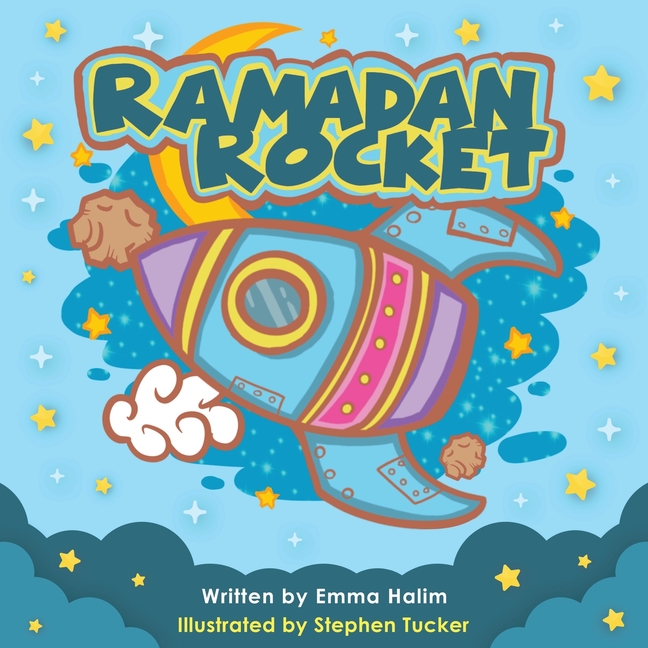
The banter in this 36 page Ramadan moon book is fun and engaging, and as the mom of five kids who was once a kid herself, the struggle is real to try and spot the Ramadan moon.   Most years, frustration abounds and nothing is seen. Haarith has the same problem, but last year he did something about it.  In this 36 page book for preschoolers and up, the faceless pictures will have kids giggling and their imagination’s soaring as they try and determine if Ramadan is about to begin.

img_7572

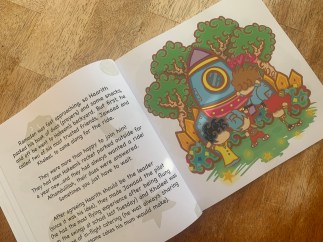
Haarith loves listening to stories about Ramadan, but always has trouble seeing the Ramadan moon. Last year, he decided to get a closer look.  He set out to build a rocket, but his best friend Hakeem had one he could borrow, so Haarith recruits two other friends, Jawaad and Khaleel, and plans are underway.  Jawaad will pilot since he flew out of a swing last week, and Khaleel will be in charge of food because his mom makes awesome cakes.  The boys head to space, passing, satellites, drones, and NASA rockets, before they see the moon and head back home.  After maghrib the community heads to search the sky and when they see nothing, it is Haarith that can locate exactly what they are looking for.

img_7571

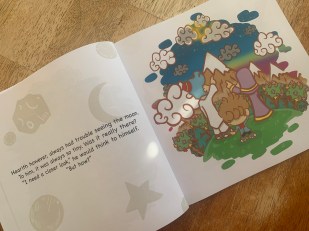
I wish the moon was shown as super thin and hard to see in the illustrations, instead of as a thick crescent so that kids that might not have personal experience could at least understand why Haarith is struggling.  Also, I’m not sure why the line spacing on one page is double what it is on the others.  Many of the pages are text heavy and could have used some editing to tighten it up, but overall the story is fun.

img_7573

The premise though sent my head spinning, and yes I’m going to show my ignorance here, you can judge me. If you go to space, the moon is spherical, the earth and shadows are no longer at play right? So wouldn’t a new moon, a full moon, or a waxing gibbous all look the same? Clearly my confidence in this matter is non existant, and while I have no problem with the characters borrowing a friend’s rocket, it has been sitting unused for a year after all, I’ve been struggling to get this point clarified in my head.  And I believe it would all depend on where the rocket is and thus the boys’ point of view.  According to the University of Maryland, “The reason that we do not always see a Moon which is half lit is because of our position relative to the Moon and the Sun. As the Moon moves in its orbit, different portions of it appear (to us!) to be lit up as we look at it from Earth. This is why we see lunar phases.” So I suppose that depending on the rocket’s position in space would determine if the moon looked like a “Ramadan moon” or say a third quarter moon.  I’ve linked a NASA video that explains that the International Space Station sees the same phases as earth, so umm yeah, maybe I should take a break from fiction and go read some nonfiction basic science books.