
Its time for Basant, the Lahore, Pakistan kite flying festival, and Malik and his siblings are ready. Ready to launch Falcon into the sky, ready to set other kites free, and ready to put the bully next door in his place. While some kids have huge kites, and some have many, Malik has just Falcon, a speedy little kite that Malik prays can get the job done.

Once again Rukhsana Khan does a remarkable job of taking a universal theme, adding some culture, and finding artists to empower minorities without making it an issue, all in a 32 page children’s book. Written on an AR level of third grade ninth month, readers see characters handling a bully by beating him “on the court” so to speak, a character having confidence in his abilities, yet still asking Allah swt for help, and a boy in a wheel chair celebrating a fun spring time festival with his family.

The illustrations are rich with texture and angles, which contrasts the font and text presentation. Little kids probably won’t be tempted to pick this book up, but as a read-a-loud first and second graders will enjoy the story and the kite flying action. Third and fourth graders will enjoy reading the book independently, and find themselves cheering for Malik, appreciating his kindness, and wanting to pick up a kite and head out themselves. The author includes a note at the back which provides more information about Basant and how it is celebrated. Although it takes place in Pakistan and is a festival not celebrated in America, there isn’t a “foreign” feeling to the book, as kids can relate to bullies, wanting to be the best and the satisfaction of succeeding and feeling like a “king for a day.”




 Nadia’s aunt is getting married and she gets to be the flower girl in the Pakistani-American wedding. She also will get mehndi put on her hands for the big event. Her cousins warn her that she might mess up and even in the midst of her excitement she begins to worry what the kids at school will say when they see her hands on Monday. As her aunt prepares the mehndi and the application process begins, various uncles peek in on her and her aunt gifts her a beautiful ring. The mehndi has to sit on the skin for a while to set and as Nadia practices sabr, patience, I couldn’t help but think something seemed off in the story. I’ve been at, in, and around a lot of Pakistani and Pakistani-American weddings, and this story didn’t seem to reflect the tone of such occasions. The book doesn’t reflect the hustle and bustle and near chaos, it doesn’t sound like the tinkle of jewelry and laughter as the women sit around chatting and getting mehndi put on together, the pots on the stove are referenced but not described so that the reader can smell the sauces thickening and hear the pans crashing and taste the deep rich flavors. It is lonely. Nadia is lonely and filled with anxiety about Monday. Durring the wedding she is walking down the aisle and suddenly freezes when she looks down and doesn’t recognize her hands. Her cousins seem to show unsupportive “I-told-you-so” expressions as she searches for some comforting encouragement to continue on. When she finishes her flower girl duties, her grandma asks if she understands why looking at her hands makes her feel like she is “looking at my past and future at the same time.” Nadia doesn’t understand and the author doesn’t explain. At the end she is ready to embrace that her hands are in fact hers and that she will show her friends on Monday. But the reader has no idea how it goes, or what exactly the significance of her painted hands are. The book fails to give any insight or excitement for a culture bursting with tradition at a time of marriage.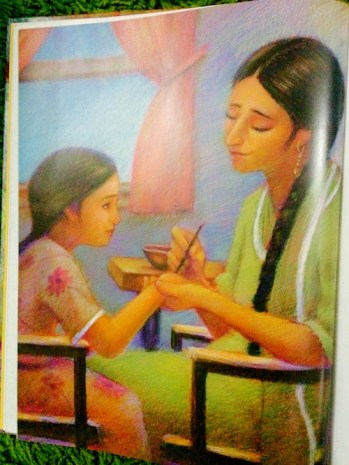







 Islamic School Librarian