Category Archives: Uncategorized

Silly Chicken by Rukhsana Khan illustrated by Yunmee Kyong

Standard

silly chicken

Silly Chicken is a story about sibling rivalry, except there isn’t a sibling, there is a chicken.  Rani feels that her mom, Ami, loves a chicken, Bibi, more than she loves her.  Rani is jealous of the attention Bibi receives and finds the chicken in general, silly.  One day when Rani and Ami leave their home by tonga to visit her father’s grave, a dog gets in and when they return, Bibi is no more.  Ami is devastated and Rani is sure she closed the gate.  It isn’t until Bibi’s egg hatches by surprise, that the story comes full circle and Rani responds to Ami’s chiding that she loves the baby chick more than her mother, that the reader and Rani realize how silly that would be.

I really liked this 32-page, brightly and playfully illustrated book.  It is written on a AR 2.3 level and is fun out loud or at bed time.  The story takes place in Pakistan and a lot of reviews online remark that it is a good book about Pakistan or for showing Pakistani culture, critiques that I both agree and disagree with.  Every kid, everywhere, through out time, can probably relate to being jealous of something or someone occupying their mother’s attention.  The concept of a pet and loving it and being sad and feeling guilty, are all universal themes.  That being said, both the author and illustrator do a remarkable job of breaking stereotypes without drawing attention to them.  Ami and Rani are relatable and are clearly Pakistani, subtly removing an us and them stance.   Rani’s dad has passed away, but Ami and Rani seem to be doing well.  Ami seems very self-sufficient in daily activities and brave when they think a burglar may be present.  The two chat with neighbors and travel independently breaking down the erroneous stereotype that women cannot go out or be recognized without a male.  The mother wears hijab and traditional Pakistani clothes while Rani being young obviously does not cover.  Their clothes are bright and colorful and their expressions relatable and inviting.  The way that Bibi’s death is handled is age appropriate and a child could possibly think she simply was run off rather than killed, either interpretation would allow the reader empathy for Ami and be a great topic to explore with a child.  Enjoy!


The Secret Sky: A Novel of Forbidden Love in Afghanistan by Atia Abawi

Standard

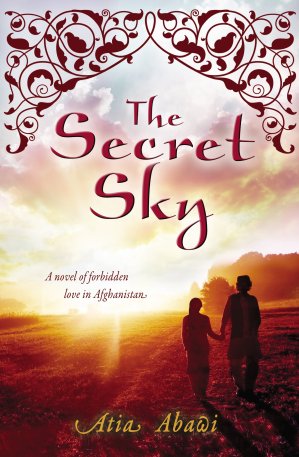
The Secret Sky A novel of Forbidden love in Afghanistan

This was another book I stumbled upon in the Scholastic Teen Book Flyers, and I wanted to read it to see, once again, how Muslims are being portrayed in books presented and widely distributed in the school markets.    I didn’t figure given the “romantic element” it would be a candidate for our Book Club, but none-the-less wanted to know if it should at least be on our library shelves in the Middle School section.  The book is not in the Accelerated Reader data base, bur for content I would think 11th or 12th grade.  The book is written by a woman whose family left Afghanistan right before she was born and later returned as a television correspondent.  Her story is included as the introduction of the book and a glossary at the end make the total length 292 pages.

SYNOPSIS:

A boy from a landowning family, Samiullah, and a girl whose family works the land, Fatima, have known and played together their whole lives.  When Sami comes home, however, after realizing that the madrassa, religious school, he was sent to is a sham, he  finds he is still in love with his childhood friend.  Knowing that their families would never allow their union, Sami is in the midst of working up the courage to share his feelings with Fatima and try to convince her family, when Rashid, a cousin discovers them talking in the woods alone and rats them out.  The role of culture and religion make this turn of events a dire one for the couple.  As shame has been brought to Fatima’s family, her father arranges to have her married to a good friend of his, as a second wife.  Fatima’s mother, responds very harshly by beating her and pouring boiling water on her arms.  Sami is beaten as well, but not to Rashid’s satisfaction and thus he decides to go “tattle” to the local Taliban leader.  As the story unfolds it becomes clear that Mullah Latif is not religious in the least and that he has no conscious.  Latif and his gang leave a path of murder and suffering as they set out to make an example of the couple in the name of religion and culture.

WHY I LIKE IT:

The author actually does a pretty good job of making in clear that Latif and Rashid are one extreme of bad; manipulating religion to justify their acts.  As Rashid realized how little Latif even knows about Islam he sets to distance himself from the gang.  Latif at one point doesn’t even want to enter a mosque.  The opposite of the Latif character is Mullah Sarwar who is good, and kind, and gentle, and loving.  Overall the author doesn’t paint one group with a broad stroke, there are good and bad land owners, workers.  There is even a grandma who supports women being educated and marrying for love, contrasted with a mother who wants to see her daughter killed for her actions.  The story is also pretty universal and has some Romeo and Juliet similarities, simply set in Afghanistan.  Some of the culture shines through to add context and understanding outside of the story alone, and that is nice.  Fatima logically works through why she can’t marry her fathers friend.  And in some ways you see why the country struggles as it does in real life, and why there isn’t an easy fix.  Each chapter is told from a different perspective, either Fatima’s, Samiullah’s, or Rashid’s which does give a more rounded view of the events.  But in some cases, not quite enough.  One thing I didn’t find believable was how purely evil Rashid was one minute, and then his quick change (SPOILER).  The reader is not given much insight into him and yet he has such a huge influence on every aspect of the story that it seemed a little abrupt and unrealistic.

FLAGS:

The love story aspect is actually pretty clean and sweet in many ways.  The unexpected violence, however, is a huge flag to me. (SPOILER ALERT) It mentions in some detail that Sami left the madrassa when he caught the head of the school sodomizing a young village boy.  It isn’t graphic, but it is detailed enough to be noted.  Fatima’s younger sister is also killed when Latif breaks her neck with his bare hands, again incredibly brutal, horrific and sad.  Mullah Sarwar is murdered and hanged in the village.  All reasons why the book in my opinion is for older and mature audiences.

A small religious point, that I think most would be fine with, but just in case should be mentioned, is that Sami goes to pray at a shrine.  The author explains how it evolved as a place to pray to Allah for matters regarding love, but it could be construed as being inappropriate.

TOOLS FOR LEADING THE DISCUSSION:

I wouldn’t teach this book to the ages I currently work with, but here is a little insight from the author about what she wanted the readers to take away from her novel: https://www.youtube.com/watch?v=M2rMD16g23E


How Big is Allah? Written and illustrated by Emma Apple

Standard

how big is Allah.jpg

I chose this book thinking it would be a good reference style book to have in the house for the kids to ponder over.  Being it is non fiction, the fact that the pictures are black and white didn’t immediately put me off.  Reading it however, did.  The book is technically 28 pages, but it feels and resembles a pamphlet more than a book.  The pages are thin, the illustrations mere doodles with the majority, outer space being black, and the “story” is really only about 19 pages.  At a cost of over $10 I felt a little shortchanged and really disappointed.

The concept is fabulous.  Using space to stretch the readers mind to understand how big Allah swt is, I get it, I appreciate it. But the book even in its sparsity seems disjointed to me.  It starts with asking what the smallest thing you can think of is:  an ant, a snow flake, a piece of sand? It then asks the reader to compare that to the biggest thing you can think of as a comparison.  From there it is pretty much a book about space, complete with an appendix in the back comparing various planets and the sun. Again all interesting facts, but not cohesive and not packaged well.

I tried reading it to a small group of 4 year old students, and it was a bit over their heads as written.  I was able to use it as a guideline to facilitate a discussion which went well, but as is, in all honesty will probably just be lost on the book shelf and forgotten.  It seems to be self published, and I can’t help but think that the book could be great.  Big glossy pictures, a few more pages, or even a more accurate price would help the book in my humble opinion.


Invincible Abdullah: The Car Theft Kidnapping by Haji Uthman Hutchinson

Standard

invincible

 I don’t usually post a review of the second book in a series so close to the original, but I wanted to read this one and see if it would be a better fit for Book Club being it takes place in England.  Nothing against  Invincible Abdullah and the Deadly Mountain Revenge, but we’ve done a lot of books for Book Club set in Pakistan and Afghanistan, and I want to make sure that the students see Muslims in a variety of settings. This book has the same main character, but is not dependent on the first book for understanding in any way.  Writing style is about a fourth grade level and it is just 152 pages, with sporadic pictures and a glossary of terms at the back.

SUMMARY:

Abdullah and his Malaysian friend Zaki are karate buddies that train and worship together while attending college.  The book opens with the two sparring and Abdullah going home to a letter from an old karate friend, John, who got mixed up with drugs and stealing cars and is now in prison.  John asks Abdullah to come visit him to answer some questions he has about Islam.  After a few visits John takes shahada and changes his name to Abd ur-Rahman. When Abd ur-Rahman gets out Abdullah and his family support him and the sensei even lets him back in to the dojo.  However, things don’t stay calm for long and when Zaki’s car gets stolen, and Abdullah is kidnapped, the boys friendship, loyalty and faith is tested.

WHY I LIKE IT:

The story is face paced and action filled, it also never waivers from being a strong Islamically based book.  The characters balance religion, and day-to-day living in a realistic and inspiring way that engages the reader and makes the character’s morality seamless and believable.  I love that the characters forgive a convict in words and actions and that the friends are from a variety of ethnicities that again, seem realistic and not preachy and forced.  The twists and turns in the story keep the reader’s interest and although you know things will end up alright, the author does keep you curious.

FLAGS:

Obviously there is an element of criminals and drugs that while presented in a negative light is central to the story.  There are not a lot of details about the drug use, but there is some violence that the characters go through, and mention of guns.   There is also brief mention of a bar in the book that is visited to make a few phone calls from.  The only concern that I have, was that it could be perceived that John had to change his name when he takes shahada and I don’t know if I agree that, that is mandatory.  In the book it weaves a little bit of a side story and is presented very positively, but it is something to be aware of none-the-less.

TOOLS FOR LEADING THE DISCUSSION:

I will probably use this book for the 3rd to 5th grade Book Club selection later this school year, because I think there is a lot to talk about. Topics of rehabilitation, taking shahada, and being a good friend are prevalent through out and something I think kids can wrap their heads around and have opinions about.  There doesn’t seem to be a lot of information about the book online and I’ve heard from one distributor that the book is out of print, but on some sites there are still copies available and there is also a workbook.

The Librarian of Basra: A True Story from Iraq By Jeanette Winter

Standard

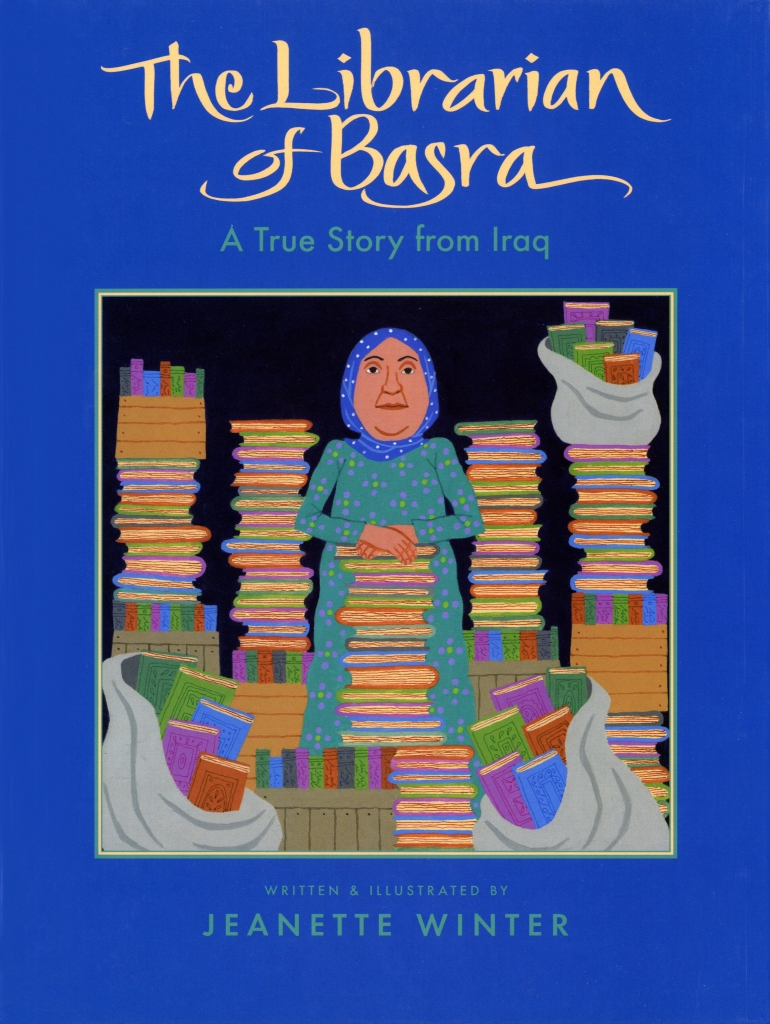
The Librarian of Basra by Jeanette Winter

An absolutely lovely book that naturally friends have been urging me to read for quite a while, and it didn’t disappoint.  The story is about the invasion of Iraq in 2003 and how the chief librarian of Basra’s Central Library, Alia Muhammad Baker, “managed to save 70% of the library’s collection before the library was burned to the ground nine days later” (A note from the Author).  The large hardback brightly illustrated pictures show children the seriousness of war without frightening them.  The text also maintains this delicate balance as it conveys Alia Muhammad Baker’s fear and urgency in trying to save the books without overwhelming the reader.  The AR level is 3.2 and I think younger students can appreciate the importance of libraries and knowledge and preserving it.  While at the same time, older students can appreciate what is destroyed, possibly inadvertently in a war, and how individuals can make a difference.  The book scratches the surface and I’ve read some harsh critiques of the book claiming that their are glaring omissions as to why the library was destroyed, who destroyed it, why the soldiers look as they do etc.  But honestly I choose to take it at face value and to appreciate that this book exists, that the characters and community in the book care enough to save nearly 30,000 books and that it is presented in a way accessible to children.

Some Links:

How the Author acquired and retold the story: http://www.harcourtbooks.com/authorinterviews/bookinterview_Winter.asp

Fourth grade lesson plan: http://cmes.arizona.edu/sites/cmes.arizona.edu/files/The%20Librarian%20of%20Basra.pdf

The Friendship Matchmaker Goes Undercover

Standard

friendship

I’m posting yet another Randa Abdel-Fattah book that my mom stumbled upon and sent me 10 copies to do for our Book Club. I didn’t love the book, but it is clean and brings up the issue of bullying, friendship and honesty.  So, I’ve decided to do a 3rd- 5th grade Jr. Book Club and use it as a starting point to discuss this critical social realms that they are facing.  The book is a 4.4 Accelerated Reader level and has no Muslim characters or themes.

SYNOPSIS:

This book is the second in the series, and, thankfully, having not read the first book, The Friendship Matchmaker, didn’t hinder my understanding.  Told from the perspective of Lara Zany, a former friendship matchmaker of Potts Middle School, the reader gets to know the major characters at the school and their problems.  Lara now has a best friend and has retired from the matchmaking business, but old habits are hard to kick, and as a new student from Somali out plays the school bully in soccer, Lara is forced to go undercover to help her classmates.

WHY I LIKE IT:

The book doesn’t stand out in the genre, but it is fun because I think 3rd through 5th graders deal with everything in the book, every day.  The book shows restraint where a lot of books over do it.  The characters show growth, they aren’t disrespectful and they aren’t all painted with a simplistic brush stroke.  The bully has redeeming qualities and no one is perfect or hopeless.

FLAGS:

The book is clean in regards to violence, relationships, and language.  The only concern I have is there are two major instances where the characters lie, and there are no consequences.  The smaller breaches of honesty the characters in some way or another must own up to, but there are two scenarios: a forged field trip signature, and an untruthful excuse given for being late to class, that rubbed me the wrong way.  Before allowing students to check it out for the purposes of Book Club, I sent a note to the parents with these two concerns and left it to them to encourage or discourage their student’s from checking it out.  My goal is to discuss why the author included these in the book, and realistic alternatives that would promote honesty, but still allow for a happy ending.

Zaki’s Ramadhan Fast By Ann P. El-Moslimany Illustrated By Erica L. Butler

Standard

zaki


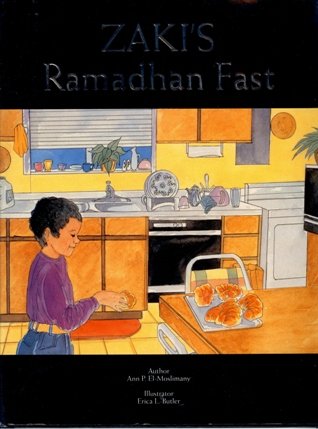
Zaki’s Ramadhan Fast is an age appropriate picture book for kids trying to fast for the first time (Little ones to 8 or 9 years old).  The illustrations drive the story and the short paragraphs explain the excitement and difficulties Zaki experiences on his “first real fast.”  The book talks about the rituals of waking up early, the importance of not fighting and getting angry, and the mercy of Allah.  Zaki makes his way through the day with the help of his supportive family and climaxes with Zaki forgetting he is fasting and eating a muffin.  The book is a great introduction to Islam and Ramadan to children of all backgrounds, but is definitely more applicable to young Muslims trying to fast, especially during these long hot summer days.

Wanting Mor By Rukhsana Khan

Standard

Image

SYNOPSIS:

Jameela has a lot of obstacles as the book opens: poverty, her mother, Mor, has just died, a cleft lip, and an angry  father that returns to drugs and alcohol.  As the book progresses however, things don’t get better in fact they get worse.  In war-torn Afghanistan Jameela and her father move from their small village to the bustling city of Kabul, recently freed from Taliban control. With only her faith in Allah and her memory of Mor, Jameela endures being a virtual slave in one home, before being whisked away for her father’s inappropriate actions with the lady of the house.  Desperate for a place to live, Jameela’s father marries a widow for her money and Jameela becomes a slave to her new stepmother.  When her stepbrother Masood, tries to teach her how to read and write her name, her stepmother convinces Jameela’s father to take her to the busy market place and leave her.  Alone, lost, and with no where to go a kind butcher tries to help her, but ultimately she ends up in an orphanage.  Prospects look up for Jameela as she finally is allowed an education, friends, and security, however, issues with her father and stepmother must be resolved and ultimately this serves to be the biggest test for Jameela.

WHY I LIKE IT:

The story in a nutshell, is heartbreaking, yet Khan never seems to diminish the hope felt for Jameela and the belief that she will find a way to have a full life.  Based on a true story, it is hard to put the book down and the 183 pages fly by quickly.  Jameela is very devout in her prayers, her modesty and her imaan, illuminating  a story where so much sadness prevails. Her faith in Allah swt brings her peace and strength and Khan successfully passes that message on to the reader.  Jameela not only has to navigate her family issues, but also the challenge of making friends, dealing with her appearance, taking control of matters regarding her education, and so much more than most student’s coming of age have to endure.  I think Jameela’s strengths and faults will inspire and serve as lessons to the readers, most likely girls who have it much, much easier.  And who after reading the book, inshaAllah, will appreciate how much harder their lives could be.  

This is the second book I’ve read and blogged about by Rukhsana Khan, the first was a children’s fiction book My Big Red Lollipop.  The two books are both well written and I enjoy her voice as an author, this book however, Wanting Mor, while only an AR Level 3.7, I would reserve for a more mature audience.  The reading is easy and fluid, the story is powerful and well told and I think would be fine in a 7th or 8th grade and up environment.  I would be nervous to recommend this book blindly to a young adult reader without context, direction, and some background.  The incident after a party, with alcohol, where Jameela’s father enters a married woman’s room, implies more than I would want a 3rd or 4th grader inquiring about.  Details aren’t given, but it causes a huge turning point in the story and is thus critical.  At one point a character is groped in the street and Jameela laughs, highly inappropriate that it happens and equally inappropriate that Jameela laughs at her friend.

Another point I would want to discuss with anyone reading the book before hand is the concept that, If you can’t be beautiful, you should at least be good.”  Mor tells it to Jameela, presumably because of her birth defect, but I think that a young girl reading the book shouldn’t take it at face value, I would want to explain the culture, the environment, and talk about such a statement on many levels.

FLAGS:

 Implied sexual violence, drug and alcohol use

TOOLS FOR LEADING THE DISCUSSION:

Given the right group of older students, this book would make a decent book club selections with plenty to discuss and plenty of emotion.

The author’s website page:  http://www.rukhsanakhan.com/books/wantingmor.html

Teacher’s guide:  http://www.rukhsanakhan.com/teacherguides/Wanting%20Mor%20Teacher’s%20Guide.PDF

Wanting Mor Presentation:  http://www.rukhsanakhan.com/teacherguides/Wanting%20Mor%20Presentation%20Guide.PDF


Beneath My Mother’s Feet By Amjed Qamar

Standard

Image


I was so surprised by this book, subhanAllah.  I picked it up at a used bookstore and didn’t think much of it, tossed it in my bag one day as I headed out with my children’s class on a field trip and seriously didn’t want the bus ride to end I was so caught up in the book.  An easy 200 page read if you are familiar with Pakistani culture, even more so if you have ties to Karachi (specifically Defense), the detail takes you to the streets and gullies you know and you want to stay and look around.  If you don’t have these reference points, the book might be a bit hard to connect with, but I think the Author still gets her story across if you are willing to try (there is a glossory in the back).  Beneath My Mother’s Feet is a 4.9 reading level, and because of the heavy cultural references I don’t think I would do it as a book club book, but I have already suggested it to certain students that I know will find a connection and appreciate their mothers and their opportunities in America all the more.

SYNOPSIS:

Nazia is a typical fourteen-year-old Pakistani girl in the large and bustling city of Karachi, Her working class family suddenly is thrown into chaos when her father gets injured at his construction job.  As we learn more about her father, Nazia and the reader discover how lazy, selfish, and dishonest he is, despite Nazia’s determination to see the best in him.  While the family has had hard times before, this time something more than Nazia’s mom scraping and sewing to get by is needed.  As a result Nazia is pulled out of school to help her mom be a maid, masi, in wealthy families’ homes.  The family eventually loses their home, and Nazia’s older brother steals all the jewelry and clothing intended for Nazia on her wedding.  Her father disappears and the women of the family are left to find the strength and resources to carry on.  While the cover teases the idea that Nazia is a “perfect daughter” and that she is such a “good girl” I found these to be incredibly misleading statements and pulled quotes.  I think the story, shows how determined Nazia is, but not at a rebellious level, more as a girl finding her self and willing to risk it all for what she believes, a trait very much in line with her mother’s example.  

WHY I LIKE IT:

I like that it shows self resilience and self reliance both from Nazia and her mom, Naseem.  Nazia holds on to her friendships, her dreams, and isn’t afraid of hard work.  She explores what it means to be a good daughter, good sister, good friend, and good worker. She also is emotionally sympathetic and generous to a small servant boy, all wonderful concepts to present to a 4th through 6th grade audience.  I like that although Nazia isn’t terribly religious she does rely on Allah (swt) and her faith to help her endure the various hardships she encounters.  Islam isn’t at the forefront, but clearly she Muslim.  The book is heavily steeped in culture, the concept of a dowry, how masi’s are treated are not Islamic in the least, and unfortunately the author doesn’t articulate that it is only a cultural norm.  While the women tend to be highlighted in different colors throughout the book, the men seem to be brushed over in a very negative light.  On the surface it is nice to see strong women of various socio/economic spheres coming together and making decisions, but to push all the men aside as being worthless, isn’t realistic or fair.  I liked the uncertainty at the end, usually I prefer books that wrap up all loose ends, but here i think it opens the door to imagine what would have happened and discuss it.  

FLAGS:

The book is remarkably clean, There is lying, but consequences are clear.  There is some violence in the mistreatment of the masis, but the author shows Nazia bothered by it and it is discussed.  Nazia and her friends remark at some of the cute cricket players, but nothing is done about it and it seems innocent enough.


TOOLS FOR LEADING THE DISCUSSION:

A reading guide by the publisher:  http://www.amjedqamar.com/Reviews.html

A bit about the author and where the story idea came from:     https://www.webjunction.org/content/dam/WebJunction/Documents/ohio/Beneath_My_Mothers_Feet_toolkit.pdf

Amjed Qamar’s official website:  http://www.amjedqamar.com/

Interview with Amjed Qamar from A Year of Reading:  

    http://readingyear.blogspot.com/2008/05/sneak-peek-keep-your-eye-on-this-new.html


Nabeel’s New Pants: An Eid Tale Retold by Fawzia Gilani-Williams

Standard

Image


Nabeel’s New Pants: An Eid Tale retold by Fawzia Gilani-Williams and illustrated by Proiti Roy is a silly story about a shoemaker getting ready for Eid.  He goes to buy gifts for his wife, mother and daughter and gets a new pair of pants for himself.  The pants, however, are four fingers too long, and no one has time to hem them for him: Not the shop keeper, not his wife, not his mother, not his daughter, so he does it himself.  Nabeel then goes out to visit the poor and hand out charity and all the women in his life feel guilty andsneak over to hem his pants for him.  Luckily Nabeel has a sense of humor and there is just enough time to fix some seriously too short pants.

The book is 32 pages and an AR level 2.9.  It reads well out loud, with simple, yet colorful pictures for even the littlest ones to look at and enjoy.  The story is simple, and probably has a lot more relevance to a Muslim audience than a non Muslim one.  Eid is not described in any great detail, other than gifts are given, charity distributed, new clothes are worn, and lots of food is prepared, so it might put off those not familiar with the holiday.  Islam isn’t mentioned by name, but is obviously assumed.  Culturally the characters are Indian sub-continent based on the food’s being prepared.  Some of the women fully cover, some a little and some not at all.  And I particularly like that Nabeel can sew his pants himself.  The kids enjoy seeing themselves and their families in a silly story.  Even the three-year-olds get the punchline and all around it is just a fun book.  Alhumdulillah!