Category Archives: Muslim Character

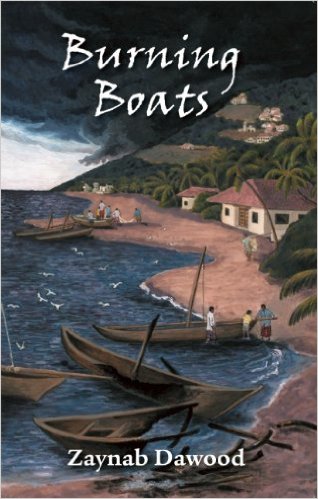
Burning Boats by Zaynab Dawood

Standard
Burning Boats by Zaynab Dawood

burning boats

This book came highly recommended from a friend that read it aloud to her Kindergartener and I ordered a class set based on her raving review.  After trying to get into the book on three separate occasions I concluded that yet again I should have waited and read the book myself before ordering it.  So I handed it over to my avid reading eight-year-old who read it in a day and said it was pretty good, asked a few questions, and continued on her way confused as to why I couldn’t finish it.  So, I started it again determined to get through it and with Ramadan quickly approaching I thought I could motivate myself to do so.  However, I could not, and it sat on the shelf for the entire month with a book mark only a few chapters in.  At the prodding of my guilty conscious to return the book to my friend, I continued reading from where I left off, rather than starting over, again, and found that by dismissing completely who any of the characters are and how they are related, the story does get off the ground and I was able to finish it.  That being said, I think the story might have appeal if read aloud one chapter at a time. To read it in one setting did not help the story that can’t seem to decide it if wants to be character driven or action driven.  The sheer number of characters is completely over the top, there are at least 20 characters mentioned by name and the book is only 137 pages.  And honestly I never bonded with any of them.  There is action in the book, but the details seem misplaced.  The author details characters all saying salam and walaikumasalam to one another and giving moral reproaches based on Quran and Sunah, but I never felt I understood why the main characters were leaving, why the villain was so bad, or how (spoiler alert) a pivotal character in the book died. I guess by never connecting to the characters or feeling an emotional tie, positive or reproachful, the book didn’t live up to it’s potential.  The book is recommended for ages 12 and up, but I think younger children could read it and even younger could listen to it being read to them without any major concerns.  With guidance the book is by no means a waste of time, but if you recommend it to a child and they struggle to get into it, you might just have to let them find something else to read.

SUMMARY:

A small fishing village is being harassed by a corrupt businessman’s attempts to take over the entire industry in Tobay.  The principal of the school and a few close friends are trying to stop him, but have decide they cannot and thus are planning to move elsewhere.  The children are forbidden to go to the harbor as boats are being burned and crimes committed to persuade the local fisherman to abandon their solo endeavors.  With few places to play, the loss of the harbor affects the children greatly as well.  A tropical storm complicates matters as it tears through the village destroying the poor inhabitants meager dwellings as well as the damaging the school and the mosque.  With friends taking in homeless neighbors and the main family planning to leave the children plan one last game that turns dangerous when all the boats in the harbor are set a blaze.

WHY I LIKE IT:

There are some definite good qualities in the book, despite the holes.  It opened up a good discussion between my daughter and I about preparing a body for ghusl and Janaza.  It does show that people can change and that when people are sincerely apologetic and are striving to correct their behaviors, those around them should offer forgiveness in not just their words, but in their actions as well.  It also shows that good kids can make bad choices, and that the consequences can also be very real.  Similarly it shows that adults also don’t always know what to do, and that they can be forced to reconsider as well.

FLAGS:

There is violence in the book and death.  Nothing too graphic, but one might have to explain to younger, more sheltered reader,  that just because someone has a Muslim name doesn’t mean they are practicing Islam and are good people.

TOOLS FOR LEADING THE DISCUSSION:

There aren’t any online tools, but I would suggest having the readers keep a character journal.  Every time a new name appears, write down who they are, (and who they are related to), so later they can look back on it if they become confused.

Because of the “holes” in the story I would probably ask the students to give their thoughts as to what happened or why the characters decided to do what they did and then turn it back on them and ask them what they would do.

Why was Ibrahim leaving? Would you have left? What made Nasser change? Would you have forgiven him? How do you think Ayesha died? Etc.

A Party in Ramadan By Asma Mobin-Uddin Illustrated by Laura Jacobsen

Standard

BMP_8604_JT.indd

This is a great book that works on a variety of levels.  Leena is fasting the whole day for the first time, but is also invited to a friends party.  Her mom gives her the choice to fast or not as it is not yet mandatory at her age, and she decides to fast AND go to the party.  The story takes you through the activities of the party and how some parts are easy and some harder for the fasting Leena.  The end has a wonderful surprise for both Leena and the reader as the author gives us all reason to hope that respect among friends exists, and that in fact one can stay true to their beliefs and have support from their friends.

This book is  great conversation starter for older kids who maybe have tried to fast and felt the temptations of day-to-day life in a non -Islamic environment.  With an AR level of 4.2 and 34 pages the story is strong enough to hold a fourth graders attention and get them to analyze what they would do in a similar situation.  Although the book is about Ramadan and some facets about how fasting is done, what it means, and why Muslims do it, are sprinkled in, the story isn’t overly religious in nature.  The characters are simply Muslim, they pray, they thank Allah, they wear hijab, they make duaas and they also go to friend’s parties. I think non-Muslims would benefit from this book and see the beauty of diversity as Leena and her friends support one another.  The pictures also do a wonderful job of depicting the story: the characters are warm and happy, some cover some do not, they eat chocolate pudding and Baklava and the reader sees how a Muslim family is just like any other family.

The added beauty of this book is that it also works for story time. The younger ones may or may not understand the potential stress of being the only Muslim at a party, let alone being the only one fasting, but they do understand that Leena wanted to eat and drink and she remembered that when her little sister wanted her dessert.  They also understand how sometimes it is hard to do what is right, but inshaAllah the reward is sweet indeed.

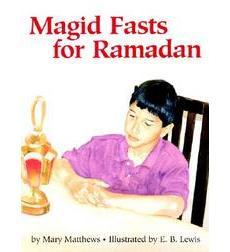
Magid Fasts for Ramadan by Mary Matthews illustrated by E. B. Lewis

Standard
Magid Fasts for Ramadan by Mary Matthews illustrated by E. B. Lewis

Magid Fasts for Ramadan

The intent of this 48 page chapter book is good, however, a few things rubbed me the wrong way about how Ramadan and Islam are presented.

Nearly eight-year-old Magid wants to fast on the first day of Ramadan, but everyone says he is much to young.  He decides to deceive everyone and fast anyway.  I’m actually okay with this main story line, as I could genuinely see a child wanting to do it so much they would lie about it.  The author even has the family sit down after the truth comes out and discuss how honesty is important and this is not how Ramadan should be celebrated.  Lesson learned for Magid and the reader, right? Nope, the author kind of blows it and takes it to the other extreme.

Magid’s sister Aisha is twelve and is “forced” to fast so she isn’t the only girl not fasting at her all girl’s school in Egypt.  What a sad reason to fast, The whole reason Magid wants to fast is to be a “truly obedient Muslim” which sounds great on the surface, but it get’s repeated so often that Magid at one point is judging a classmate who isn’t fasting and isn’t always at Jummah (Friday) prayers.  The parents decide at the end to let Aisha fast until school is out, hence shortening the day for appearance purposes, and Magid can fast til lunch.   He is told he can fast full days when the days are shorter.  Again a really odd reason to wait when fasting has been prescribed for us, to make it an issue of convenience.

So aside from the very negative view of Ramadan and the kids rejoicing at the end that they don’t “have” to fast, the lying, the disobeying your mother, and the judgmental laden diction of being truly obedient, the book does cover a lot of ground well.  The book shows the characters doing wudu and praying, it shows them trying to be kind to one another, it talks about how the Quran was revealed in the month of Ramadan and it does have a plot.

The water color illustrations are nice, and I also like how it showed a bit of Egyptian culture with the lanterns, singing, and food.  Interestingly the author says it is harder for Muslim’s in America to fast, but elsewhere says that Aisha has to watch the girls at school not fasting, eat lunch.

I really wouldn’t recommend this book, for the intended audience of 3rd through fifth graders I think it would do more harm than good in promoting Islamic values in Muslim children and in showing non-Muslims what Ramadan means to Muslims.

Does My Head Look Big in This? By Randa Abdel-Fattah

Standard
Does My Head Look Big in This? By Randa Abdel-Fattah

Image

I think I have purchased this book at least twice before and have never gotten around to reading before loaning it off to someone, that is until we were snowed in a few days ago.  Similarly bizarre, whenever I’ve asked someone who has read it what they thought of it, I’d nearly always get a a smirk, a shrug a nod of the head, and a vague response.  So when the book came in the mail and the snow hit the roads, I decided to put an end to all this none sense.  Needless to say I’m very tempted to make a video of me shrugging, smirking, and shaking my head instead of writing a synopsis, ya, it’s got a lot going on.

According to Accelerated Reader it is a 4.9, so fourth grade ninth month reading level, however, I wouldn’t encourage anyone that young to read it, you would need to be at least a junior or senior in high school for content.  It has 360 pages that fly by and is one of those books that if you put it down you could pick it up a month later and not miss anything, or you could read it in one sitting and not find it to be a daunting task.  I akin it to empty calories, a half hour sitcom, or books like Janet Evanovich’s Plum novels or Sophie Kinsella’s Shopoholic books; entertaining, light, and with a happy ending.

SYNOPSIS:

Australian born Amal Mohamaed Narullag Abdel-Hakim is considering wearing hijab and as she makes the decision, she is forced to handle obstacles in every relationship her sixteen-year-old life contains.  The only child of her Palestinian born parents, her mother is a dentist, her father a doctor, Amal seems to have it all: a few close Muslim friends from her days in an Islamic School, a few close friends at her current prep school, an amazing relationship with her parents, brains, looks, opportunity.  There is really no climax as she navigates all this other than the fact that she is a teenager and doesn’t often know what she wants.  Additionally she is Muslim and as various terrorist plots occur she is challenged with coping at school, deciding if she can achieve her goals and cover her head, if she can have male friends and go to parties, and if she can win over her critical elderly neighbor.  This book honestly has it all: Islam vs. culture, boy girl issues, gender roles, immigrant and assimilation, extremism vs liberal, weight and self esteem issues, Ramadan, cousins and family members who make things difficult, female circumcision, terrorism, drug and alcohol use, smoking, racism and bigotry,  and even at times a poignant moment or two.

But, to cram all that in to a YA book is really just too much that it gets lost and ultimately doesn’t leave a memorable place in the reader’s head or heart.

Never really getting into Amal’s head about why she wants to cover, the book stays superficial with her infatuation with Adam and her poor choices regarding her relationship with him.  A constant struggle she has is wondering if she can ever get a job and be taken serious as a professional while wearing a hijab, which seems really silly since her mom is a successful dentist who covers, but that never even is addressed.  Amal fights with her Principal, fights with classmates and at times even her parents regarding her decision to cover, and while yes you cheer for her, it seems to almost contradict how flighty she is in other capacities of her life.  The other main story line is with Amal’s Muslim friend Leila who’s parents are “cultural” and not very religious and thus oppressive in letting Leila practice Islam.  A worthwhile story line, however it almost makes Amal’s family in contrast seem “too perfect” which after a while just seems unrealistic.  The character fasts and prays and does many of the prescribed aspects of faith, but Amal seems in many regards to lack spirituality or enthusiasm or even a deeper connection for Islam.  She is a character who is Muslim, but not necessarily defined internally by her love of Allah, she just wears it on her head.

WHY I LIKE IT:

Many reviews of the book remark that it is a book that “needed to be written and needs to be read,” and I think yes, if you are an avid reader that is looking for a quick entertaining read about a Muslim, by a Muslim, go for it.  I don’t foresee me using this as a book club selection, but i think in a few years there are some students that I would recommend picking it up and reading it.  To some non-Muslims I think it would show that Muslim’s have the same everyday problems that everyone has, and in fact we are not all extremists.

FLAGS:

There is a little cursing in the book, girl/boy issues of dating, kissing,  mentioning of porn and prostitution, there is alcohol, drug use by a minor character, smoking, and lying to parents as a norm.

TOOLS FOR LEADING THE DISCUSSION:

Click to access RA-DMHLBITNotes.pdf

A little about the author and why she wrote the book:

http://www.randaabdelfattah.com/index.asp


Golden Domes and Silver Lanterns By Hena Khan

Standard
Golden Domes and Silver Lanterns By Hena Khan

Image

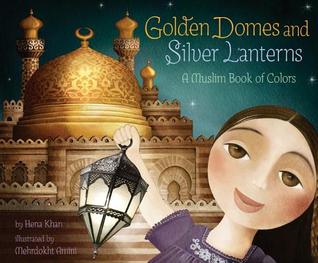
As a librarian I do a few story time sessions a week, so I will include the Islamic themed books that the students and I particularly love. Golden Domes and Silver Lanterns: A Muslim Book of Colors by Hena Khan, is currently at the top of the list.  The pictures are beautiful and engaging, the text is simple and poetic, and the fact that the students first saw the book at the Scholastic Book Fair, made it all the more appealing.  For such youngsters to see themselves, their religion, their culture, so simply and beautifully presented elicits smiles from even the youngest story time listener.  Recently the intermediate Language Arts teacher even borrowed it to review adjectives, and the students loved it.  From orange henna, to black ink writing Allah, the book presents, eid, hijab, prayer rugs, mosques, and love.  An absolute must on any book shelf, you won’t regret it.

To see some pages from the book online:

http://www.books4yourkids.com/2012/09/golden-domes-and-silver-lanterns-muslim.html

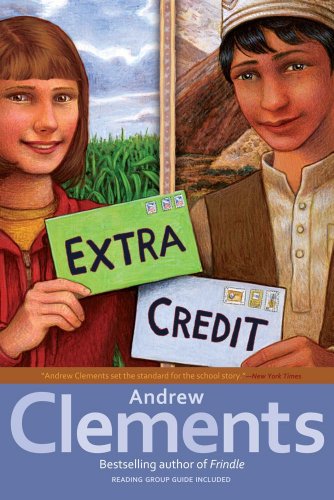
Extra Credit by Andrew Clements

Standard
Extra Credit by Andrew Clements

ImageHaving seen this book a million times, I never paid close enough attention to realize that the boy on the cover is an Afghani boy and that half of the story is told from an American girl’s perspective and half from young Sadeed.  My trusted librarian friend advised that the book is best taught through a discussion on what rules exist in Islam regarding gender roles, and why they exist.  And after reading it, I quite agree.  The story is very straight forward and predictable, and I really doubt most kids would find this to be Clements best work, however, I think if the students could be directed to critically evaluate WHY Sadeed’s community doesn’t want him communicating directly with American Abby, they might realize more about their parents own rules and reasoning, and be able to talk about them objectively.  The book is 183 pages and an Accelerated Reader Level 5.3.

SYNOPSIS:

Sixth grader Abby is in danger of being held back if she doesn’t keep up on her homework and do extra credit.  The extra credit assignment is to do a pen-pal project with a student in Afghanistan, unfortunately Sadeed, is the most qualified, but the village elders don’t think it appropriate for a girl and a boy to communicate.  As a result, Sadeed’s younger sister, Amira,  is selected to write back to Abby with Sadeed’s help.  Sadeed is annoyed by the process and begins writing to Abby independently, until events force him to reconsider.  The book is meant to show how people are universally the same, even when they seem so different.  Abby loves to rock climb and doesn’t like school, Sadeed loves school and has never thought to climb a mountain. Through their letters they realize they have more in common than originally thought.

WHY I LIKE IT:

The book discusses the Taliban and how fortunate Amira is to attend school.  It talks about Afghan culture in a fair light, and doesn’t paint all in Sadeed’s village with one stroke.  His parents, the village elders, the principal, all are seen as different individuals, with different thoughts and in a positive light.  If anything Abby’s world is seen as more bland and presented with a broad stroke of uncaring characters.  Sadeed and his family practice Islam and it shapes their moral conduct as well as their every day lives.  Islam is not what the book is about, but it does define the characters and their environment.  I like that it is age appropriate in dealing with complex topics of gender roles, and societal customs, I think our students can relate to both Abby and Sadeed (and even Amira), however I think that the characters would soon be forgotten.  While the book has a lot going for it, it seems to come up a little short.  If I do this as a book club discussion I would keep it 4th through 6th graders, I think the older students would be bored by it.  I think that the discussion would be more fruitful than the book alone.  InshaAllah, if one can get through the tediousness of, if Abby will get to go to seventh grade, and reach the top of the rock wall, there is a sweet story of building bridges and trying to see the world from other people’s perspectives; as well as opening the door to understanding why religiously and culturally our parents set up the boundaries that they do.

FLAGS:

The younger sister teases her older brother that he has a crush on her pen pal, and one could argue either way that he does, but, it is clean in terms of language, violence, and anything clearly objectionable.

TOOLS FOR LEADING THE DISCUSSION:

The discussion guide is found in the back of some editions, if not you can see it here:

http://books.simonandschuster.com/Extra-Credit/Andrew-Clements/9781416949312/reading_group_guide