Category Archives: Kg-2nd

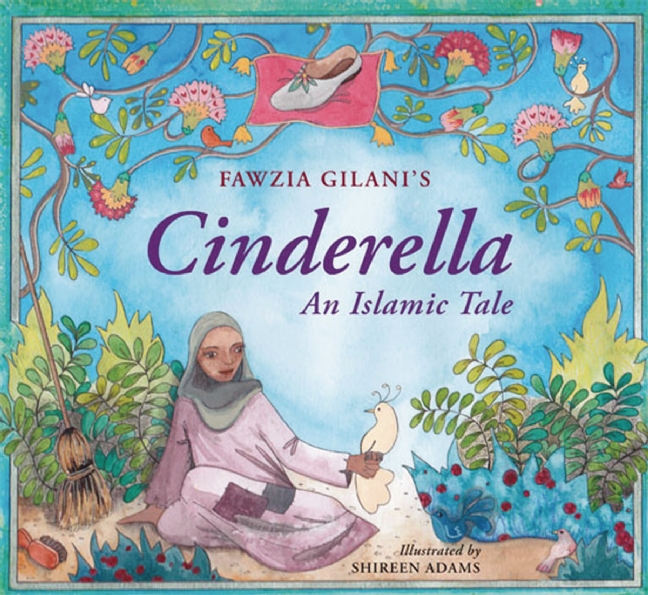
Cinderella: An Islamic Tale by Fawzia Gilani illustrated by Shireen Adams

Standard

cinderella

I’ve seen this book countless times online and honestly have never given it a second glance.  I mean Cinderella is a classic fairytale and I have a few different versions from around the world, but an Islamic one? It seemed like it would be awkward or overly preachy and forced.  I should have given Fawzia Gilani’s version a chance though, she has surprised me with her other re-tellings of Eid Kareem Ameer Saab and Nabeel’s New Pants. And, mashaAllah, to her credit she manages to weave a decent story full of Islamic tenants, void of magic, and more feminist than the Disney or Grimm versions.

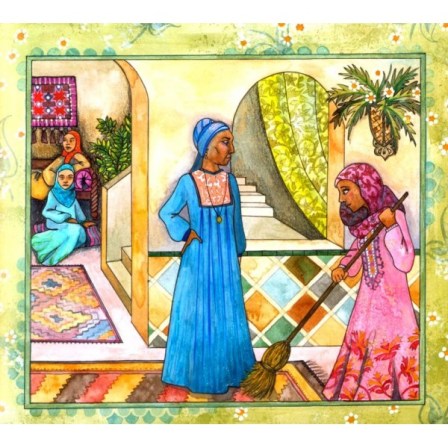
I’m not going to summarize such a familiar tale, but I will point out major twists.  Zahra is a practicing Muslim who is very devout in her prayers, fasting, and reading of the Quran. Her step-sisters nickname her Cinderella after some cinders from the fire burn holes in her clothes.  A bit of a stretch, from Zahra, but I think even the youngest readers will know the original Cinderella story and be ok with it.

cinderella3.jpg

Cinderella is constantly remembering to be patient despite the treatment of her step family through various duaas, ayats in the quran, and fasting on the day of Arafah.  When an invitation to an Eid Party at the palace comes, she naturally is forbidden from going unless she completes all her chores.  Luckily her Grandmother returns from Hajj with servants to help clean the house and a new abaya to wear to the party.  At the palace the women and men are in different rooms, but Cinderella catches the King, the Queen, and Prince Bilal’s attention when passing in the hallway for being in full hijab.  She continues to impress the Queen, when she remains quiet during the athan, prays in jammat, and shows grace in her manners and speech. After winning over the mom, the slipper and happily ever after follow the traditional script, however, like the story of Yusuf (as) and how he forgives his brothers, Zahra forgives her step-family as well.

cinderella-text

The 41 page story is heavy on the text and is not AR.  I would imagine that it would be on a third grade level for Muslim children familiar with the vocabulary, and fourth grade for those that are not.  There is a glossary at the back, but not all of the Arabic words are included, and I’m not sure that the context would allow for them in some cases to be understood.  This book would be hard to do in a story time setting because of the length, at bedtime, however, the pictures are detailed and rich enough that one-on-one could hold a five or six year olds’ attention.

Overall the story doesn’t feel forced, and you’ll find your self smiling at some of the “islamicifaction” of the plot.  Most of it flows really well.  I love that it isn’t focused on her appearance alone.  I also like that she isn’t helplessly waiting to be saved or alleviated from her burdens.  By and large it doesn’t feel like a love story, Prince Bilal is pretty much a minor story point.  The book works for Muslims and non-Muslims alike.  It isn’t preachy, but it definitely is strong in it’s moral messages. I think non Muslims will find the Islamic version just as fun as the hundreds of other “twists” on Cinderella and Muslim children will love to see someone like them living happily ever after as well, inshaAllah.


Tales of Nasreddin Hodja: The Parrot and the Turkey prepared by Gamze Alici illustrated by Sinem Zengincelebi

Standard

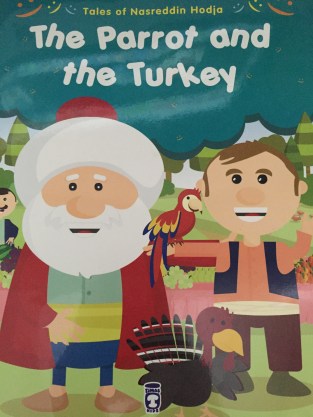
img_2803I ordered this book a while ago online.  There is a whole series of Nasreddin Hodja, so I picked a title at random.  I read it when it arrived and the story seemed to wander more than my attention span could follow.  So naturally,  I had my children read it, and they said it seemed funny, but they didn’t understand it.  I glanced through it again and figured maybe it was one of those beloved cultural characters that just lost some of their charm in translation.  In this case, Nasreddin Hodja is a folktale type character born in the 13th century from Konya, Turkey, who is the star of short stories that teach a point in a silly way.  The opening page tells a bit about him and what you can hope to learn in the story, but it didn’t help understand why the book was so fragmented.

nasreddin-hodja

In my latest move, I found the book again, read it again, and was stumped again. But luckily this time I contacted a Turkish friend instead of putting it back on the shelf and realized this book does not do Nasreddin Hodja justice, he is a hoot.  The book, not so much.

So first, a review of the book.  The book is beautiful and fun to look at.  The colorful glossy pages and clear font invite readers between ages 6-9 to read it and younger kids to have the story read to them.  The illustrations are delightful and after hearing about Nasreddin Hodja I think they convey his silly, yet wise persona.

Unfortunately the story is long.  At 32 pages with a fair amount of text on each page the author seems to try and take three tales and connect them into one coherent story.  The result is an abundance of detail that doesn’t move the story to his poignant conclusion and instead results in unresolved tangents.  For example in the first part of the story, he goes to the market to buy a few things for an alfresco breakfast with his wife.  Along the way he stops at a fountain to drink some water, he then begins shopping and after listing off dozens of vegetables and fruits, and details how he buys each item and what season they come from, he gets to his commentary of how silly a man selling a parrot for a ton of money is.  He then returns home to get his turkey to make the point to the parrot vendor that if he is asking 50 pieces of silver for a parrot that can talk, he will sell his turkey who can think for 100 pieces of silver.

This story covers about 17 pages of the book, but the same tale as told on the website http://www.readliterature.com/hodjastories.htm is only a few short sentences.

Parrot

One day The Hodja was walking around in the market place. He saw a bright-coloured bird for sale for 12 gold coins. Hodja was amazed. He approached the crowd gathered around the bird and its seller.

How can a bird be so expensive?’ he asked the people watching the bird.

This is a special bird,’ they explained, `it can talk like a human being!’

This gave Hodja an idea. He went straight to his home, grabbed his turkey and brought him to the market place. He stood near the man selling the parrot.

Turkey, for sale, ten gold coins!’ he yelled.

Hodja Effendi, how can a turkey be worth ten gold coins?’ the shoppers protested.

There is a bird there for 12 gold.’ insisted the adamant Hodja.

But Hodja Effendi, that bird can talk like a human being.’ the people tried to reason. But Hodja was unbending.

And this turkey can think like a human being.’ he countered.

Obviously I can understand what the writer was trying to do. But, unfortunately it doesn’t work.  Mina Javaherbin did something similar when retelling Rumi’s poems in children’s book form, but she had better luck.  Perhaps if the author would have kept them shorter and not embellished them to teach so many lessons about vocabulary and seasons and colors it would have actually had a begining, middle and end.  Early readers will find the pages over bearing and fluid readers will see the holes in the narrative.  Perhaps if each story were only a few pages there would have been a plot and take-away-lesson. Unfortunately as written Hodja’s message gets lost and the reader takes very little if anything away from the book.

When you research some of Nasreddin Hodja’s stories they are fun, and it becomes easy to see why children (according to my friend) dress up as him in school and he is quoted and referenced so widely and lovingly.  His stories work well in an oral tradition, obviously, and if you follow my mother’s advice (a preschool teacher for a few dozen years) and “tell” a story to little kids instead of “read” it, this book can get some use.  In story time with 3 to 5 year olds showing the pictures and talking about what is going on, on each page before winding around to the point allows them to to interact with the pictures and story and the reader to impart some of this beloved characters insight on to the audience.

hodja-set

One Hundred Ice Creams by Sumayyah Hussein illustrated by Derry Maulana

Standard

one-hundred-ice-creams

This book on my first reading reminded me a lot of Amira’s Totally Chocolate World in that it takes a religious idea, in this case Jannah or heaven, and uses a child’s excitement for a favorite food to explore it.  Not a bad technique, and alhumdulillah the author was able to stay on the idea of heaven and add some additional information then just the silliness of having all the ice cream you could imagine.  The book is 36 pages and can probably be read by a first or second grader independently and appeal to story time ages of preschool 4 and up.  The book unfortunately takes a while to get going. I struggled with the first few pages, which I found really wordy, and puzzling.  The kids seem to be about 6 years old in the illustrations and in their mannerisms, but they start off the book complaining about homework and needing a break from it, which even my own children found confusing and remarked on it.  There also seems to be some unnecessary description too, in setting the stage: the day, the vehicle, the season, that it’s their favorite park, that they haven’t been there in a while, that they took a breath of fresh air, that they waited 10 minutes, etc..

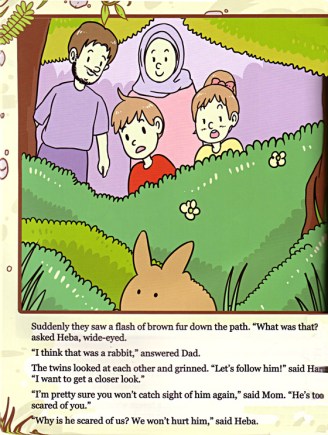
Thankfully I think once the reader’s get that the park is crowded, that the kids couldn’t enjoy the swings and slide and decide to explore the nearby woods, the story finds its rhythm and engages the reader quite well.  A few minor hiccups throughout the book are again, the abundance of details that don’t further the story and aren’t developed. The river is described when they cross the bridge, and then there is another one, or possibly the same one, as this one is now rushing, and it jars the story as there seems to be a lot of rivers in this park.   There is also a rabbit that pops up and excites the kids and then shows up at the end again, which is cute and brings the story to a happy close, but I don’t really love how the parents dismissed it.  Why not let the kids see that he is scared of them and figure out that he doesn’t know they won’t hurt him/her,  rather than have mom tell them they won’t see him again and dad quickly steering them in another direction. Granted this is my personal preference, but I like when kids figure stuff out in books and solve things themselves, rather than how perhaps it is in real life, with mom and dad constantly calling the shots.ice-creams1I really like how when discussing Jannah, they talk about the rivers of milk and honey, and I absolutely loved how they talk about Grandpa (hopefully) being in Jannah and being young and strong.  I couldn’t figure out why when in the woods and marveling at nature the characters didn’t use Islamic expressions like, mashaAllah, subhanAllah, and inshaAllah, and when I read it aloud I had to add them when we got to the pages about Grandpa.  It seemed awkward not too.  The book is clearly for Muslim children, there is a reference page in the back with the ayats from the Quran and hadeeth that tell us about Paradise, and the characters are discussing an Islamic concept, so I’m not sure why their language isn’t reflective of that.ice-creams-2
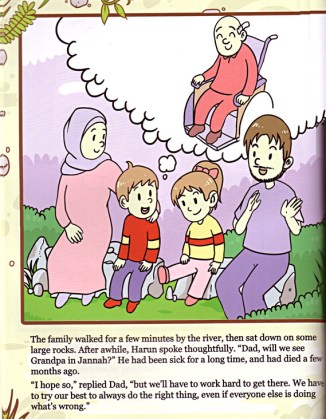
The illustrations are simple and colorful and complimentary to the story.  I don’t know why the color of the character’s skin is yellowish green.  It seems to match the ice cream and on some pages seemed more noticeable then others.  Dad’s face when he is swatting the fly is a little angry and the color of the skin makes him look mean.  Not sure why the flies are mentioned. And the illustration is not reflective of his personality in the rest of the book.
cream.JPG

Overall the book has a good message, I think I have just loved all the books at Ruqaya’s Bookshelf so much, that my expectations may have been a little too high.  I’ve never written a book and I have no idea what the publishing process for this book was, but I feel like a a few minor adjustments from an editor or proofer would have made this book absolutely phenomenal.  That is not to say it isn’t a good book,  children undoubtedly, will get a tangible understanding of Jannah after reading the story.  An additional plus is that it is on their level in both content and in perspective, meaning that there is lots to chat about after.  Concepts that the children can discuss based on what they understood from the story with little prodding from an adult.  Points from how the kids are treated at the playground, to adding what they would want they are in Jannah, and ultimately steps we can take to increase our chances of getting there, inshaAllah.

Laila and Pesto the Fly by Rania Marwan illustrated by Fatima Asheala Moore Jewel Series Story #1 Cheating

Standard

laila-and-pesto-the-fly

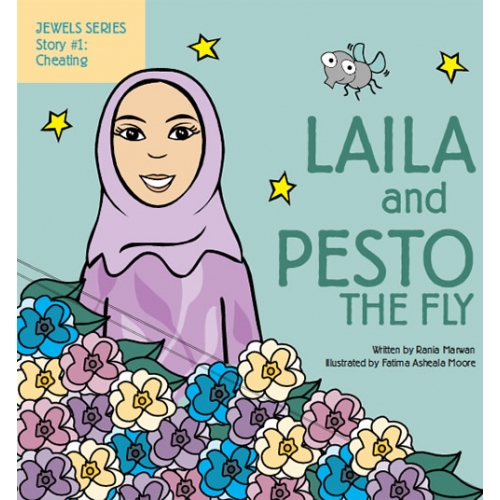
I ordered this book with the hopes that it would be the first book of a wonderful series teaching values in an Islamic context.   It says that it is book #1 in the Jewels Series and it focuses on cheating.  However, the book was published in 2009 and I can’t find any other books in the series.  Sadly, I can possibly see why.  The book is not great.  The illustrations make it so tempting even if all the girls are gorgeous and the illustrations simple, they would seemingly work well with a book aimed at 4 to 8 year olds, and just 24 pages long.

laila1

Unfortunately the text is lacking and doesn’t create a story worth reading more than once. The sentences are repetitive. And the same words are used over and over.  The first page alone says the word “play” four times in three sentences.  It is about 4th grade girls that play, watch cartoons and essentially hold lessons/ book clubs for each other once a week.  A lot going on for a book that on the second page says the word “flies” three times in three sentences.  Needless to say the repetition makes it hard for a story time selection, and the run on sentences hard for young readers.  The first page features a font that is probably about a size 20 and the next page it drops down to one that is about 11, the third page is about a 14 and the trend of the ever-changing font size continues throughout the book.

laila-text

Example of repetitiveness from Laila and Pesto the Fly

The story idea is a good one at its core.  A girl teaches her friends about flies.  Then the fly talks about Laila and how she is kind and honest. Then the next sections returns to Laila not being ready for a math test and she is tempted to cheat when Pesto, the fly, distracts her and writes a message for her in glitter.  I’m not sure how the glitter stays on the page, but, the message is received by Laila and emphasized by the author sharing a hadith, “He that deceives us is not one of us.” The last page of the book is a bulleted list emphasizing the harms of cheating, and how to overcome the temptation as the girls urge you to join their Cheat Deceit Foundation.

Overall, the book is awkward and doesn’t work for me.  There are a lot of better books out there.  That being said, if the author wrote another book, I may give her another chance, it isn’t hopeless. It just needs some tweaks. The fly is a silly likeable character, but the group of friends are a monolith and have no individual roles.  The message is clear and important, and we need books like this, but alhumdulillah the standards have gone up, way up, and the writing quality isn’t where it needs to be to attract Muslim children or their parents.


Nusaiba and the 5th Grade Bullies by Asmaa Hussein illustrated by Zul Lee

Standard

Nusaiba.png

As someone who deals a lot with reading and comprehension, I really misread the description of this book and assumed erroneously that it was a chapter book targeting 5th graders.  Oops, alhumdulillah, my confusion and slight disappointment didn’t last long as I got swept up in Nusaiba’s spunky imagination and endearing personality.  The message of the book is powerful.  Not only does Nusaiba have to deal with bullies, but she has to wrangle with accepting herself, even if that means being different.

nuaiba2

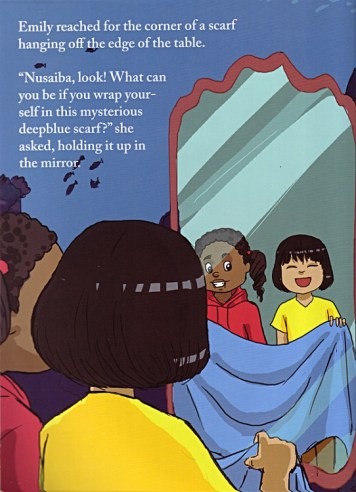
Nusaiba is almost to school when she overhears some 5th grade boys making fun of her mom and what she is wearing.  Nusaiba’s mom is wearing a hijab, and the story is set up to imply that that is what they find “weird.”  This morning encounter bothers Nusaiba all day, and while she doesn’t talk to her teacher about it when asked, she does spill the beans to her best friend Emily.  The next day Nusaiba distances herself from her mom and asks to walk to the school gate alone.  The bullies don’t say anything, but Nusaiba feels guilty about leaving her mom like that. Later that day when Mom picks Nusaiba and Emily up from soccer they swing by a local hijab shop for some clothes shopping.  I don’t know why, but I found the premise for taking the girls clothes shopping a little forced.  It seemed too words of a setup, and I couldn’t help but wonder why Emily would be dragged along.  As mom tries on skirts for work, the girls in their boredom get swept up in using the scarves as costumes and transforming themselves from queens, to underwater divers, to fisherwomen, to mountain climbers, to fantastic cleaners ready to clean up all the scarves on the display.  Her mom lets her pick one to buy, and she decides to wear it to school the next day.  It is noteworthy that Emily doesn’t try on any of the scarves.  She is an amazingly supportive friend, and even in make-believe is right there with Nusaiba, but she doesn’t put one on, and I kind of want to know the author’s reasoning or purpose as to why.  So the next day at school, Nusaiba asks her mom to again walk with her, and when the 5th grade boys call her mom an “odd-ball.” Nusaiba finds her courage to confront them.  Nusaiba and the reader discover the boys are making fun of Nusaiba’s mom, but it isn’t for her hijab.  Nusaiba and her mom set the boys straight and giggle in the process, as Nusaiba realizes she can be anything she dreams.

nusaiba1

The book is 44 pages and probably about a second grade mid year reading level.  The pictures are big and bold and beautiful making it a great option for story time to ages 4 and up.  The pictures do an amazing job complementing the story and going back through to look at them after the “twist” at the end was even more delightful.  The illustrator draws you into Nusaiba’s world and you really do cheer her on when she stands up for herself. The book easily lends itself to discussion, and there is also a question guide at the end, incase you get stumped. It reads more like a school assignment, but it could obviously be re-worded to engage a child at bedtime or in a read-a-loud environment.  The font is a nice size, however, I found it distracting. On some pages it is white on others black, on some it has a shadow and on others it does not.  I’m certain most people would not notice, but for some reason it was jarring to me.  Alhumdulillah, alhumdulillah, if that is the only negative in a book, I think everyone who reads it will be glad to have a copy of their own to read again and again and again and again and….


King For A Day by Rukhsana Khan illustrated by Christiane Krome

Standard

King-for-a-Day1.jpg

Its time for Basant, the Lahore, Pakistan kite flying festival, and Malik and his siblings are ready.  Ready to launch Falcon into the sky, ready to set other kites free, and ready to put the bully next door in his place.  While some kids have huge kites, and some have many, Malik has just Falcon, a speedy little kite that Malik prays can get the job done.

King for a day inside

Once again Rukhsana Khan does a remarkable job of taking a universal theme, adding some culture, and finding artists to empower minorities without making it an issue, all in a 32 page children’s book.  Written on an AR level of third grade ninth month, readers see characters handling a bully by beating him “on the court” so to speak, a character having confidence in his abilities, yet still asking Allah swt for help, and a boy in a wheel chair celebrating a fun spring time festival with his family.

king 1

The illustrations are rich with texture and angles, which contrasts the font and text presentation.  Little kids probably won’t be tempted to pick this book up, but as a read-a-loud first and second graders will enjoy the story and the kite flying action.  Third and fourth graders will enjoy reading the book independently, and find themselves cheering for Malik, appreciating his kindness, and wanting to pick up a kite and head out themselves.  The author includes a note at the back which provides more information about Basant and how it is celebrated.  Although it takes place in Pakistan and is a festival not celebrated in America, there isn’t a “foreign” feeling to the book, as kids can relate to bullies, wanting to be the best and the satisfaction of succeeding and feeling like a “king for a day.”

king2

Nadia’s Hands by Karen English illustrated by Jonathon Weiner

Standard

nadia's hands.jpegNadia’s aunt is getting married and she gets to be the flower girl in the Pakistani-American wedding.  She also will get mehndi put on her hands for the big event.  Her cousins warn her that she might mess up and even in the midst of her excitement she begins to worry what the kids at school will say when they see her hands on Monday.  As her aunt prepares the mehndi and the application process begins, various uncles peek in on her and her aunt gifts her a beautiful ring.  The mehndi has to sit on the skin for a while to set and as Nadia practices sabr, patience, I couldn’t help but think something seemed off in the story.  I’ve been at, in, and around a lot of Pakistani and Pakistani-American weddings, and this story didn’t seem to reflect the tone of such occasions.  The book doesn’t reflect the hustle and bustle and near chaos, it doesn’t sound like the tinkle of jewelry and laughter as the women sit around chatting and getting mehndi put on together, the pots on the stove are referenced but not described so that the reader can smell the sauces thickening and hear the pans crashing and taste the deep rich flavors.  It is lonely.  Nadia is lonely and filled with anxiety about Monday.  Durring the wedding she is walking down the aisle and suddenly freezes when she looks down and doesn’t recognize her hands.  Her cousins seem to show unsupportive “I-told-you-so” expressions as she searches for some comforting encouragement to continue on.  When she finishes her flower girl duties, her grandma asks if she understands why looking at her hands makes her feel like she is “looking at my past and future at the same time.” Nadia doesn’t understand and the author doesn’t explain.  At the end she is ready to embrace that her hands are in fact hers and that she will show her friends on Monday.  But the reader has no idea how it goes, or what exactly the significance of her painted hands are.  The book fails to give any insight or excitement for a culture bursting with tradition at a time of marriage.
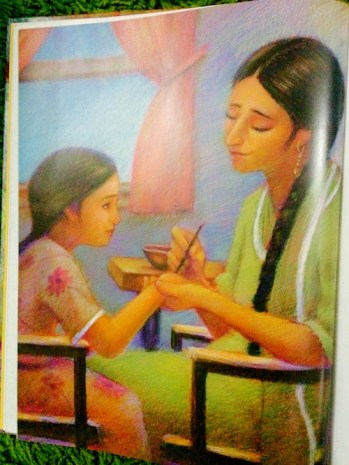
 nadia's hands inside

There is a glossary at the beginning for the few Urdu words sprinkled in the book.  There is no further explanation however, of  mehndi, or weddings, of the brides clothes etc.  The illustrations are adequate, but because the text doesn’t offer much warmth or vibrance, they seem a little drab, and raise more questions about what some of the traditional items depicted are.  The book is a standard 32 page picture book and is written on an AR 3.8 level, which I think is a little high.  Granted my children are familiar with mehndi, but my first grader read it to me with little assistance.  There isn’t any mention of Islam and could probably be argued that the story reflects any wedding from the subcontinent background performed in the west.  The bride has a duputta on her head in the picture, but that is neither here nor there, and no one in the audience appears religiously covered.  I would assume they are Muslim because of the minor characters’ names: Omar, Saleha, Amina, Abdul Raheem.  Also, the word Sabr, an Arabic word, suggests that they are Muslim.  Plus they eat kabobs which the glossary defines as mincemeat, so probably not Hindu.  Overall the book is not, “bad” or “wrong,” I just wish there were more to it.


Snow in Jerusalem by Deborah da Costa illustrated by Cornelius Van Wright & Ying-Hwa Hu

Standard

Snow in Jerusalem

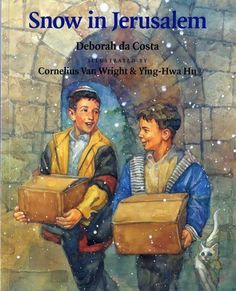
The world is always in need of kindness for animals and for one another, so when I saw this book written in 2001 about two boys who live in different quarters of Jerusalem coming together when they learn they are caring for the same stray cat, I was definitely excited to dive in.

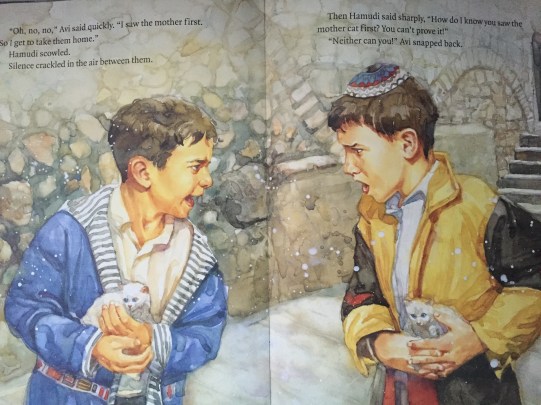
The book starts with a Jewish boy, Avi, caring for a fluffy white stray cat and his mom teasing him for caring for him.  He begins to wonder where the cat goes and resolves next time he comes around to follow him.  The reader then sees the cat journey through a market place and have the exact same interaction with Hamudi, a Muslim boy.  Both boys go days without seeing their beloved cat and when they begin to look for her, they find each other.  The boys fight over her as it begins to snow and the cat takes them to see where she has been, with her new kittens.

Again the boys fight and ultimately resolve to divide up the kittens to care for them and let the mama cat go back and forth to feed them.  Needless to say, I was a little let down by the book, I had hoped the boys would bond or see how similar they are. Instead they simply work out a solution for this one situation.  I can’t help but thinking the kitty family getting broken up and the poor mom having to go back in forth is rather selfish on the boys behalf.

IMG_0326

The book is 32 pages and written on an AR level 3.1.  Third grade and up can probably understand the similarities of the boys and how they come together to care for the cat and appreciate it with a simplistic understanding of Jerusalem’s complexities. Kindergarten and 1st graders could probably handle it as a story time selection, and understand working together to help a cat.  I’m sure fifth graders and up however, will be a little concerned for the mama cat and disappointed in the boys at a lost opportunity to provide hope in a troubled region.

There is an Author’s note and Glossary of Arabic and Hebrew words at the end, and a simple, yet valuable map of the Old City at the beginning.


Max Celebrates Ramadan by Adria F. Worsham illustrated b y Mernie Gallagher-Cole

Standard

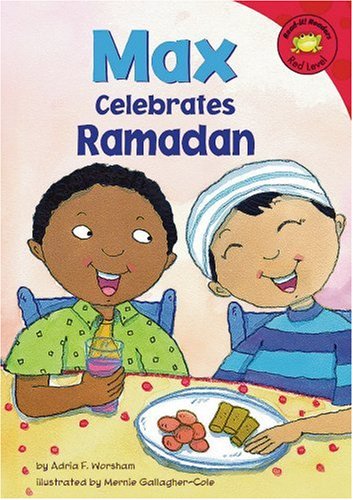
Max Celebrates Ramadan

Max is a character in a series of leveled readers that explores familiar topics to build reading confidence (Max Goes to the Doctor, Max Goes to School, etc.), and introduces new ideas as the reader’s skills build (Max Celebrates Cinco de Mayo, Max Learns Sign Language, etc.).  I love that Ramadan was included and this 24 page AR 2.0 book is spot on, in what a new reader can handle without getting frustrated or bored in terms of content, and ability.

max

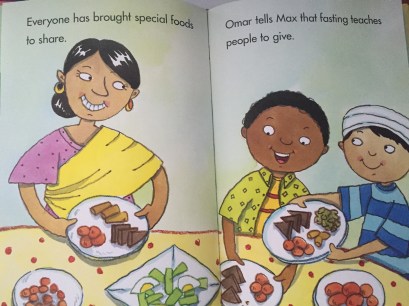
Max goes to his friend Omar’s house to celebrate Ramadan.  He learns a little about the month, what the Quran is and about Eid al Fitr too.  The foreign words are explained in the text and there is no explanation of belief or doctrine.  There are just simplified, age appropriate, descriptions of what a Muslim does and what you might see during Ramadan.  Very level appropriate for Muslim and non Muslim children.  Omar’s family is inviting and kind, and the illustrations show them to probably be of Indian decent as the mother and other females are wearing saris.  None of the women cover, but the males all wear kufis.max1

The book doesn’t stand out in any way, but most leveled readers, in my opinion, don’t.  If you have young readers check and see if your library has the book, the kids will enjoy it.  It works ok in small groups, but not for story time so well, as it is rather repetitive in a dry, not predictive way.  If you are a kindergarten through 3rd grade teacher, I think this book would be a great addition to your book shelf, as well as the others in the series as a way to learn about other people in an independent way.  My son going in to first grade read it by himself fluently and enjoyed the pictures.  Someone new to the concept of Ramadan, i think, would also be able to grasp the concepts without much outside help.