The Grand Mosque of Paris: A Story of How Muslims Rescued Jews During the Holocaust by Karen Gray Ruelle and Deborah Durland Desaix

Standard

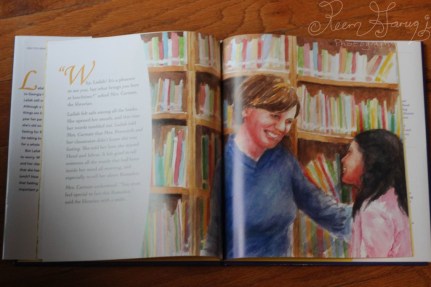
The Grand Mosque of ParisThis beautiful, beautiful book tells of a little and sparsely known event in history.  During the holocaust The Grand Mosque of Paris served as a place of refuge for many North African Jews.  Many who passed through the vast gardens and beautiful Mosque were given fake documents of conversion, tombstones with their family names inscribed, and access to truly underground passageways (subterranean mazes), as the Muslims of Paris offered assistance to keep their Jewish brother’s and sister’s safe from the Nazi regime. Many of the stories were recently uncovered and with the passage of time, so much of the information has been lost.  As a result the book is a bit choppy, each page tells what is known about the Muslims’ assistance in some capacity, but does not flow to the next page.  So there are generalized recountings of children being hidden with other families, the efforts of the Kabyle Ressistance (Berbers from Algeria) to smuggle Jews to safety, etc.. There are also a few specific examples of Salim Halali, a young Berber Jew from Algeria, two friends one a Muslim the other a Jew seeking shelter, a Tunisian Jew who stayed at the Mosque for over two years,and a few others, but with the exception of the use of the Grand Mosque and a Doctor Ahmed Somia very little flows throughout the book.  Thus making it more of a historical account than a story.

Truly the book would not work for story time, it is geared for children (and adults) ages 12 and up,  it has an AR level of 7.1.  I would imagine it would be an amazing addition to any class studying World War II and finding the humanity offered in one of the bleakest times of our world.  It should, in my opinion, be standard required reading in Islamic School curriculum to supplement WWII study.  The hope and pride one feels when reading this book, shows how rich our faith’s are in coming together.  It would also work in understanding how history is lost, and the importance of perserving it.  There is an Afterword on page 34 that is very informative and interesting.  It is followed by a Glossary, Acknowledgements, References, Bibliography, Recommended Book and Films, and an Index.

The book also sparked my interest to know more about, not just how Muslim’s helped Jews during the Holocaust, but also how Muslims were treated in France.  The book says, “The Grand Mosque shimmered like a mirage, the white domes and the glittering mosaics of the minaret in stark contrast to the muted colors of Paris.  When the mosque was built in 1926, the North African countries of Algeria, Morocco, and Tunisia were under French rule, and many Muslims had come to Paris from those countries.  The land for the mosque was given by the French government, in exchange for a symbolic payment of one franc, to thank the half-million Muslim soldiers who had fought for France during the First World War.”

The Grand Mosque of Paris1.jpg

I have already read the book more then once, and gone back and read passages multiple times.  It is as fascinating as it is informative, and a great addition on any book shelf.


The Red Pencil by Andrea Davis Pinkney illustrated by Shane W. Evans

Standard

The Red Pencil.jpg

I didn’t realize the book was written in prose until I opened it up to read, and immediately taken-aback I rechecked the AR level and sure enough, this 309 page book that is written in prose and covers the genocide in Darfur, is written on a 4.2 level. And it is amazing. I forced myself to stop reading at one point so as to not rush the depth and soul of the simple words from being lost in haste.  It is truly, in my opinion, a beautifully remarkable feat to convey such horrific atrocities with such hope and integrity to young adults in a palatable and inspiring way.

“Allah is the light,” he says.

I ask,

“How do you find Allah’s light?”

Old Anwar says,

“Take the path that shines the brightest.”

SUMMARY:

Amira’s life on her family’s farm is by no means easy, but she has loving parents, a little sister, her beloved sheep, and a dream of going to school.  Her father advocates for her, but her mother, steeped in tradition, sees education only as a waste of time.  The illustrations and sparse words manage to convey fairly solid understanding of Amira’s life, optimism, and relationships with those closest to her.  Although warned of the dangers the Janjaweed could cause, Amira remains fairly unconcerned about the mounting political unrest around her, until it is too late.  When death and the destruction of her home force the surviving members of her family and neighbors to seek refuge in a camp many miles away, the reader sees how truly horrific her experiences have been.  She refuses to speak or rather cannot, when a chance encounter with an aid worker brings her the prospect of getting her voice back, through the empowerment of a red pencil.  With restored determination she convinces an elder neighbor to teach her, but it is not enough for Amira Bright.  Her sparrow needs to soar free.

WHY I LIKE IT:

You expect a book written in verse to have a lot of imagery and symbolism, and The Red Pencil does a good job of balancing the story and the description, to keep the book on track.  The linear story line remains focused on telling the story at hand, making it attainable for elementary and middle school children.  The Darfur conflict is complicated at best, and using verse to convey it from a young girl’s voice allows a lot of the politics and dirtiness of war to be side-stepped without dismissing it.  Amira’s optimism and hope is at times naive, but more as a reflection of her personality then out of ignorance. She sees things, and feels things, and must deal with things, no child should, but her spirit shines through and keeps the book from being depressing, while still being sad.

Today the red pencil does more

than beg for my hand.

It makes me a promise.

It tells me to try.

The characters are Muslim and they rely on Allah, and pray, yet Amira’s thirst for knowledge includes that of learning the Koran (Qur’an) as that knowledge too, has not been readily available to her  There is a lot to discuss in the book, both what is written and what the reader brings to it.  I look forward to teaching the book, and re-reading it once again to savor in the rich images.

Here,

Muma stoops.

Here,

she has nothing to reach for.

FLAGS:

Their is violence when the Janjaweed attack her family.  But I think it is conveyed in a manner suitable for 3rd grade and up.  It is not celebrated or glorified, it is traumatic and has repercussions that are respectfully conveyed.  There is also mention of a child bride, but not in so many words, that in all honesty I doubt most young readers will be as bothered by it as perhaps they should.

TOOLS FOR LEADING THE DISCUSSION:

There is a discussion guide in the back of the book along with an Author’s Note, Acknowledgements, Glossary/Pronunciation Guide, Character/Location Pronunciations, and Important Terms that Appear in the Book.

An Educators Guide: http://media.hdp.hbgusa.com/titles/assets/reading_group_guide/9780316247801/EG_9780316247801.pdf

A study guide and quiz: http://www.bookrags.com/studyguide-the-red-pencil/free-quiz.html#gsc.tab=0

The Red Pencil 1

Ibrahim’s Search by Qasim Najar illustrated by Patricia Meehan

Standard

Ibrahim's Search

What a surprisingly insightful book, mashaAllah.  The pictures look like they are done with crayons and colored pencils, and the type set is completely uninviting.  The text  is a bit too wordy, yet somehow it does a decent job overall of conveying how a child might understand Allah (swt) in a logical, critically thinking manner.  The book works well for four year old children to maybe about 2nd grade.  There are 40 pages and the story takes on a insightful repetitive pattern as young Ibrahim searches for Allah.

The book opens with a humorous nod to moms everywhere.  Ibrahim learns that Allah is the creator of everything and wants to see Allah.  His teacher says he can’t show him Allah, so Ibrahim goes to find someone who can, his mom.  Ummi tells him that we understand Allah swt through his creations all around us, but Ibrahim is not satisfied with her answer either.  And because Muslims are encouraged to ask questions and seek knowledge, Ummi allows Ibrahim to go search for Allah so that he might thank him.

Ibrahim sees a mountain, and thinks perhaps something so big and strong is Allah, then he notices the stream running through the mountain and wonders if then the water is Allah.  When the water evaporates, he wonders if the sun is Allah, this goes on and on until he realizes that the one who made the world, holds it together, and keeps it in balance is Allah.  He also appreciates that his mother was right and goes home to tell her, Alhumdulillah.

This book goes well with Ilyas & Duck Search for Allah and Allah Created Everything if you are doing a story time, as they all convey the same information in different ways and appeal to the same audience more or less.


The Hijab Boutique by Michelle Khan

Standard

The Hijab Boutique

I was really hoping this book would help out the sparsely populated early chapter book section.  And it should, at just 52 pages with beautiful full page pencil style drawings, it just somehow seemed confused instead.  The content is much more young adult in story line, but because of the short length, the characters seem flat and underdeveloped.  My fourth grader read it in less than a half an hour. Yet, I don’t think a 1st or 2nd grader would get much out of the book.  I don’t know what kind of editing process the Islamic Foundation puts its books through, but back when I was a teacher, I would have told the student they have a wonderful, wonderful rough draft with so much potential, they just need to flesh it out and add more detail so the reader connects with the characters. The back of the  book suggests the book for ages 10 and up and content wise that is fine, but it also has a list price of $7.95 and for something that can be read in less than a half an hour, it seems a little steep. If it didn’t have so much potential, perhaps I wouldn’t be so bothered, I just feel like if she stretched it out to being 200 pages, it could be so powerful.

Farah is a fifth grader at an all girls art school.  She has a best friend, who’s mom is a soap opera star, but some popular girls still make  her nervous.  When her Social Studies teacher assigns the girls to bring in something representing her mother, she can’t find anything to share about her mother that she doesn’t think is boring.  Farah’s father passed away two years prior and with money tight, Farah’s mom is opening up a Hijab Boutique.  No real details are given about her family life with her father or the impact his death had on her, which is unfortunate.  The story discusses why the mom started wearing hijab and why it is important, but makes it seem like Farah knows so little about her mother.  Again a hole that if explored would make the book that much more interesting. Not to mention that it could prod young girls to talk to their own mothers about such things.  To no one’s surprise Farah brings in some hijabs to represent her mother and Alhumdulillah the book ends on a positive note with little fanfare, catharsis or drama.

Farah and her mom are practicing Muslims who are an active part of their western community.  It would seem Farah is the only Muslim in her school and it doesn’t seem to be an issue.  They are all upper class and a bit snobbish, but there are no flags.  If your library has the book, reading it is by no means a waste of time.  I don’t know that you’d read it more than once if you purchased it, but 4th through 6th graders might enjoy the short read, and be inspired by fashionably fabulous hijabs while furthering their understanding about why Muslimah’s are required to cover.


How Big is Allah? Written and illustrated by Emma Apple

Standard

how big is Allah.jpg

I chose this book thinking it would be a good reference style book to have in the house for the kids to ponder over.  Being it is non fiction, the fact that the pictures are black and white didn’t immediately put me off.  Reading it however, did.  The book is technically 28 pages, but it feels and resembles a pamphlet more than a book.  The pages are thin, the illustrations mere doodles with the majority, outer space being black, and the “story” is really only about 19 pages.  At a cost of over $10 I felt a little shortchanged and really disappointed.

The concept is fabulous.  Using space to stretch the readers mind to understand how big Allah swt is, I get it, I appreciate it. But the book even in its sparsity seems disjointed to me.  It starts with asking what the smallest thing you can think of is:  an ant, a snow flake, a piece of sand? It then asks the reader to compare that to the biggest thing you can think of as a comparison.  From there it is pretty much a book about space, complete with an appendix in the back comparing various planets and the sun. Again all interesting facts, but not cohesive and not packaged well.

I tried reading it to a small group of 4 year old students, and it was a bit over their heads as written.  I was able to use it as a guideline to facilitate a discussion which went well, but as is, in all honesty will probably just be lost on the book shelf and forgotten.  It seems to be self published, and I can’t help but think that the book could be great.  Big glossy pictures, a few more pages, or even a more accurate price would help the book in my humble opinion.


Adam in Lost and Found by Zanib Mian illustrated by Maria M. Goncalves

Standard
Adam in Lost and Found by Zanib Mian illustrated by Maria M. Goncalves

Adam in Lost and Found

This book resembles kindergarten and 1st grade leveled readers in both appearance (shape and size) and appeal.  It very easily could have been a picture book, with its sparse words and simple linear story, but by making it a smaller size, with a variety of playful fonts, it really excites beginning readers who pick it up and are thrilled to see Muslim characters in an Islamic book on their level.  The book is 32 pages and has nice large age appropriate pictures that work very well, even when reading the book aloud to small groups.

adam 1

The  story explores the concept of “finders keepers losers weepers” in a fulfilling way.  Adam, a young boy on a train with his family, finds a toy train and desperately wants to keep it.  His father kindly explains to him the two options before him and lets him choose.  Adam, Alhumdulillah,  chooses to give the train to the lost and found man and earn Allah’s reward.  Later, Adam realizes after much searching and help from his family, that when he found the train, he left his toy airplane.  The moral is cemented in the readers, as they too hope, with Adam, that whomever found his plane, also did the right thing and gave it to the lost and found. By coming full circle the message is conveyed, and a happy ending is had by all.

The book takes place in Britain and is book two in the Adam series.adam 2


Zak and His Good Intentions by J. Samia Mair illustrated by Omar Burgess

Standard

Zak and his good intentions

Zak  and his sister Hana compete to do good deeds, but nothing goes as Zak intends.  Each time he sets off to help someone or do something kind, he is thwarted by something unexpected.  As frustration mounts with each failure, his mom steps in to reassure him that, “Prophet Muhammad (saw) said that whoever intends to do a good deed, but does not do it, still gets a good deed for his or her intention.” With his spirits restored Zak appreciates Allah’s mercy and accepts that even when we try and plan, it is Allah’s plan that ultimately prevails.

The beauty of the book is in its simple message that is reiterated four times and brought to life with simple straightforward text and detailed, but not overwhelming illustrations.  The book is written on about a second grade level and would appeal to ages 4 to about 8.  It has 32 pages and contains discussion points at the end.  The book is fun and funny and conveys a message and moral in a relevant non preachy way.  Young kids can definitely relate to the character’s desire to do good, disappointment when he fails, and comfort in knowing that Allah swt knows all and is the most just.

Overall a good book with a strong message that can be read more than once and referenced often in both the home and school setting.


The Turtle of Oman by Naomi Shihab Nye

Standard

The Turtle of Oman

This slow, aimless, subtle, quiet prose-like book, is unexpectedly charming and endearing, and so not like most every young adult book out there.   I truly want to make all 4th through 8th graders read it, absorb it and ruminate in the love shared between a nine-year-old boy, his grandfather, and their home.  The easy 299 pages flow by on a 4.6 reading level and make you long for a kind grandfather to help you see the amazing in the ordinary, and provide you with gentle strength when facing life changing events .  The Turtle of Oman has no climax and no conclusion, yet it offers hope and warmth in a reassuring manner that makes you feel better for having read it.

SUMMARY:

Aref is moving from Oman to Ann Arbor Michigan for three years while his parents pursue their education.  To say he is dreading the move is an understatement.  Lucky for him, and the reader, Aref’s grandfather Sidi, helps him create some memories to take with him to America.  While they spend time together, travel around the country, and talk, the reader is drawn into a world where Aref and Sidi, finish each other’s sentences, and blur the lines of fact and make believe with their stories.  Their love and ease with one another is so seamless that not only are they best friends, and relatives, but they are so intertwined the thought of their separation is heartbreaking.

“Aref kept thinking that no matter what you say, there is something more inside that you can’t say.  You talk around it in a circle, like stirring water with a stick, when ripples swirl out from the center.  You say something that isn’t quite right and that’s worse.  Then you want to say, sorry!  But no one knows what you mean.

He wished he could tell Sidi, you are the king of my heart forever, I don’t care who else I meet, I don’t care about traveling and new friends and different flavored yogurts, I only care about how nice you are and how much I cannot stand the thought of being far from you, ever, ever, ever.

But he could never say this.”

Sidi has passed his love of rocks on to Aref and each adventure involves Sidi slipping a rock to Aref as a token for him to remember their adventures and each other.  From exploring the beach, camping in the deserts, sleeping on the roof, and going out on a fishing boat, the duo relishes in the details of everyday life that make life worth living.  Along the way Aref keeps lists of interesting facts and the reader learns about animals, Oman, Michigan and so much more.  But no matter how much prodding and reassurance Sidi and Aref’s mom try and impart on him ,the book pivots around the inevitable need for Aref to pack his suitcase.  As much as packing a suitcase can be a climax or a conclusion, that is what the author gives, and the reader must be content to understand that like Aref’s beloved turtles, he will have to find his way to the ocean only to return once more to Oman.

WHY I LIKE IT:

I love that it meanders and cannot be rushed.  I love the cultural warmth and the emotional depth.  While the setting is Islamic, there is no religion mentioned other than the call to prayer heard in the market place.  Quiet books usually border on boring for young adult readers, but I feel like this one doesn’t.  I am leaning toward doing it for the Junior Book Club to see if it has the emotional appeal that I think it will.  The main character is scared and unsure about the big move, feelings many children have felt.  But his way of handling it, while childish and whiny in his stubbornness to pack, also offers nuanced hope.  Aref is allowed to work through his thoughts and feelings, and while some characters rush him, his time with Sidi doesn’t feel rushed and forced.  His time with Sidi is reassuring and patient, a fictional soft place for the scary unknown.

“Talking with Sidi felt like a sky of floating words,” Aref explains. “You could say anything.”

FLAGS:

None, the book is completely clean.

TOOLS FOR LEADING THE DISCUSSION:

Interview with the author:  http://www.hbook.com/2014/12/talks-with-roger/naomi-shihab-nye-talks-with-roger/#_

https://www.readingtokids.org/Books/BookView.php?pag=5&bookID=00001192


Ilyas & Duck Search for Allah by Omar S. Khawaj illustrated by Leo Antolini

Standard

Ilyas and Duck  Search for Allah

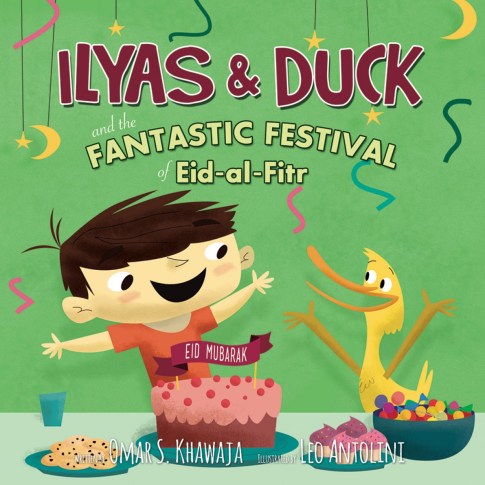
I might have squealed in delight after reading this book.  Alhumdulillah, since starting this blog I have found that there are indeed a lot of good quality children’s books out there, but this one, well it just does it all.

Ilyas & Duck Search for Allah is concise in words, but somehow successfully tackles the huge concept of understanding Allah (swt) through His creation in a powerful way.  And I think a big part of its power comes from its humor and silliness.  The book says it is for ages 3-6 on the inside cover, and I think that is spot on.  The dialogue between Ilyas and duck and the animals they meet on their adventure is written on a child’s level of understanding, and is silly, but not demeaning, and my favorite part is that Ilyas and Duck figure it out on their own.  There are no adults in the book telling them what Allah is or where Allah is, they ask the various animals they meet in the rain forest, underwater,  in the mountains, and come to their own understanding.  This progression makes the book pure gold at story time.  You can almost see the kids brains turning right along with the characters’ brains in the book and when they get it, forget asking them to wait to raise their hands to be called on and explain it, they are so gleefully excited they can’t contain their understanding.

The book starts with an ayah from the Quran and is not preachy or cultural.  There is a glossary of sorts at the end telling a little bit about the four animals they meet and each of the 39 pages are beautifully illustrated.  The dialogue and interactions remind me a lot of the show Justin Time, which is neither here nor there, but conveys my impression of the story’s tone.

ilyas and duck inside Whether you have students or children that are naturally curious and have asked where they can find Allah or not, this book is engaging and fun and one the kids want read to them over and over again, alhumdulillah.

Ms. Marvel No Normal & Generation Why by G. Willow Wilson illustrated byAdrian Alphona & Jacob Wyatt

Standard
Ms. Marvel No Normal & Generation Why by G. Willow Wilson illustrated byAdrian Alphona & Jacob Wyatt

I have to be completely honest these are the first comic books I’ve ever read from cover to cover.  So, while I’m in no position to review the art work, or historical role of the original Ms. Marvel or even have a valid opinion on the superhero story lines, I do want to cover the Islamic elements because even as someone as outside the comic book world as I am, I knew that Marvel’s new Ms. Marvel is a Pakistani-American Muslim girl from Jersey and that’s pretty big.

I was intimidated to read No Normal, I ordered it from Scholastic and have had it on my shelf for a while, I was excited, but nervous. But then I ordered the second one, which is also a collection of 5 comic books, and thought, let’s do this.  Both collections are easy reads, and the text and what to read first in each story frame is clear.  As with comics and graphic novels the pictures convey much of the story so there isn’t a lot of “explanation,” but the story is compelling enough, that even a novice like me didn’t get too hung up on what was going on and how it could be possible.   While it may tempt younger children, I would hold off until the reader is a teen, especially if the reader is Muslim.  There is a bit of drug use and alcohol in No Normal and obviously violence, but at it’s core it is a story of a girl trying to discover who she is and there is some angsty teenage stuff that someone who hasn’t gone through the emotions, might take as attacks on Islam, parents, and culture.

Kamala Khan is a high school student in Jersey City, New Jersey.  She has a Muslim friend, Nakia, who wears hijab, and non Muslim friends of both genders that seem to support her faith and culture, almost more than she does.  The story opens with her sniffing bacon and her friends humoring her oddness.  Having grown up with the same group of friends around her, they understand her quirks and nerdiness and she seems to fit in.  As with most teens though, she feels on the “outside” and Kamala right away tries to seem cool with the more popular crowd.  She  is struggling to find herself within her Pakistani culture, her American life, her Islamic beliefs and teenage friends, information all presented in the first few pages while at the local convenience store hangout.  A lot for Kamala to balance and she hasn’t even discovered her “powers” yet.

Kamala’s parents initially seem more “cultural” than religious as her father chastises Kamala’s brother Aamir for being too religious, yet is constantly on Kamala, presumably because she is a girl.  In a fit of defiance against her parents strict curfew, Kamala sneaks out of the house to attend a party, accidentally drinks alcohol (she spits it out) and gets caught in some “fog” that gives her morphing, stretching, embiggening, and quick healing powers.

As Kamala tests how her powers work, and what they mean, there are a few funny asides that appeal to Muslim readers: she attempts to use her Burkini as a base for her super hero disguise, and her mother threatens to send her to the Sheikh if she gets caught sneaking out again.  Her parents start to grow on you though, the mom is a very stereotypical immigrant mother who cares for her daughter in a worrying nagging way, the dad actually tries to communicate with Kamala and comes across a little more genuine toward the end of the first collection.  Her brother seems to be level headed, but a minor influence.  He sticks up for her and tries to help, but it doesn’t seem like they are that close.   The final scene in No Normal left a little bit of a bitter taste in my mouth and I was glad that I already had Generation Why to dive right into and not let the conclusion of the first one fester in my head.  Kamala shows up to a wedding late, complete in Shalwar Kameez (Pakistani clothing) and gets in an argument with her mom.  Kamala says, “You and Baba want me to be a perfect little Muslim Girl–straight A’s, med school, no boys, no booze, then some hand picked rich husband from Karachi and a billion babies.”  The mom says, “Your father and I want the best for our only daughter our expectations are high so that your successes will be many.”  It goes back and fourth then the mom says she is grounded and the book ends with Kamala retorting, “wanna bet…?”  While I’m sure most every Muslim American teen has felt this way, I don’t think I’d want my 9 year-old-daughter thinking that is how narrow success is defined, or that being the best you can be is a punishment. It’s probably a realistic gripe, but to have it be the last impression, naturally brought out my defensive instincts.

A lot of the awkwardness and stage setting in No Normal is resolved by Generation Why and I found I enjoyed it a lot more than I thought I would.  I might even be anxiously waiting to see what happens next.  Kamala is sent to the Sheikh and while she is intentionally vague about telling him what is going on with her, she does suffice it to say she is trying to help people and he responds by telling her to do it with as much honor and skill as she can. I love that he wasn’t putting her down, but rather trying to mentor her spiritually to find her self and do so honorably.  Really the only other religious/cultural scene is when Lockjaw a giant dog with transporting abilities shows up to help Kamala and her parents say he can stay, but outside because he isn’t clean.  I don’t know if non-Muslims will fully understand why, but it made me chuckle.  It also made me like her family a bit more.  They are strict, but not unreasonable.  They didn’t say, “no” they found a compromise.

Generation Why contains more action than back story.  I’m not entirely sure why Wolverine shows up, I have no idea who the lady in charge of stuff is with Captain America, and I’m not sure why no one finds it odd that the Inventor is a bird man, but hey it is fun.  And it definitely had me cheering on Ms. Marvel as she empowers her generation and learns that being American Muslim might be the easiest of her identity issues when she learns she is inhuman.  It gets a little cheesy, but the foundation of comic books being good against evil, lends itself to that right?

Overall, I think I would recommend both collections are read together, as it gives a better picture of what Ms. Marvel is and can be.  I think thus far the author has done a good job of showing that she is Muslim and that her faith adds depth to the character.  Her tenacity, persistence, determination, compassion for animals, her humor, her nerdiness, all make her very like-able and admirable.  I probably wouldn’t do it as a Book Club selection, because our school only goes to 8th grade and being an Islamic School I don’t know that most of the students feel the identity crisis until possibly much later if at all.  But I think the books would work well for discussion with older kids.  Topics of what youth can do, their role in preserving the planet, discovering your sense of self and purposes are all there in comic book, super hero, action packed form!

Kamala Khan