Lailah’s Lunchbox: A Ramadan Story by Reem Faruqi illustrated by Lea Lyon

Standard

Lailah's Lunchbox

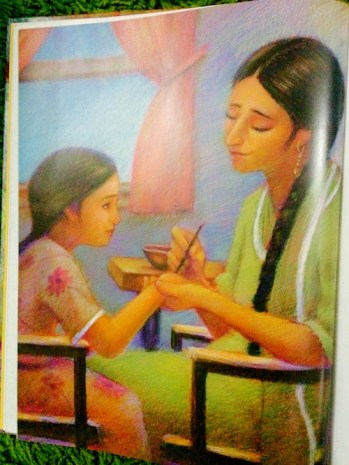
Another standout in a crowded field of Ramadan picture books, mashaAllah, Lailah’s Lunchbox works well even outside of Ramadan for Muslim and Muslim children alike.  In 32 pages, the reader gets to know Lailah and understand how hard it has been for her to move to America from Abu Dhabi, make new friends, how nerovus she is to be identified as different, as well as how excited she is that her mother has finally agreed to let her fast this Ramadan.

Lailah is excited to wake up and have sehri with her family before heading to her new school, fasting for the first time.  Her mother has written a note for her teacher, but on the bus, Lailah reads the note and suddenly worries if her teacher will even know what Ramadan is ,and decides not to give it to her teacher.  Lunchtime arrives, and when the teacher asks Lailah if she forgot her lunch, her voice fails her, and her classmates offer to share their lunch with her.  Lailah decides to leave the cafeteria and finds herself in the library spilling all her worries and stresses and fears to a kind librarian.  (Yes the librarian is the hero, and really no one should be surprised, right!?) With the librarian’s urging and Lailah’s determination, she writes a note to the teacher explaining that she is Muslim, and fasting, and even includes a poem.  She leaves the note on her teacher’s desk at the end of the day.  The following day, the teacher has written her back and the reader, along with Lailah, know that having courage and staying true to one’s self can often be scary, but also wonderful too.

lilah inside

While the story is billed a Ramadan Story, it really just is the back drop for a lot of really good messages.  I think 2nd and 3rd graders to early middle schoolers could really benefit from the book.  It is semi autobiographical and I think the authenticity of the emotion woven in, makes the book very relatable and powerful.  I plan to discuss it with my daughter going in to 5th grade, who is also a bit shy on occasion: the way Lailah worked out the problem, the way she found someone to trust and talk to that was patient with her, to point out to her that the kids in her class were very kind and that most of her fear and anxiety was with herself, not them.  I also really like the message that she was so excited to fast, and how her nerves took that excitement away, but having the courage to face her fear, brought back her happiness and enthusiasm.

The end of the book has an Author’s note, telling how the story came about and a bit more about Ramadan. It also tells the definition of Sehri and Iftar, the only two “foreign” words in the book.  I found it interesting that the word Sehri, an Urdu word, was used instead of Suhoor, if they are coming from Abu Dhabi, but perhaps the author is of subcontinent heritage.  The illustrations are colorful and realistic, complementing the story and tying in the range of emotions and events Lailah is experiencing.

I was pleasantly surprised at the book, and even more excited to see that it is available in the public library system.  Here is the link to the author’s blog I hope she plans to write more, as her style and message resonate with Muslim American kids, and their parents, alhumdulillah.


It’s Ramadan Curious George by Hena Khan illustrated by Mary O’Keefe Young

Standard

It' Ramadan Curious George

This highly anticipated book came with a lot of expectations and hope for many of us born and raised in America.  Alhumdulillah, Hena Khan did a great job and everyone’s favorite monkey learns and enjoys Ramadan and Eid.

The 14 page rhyming board book is festive and inviting as the tabbed ends head different aspects of Ramadan and Eid  The first tab is George helping his friend Kareem and his family get ready for Ramadan while explaining to the reader how Kareem is going to try and fast all day.  The pictures show Kareem’s mom in hijab and dad helping in the kitchen.  A banner they are hanging says Ramadan Mubarak, but there is no mention of religion or Muslims or Islam.

Curious GeorgeThe next tab has George helping Kareem get up for a predawn meal, keeping his mind off food and keeping him busy.  Not the normal mischievous George in this book, but rather a very helpful one.

 curious george 3

The next tab talks about dates and breaking the fast and the sounds of prayer, but  again no specific mention of religion or belief.  The pictures show men and women of different skin colors, veiled and un veiled, visiting together.  The next tab is all about food, in all of its diverse glory.  The next tab has Kareem inviting George to the mosque to make food baskets for those in need.  George gets a little silly, and inspires the imam to add a clothing drive next year.  The final tabs are spotting the moon and celebrating Eid.  Gifts are given to George and the man in the yellow hat. Kareem and George are sad the month is over, but George enjoyed celebrating his first Ramadan with his friend.

curious george 1

Overall the book is great for Muslim kids, non Muslim kids, and also notably for non Muslim kids with Muslim friends.  The book does not label and discuss belief or even spirituality, but rather shows how Muslims celebrate Ramadan and Eid in its most basic way, and shows that it is a part of American culture.  For as excited as my family (and myself) were to see Curious George enjoying Ramadan and doing things we do, I can see many of my neighbors and kid’s friends also identifying that they know what George is doing too because of their Muslim friends, and getting excited.  The book works for all ages, to be read independently or aloud.

MashaAllah, don’t judge it by its size, it accomplishes a lot in just a few pages, a lot like a curious little monkey!

Ilyas & Duck and the Fantastic Festival of Eid-al-Fitr by Omar S. Khawaja illustrated by Leo Antolini

Standard
Ilyas & Duck and the Fantastic Festival of Eid-al-Fitr by Omar S. Khawaja illustrated by Leo Antolini

Ilyas & Duck and the Fantastic Festival of Eid-al-Fitr


In the world of Islamic fiction, there are a lot of Eid books out there for children, but this one is definitely more fun than most, especially for the younger crowd.  The presentation of a big, bright, hardback book is aimed at 3 to 6 year olds, and reads well out loud, however, the book is very, very inviting, and older kids with happily pick it up and thumb through the 32 pages of rhyming lines as well.

The book starts with Ilyas watching the sky to see if Ramadan is over and if Eid is here.  Duck in all his silliness doesn’t know what Eid is and rushes out to get decorations to celebrate.  he returns with a Christmas tree and ornaments.  Ilyas non judgmentally explains that those are for our Chrisitian neighbors for their holiday.  Duck then runs out again and returns with a menorah and dreidel and once again Ilyas explains that those are for our Jewish friends celebrating Hanukkah.  Ilyas and Duck then fly away in their hot air balloon to the Masjid to learn about Eid.

Ilyas and Duck2Ilayas and duck

The book works for Muslim children to understand what others celebrate and works for non Muslims to see what we celebrate.  It is all done in a matter of fact way of celebration, not of doctrine.  It is built on the idea that, “There is an Eid for every nation ant his is our Eid.”ilyas and duck eid

Much like the first Ilyas and Duck book, this one is great to have around and read again and again!

Calabash Cat and His Amazing Journey by James Rumford

Standard
Calabash Cat and His Amazing Journey by James Rumford

calabsh cat

We stumbled on this book at the library and got excited when we saw that it is written in both English and Arabic.  It isn’t a book that has been translated, the author wrote it in both the Arabic dialect of Chad and English.  The Arabic script compliments the artistic style of designs burned on a calabash gourd. The simplistic contrasting color illustrations, force the reader/ listener to give life to the folktale style story.  I debated on whether to review it here on the blog being as it is not Islamic (or unIslamic) in any way, but opted to do so, because it would probably excite other children to see the Arabic just as it did mine.

calabsh cat 2A calabash cat in the middle of Africa wants to see where the world ends. When the road stops at the edge of the great desert he thinks it stops there. But a Camel corrects him and offers him a ride on his back to show him where the world ends.  When they get across the desert, the camel puts him down on the edge of the grassland and tells him this is where the world ends.  A horse corrects him, that in fact this is not where the world ends and offers to show him where it does.  He climbs up on the horse and the gallop through the grassland.  This continues through the jungle on a tiger, the ocean on a whale, then on the back of an eagle all the way home. Written on a 3.3 level, there are 32 pages with a author’s note about where the idea for the story came from.  The book works well for story time and  the repetition makes it good for bedtime too.

 calabsh whalecalabash


The Elephant from Baghdad by Mary Tavener Holmes and John Harris illustrated by Jon Cannell

Standard

the elephant from baghdad cover

This fun and informative picture book written on a 4th grade 8th month AR level retells a historical event through a fictionalized narrator.  A great retelling of a West meets East event with an albino elephant thrown in, makes for a story that is hard to believe is true.

Charlemagne, the medieval ruler of most of Europe, sent ambassadors to meet the Caliph of Baghdad, Harun al-Rashid.  Charlemagne was curious to learn more about the amazing ruler he had heard so much about.  When the Europeans arrived they were astounded at the buildings, libraries, organization and cleanliness of the city.  For months, Harun “introduced the men to artists, musicians, scholars, mathematicians, architects and poets” and taught them about “science, medicine, engineering, and art.”  Harun al-Rashid’s generosity however did not stop there.  “He loaded a caravan with presents fit for a fellow emperor.”  He sent a saber and scabbard, a precious water jug, and a magnificent clock that he had commissioned his artisans to create.  A mechanical water clock, that unfortunately, has been lost in history, but was detailed in the 807 CE Annles regain Francium, a journal that chronicled the daily life in Charlemagne’s court as well as in a book written 400 years after Harun by Al-Jazazi in Istanbul, Turkey.  Even this, however, was not enough for the great emperor of the West, and Harun gave Charlemagne the rarest treasure of his court, an albino Elephant named Abu.the elephant from baghdad

Abu even had his own keeper, a Jewish man named Isaac, and when they returned back to Europe both were invited to live in the palace.  “Once or twice a day Charlemagne would visit his immense guest.” Abu’s image was preserved in portraits and began to appear on coins and tapestries in the empire.  Even in Charlemagne’s tomb is a silk cloth woven with elephants.  Abu was taken into battle against the Danes and when he got old, Charlemagne had a house built for him and Isaac near a river.  In 810 Abu died and when Charlemagne learned of his death, “he wept.”

The story shows the amazing respect the two leaders had for one another, for animals, and the tolerance of people of different faiths.   At 40 pages it works for story time and for older students learning about the Middle Ages.  Obviously they would take away drastically  different points from the story, but both groups would enjoy it.  I learned a lot, so I recommend it to adults as well.  The pictures are beautiful water colors and pencil, supplemented with actual photos of artifacts, that all combine to make the story and book a wonderful addition to your library to be read and enjoyed again and again. elephant from baghdad 2


Hiss-s-s-s! by Eric Kimmel

Standard
Hiss-s-s-s! by Eric Kimmel

Hiss-s-s-s!

So um ya, its a book about a boy who wants a pet snake. Very linear, very simple, often more instructional than story, but somehow I really enjoyed it and read it in one sitting, as did my 9-year-old daughter and 7-year-old son. The book is 154 pages (including the author’s note) and is written on an AR 3.7 level.

SYNOPSIS:

Omar is an American Muslim who wants a snake.  His dad, Ahmed, supports the idea, but his mother, Hoda, is terrified of snakes, and begrudgingly gives her permission.  The rules are pretty simple, Omar will have to take care of the pet, and it is never to leave his room.  His mother basically doesn’t want to know that there is a snake under the same roof.  Little sister Zara is just excited.  The majority of the book is Omar learning about corn snakes, and everything involved in their care.  There are a lot of lists, and passages about him researching and taking notes. His friend Philip, nicknamed Samkatt-short for Samurai Cat, is the comical sidekick, who in this case also is the brains in the group, keeps the plot moving along. The author sprinkles in some anecdotes and history giving the characters depth.  We learn Ahmed’s dad is from Pakistan and while he grew up in the city he spent time in the country and with snakes.  He retells a fictional story about how snakes kept the rodent population down, and thus allowed the farmers in his family to have higher grain yields.  He also tells Omar tidbits about his time in college working in a biology lab with snakes.  Omar’s mom is an accomplished artist that often incorporates her Lebanese culture into her work and gallery shows.  The banter between her and Samkatt keep the story light and entertaining.  (SPOILER ALERT) At the climax, the snake gets loose, and Omar learns where his mother’s phobia comes from in her childhood.  During one of Lebanon’s many wars, a man with a snake tattoo beat her father extensively while she was forced to watch.  This somehow over time developed in to Ophidiophobia, the fear of snakes.  When the snake pops up, mayhem ensues, resulting in Hoda going to the hospital and Omar having to decide what to do with his snake, Arrow.

WHY I LIKE IT:

It is such a simple story, yet the warmth of the characters at the beginning and end really made it enjoyable.  I truly applaud the author for stretching a very simple idea into a full fledged YA novel.  The characters and family are Muslim, but it isn’t really discussed or made an issue.  There is nothing religious talked about or detailed.  In some ways, it would have been nice to throw a little more cultural or religious depth in to the story to connect with the characters, but being as the author is not Muslim it is kind of impressive that he presented them as just a regular American family.  Culturally there are only a few references outside of the anecdotes the parents share: Omar can’t come up with an example of when he was bullied, some of the foods served or eaten, the mother’s art work.

FLAGS:

None. Even if you don’t like snakes, the book should not make you squeamish.

TOOLS FOR TEACHING THE DISCUSSION:

There is not much to discuss with the book, and thus I wouldn’t choose it for a book club pick.  I think 2nd or 3rd graders, however,would do well with the book in small groups.  There is just a tinge of foreshadowing, symbolism, and interpretation that wouldn’t overwhelm the student, but would boost their confidence when they connect the dots so to speak.  Plus, some discussion could come from how he had to persuade his family, the responsibility he had to show, and the sequencing of events. The worksheets and questions would practically write themselves.

Author Eric Kimmel’s blog about the book http://ericakimmel.com/2012/02/h-i-s-s-s-s-s/

The White Nights of Ramadan by Maha Addasi illustrated by Ned Gannon

Standard

the white nights of ramadan

I love learning about people’s Ramadan traditions, and am slightly embarrassed to admit that I never knew about this Gulf tradition of Girgian.  My kids and I enjoyed reading this book during the middle of Ramadan, when the moon is full and bright, and thus known as the white nights of Ramadan.  Written on an AR 3.6 level the story does a good job of blending the concepts of Ramadan, Girgian, Islam in a 32 page fiction story format for Muslim and non-Muslim children alike.  There is an Author’s note and Glossary in the back as well.

A young girl, Noor, excitedly waits and prepares for Girgian.  She explains the activites to her two younger brothers, Sam and Dan, how they will walk the streets with lanterns (fanouses) and get treats from neighbors for three nights.  But before night falls, they first have a lot to do to prepare, and with the help of their parents and grandparents, the children make and wrap the candy, decorate bags to keep the candy in, and get dressed in fancy traditional clothes.  In the process the book also explains Ramadan, and shows Noor praying and reading Quran.  Arabic and islamic words are tossed in and well explained: iftar, fanous, suhoor, dishdashas, musaher, etc.. Noor in all the excitement shares a tender moment with her grandma where they discuss how fun Ramadan is, but that the “true meaning of Ramadan is spending time with family and sharing with those less fortunate.” A religious scholar may add more to what Ramadan is, but for a children’s book, the message is beautiful and perfect.  The story concludes with Noor and her grandfather taking a basket of food to the mosque to give to the poor.

The book has a slow melancholy type feel to it and the pictures definitely help set that tone.  They are detailed and well done, but maybe not overly inviting to younger readers.

IMG_9586

white nights of ramadan

The book made me want to learn more about the tradition, and talk to people that may have celebrated it to see how it has evolved over time.  My kids liked the idea of having a musaher, a drummer walking the streets waking people up for suhoor.  As a mom of four, I can see why something fun in the middle of the month, especially when the days are so long, is a great way to re-energize the children about the fun and blessings of Ramadan.

The Secret Sky: A Novel of Forbidden Love in Afghanistan by Atia Abawi

Standard

The Secret Sky A novel of Forbidden love in Afghanistan

This was another book I stumbled upon in the Scholastic Teen Book Flyers, and I wanted to read it to see, once again, how Muslims are being portrayed in books presented and widely distributed in the school markets.    I didn’t figure given the “romantic element” it would be a candidate for our Book Club, but none-the-less wanted to know if it should at least be on our library shelves in the Middle School section.  The book is not in the Accelerated Reader data base, bur for content I would think 11th or 12th grade.  The book is written by a woman whose family left Afghanistan right before she was born and later returned as a television correspondent.  Her story is included as the introduction of the book and a glossary at the end make the total length 292 pages.

SYNOPSIS:

A boy from a landowning family, Samiullah, and a girl whose family works the land, Fatima, have known and played together their whole lives.  When Sami comes home, however, after realizing that the madrassa, religious school, he was sent to is a sham, he  finds he is still in love with his childhood friend.  Knowing that their families would never allow their union, Sami is in the midst of working up the courage to share his feelings with Fatima and try to convince her family, when Rashid, a cousin discovers them talking in the woods alone and rats them out.  The role of culture and religion make this turn of events a dire one for the couple.  As shame has been brought to Fatima’s family, her father arranges to have her married to a good friend of his, as a second wife.  Fatima’s mother, responds very harshly by beating her and pouring boiling water on her arms.  Sami is beaten as well, but not to Rashid’s satisfaction and thus he decides to go “tattle” to the local Taliban leader.  As the story unfolds it becomes clear that Mullah Latif is not religious in the least and that he has no conscious.  Latif and his gang leave a path of murder and suffering as they set out to make an example of the couple in the name of religion and culture.

WHY I LIKE IT:

The author actually does a pretty good job of making in clear that Latif and Rashid are one extreme of bad; manipulating religion to justify their acts.  As Rashid realized how little Latif even knows about Islam he sets to distance himself from the gang.  Latif at one point doesn’t even want to enter a mosque.  The opposite of the Latif character is Mullah Sarwar who is good, and kind, and gentle, and loving.  Overall the author doesn’t paint one group with a broad stroke, there are good and bad land owners, workers.  There is even a grandma who supports women being educated and marrying for love, contrasted with a mother who wants to see her daughter killed for her actions.  The story is also pretty universal and has some Romeo and Juliet similarities, simply set in Afghanistan.  Some of the culture shines through to add context and understanding outside of the story alone, and that is nice.  Fatima logically works through why she can’t marry her fathers friend.  And in some ways you see why the country struggles as it does in real life, and why there isn’t an easy fix.  Each chapter is told from a different perspective, either Fatima’s, Samiullah’s, or Rashid’s which does give a more rounded view of the events.  But in some cases, not quite enough.  One thing I didn’t find believable was how purely evil Rashid was one minute, and then his quick change (SPOILER).  The reader is not given much insight into him and yet he has such a huge influence on every aspect of the story that it seemed a little abrupt and unrealistic.

FLAGS:

The love story aspect is actually pretty clean and sweet in many ways.  The unexpected violence, however, is a huge flag to me. (SPOILER ALERT) It mentions in some detail that Sami left the madrassa when he caught the head of the school sodomizing a young village boy.  It isn’t graphic, but it is detailed enough to be noted.  Fatima’s younger sister is also killed when Latif breaks her neck with his bare hands, again incredibly brutal, horrific and sad.  Mullah Sarwar is murdered and hanged in the village.  All reasons why the book in my opinion is for older and mature audiences.

A small religious point, that I think most would be fine with, but just in case should be mentioned, is that Sami goes to pray at a shrine.  The author explains how it evolved as a place to pray to Allah for matters regarding love, but it could be construed as being inappropriate.

TOOLS FOR LEADING THE DISCUSSION:

I wouldn’t teach this book to the ages I currently work with, but here is a little insight from the author about what she wanted the readers to take away from her novel: https://www.youtube.com/watch?v=M2rMD16g23E


The Tyrant’s Daughter by J.C. Carleson

Standard

the tyrant's daughterI was intrigued to see this book offered by Scholastic in the teen Reading Club Catalog as it sounded both action packed and cultural.  The jacket cover summary was vague in describing the characters as being from an “unnamed Middle Eastern country,” but with the slightly veiled girl on front, I figured they probably are Muslim, and I should at the very least how they/we are being portrayed.  The book is 295 pages long and that includes the story, the Author’s Note, and a  Truth in Fiction section.  The author is a former undercover CIA officer and the intense action, intertwined with cultural  understandings, leave the reader second guessing and on the edge until the end.  The AR level is 5.1, but with the profanity, sexual situations, and violence I would recommend the book to those in high school and up (15+).

SYNOPSIS:

Fifteen-year-old Laila flees her homeland, when her father, the head of the county, is killed.  Trying to fit in, in Washington, D.C. is not easy for a girl raised like a princess.  She has to navigate not only the social norms and high school drama that most kids her age do, but she also has to examine what type of ruler her father was and what price her privilege came at.   There are a lot of plot twists, and her mother’s efforts to broker deals with rebel fractions and CIA operatives, keep the plot moving forward.  The interpersonal relationships in the background give the characters some depth and memorable traits by contrasting the intensity of a country on edge with the daily dramas of daily life.  Surprisingly with so much going on, I thought the book was well written, my only major critique being,  I wish i knew more about Laila, the main character telling the story.

WHY I LIKE IT:

It’s a fun story, simple as that. The plausible political plot, the young adult characters with their own heightened sense of self worth, is well crafted by-in-large and the book was engaging.  I read it quickly because I wanted to see how it unraveled and it kept my interest.  Will I remember it a month from now? Probably not, but often books like this as YA or adult fiction are delicious empty calories and nothing more-or-less than that.

FLAGS:

The “royal” family is “Muslim.” Yes, the quotes are intentional, because they don’t identify as Muslim, yet those in America identify them as such.  A teacher asks her if she is ok with dissecting a fetal pig and she seems confused as to why that would be a problem.  A boyfriend is nervous to make a move, and again she seems taken aback that there would be a religious reason not to, as she sees it as a cultural one only.  Even at the end when she is discussing going back to her country her mother remarks that she hates wearing a veil and Leila says she never really minded it.  Laila’s mom drinks alcohol and always has, as many heads-of-states of Muslim countries are assumed to do. There is violence, some crude language, and some relationship situations.  Again I would not recommend it for younger teens.

One aspect that is worth noting is how the “bad guy,” Laila’s uncle, is painted as being “religious.”   I would hope that readers would realize that he is an extremist, an exception to the mainstream followers of Islam.  But I don’t know if they would.  He is harshly critical of how Laila and her mom dress calling them “whores,”  he uses religion as a means of power to oppress and condemn others and is just generally awful.  I think the author by largely leaving religion and the name of the country out of the book, isn’t making a judgement on the faith or region, as much as providing plausible pieces to craft an interesting story.  That is just my opinion though, and it could probably be changed.

TOOLS FOR LEADING THE DISCUSSION:

I wouldn’t teach this book, or use it for Book Club, but the supplemental information in the back of the book is definitely interesting, and I think among friends, good discussions about the story’s origins would be fruitful, speculative and engaging.

In a high school setting you could definitely connect it to a Social Studies unit or the Arab Spring.


Muslim All-Stars Helping the Polonskys by Khaleel Muhammad

Standard

Muslim All Stars

A mishmash of young teen characters come together to form the Muslim All-Stars, the first book in a new series that will hopefully stick with the same set of characters doing good deeds in their community.    With only 67 pages and colorful illustrations of a variety of sizes scattered through out, the book is enticing, but not memorable.  I never bonded with any of the characters, and really couldn’t even list them all or identify them in the pictures.  Hopefully the series will continue and their individual personalities will take shape.   There are a few plot holes: how did Leila have a note from her parents if she just read the advert, how did none of the kids know each other or recognize each other if they all went to the same school, why would something done outside of school warrant recognition in school? And some random unresolved ideas: the Polonsky’s harbored a burglar or was it a rumor, why did Mr. Polonsky call Leila three times just to tell her to go?  Despite it all however, it is overall a fun book for both girls and boys in grades 2 through 4.

SYNOPSIS:

Mr. Polonsky’s wife is coming home after having surgery and their home is a mess. Overwhelmed by the prospect of cleaning it, he gets the brilliant idea of hiring kids to do it, for cheap.  A handful of kids, all Muslim, show up to do the work.  But even overcoming Mr. Polonsky’s rotten attitude, the mountains of rubbish, the menagerie of critters that have taken up residence in the home, and a crazy washing machine, is not enough to prove themselves in the face of Mrs. Polonsky’s anger when she gets home.

WHY I LIKE IT:

I love that within the Muslim group there are kids of different ethnic and cultural backgrounds and abilities; one kid is a convert, one is Pakistani, one is good with machines, one has Aspergers, one seems to get in trouble a lot.  They all answer the advert for different reasons, but after some convincing of sorts, they all agree to help the Polonskys because it is the right thing to do.  MashaAllah the girls wear hijab, they break for salat as a group, verify the food is halal, and generally just work well together.

FLAGS:

Clean alhumdulillah

TOOLS FOR LEADING THE DISCUSSION:

There is nothing online.  It is a book that if you recommend it to a child you simply would want to follow up with them by asking about what they thought about how the kids were treated, what they would do if Mr. Polonsky treated them that way, if they were surprised by the ending etc..

The book is written in British English and American kids shouldn’t have trouble understanding what is going on, but might need some help figuring out some of the words, such as rubbish, bin liners, skip, etc..