Tag Archives: veterans

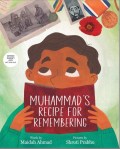
Muhammad’s Recipe for Remembering By Maidah Ahmad illustrated by Shruti Prabhu

Standard
Muhammad’s Recipe for Remembering By Maidah Ahmad illustrated by Shruti Prabhu

img_4274-1

I feel like the idea and heart of this 40 page picture book is decent, but the story, presentation and takeaway are just really poorly executed.  The pitch is a Muslim Desi kid feeling left out when all his friends are rehearsing for the upcoming veterans assembly because he doesn’t have anything to share.  He then starts asking his family, and the Muslims and non Muslims hanging out at the mosque to find out about Muslim and Indian involvement in the World Wars.  A rarely explored topic, considering in the West WWI and WWII are taught from a Western centric perspective, no doubt.  Unfortunately, most early elementary readers, the book’s target audience is 4-7, have limited knowledge of the World Wars, let alone about the subcontinents own politics and that they were occupied themselves under colonial rule at the time, and this book does nothing to explain any of it.  The inconsistencies, plot holes, vocabulary and ultimate lack of sharing a single story from a descendant of someone who fought, make the book rather pointless and forgettable.  Truly the take away is that there were Muslims among the Indian army, they made roti and prayed.  No real idea what they experienced, saw, endured, or gained in return for being forced to fight for Britain on the global stage.

img_4275-2-1

The book starts with Muhammad listening in to his classmates talk about their family members that are veterans and him feeling left out.  At recess they don’t let him battle in the reenactments and instead make him be the cook. When he gets home his dad is making rotis and Muhammad asks his dad if they have veterans in their family, they then go ask his grandfather if his great great grandfather fought in either World Wars.  Dada jaan recalls that “they sent my grandfather to France in World War One.”  But he never spoke about it except to mention that they shared rotis.  He suggests they go to the mosque the next night as that is where, “a kaleidoscope of people gather.” He learns from a Sikh uncle in a turban that whole villages went to fight and from Imam Rafiq that the soldiers fasted in Ramadan, prayed, and celebrated Eid.  No one has any visible tokens of their family’s service as they were lost over time.  Determined not to let the stories be lost, Muhammad shares roti at the assembly.

img_4277-1

Ok, buckle up, I have a lot to point out, but first the positive.  I like that the dad makes rotis.  Mom isn’t in the book, but there are a lot of pictures of a lady hanging on the walls of the house, so possibly she has passed and dad has to cook, no matter, it is nice seeing a Desi dad in the kitchen.  I also like that the mosque is central to the story, I wish it was called a masjid, and that it was explained why people that are not Muslim are hanging out there.  Brown people are generally lumped together and this seems to reinforce that stereotype, which makes me less than thrilled.  It seems like a social environment with ping pong tables and snacks happening, so why not say it is a social hall at the masjid where people of all faiths often gather.  A “kaleidoscope of people” does not explain people of different religions at a mosque to most four year olds.  The book claims the assembly is honoring veterans, so why is Muhammad only curious about WWI and WWII is never explained.  He is teased and forced to be the cook by his friends, with a very negative connotations and depiction in the illustration, but that notion is never pushed back upon, and is actually heightened with rotis being the thread that ties the entire book together.  A missed opportunity to be sure.

img_4279-1

I really struggle with the reality that the majority of Indians were forced to fight, and the book keeps it vague in the text with lines such as “joined the war effort,” and “they sent..” who is they? It sounds nice that Muhammad doesn’t want the stories, like the artifacts to be lost, but WHAT STORIES? If the book is about remembering, and stories are to be shared at the assembly, I feel short changed that the reader doesn’t get a single story about a Muslim or Indian that fought in one of the World Wars.  Isn’t that the point of the book? Yes the book has sources at the end, but it is fictionalized, make up a story, give the reader and Muhammad something to take pride in, to understand through, to imagine, what it was like for his great great grandfather.

img_4280-1

I struggled with the illustrations as well, Imam Rafiq looks off in the final image, I don’t get why Dada jaans memories seem to be on the TV either.  I also didn’t understand why rotis were the thread, but then it is paratha at breakfast that gives the idea, and who really is constantly spreading ghee on paratha or roti let alone at war, or at recess.
img_4278-1

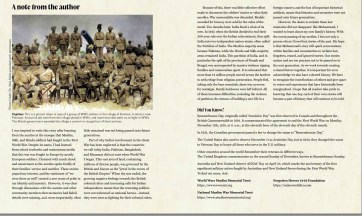
War is not a trivial matter, and I kind of feel like this book reduced it to food, and allowed some racism, classism, and  Islamophobia, to go unchecked along the way.  I like that the backmatter has a recipe and an author’s note, but colonialism, service, war, are all heavy topics that are hard to bring down to an early elementary level picture book, and sadly this book is unable to connect and inform readers about this time in history.

Anything But Okay by Sarah Darer Littman

Standard
Anything But Okay by Sarah Darer Littman

anything but ok.jpg

This 345 page contemporary book is brand new from Scholastic and isn’t yet in the AR database, it is billed as appropriate for ages 12 and up and is probably pretty accurate.  The cover, in my opinion, is rather a disservice for the audience.  The book would appeal to girls and boys, and isn’t really about school drama, which is the vibe I got from the cover.  The story is actually pretty deep and thought provoking, on a wide range of issues facing many young adults today.

SYNOPSIS:

Told from Stella Walker’s perspective, the book opens with her and her friends, Ken and Farida, reviewing old movies.  Farida, an Iraqi immigrant, is constantly pointing out the stereotypes, tropes, and bias they engage in regularly and see depicted around them.  She is constantly nagging her friends to recognize their privilege and check it.  Stella tries to get it, but it’s not that easy. Nor are the obstacles that the book explores. 

Stella’s parents are vets, and her brother, Rob, has just returned from his second tour in Afghanistan and is suffering from PTSD.  Additionally, Rob’s best friend commits suicide and yet, Stella’s family doesn’t involve her in the conversations and concerns, and as a result she doesn’t talk to her best friend Farida.  This tension is amplified when Farida wants to run for class president, but her parents advise her against it, as Islamaphobia is on the rise with the mayor, up for re-election, spouting hate speech, and his son, already in the race to lead the school. 

Stella, as a result, is convinced to run with the help and support of her friends.  All should be going well, but in a desperate attempt to get Rob out of the house, a trip to the mall to watch a movie results in Rob sticking up for a Sikh kid being bullied, and breaking the instigators nose.  The police are called in, and the real drama of the book takes center stage, as social media, a bigoted mayor, and a family’s member friendship with a Muslim paint Rob as a radicalized terrorist.  The Walker’s house is vandalized and Farida’s family’s restaurant is suffering and the mayoral election and class office election will all require some tough decisions and insights into honesty, framing, perseverance and friendship.

WHY I LIKE IT:

I don’t think I was expecting the book to explore so many topics and to do it, in a rather real and raw way.  The arc of concepts covered provides a lot of juice and relevance and the quick pace, makes it a quick read.  Some pages are letters written by Rob, a number of pages are the various police reports taken after the mall assault and the various points of view are great.  It explores how media editing and framing can change a narrative to one side or another. 

I love Farida, bless her, she is annoying and one-dimensional, but yet so relatable.  She is the token minority that ties it all together and is the billboard representation of “other.”  I can so relate to her, being the minority and the one that constantly had to be the gadfly on the masses.  

The school election is a little cheesy and overly elevated in importance, but it is the catalyst, so while I wasn’t really invested in who won, I liked the concepts it brought to the forefront of the characters lives.  The family struggles and retaking the truth and owning it, was the real strength of the book, and introducing kids to the horrors of war, returning from war, mental illness, the blind eye of politicians, the struggles of the VA, the power of the media, friendship, and concepts of patriotism, privilege, pride, suicide, and moving forward.

My biggest complaint is the awkward and forced romance.  It isn’t even romance really.  After the mall incident, Stella confides in a classmate, Adam,  who comes over to see if she is okay and they hold hands and kiss.  It is so out of left field and so awkward I would imagine for most readers, not just me the conservative muslim mama looking for books for my kids and their school book club.  In all they kiss five times I think, and mentions them holding hands twice.  It isn’t lamented or dwelled on, it just kind of boom, jumps in to the story and then yes, they kind of snuggle after the election results, which is a little more fitting (but still irritating).  Rob meets a girl, and again later on when she comes to celebrate the plea deal its nice that she is there, but they talk like once and he completely falls for her, kind of intense and random.  The discussions about letting someone in to your life and all is good, and more natural and they don’t kiss, but they do have “feelings” for each other.  

There isn’t much about Islam other than that Farida is Muslim and that her mom wears hijab.  Even the Islamaphobia is mentioned more for political and prejudicial purposes than as a segway in to understanding Islam.

FLAGS:

Kissing (see above), suicide, war, violence.  Beer is mentioned at the end when a college veteran gets one out of the fridge.  

TOOLS FOR LEADING THE DISCUSSION:

I really want to do this as a Middle School Book Club choice, yes I’m hosting those again.  I need to talk to the school counselor about the kissing stuff.  I think they can handle it, but I don’t know the kids well enough just yet, to verify this.   Being it isn’t the Muslim characters, I can’t imagine it is any different from what they see on TV or in Disney Movies, but still, I can’t confidently say it will happen.  Twelve and up is the non Muslim age point, I’ll have to think it over and update this once I investigate. 

Author’s website: https://sarahdarerlittman.com/books_2/young-adult/anything-but-okay-coming.html

Reading Guide: https://sarahdarerlittman.com/books_2/young-adult/abo-teaching-reading-guide.pdf