Tag Archives: moral

The Wooden Sword by Ann Redisch Stampler illustrated by Carol Liddiment

Standard
The Wooden Sword by Ann Redisch Stampler illustrated by Carol Liddiment

wooden sword

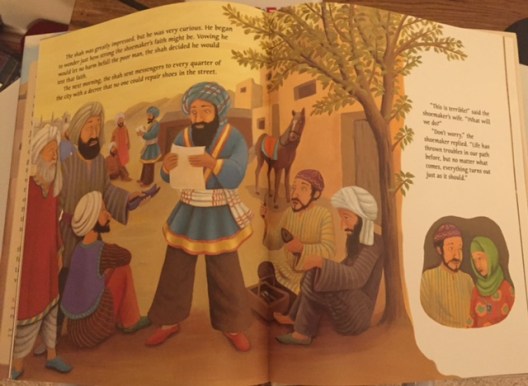
A Muslim Afghani Shah tests a poor Jewish man in this “softened” Jewish folktale.  I say softened because the author’s note at the end implies that she is retelling a well-known story in the Jewish tradition that often features mean-spirited characters.  In this version, however, the interaction between the rich Shah and the poor man, the Muslim and the Jew, are framed in contrast to show mutual respect, similar values, and the trust one has in God.  
sword3

This 32 page, AR 4.6 picture book, is beautifully illustrated and would work fabulous in interfaith settings, as well as in any lesson teaching how we should trust God in all things.  For children not of Islamic, or Jewish, or Afghani backgrounds, there is very little preaching and would still work very well as a moral narrative or even as a culture lesson, as it is a folktale.  From a current events standpoint, it would also do well with older children, as it shows that Muslim and Jews co-existed quite nicely once upon a time in Afghanistan as well.  
sword

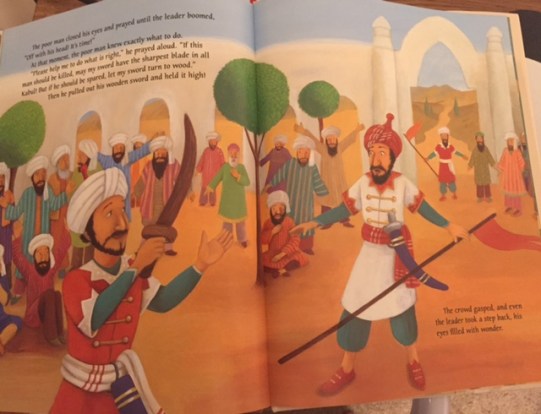
The plot is warm, although the Shah is clearly abusing his power as he meets a poor shoemaker and passes royal decree after royal decree to test the man’s faith that “everything turns out just as it should” and that God will provide.  The Shah decrees no one can repair shoes in the street, followed by banning the selling of water in the streets, and so on, until finally the poor man finds him self in the Shah’s Royal Guard without a sword, ordered to kill someone.  Not wanting to spoil how he handled the prediciment, I’ll suffice to say, in the end the poor man is made the shah’s advisor and presumably all is well. 

sword1

Throughout the tests, we also meet the poor man’s wife, who is supportive and very hospitable as they feed the Shah dressed as a peasant and offer him what little they have.  Her clothing is incredibly similar to what Muslims in Afghanistan wear, and makes me want to research this aspect for accuracy and to satisfy my own curiosity.    

Overall, a sweet interfaith folktale that I hope to share at our next interfaith storytime.
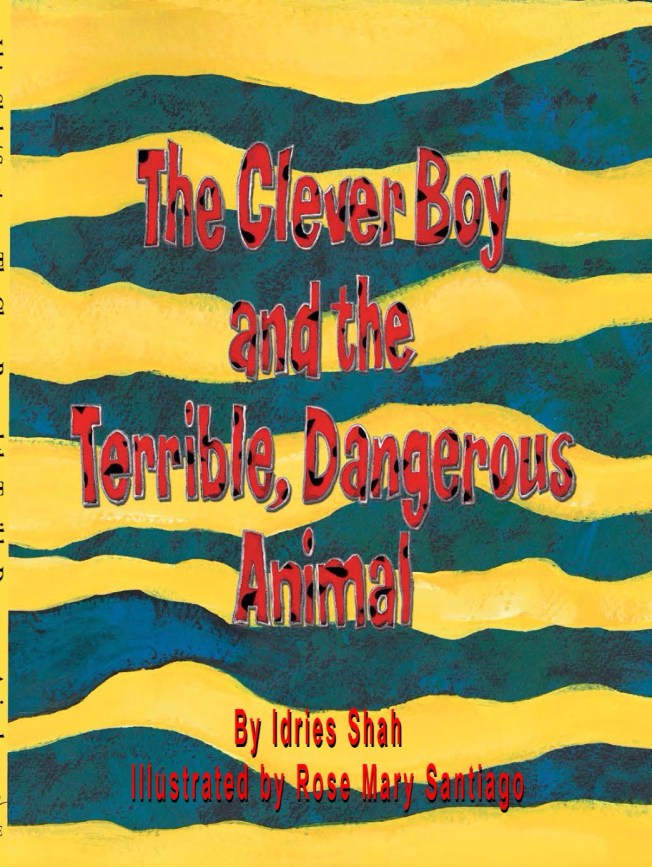
The Clever Boy and the Terrible, Dangerous Animal by Idries Shah illustrated by Rose Mary Santiago

Standard
The Clever Boy and the Terrible, Dangerous Animal by Idries Shah illustrated by Rose Mary Santiago

clever-boy.jpg

This book makes me forgive the author for his other books that left me puzzled as to his popularity.  This is wonderful, timeless and so simplistic, yet full of wisdom, lessons, and reflection that I’m thinking of gifting it to many of my teacher friends.  In its 32 pages written on an AR third grade, 2nd month level, the simple and powerful lesson of how ridiculous it can be to be afraid of what you don’t know is driven home.

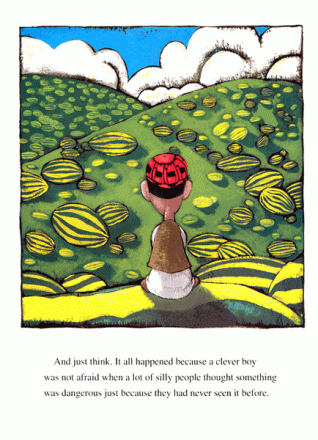
And just think. It all happened because a clever boy was not afraid when a lot of silly people thought something was dangerous just because they had never seen it before.

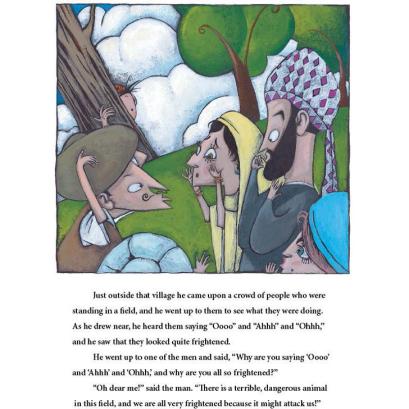
A boy goes to a neighboring village and finds the villagers afraid of, wait for it, a watermelon.  The boy laughs and laughs, and pulls out a knife to cut it and enjoy its sweet juices.  The villagers then fear the boy, until experience and knowledge about what it is and how to grow it, change everyone’s opinion and the village renames itself Watermelon Village. Oh, the power of knowledge.

clever 2

I can see this book being so great to introduce kids to how a little knowledge, asking questions, trying something can do everything from finding something you like, to breaking down stereotypes, to shifting your paradigm.  I feel like Islamaphobia, among so many other things, could be done away with by and large if people would just get to know us!

clever 3

The villagers depicted wear kufis and hijabs and kurtas, and the author writes to share his stories from his oral Sufi tradition, but there isn’t anything overtly Islamic in the text.  The kids as young as preschool will enjoy this at storytime.  They will find being afraid of a watermelon preposterous and silly, making the point that much stronger.

I like that the cover doesn’t given much away, and most children will take the title at its word and think that it is an animal.  Getting student’s ideas of what the terrible animal will be adds to the creative thinking and discussing after as well.  The pictures are wonderful and endearing and many editions come in two language formats.

clever1

Adam in Lost and Found by Zanib Mian illustrated by Maria M. Goncalves

Standard
Adam in Lost and Found by Zanib Mian illustrated by Maria M. Goncalves

Adam in Lost and Found

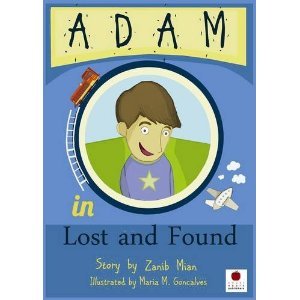
This book resembles kindergarten and 1st grade leveled readers in both appearance (shape and size) and appeal.  It very easily could have been a picture book, with its sparse words and simple linear story, but by making it a smaller size, with a variety of playful fonts, it really excites beginning readers who pick it up and are thrilled to see Muslim characters in an Islamic book on their level.  The book is 32 pages and has nice large age appropriate pictures that work very well, even when reading the book aloud to small groups.

adam 1

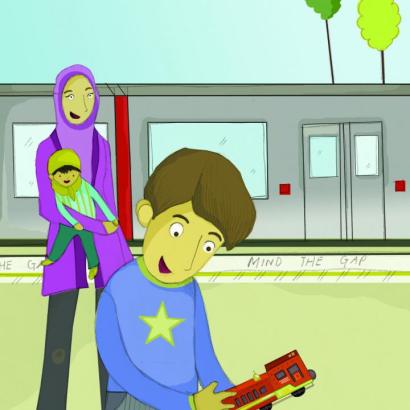
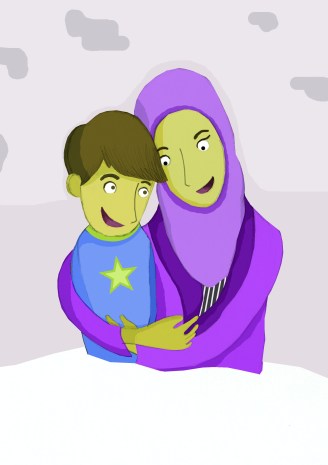
The  story explores the concept of “finders keepers losers weepers” in a fulfilling way.  Adam, a young boy on a train with his family, finds a toy train and desperately wants to keep it.  His father kindly explains to him the two options before him and lets him choose.  Adam, Alhumdulillah,  chooses to give the train to the lost and found man and earn Allah’s reward.  Later, Adam realizes after much searching and help from his family, that when he found the train, he left his toy airplane.  The moral is cemented in the readers, as they too hope, with Adam, that whomever found his plane, also did the right thing and gave it to the lost and found. By coming full circle the message is conveyed, and a happy ending is had by all.

The book takes place in Britain and is book two in the Adam series.adam 2


My Name is Bilal by Asma Mobin-Uddin, Illustrated by Barbara Kiwak

Standard

bilal

The other book I discussed during my Story Time theme of bullying was, My Name is Bilal, by Asma Mobin-Uddin,  The book is an AR 3.5 so I summarized parts when reading it aloud, but at bedtime one-on-one my five-year-old was able to grasp what the characters were going through and how best to handle “mean” people.

The premise of this 32 page, fairly content heavy picture book, is a new family starting at a new school.  The main character Bilal does not stand up to some boys teasing and pulling off his sister’s hijab, and then chooses to tell people his name is Bill instead of Bilal so that no one knows he is Muslim.  Fortunately, Bilal has a Muslim teacher who doesn’t jump in to “save” Bilal, but instead shares with him a book about Bilal Ibn-Rabah, the slave who was tortured by the people of Mecca in their attempts to get him to renounce Allah (swt) and Islam.  Young Bilal, finds strength in this story to stand up to the bullies as well as compassion in giving them a second chance.  He even finds there are more Muslim’s around him and being true to yourself is something even those different than you can understand and respect.

Yes, the book is to neat and tidy and it all works out in the end.  But, I think it is a good introduction to being proud of who you are and not backing down.  I like that the kids essentially handle things on their own and that no one is painted singularly as “good” or “bad,” both Bilal and the other kids are flawed and figuring things out. When I read this during Story Time we talked about it from the “bullies” point of view of what a better way to handle someone or something that you don’t understand would be, a scarf in this case, and how asking questions is always more respectful than teasing. We also talked about being the different one in a new environment and how to be prepared if someone does give you a hard time.  The characters in the book are older presumably than 4th or 5th grade allowing this to be a gateway into discussing bullying a bit abstractly, inshaAllah not once it has already begun.

The illustrations are colorful and realistic, not detracting from the seriousness of  the subject matter.  Overall the book serves a purpose and tells a good story.  Plus, the reader learns a little about Bilal and how the early Muslim’s struggled and encourages them to seek out what their own names mean and represent.

Circle of Sandcastles by Mariam Al-Kalby, Illustrated by Yee Von Chan

Standard

circle of sandcastles

The second book by Mariam Al-Kalby in The Prophet Says Series, is just as good, if not better than the first book, The Apple Tree.  Dedicated to her second daughter Maimuna, this story focuses on the hadith, “Whoever amongst you sees an evil, he must change it with his hands; if he is not able to do so, then with his tongue; and if he is not able to do so, then with his heart; and that is the weakest form of Faith” (Sahih Muslim).

The book follows shy Maimuna as she goes from stopping bullies picking on a deaf classmate within her heart, with her tongue and finally as she has to get her hands involved.  Once again the illustrator does a wonderful job bringing the story to life with joyful playful illustrations and detail.  I used this book with the preschoolers at story time when talking about the five senses and with the kindergartners when talking about bullying and being mean, in both scenarios the book had a strong impact on the students.  I’ve had students remind me in passing how we should handle bullies in our heart or with our tongue and even my own 4 year old has referenced the book when seeing people communication in sign language.  Like the first book, the discussion that follows can be different with each reading, which keeps it in regular rotation.  The bullies are not all bad, but one doesn’t feel guilty giving lots for the reader to speculate upon if they so choose. Shy Maimuna has to be courageous and assess the situation if it is something she feels she can get involved with or not.  Mu’min, the child’s whose sandcastles keep getting destroyed, shows us that Allah swt made us each different, but really the same too.

The book has four Urdu words in it, that actually kind of seem awkward and forced, I simply translated them to English when reading to students (there is a glossary in the back), if you are familiar with Urdu they are fine, but rather unnecessary in my opinion.  The book has 32 pages, is hardback and beautiful inside and out. The author’s website has a cute coloring page http://apocketfulofnotes.com/2013/11/14/circle-of-sandcastles-coloring-sheet/ and inshaAllah your kids enjoy the book as much as mine do, I can’t wait to see what she writes next.