Tag Archives: librarian

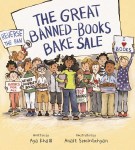
The Great Banned-Books Bake Sale by Aya Khalil illustrated by Anait Semirdzhyan

Standard
The Great Banned-Books Bake Sale by Aya Khalil illustrated by Anait Semirdzhyan

banned

This follow-up picture book to The Arabic Quilt, takes readers back to Kanzi’s school, but also works as a standalone for ages 7-10.  Addressing the hot topic of book banning, the fictional story brings the discussion down to an elementary level and shows kids speaking up and pushing back against something they don’t agree with.  The main character finds a connecting thread to events in Egypt, and with her class and family behind her, she finds her voice and takes the lead.  The story bounces around a bit and feels a little rough and underdeveloped at times, but the subject matter is important and can be used to help guide discussions, encourage peaceful protesting, and taking action.  There is nothing Islamic specific in the text, the main character’s mom and teita wear hijab and are in the illustrations (#muslimsintheillustrations), in a memory of Egypt there is a man holding a cross.  The author is Muslim and mentions it in the Author’s Note at the end.
banned1

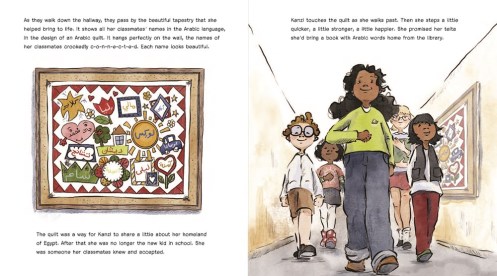
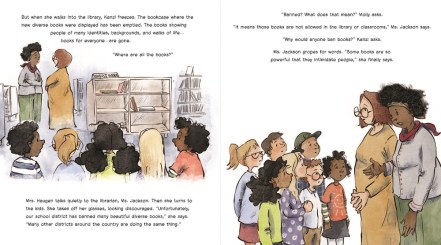
The book starts with Kanzi leading the class to the library, she passes the Arabic quilt she helped bring to life and walks a little taller.  She has promised her Teita she will bring home a book with Arabic words from the library, but when she walks in to the library, the “bookcase where the new diverse books were displayed has been emptied.”  The librarian explains that the books have been banned.  That the school district, like many others around the country, have decided certain books are not allowed. Kanzi is upset, but her classmates “gather near (her) in solidarity. They want her to know that they care, too.”
banned 2

Back in class the teacher opens up the discussion, and Kanzi can’t find her words.  Kareem says it is unfair and when the teacher explains that people are responding by protesting, writing letters, and buying more copies of banned books.  Kanzi finds her voice and suggests a bake sale.  Kareem suggests they raise money to buy books that are banned and call it “The Great Banned-Books Bake Sale and Protest.” Molly adds that they can put the books in Little Free Libraries. The class agrees that Friday will be the day, that baked foods inspired by books that are banned will be sold to raise funds to buy more banned books, and the local news station will be invited to broadcast the protest.

banned 3

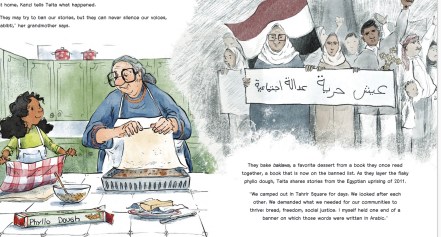
Kanzi helps Teita make baklawa from a book they once read, while her grandma tells her stories of protesting in Tahrir Square.  Teita held a banner and demanded rights for the people of Egypt. Friday comes, and the kids are determined to be heard, as the crowd grows, Kanzi’s nerves also grow, but her strength comes from those that support her and who have also spoken up to be heard.

I enjoyed the illustrations and the backmatter.  The inclusion of a baklawa recipe and insight to how this story came about with the banning of The Arabic Quilt, definitely adds to the book’s appeal.  I felt a little disconnect though from the emotions of the book, and oddly enough, little connection to the characters.

I wish it would have shown her joy when she first saw the diverse book display.  How it made her feel seen and valued and included to see books that reflected her and her classmates.  Then we, the readers,  would feel the pain too, now that they are gone.

I also was a little unsure of the scene when all the kids gather around Kanzi in solidarity, why is she the only one upset? Is it that they care about her or that they care that the books are no longer available? Sure it can be both, but again, as it is written, it isn’t particularly strong.
img_8594

I’m not sure why the three characters named in the book Kanzi, Kareem, and Molly, do not have their names shown on the Arabic quilt pictured in the illustrations, and I also don’t know why it bothered me that the book banned that had baklawa/baklava was not named.  I don’t care that it isn’t a real book, but I wanted a title to make the case of how ridiculous this ban is more articulate.  Additionally, I love Little Free Libraries, but it seemed tossed in without much fleshing out. The book doesn’t explain what Little Free Libraries are, so I’m not sure that kids will even understand the plan.

The book is a decent read, I don’t know that the climax or characters will be memorable on their own, which is unfortunate because connection with the success or failure of this fictionalized book ban really could have radiated out of the book and deeply inspired kids.  The reversal of the boards decision doesn’t directly link to the kids’ actions.  I had to provide that link to my own kid when I read the book to him (he is almost 8).  It is implied, but a line or two about how the kids protest encouraged other people to also speak up, or write letters, or that the school board attended the bake sale, would have shown that when voices amplify it is hard to ignore them.

The book has value on the shelf and can be preordered here https://amzn.to/3C5Baaj

Alia’s Mission: Saving the Books of Iraq by Mark Alan Stamaty

Standard
Alia’s Mission: Saving the Books of Iraq by Mark Alan Stamaty

alia

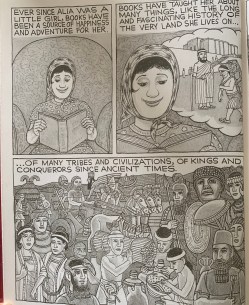
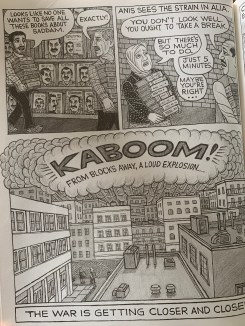
Based on the true story of Alia Muhammed Baker, the Basra librarian who saved 30,000 books in 2003 from the destruction during the Iraq War, this 32 page graphic novel, is an AR 3.9 and while it isn’t a chapter book and isn’t just a picture book, it works well for 2nd through 4th grade readers that will enjoy a bit of history, a lot of excitement, and detailed panels that make the story come to life.  The story, as it is based on fact, is very similar to The Librarian of Basra, but with it’s different presentation style, might appeal to a larger audience to appreciate and celebrate what she did to save such precious books, naturally, I’m a huge fan!

5532A37C-C4DF-46FA-8334-5F4AA3A06AB5

SYNOPSIS:

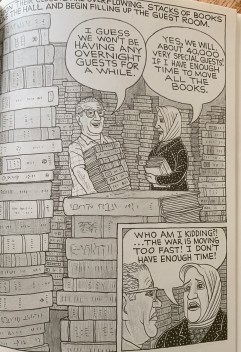
Alia is the Chief Librarian of Basra Central Library and has always loved books and learning.  As war draws closer, she tells her husband she is worried that the library could be bombed or set ablaze.  She goes to the government to voice her concerns and ask that the books are relocated, but her request is denied.  So she takes matters in to her own hands, and starts smuggling books under her shawl and in to her car, and stacks them in her home.  Every day she does this for a week, soon closets are over flowing and she starts stacking the books in her guest room.  Worried that she isn’t making fast enough progress, she gets the restaurant owner next door to help her when looters start taking the pencil sharpeners and furniture from the library.  She has a plan to have everyone possible come together to move the books, and many people come to help.

Eventually the library is set on fire, the news gives Alia a stroke.  When she recovers she learns she saved 30,000 books, and up next for this real life super hero? Building a new library, inshaAllah.

A3A17616-7940-4E80-8CA1-9798A8BA4FC8

WHY I LIKE IT:

I love that it shows the value of libraries and books, the determination of one person, and the support of a community.  People are awful during a war, yet, sometimes they are pretty amazing too.  The illustrations are detailed and varied, with inviting text and clear concise language.  It really is well done.

B0FB5A2A-7376-4F20-BCD1-6D64956B77C6

FLAGS:

Destruction of property, sneaking, looting.

TOOLS FOR LEADING THE DISCUSSION:

I think it would be great to have kids read this story and the librarian of Basra and discuss


Unlikely Friends by Sahar AbdulAziz

Standard
Unlikely Friends by Sahar AbdulAziz

unlikely friends.jpeg

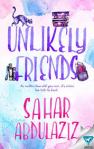
Another wonderful book by a Muslim author that doesn’t discuss Islam, but is expertly written and such a great read, that I wanted to highlight it here on the blog.  At 293 pages and involving a teen character I was really on the fence if this would qualify as “young adult,” so I reached out to the author to ask, and she, mashaAllah, responded! Unfortunately, she felt it wouldn’t quite qualify, even though it is a bit of a coming of age story.  So, why am I still reviewing it?  Because I think high schoolers (muslim and non) would really enjoy the book, and with finals nearly over, anyone in that demographic looking for feel good story that is pretty clean (Ramadan is nearly here), I think this book would be a great choice! And full disclosure, yes I’m biased, the librarian is the hero!

SYNOPSIS:

Told from multiple points of view the linear story brings together two introverts, Irwin and Harper, that have a lot of real and serious issues pressing them.  Their traumatic back stories are slowly revealed as the two unlikely friends come together to deal with their current predicaments.

Irwin is an old ornery librarian that doesn’t like people or change.  He is set in his ways and the stubborn Harper, a young high school student for some reason latches on to him.  He tries to shake her, but finds he is genuinely concerned about her and despite his better judgement finds himself helping her and getting tangled in to her messy home life.  

Surrounded by a cast of developed and diverse characters the fictional world of Irwin and Harper is both believable and realistic.  Irwin’s author neighbor is losing her memory, slowly, but noticeably, his deceased fiance’s daughter passes away shaking his routine, and his colleagues at the library are funny and annoying in their own ways.  Harper’s father is released from prison and her mother must make a stand to resist falling into old drug habits, all while trying to make ends meet and put food on the table.

WHY I LIKE IT:

I like that it reads so very smoothly.  You feel Irwin’s shell cracking and you see that he is so much more than just a stereotypical grumpy old man.  You also see Harper’s mother, Olivia concerned that her daughter and an old man are becoming friends.  You probably could predict how things will end up, but the way it is written you aren’t really worried, you are just enjoying getting to know the characters presented.  Overall, it really is a great lens to remind us all that friendship, real friendship is incredibly valuable.  In a world of filters and digital everything, sometimes our humanity is all we have.  I also like that people are given the chance to change and grow, the group of main characters are not stagnant or one dimensional, their challenges and dilemmas are brought in to the open and you feel for them as you would a real person.

The only two questions that stood out as inconsistent with the characters and story development are why didn’t Harper just get a job to help out her and her mother’s financial situation? Plenty of teens have jobs, so that seemed a little off to me.  Secondly, Olivia works at a supermarket presumably or a market of some sort, so it would seem that an employee discount or nearly expired food section would make their food insecure situation a little less severe.  Granted its fiction, but these two jarring concepts seemed to hold me back from completely being swept away.  

FLAGS:

The book is clean in terms of what is explicitly conveyed.  The details that make it possibly/probably not suitable for younger readers are the drug histories of Harper’s parents and what they did to acquire drugs, what they did when on drugs and what was allowed to take place around Harper when she was a child.  Darren, Harper’s father, believes that Harper was sexually abused by someone when he was high and this memory haunts him.  It isn’t explicit, but it is there.  Some mention of Olivia waking up in dealer’s beds is again mentioned in passing, but not detailed.  One could imagine two druggies trying to raise a child and get their next hit, but a lot of the understanding will come from the prior knowledge the reader has of such scenarios, not from the text itself. 

There is the idea that physical abuse was common between Darren and Olivia and is shown in Darren’s temper when he throws a vase against a wall after coming to Olivia and Harper’s home when released from prison.

There is some mention of Irwin’s fiance’s relationship with her ex-husband in that he cheated on her regularly.

So definitely, the book has elements for older readers, but the way the topics are discussed: drugs, abuse, infidelity, are not glorified or even detailed, more they set the stage in defining the current conflicts the characters face, the pasts they must over come, and the environments that they want to improve upon.  I think 15 and up could handle it.

TOOLS FOR LEADING THE DISCUSSION:

I’m thinking to recommend this book to the Sister that runs the high school book club.  I think there would be so much to discuss and myths to dispel that an older group would benefit from the experience and work the author does and writes about in this book.

Plus the fact that the author so easily responded to me, might inspire a group of teenagers to reach out and be equally inspired.