Tag Archives: language

The Arabic Quilt: An Immigrant Story by Aya Khalil illustrated by Anait Semirdzhyan

Standard
The Arabic Quilt: An Immigrant Story by Aya Khalil illustrated by Anait Semirdzhyan


arabic quilt

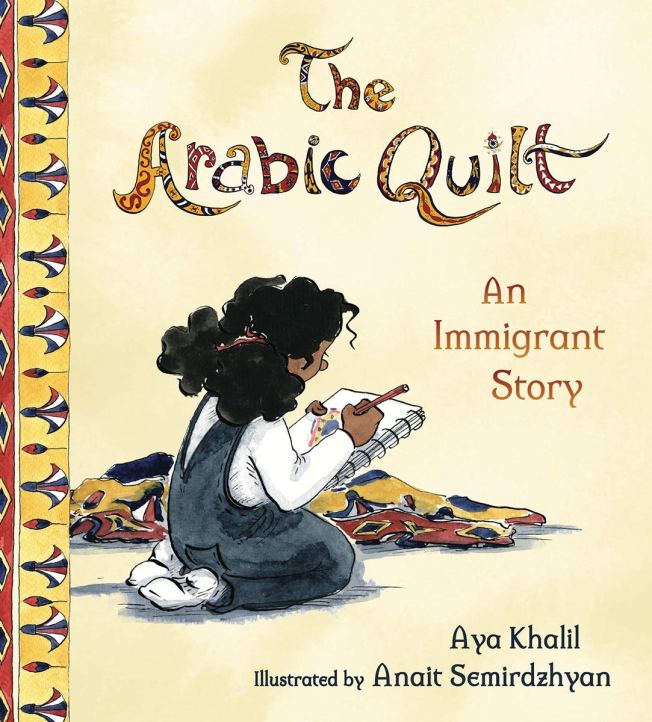
This 36 page picture book tells a beautifully presented story that incorporates events from the author’s real life that convey a story of loving your culture, finding similarities and giving people a second chance.  Ideal for students between 2nd and 4th grade, younger children will enjoy having the story read to them, and older kids will benefit from the message as well.
7C03525B-A26D-427F-A7EA-591BB3095F10

Kanzi is about to start her first day of 3rd grade in a new school.  It doesn’t specify if she has just come from Egypt, but being she seems to speak English well, knows that she’d rather have peanut butter and jelly instead of a kofta sandwich and mentions that she got a quilt when she visited her grandmother, in Egypt, she possibly is just starting a new school, not her first in America, but it is considered an immigrant story, so I’m not certain. E403D261-438B-4263-A2FB-C3F8693C9D3E
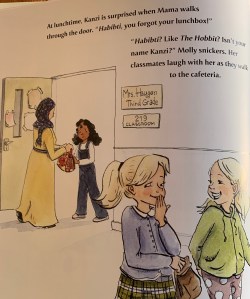
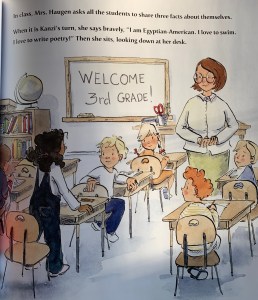
When she arrives in class and introduces herself she bravely says that she is Egyptian-American, but on the way to school she turns down the Arabic music in the car, so the reader sees that she is a little nervous about being seen as “different.”  When her hijab wearing mom brings her forgotten kofta sandwich and calls Kanzi ‘Habibti,’ classmate Molly teases her that she is being called a hobbit.

A crying Kanzi tells her teacher and Mrs. Haugen reassures her that “being bilingual is beautiful.”  That night Kanzi asks her mom to send her a turkey sandwich for lunch the next day, and before beds she writes a poem as she snuggles in her beloved quilt.

76FCD440-0D81-4893-80F3-1CC6033E8461

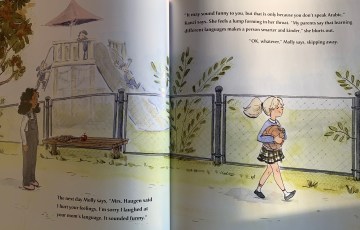
At school Molly apologizes to her and says that it just sounded funny.  Kanzi tells Molly it is because she doesn’t speak Arabic and that her mom says that “learning different languages makes a person smarter and kinder.”  Molly dismisses the comment and smugly walks off.

Mrs. Haugen sees Kanzi’s poem about her quilt from her grandma in Egypt and asks her to bring her quilt to school. The kids love it, and Friday Kanzi’s mom shows up to help with a special project: an Arabic quilt with the kids names.
98E875AE-0FD1-4827-BF39-1CA7B1172843

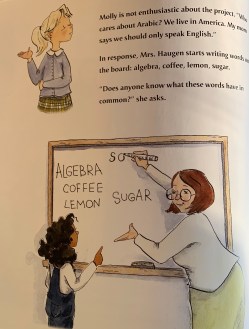
Molly is not enthusiastic and Mrs. Haugen writes English words that come from Arabic on the board: coffee, lemon, sugar, algebra.  Telling the kids that “we can speak non-English languages and still be American.”

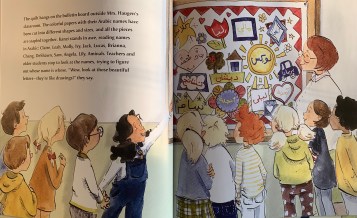
Kanzi and her mom write the kids names down and the children copy them.  The teacher cuts them out and makes a quilt to hang in the hall.  On Monday when everyone sees the quilt, they love the beautiful letters and colors.  Even Molly sincerely apologizes and asks Kanzi to write her mom’s name in Arabic as a gift.  The two hug and seemingly will become friends.
832244F2-1F7E-4C4A-9778-40E0EEC6BE82

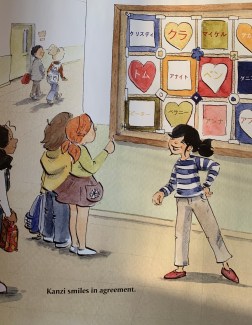
Across the hall another quilt is hung with names in Japanese, as another student and teacher were inspired by Kanzi and her quilt.  The last page of the story is a letter Kanzi has written to her parents telling them how grateful she is that she has two languages and that she will speak them without guilt.
BB6797A4-05C9-4CDC-AC70-88273ED3997B

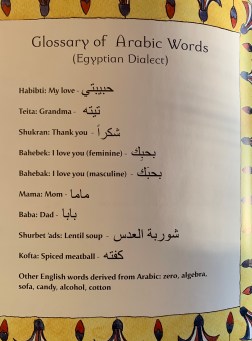
The story is beautifully told and exquisitely illustrated on well-sized 9.5 x 10.5 pages in a hardback binding.  The mom wears hijab and it mentions it, but there is nothing religious about the text.  It is a universal story of coming to be proud of your roots and inviting those around you to learn and grow.  There is a Glossary of Arabic Words at the end and a bit about the author and illustrator.
9AF3D465-F5DA-4F25-8FC1-5BEE16FD9B21

My kids favorite page by far was reading the names written in Arabic and they all enjoyed the story (ages 13, 10, 9, 4).  I actually had an issue when Molly apologized the first time, feeling that Kanzi’s response was a bit pretentious to what seemed like an 8 year old being told to go say she was sorry, but my older three unanimously and fervently disagreed with me, saying that she was obviously insincere and Kanzi knew it.  I’d love to hear from other readers if they felt like Molly was sufficient in saying sorry and admitting that it sounded funny and that Kanzi was arrogant in saying that people that know two languages are smarter and kinder, or if Molly was being rude and racist and Kanzi was sticking up for herself.
CF16ACA2-8EC4-443B-AA8B-2B9EA3D05D6D

Irregardless, the book is well done, enjoyable, and will get repeated reads by a large range of readers.  My children keep pulling it off the book shelf, and for that I need to thank Gayatri Sethi (@desibookaunty) who generously sent me the book the same day I checked it out from the public library.  Her generosity once again is a gift that I hope to pay forward in the future.  This book also highlights how amazing teachers can be and often are in facilitating inclusion, understanding, and respect.

ED8D19BC-96FE-4B8F-8B35-87A1AA885B7F


Yes No Maybe So by Becky Ablertalli and Aisha Saeed

Standard
Yes No Maybe So by Becky Ablertalli and Aisha Saeed

yes no

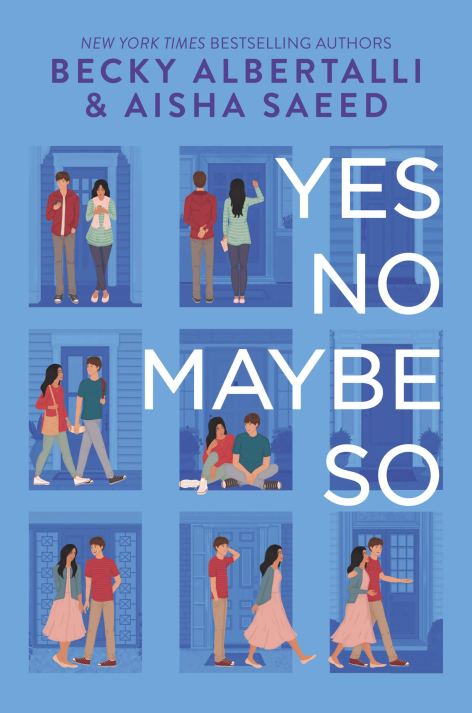
This new rom com in book form with a Muslim female character written by a Muslim author, sets itself apart by being co-written by a Jewish author and the other half of the love story being told by a Jewish boy’s point of view.  This YA book is very relevant as a special election in Georgia served as the catalyst of the two authors coming together and fictionalizing the effects of white supremacy, Islamaphobia, and antisemitism for the book, while real headlines were urging the two to canvas, get involved, and make a change against the increased showing of hate with the election of Trump.  The presentation of Islam is probably realistic, but definitely not ideal, and with the kissing, multiple LGBTQ+ supporting characters, the profanities, and 436 page length, the book is probably best for 15 year old readers and up.

SYNOPSIS:

Jamie Goldberg is 17 and is spending his summer helping his cousin work on a special election campaign for a Democratic candidate in an incredibly red district in Georgia.  A very nervous kid, who hates public speaking and talking to girls in general, he would rather be behind the scenes or hanging out at Target.  His little sister, Sophie’s bat mitzvah is coming and things at home are crazy with pre party planning.  His grandma, an Instagram sensation uses him for tech support and video filming, and his easy going demeanor means he spends a lot of time, being bossed around.

Maya is the 17 year old only child of a lawyer mom and physician dad and has just found out that they are separating.  With her one friend too busy with work and starting at the University of Georgia, US born, Pakistani-American Muslim Maya, is not having a very good Ramadan.  When an interfaith event reunites her with a childhood play-date friend, Jamie, her mom convinces her to help him canvas to keep busy and sweetens the deal by bribing her with a car.

Naturally the two spend a lot of time together vounteering for Jordan Rossum, stuffing envelopes, canvassing, and putting up signs.  Along their way they become good friends, and invested in the election as a House Bill banning head coverings, and antisemitic bumper stickers start getting plastered around town.  The end of Ramadan, the election, the hate the two encounter, and families changing, bring Jamie and Maya together.

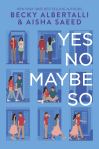
Maya’s parents are pretty chill about boys, and only caution her about unnecessary complications by dating in high school, when Maya throws it back on them, that their relationship is pretty complicated, she seems to not find an Islamic reason not to make-out with Jamie.  The whole book is angsty and the two feign cluelessness, but based on the cover of the book alone you know where it is going.  The true climax is how much the relationship can be used for political gain, and if they can get their candidate elected.

WHY I LIKE IT:

I like the political setting, it is a different and very relevant slant.  It might be a little alienating to readers outside the United States, because the political process isn’t really detailed, but the characters involvement in their small slice is a major aspect of the book.  The book is definitely pro Democrat, but addresses the gas lighting, hate speech, and views of those on both sides.

I also like that two minority authors came together to share an OWN voice perspective of life today.  For the most part the story telling is smooth with the two characters getting alternating chapters to tell their story from their point of view.  A few times, I felt details were missing, for example what Maya wore for Eid, when space was given to detail that she didn’t wear ethnic clothes to an iftar, and her picking a dress for Sophie’s bat mitzvah.  Similarly, Maya’s parents seemed flat for their trial separation being a major part of Maya’s stress.  Jamie’s grandma was probably my favorite side character, and one of the most fleshed out.

I am fully aware that some Muslims pick and chose what to follow and that not everyone is strict about boy/girl relations, but I felt like for a book that is set in Ramadan, uses religion as a catalyst for civic action, Maya’s mom wearing hijab, and an opening scene being set at the masjid, there is really nothing Islam in the defining aspects of the characters or story.  It is so watered down and almost catering to non Muslims to feel comfortable, that it left me annoyed.  And I think non Muslims too will wonder why Maya’s mom covers and Maya doesn’t and how that works, or why Maya switches to having one reason for not dating and then a religious one.

The book sets out to do a lot in terms of humanizing the effects of laws and policy on average people, but I don’t know that most Muslims hoping to see a mirror to their experience will find that in Maya.  I can’t speak about Jamie, and the Jewish experience, but Maya is rather forgettable in my opinion.

FLAGS:

There is a lot of cursing, and the F word at that.  In the dialogue set in Ramadan, it becomes a joke to substitute it for something else, but once the month is over, the language resumes.  There is kissing, and making-out with the main characters.  There is talk of hooking up, but nothing explicit.  There are is a side character friend that is gay and he and his boyfriend are affectionate.  After the bat mitzvah Sophie comes out to Jamie.

TOOLS FOR LEADING THE DISCUSSION:

I don’t think that I could do this as a middle school selection, the rationale for Jamie and Maya dating, isn’t ok for an Islamic School message.  I really wish just once, a book like this would have the main character, being like, “nope, sorry.”  It is getting predictable and while I know it is countering the oppressed woman view, it is becoming equally one dimensional in its presentation of Muslim women.


A Very Large Expanse of Sea by Tahereh Mafi

Standard
A Very Large Expanse of Sea by Tahereh Mafi

avleos

The book is often marketed as a Muslim coming of age story in a post 9/11 world.  The contemporary work is semi-autobiographical, but really I think the positioning is a bit misleading.  It’s a love story, and the main character is Muslim, and her environment is awful and she is angry. Its an engaging read, I read all 310 pages in one sitting, but I don’t know that the take-away will enlighten anyone about Islam, or really what it was like to be Muslim in the years after 9/11, I think people will remember how sweet the couple is and wonder how much of it mirrors the author and her husband, author Ransom Riggs (Miss Peregrine’s Peculiar Children), but not suddenly become knowledgable about more than what the main character experiences and endures.   I appreciate that the book challenges the stereotypes of Muslim women, there is authenticity as it comes from a writer who lives it, and I do think it shows evolution of attitudes that teens can benefit from.  The book is not yet in the AR database as it just came out, but I would imagine high school and up.  

SYNOPSIS:

Shirin’s Persian-American family moves a lot.  Her and her older brother are incredibly close as their parents are rather aloof to the day-to-day experiences the kids endure.  That isn’t too say her parents aren’t around, they eat two meals a day together and the parent’s are warm, but Shirin’s brother Navid is a much more present.  The story starts with 16-year-old Shirin starting her 12th new school.  Conditioned to not make eye contact, remember faces, or get affected by the trivialities around her, the reader sees how angry she is as she curses at a teacher that assumes she needs ESL not Honors.  Knowing how fleeting her time in any location can be, as her parents are constantly trying to find better jobs, Shirin doesn’t feel compelled to make friends or get attached to anyone or anything.  This intimidating vibe similarly keeps offers at bay, for the most part.  When she gets paired up with Ocean to dissect a cat, he tries to talk to her, and this throws her off her game.  Most every interaction she experiences at school are people making racist comments and being very one dimensional and bigoted.  Ocean tries to be nice, an attitude so foreign to Shirin that it begins to force her to change.  Simultaneously, Navid, who is charismatic and has no problem finding friends wherever they go, decides to put his and his sister’s dream into action and they start a break dancing club at school.  Three other kids join, and start becoming, not just Navid’s friends, but Shirin’s as well.  

Shirin and Ocean fall in love, despite Shirin fearing what the backlash will be for ocean.  She doesn’t really know anything about him, but feels strongly that all the racial slurs thrown at her on a daily bases will effect him and ultimately make them wish they didn’t pursue a relationship. She draws line after line in the sand, and crosses them all.  Only then does she learn how blind she has been, he is in two of her classes, not just one, he is a year older than her, and he is the golden star of the high school basketball team.  Being that the story is told from Shirin’s perspective, this is surprising to the reader as well.  The town turns on the pair and things get really ugly for Ocean who is willing to risk it all for Shirin.  Threats by the basketball coach, pictures of Shirin without her hijab being taken, accusations of terrorist ties and sympathies all challenge the couple and shape Shirin.

WHY I LIKE IT:

I really like the twist of having the relationship be difficult for the non Muslim, rather than going with the assumed Muslim girl having to sneak around.  Not saying that I support it, but interestingly she never mentions that what she is doing is going against anything religious.  She mentions twice that her parents wouldn’t like her with any guy, and that they view her as a child still, but she doesn’t explore Islamically any boundaries regarding their relationship.  She hides talking on the phone to Ocean, because her parents are adamant she gets enough sleep at night.  That is about it.  Shirin discusses that she wears hijab like an armor that she gets to pick who she shows her hair too.  I love the strength in that, but wish there was a bit of doctrine to back it up too.  At one point a Muslim, non hijabi, at school calls her out for wearing hijab and having a boyfriend, but she essential tells her it is none of her business, which it isn’t and who is to say that one sin is worse than another, but still it befuddles what exactly Shirin believes and why.  The book just paints her as a Persian Muslim, but never explores what that means other than the superficial outward appearance.  They do fast in Ramadan, no explanation about why is given, just that they not eat or drink during daylight hours, and right near the end, Shirin remarks how her mom asks her and her brother every morning if they have prayed and they lie and say yes, their mother sighs and tells them to make sure they pray the afternoon one, to which they lie and agree, only to have their mother sigh again.  AstagfirAllah, that is awful lying, and lying about Salat, but it is so real, I audibly chuckled.  

I like that the parents aren’t harsh, they just seem disinterested.  I didn’t want to read another book about the parent’s being the gatekeepers and bad guys, so that was really refreshing.  They mention they don’t celebrate Christmas, but they have an open door policy on Thanksgiving for any friends wanting to come.  I did hope for a bit more about them, why they don’t talk to the kids about moving, what makes them tick, because really they seem to have a solid relationship with the kids, they are just clueless to their social experiences and school environment stresses.

I love the growth and self reflection of Shirin, she holds a mirror to herself and she and readers are better for it.  She has to realize that she is doing so much of what she is accusing others of doing.  I love the support and genuine concern of the breakdancers and her brother.  It resonated to me as a girl with an older brother and the relationship feels very genuine. I just wanted to know more about Navid. 

FLAGS:

There is a lot of cursing. kissing, hand holding, romance, lying, and ditching school.  There is a brief mention of graffiti being sprayed.  There is racial slurs, threats of violence, violent physical outbursts by people of authority.  When a student throws a cinnamon roll at Shirin, Navid and his friends beat the kid up severely, it isn’t detailed, but it is mentioned.  Ocean  also gets suspended for a few games for a fight he engages in, and there is some detail of Shirin getting jumped in a previous city for wearing hijab.

TOOLS FOR LEADING THE DISCUSSION:

I don’t think I could in good conscience present this to a group of Muslim students.  I wouldn’t want them to think I was endorsing the violence and language and romance.  Like so many books of the genre though, if someone found it and read it on their own, I’d love to chat with them about it, as it is well written.

Youtube video about the book by the author: https://www.hypable.com/tahereh-mafi-a-very-large-expanse-of-sea-tour/