Tag Archives: Fun

The Treasure at Bayan Bluffs by Farah Zaman illustrated by Kim Zaman

Standard
The Treasure at Bayan Bluffs by Farah Zaman illustrated by Kim Zaman

img_2961

At 231 pages this book claims to be for ages 9 to 18 and that’s a pretty large spread for a mystery, yet alone an Islamic fiction one by a first time author.   In a tone reminiscent of Nancy Drew and the Hardy Boys,  it should really should just say 9 and up, I was hooked!

SYNOPSIS:

Adam and Layla along with their younger twin brothers Hassan and Hakeem from America are visiting their family home of Bayan Bluffs in Midan for the summer.  Their grandfather and great aunt and a few long time servants aren’t much entertainment for the children, so their parents arrange for their college friends kids’ Zaid and Zahra from Crescent City, a few hours away, on the other side of Midan to join them.  The children get along right away and decide to try and solve a mystery of a hidden treasure that they have heard bits and pieces of over the years.  Their search for the Moon of Masarrah starts innocently enough, but quickly escalates as they learn they aren’t the only ones searching for the missing gem.  As they learn more about the jewel and the circumstances of its disappearance the gem and the murder of Adam and Layla’s great grandfather get further entwined.  With a few of the suspects still alive and many of their family members still in the city, the children soon find they themselves in danger as well.

WHY I LIKE IT:

The biggest reason I like it, is it is well written.  There aren’t confusing passages, or too many characters or boring preachy paragraphs.  The plot is good, the dialogue believable and the fact that they are Muslim children, just depth to the story.  They plan to meet after asr or before Jummah, and they say inshaAllah and mashaAllah, and its just a really good balance of who they are, but not all they are.  In retrospect, maybe they all get a long a little too well, but it isn’t syrupy and they have some minor annoyances, so it doesn’t hinder the story.  The only thing I caught myself looking back on was the age of the twins.  At times they seem like toddlers and at other times much, much older.  Even the author says they are “about six years old,” and having a six year old myself, I do believed that they can vacillate to both extremes in any given moment and thus I accepted their antics and let it go.  Additionally I wish she included a map.  It isn’t confusing, but it would have been great to look back upon as the action speeds up, and would definitely help younger readers visualize the details.  The terrain vocabulary for anyone younger than nine might need some explanation.  There is a glossary at the end for some of the Arabic words, and for some of the specific ships and weapons mentioned.  Their are a few illustrations that I think help the younger readers, they aren’t needed for the story, but they don’t impede it either.  I wasn’t crazy about them within the story, but I did appreciate that they show the girls in hijab and the illustrator clearly put a lot of work in to them.
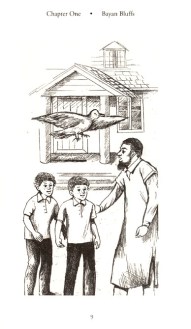
bayan.jpeg

I wish that the cover was more appealing, for a story that was so good, I wish it begged to be picked up.  InshaAllah word of mouth will carry the book, so that more like it are written and published.

FLAGS:

None, mashaAllah it is clean and wholesome.  There are good and bad Muslims and no judgement is put in a religious context.  There is some violence, but it is nothing even a seven year old would find offensive.  Alhumdulillah.

TOOLS FOR LEADING THE DISCUSSION:

I would love to do this as a Book Club book for 5th through 8th grade.  The writing quality and the different characters the students would be able to identify with, would make it a lot of fun.  There isn’t any deep or though provoking discussion points to accompany the book, but I think the genre is hard to come by and Muslim kids seeing Muslim kids solving a crime and going on a treasure hunt, is just exciting.  I couldn’t find any study guides or even much information on the book or author, but none is needed to enjoy the story.  Farah Zaman if somehow you see this review, know that I hope you keep writing, and I thoroughly enjoyed your book!  Happy Reading Everyone!


Owl & Cat Islam is… by Emma Apple

Standard
Owl & Cat Islam is… by Emma Apple

img_2935

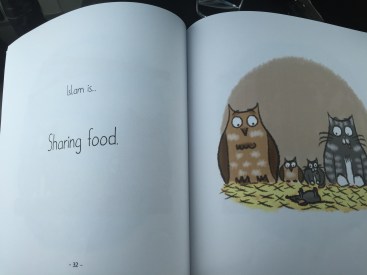
The book’s charm is its simplicity.  The text is minimal and the illustrations a small portion of the page.  But at 59 pages the book finds power in showing what Islam is to muslim and non muslim children alike.

img_2936

To say that I liked the book is an understatement, I loved it! It is perfect for bedtime and story time for kids 1 to 4.  Ages 5 and up can read it themselves in mere minutes.  The pictures not only are the story, but add a wonderful sprinkling of humor.  I mean really lets eat a mouse, better yet lets share it! EEEW! Oh wait animals and cats do eat mice!

img_2939

But why I really like the book, is because while it reminds Muslim children of all the subtle things that make up what Islam is.  It also builds bridges for children who know Muslims, or whose parents want them to widen their knowledge, as it lends it self so effortlessly to seeing how we are all the same.  Yes it mentions the names of Islamic Prayers and that Muslims read the Quran, and tells the five pillars in a non preachy way, but it also says, “Islam is Family,” and “Islam is Respecting our parents” and “Islam is Telling the truth.”  Much more alike than different.  A lesson even the littlest reader can understand and hopefully remember.

Tales of Nasreddin Hodja: The Parrot and the Turkey prepared by Gamze Alici illustrated by Sinem Zengincelebi

Standard

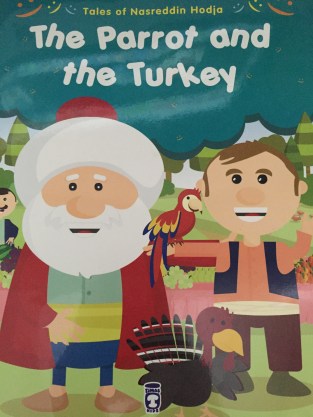
img_2803I ordered this book a while ago online.  There is a whole series of Nasreddin Hodja, so I picked a title at random.  I read it when it arrived and the story seemed to wander more than my attention span could follow.  So naturally,  I had my children read it, and they said it seemed funny, but they didn’t understand it.  I glanced through it again and figured maybe it was one of those beloved cultural characters that just lost some of their charm in translation.  In this case, Nasreddin Hodja is a folktale type character born in the 13th century from Konya, Turkey, who is the star of short stories that teach a point in a silly way.  The opening page tells a bit about him and what you can hope to learn in the story, but it didn’t help understand why the book was so fragmented.

nasreddin-hodja

In my latest move, I found the book again, read it again, and was stumped again. But luckily this time I contacted a Turkish friend instead of putting it back on the shelf and realized this book does not do Nasreddin Hodja justice, he is a hoot.  The book, not so much.

So first, a review of the book.  The book is beautiful and fun to look at.  The colorful glossy pages and clear font invite readers between ages 6-9 to read it and younger kids to have the story read to them.  The illustrations are delightful and after hearing about Nasreddin Hodja I think they convey his silly, yet wise persona.

Unfortunately the story is long.  At 32 pages with a fair amount of text on each page the author seems to try and take three tales and connect them into one coherent story.  The result is an abundance of detail that doesn’t move the story to his poignant conclusion and instead results in unresolved tangents.  For example in the first part of the story, he goes to the market to buy a few things for an alfresco breakfast with his wife.  Along the way he stops at a fountain to drink some water, he then begins shopping and after listing off dozens of vegetables and fruits, and details how he buys each item and what season they come from, he gets to his commentary of how silly a man selling a parrot for a ton of money is.  He then returns home to get his turkey to make the point to the parrot vendor that if he is asking 50 pieces of silver for a parrot that can talk, he will sell his turkey who can think for 100 pieces of silver.

This story covers about 17 pages of the book, but the same tale as told on the website http://www.readliterature.com/hodjastories.htm is only a few short sentences.

Parrot

One day The Hodja was walking around in the market place. He saw a bright-coloured bird for sale for 12 gold coins. Hodja was amazed. He approached the crowd gathered around the bird and its seller.

How can a bird be so expensive?’ he asked the people watching the bird.

This is a special bird,’ they explained, `it can talk like a human being!’

This gave Hodja an idea. He went straight to his home, grabbed his turkey and brought him to the market place. He stood near the man selling the parrot.

Turkey, for sale, ten gold coins!’ he yelled.

Hodja Effendi, how can a turkey be worth ten gold coins?’ the shoppers protested.

There is a bird there for 12 gold.’ insisted the adamant Hodja.

But Hodja Effendi, that bird can talk like a human being.’ the people tried to reason. But Hodja was unbending.

And this turkey can think like a human being.’ he countered.

Obviously I can understand what the writer was trying to do. But, unfortunately it doesn’t work.  Mina Javaherbin did something similar when retelling Rumi’s poems in children’s book form, but she had better luck.  Perhaps if the author would have kept them shorter and not embellished them to teach so many lessons about vocabulary and seasons and colors it would have actually had a begining, middle and end.  Early readers will find the pages over bearing and fluid readers will see the holes in the narrative.  Perhaps if each story were only a few pages there would have been a plot and take-away-lesson. Unfortunately as written Hodja’s message gets lost and the reader takes very little if anything away from the book.

When you research some of Nasreddin Hodja’s stories they are fun, and it becomes easy to see why children (according to my friend) dress up as him in school and he is quoted and referenced so widely and lovingly.  His stories work well in an oral tradition, obviously, and if you follow my mother’s advice (a preschool teacher for a few dozen years) and “tell” a story to little kids instead of “read” it, this book can get some use.  In story time with 3 to 5 year olds showing the pictures and talking about what is going on, on each page before winding around to the point allows them to to interact with the pictures and story and the reader to impart some of this beloved characters insight on to the audience.

hodja-set

Bedtime Ba-a-alk by Rukhsana Khan illustrated by Kristi Frost

Standard
Bedtime Ba-a-alk by Rukhsana Khan illustrated by Kristi Frost

bbaaalkcover

I know, I know another book by Rukhsana Khan, but really how great is she.  She writes books with religious references sometimes, cultural ties sometimes, and sometimes just fun books. I love that kids of all backgrounds associate her with good stories, and that she hasn’t limited herself to just one demographic.  img_1893

Bedtime Ba-a-a-lk has no religious or cultural connections and is just about a girl dealing with rogue sheep in her mind that don’t want to be counted.  The AR level is 2.6 but I don’t know that 2nd graders and below would really “get” the story.  The vocabulary is great, with a little assistance: balk, conjuring, deliberate, snub, mutiny, haunches, eider-down, furrowed, etc..  And the concept of a girl creating her imaginary dream world and conversing with the characters in it, is grand, but I look forward to testing out which age groups grasp it, and which ones just think it is a funny story with an obstinate ram.

img_1894

The book is 30 pages and beautifully, playfully illustrated.  The pictures are just “fuzzy” enough to give a sleepy feel, and bold enough to stretch the imagination.  The lines do not rhyme, but flow easily.  The font is large and inviting, and well placed on the page.  The book is clean, and the girl in her pleading with the sheep uses “please” and good manners in her firm demands.   It does use the word, stupidly and darn, once each, but overall a silly fun read.


Ilyas & Duck Search for Allah by Omar S. Khawaj illustrated by Leo Antolini

Standard

Ilyas and Duck  Search for Allah

I might have squealed in delight after reading this book.  Alhumdulillah, since starting this blog I have found that there are indeed a lot of good quality children’s books out there, but this one, well it just does it all.

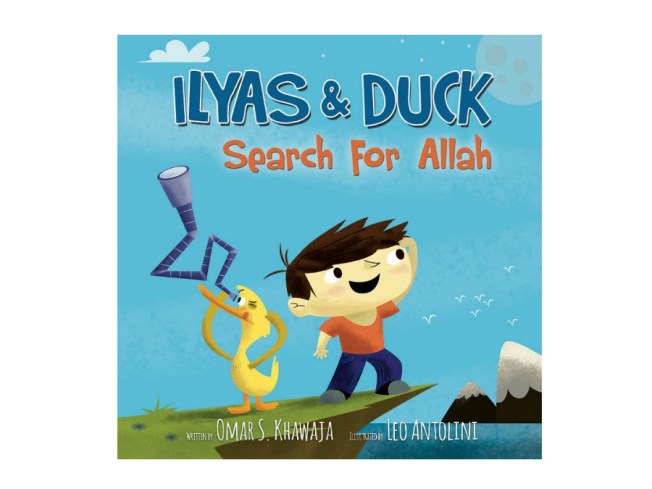
Ilyas & Duck Search for Allah is concise in words, but somehow successfully tackles the huge concept of understanding Allah (swt) through His creation in a powerful way.  And I think a big part of its power comes from its humor and silliness.  The book says it is for ages 3-6 on the inside cover, and I think that is spot on.  The dialogue between Ilyas and duck and the animals they meet on their adventure is written on a child’s level of understanding, and is silly, but not demeaning, and my favorite part is that Ilyas and Duck figure it out on their own.  There are no adults in the book telling them what Allah is or where Allah is, they ask the various animals they meet in the rain forest, underwater,  in the mountains, and come to their own understanding.  This progression makes the book pure gold at story time.  You can almost see the kids brains turning right along with the characters’ brains in the book and when they get it, forget asking them to wait to raise their hands to be called on and explain it, they are so gleefully excited they can’t contain their understanding.

The book starts with an ayah from the Quran and is not preachy or cultural.  There is a glossary of sorts at the end telling a little bit about the four animals they meet and each of the 39 pages are beautifully illustrated.  The dialogue and interactions remind me a lot of the show Justin Time, which is neither here nor there, but conveys my impression of the story’s tone.

ilyas and duck inside Whether you have students or children that are naturally curious and have asked where they can find Allah or not, this book is engaging and fun and one the kids want read to them over and over again, alhumdulillah.
Yasmine’s Belly Button by Asmaa Hussein illustrated by Charity Russell

Standard

Yasmine's Belly Button

This book is fun, fun, fun.  The mere mention of the word belly button to little kids gets them giggling, and the words and pictures in the book kept them engaged and happy through out.

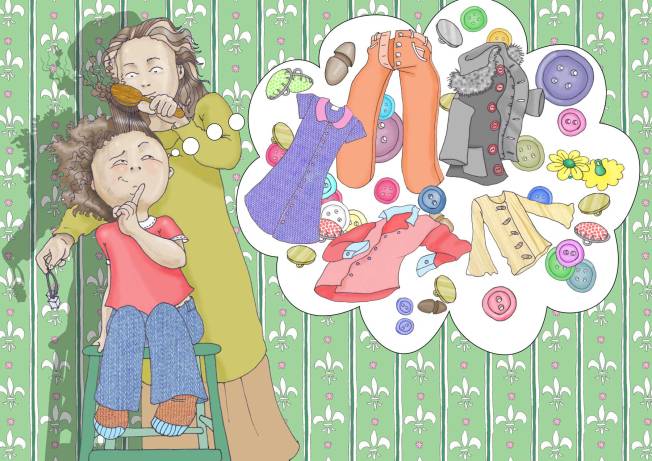
The story is a simple dialogue between 4 year-old Yasmine and her mother about belly buttons as she heads off for her first day of school full of butterflies.  We learn that everyone has a belly button, even cats! And the students have a fun time following along with Yasmine’s confusion of why it is called a button, to her understanding that it allowed her to receive food while in her mother’s tummy.  yasmine2The illustrations are bright and colorful and have a lot going on.  The expressions on the character’s faces compliment and complete the text seamlessly to tell a well thought out story.  They keep the audience’s attention even after the text is read, with the kids telling me to “wait” so that they could soak it all in before I turned each page.  The mom and teacher’s expressions on the last page amused the daycare through Kindergarten students and made them feel like they were in on the silliness.

A lot is conveyed even with just a few words on its 28 pages.  The reader sees what she thinks, they see the mom without hijab at home and with hijab when she goes out, they see a diverse classroom, a patient mom, and a way to deal with being nervous in a new situation.

I read this book to many students at school and to my own children at home, and can tell it will be an often requested book in both settings, mashaAllah, I highly recommend it.