Tag Archives: Football

Kicked Out by A.M. Dassu

Standard
Kicked Out by A.M. Dassu

81h06Amch6L._AC_UF1000,1000_QL80_

The first few chapters of this 336 page middle grade book were rough. It is a stand-alone companion novel, and I have read the previous works, so I don’t know if my expectation of myself to know the characters being introduced, was additionally muddled because the memories were faint, or as I actually suspect, the writing at the beginning is just weak. Like really weak, but I’m stubborn, and I kept reading, and I was rewarded, alhumdulillah. The book found its voice, its pacing, its heart, its relatability, its layers and I am so glad that I didn’t dnf it. The characters, their community, their tenacity, the exploration of family really stays on level with providing the reader insight and messaging to make them reflect on their own lives, without feeling preached to. The focus of football (soccer) keeps the book light and hopeful, while the difficult themes of deportation, Islamophobia, refugees, theft, absent parents, self doubt, forgiveness and second chances with adults, thread in and out. Many of the characters are Muslim, halal food is normalized as is saying salam, it isn’t focused on Islam but the kids make duas before they start a sting operation and when life changes are presented, also they consider Qadr of Allah when things occur. It feels authentic, and Muslim kids will enjoy that the focus isn’t a religious or cultural identity crisis, but just part of who they are as they take on this next chapter of their lives, non Muslims will feel the same.

SYNOPSIS:
Ali, Mark, and Sami are living it up since Mark’s mom won the lottery and they move in to a mansion with a pool. Sami’s brother Aadam starts doing the lawns to help pay for his lawyer fees to appeal his deportation, and things are looking up, expect for Mark’s mom’s new boyfriend though, he seems to be a bit of a racist. It all comes pouring down when Aadam is accused of stealing money, the boys are no longer allowed at the house, and Mark is prevented from hang out with his friends. Ali and Sami are not about to take this treatment without a fight, they have an idea to raise some money for Aadam with a charity football match, and Mark knows his mom is being influenced by her boyfriend and doesn’t abandon his friends. Ali though, is preoccupied, his absent father shows back up, and his step-brother has just been enrolled in their school. It is a lot but together Ali, Sami, and Mark support each other, stand up for what they believe in, and find ways to make sure they and Aadam are not “kicked out.”

WHY I LIKE IT:
I love the commentary on refugees, that it isn’t a political issue, but a human one. The exploration of found family and born family, and giving family second chances impressed me in a middle grade book. I also liked the kids hyping up the community and getting creative to solve a problem, rather than wait for the adults to step in. Whether it was to raise money for legal fees, or solve a mystery and clear someone’s name, these kids really have each other’s backs while dealing with a lot of heavy stresses. They mess up and make mistakes, but the book spending time to show them come back from them is a level of emotional intelligence and maturity that I think readers will benefit from.

I was thrown at a passage that mentioned that Ali can’t go to the mosque because he doesn’t have his dad around. Which made no sense to me as the kid goes to restaurants, parks, stores, on buses, on his bike alone throughout the book. Alhumdulillah, I have wiser folks I can ask concerns to, and my Lit Sister Zainab explained that in fact in the UK some masjids don’t allow women all the time and kids are not encouraged to come unsupervised, so if that stands out to you as well for being completely off, recognize it doesn’t mean it is wrong, like I did.

Truly the book is terrible at the beginning. The barrage of character names, the unlikability of Ali because of how he treats his brother, and the stress of how winning the lottery has made Mark’s life better, is all over the place. I must have read the first three chapters at least four times, before I just decided to plow through and see if the pieces fell in to place, which alhumdulillah, they did.

FLAGS:
Lying, stereotypes, racism, Islamophobia, accusations, theft, lottery, Mark has a crush on Grace, but it is subtle, anger, jealousy.

SPOILER: Ali’s dad was in love with a lady before he married Ali’s mom. His parent’s had him marry Ali’s mom to tame their “wild son” and at some point in the marriage, the dad had a nikkah with the first lady and eventually left Ali, his mom, and two siblings for his other family. The focus is how Ali feels about having his dad leave their family, being jealous of his step brother, and dealing with his return. It doesn’t make it a religious issue or judge if this was permissible, it really stays focused on the parent children relationship and the emotions involved in the leaving, not staying in touch, and the returning. I think middle grade can handle it.

Kareem Between By Shifa Saltagi Safadi

Standard
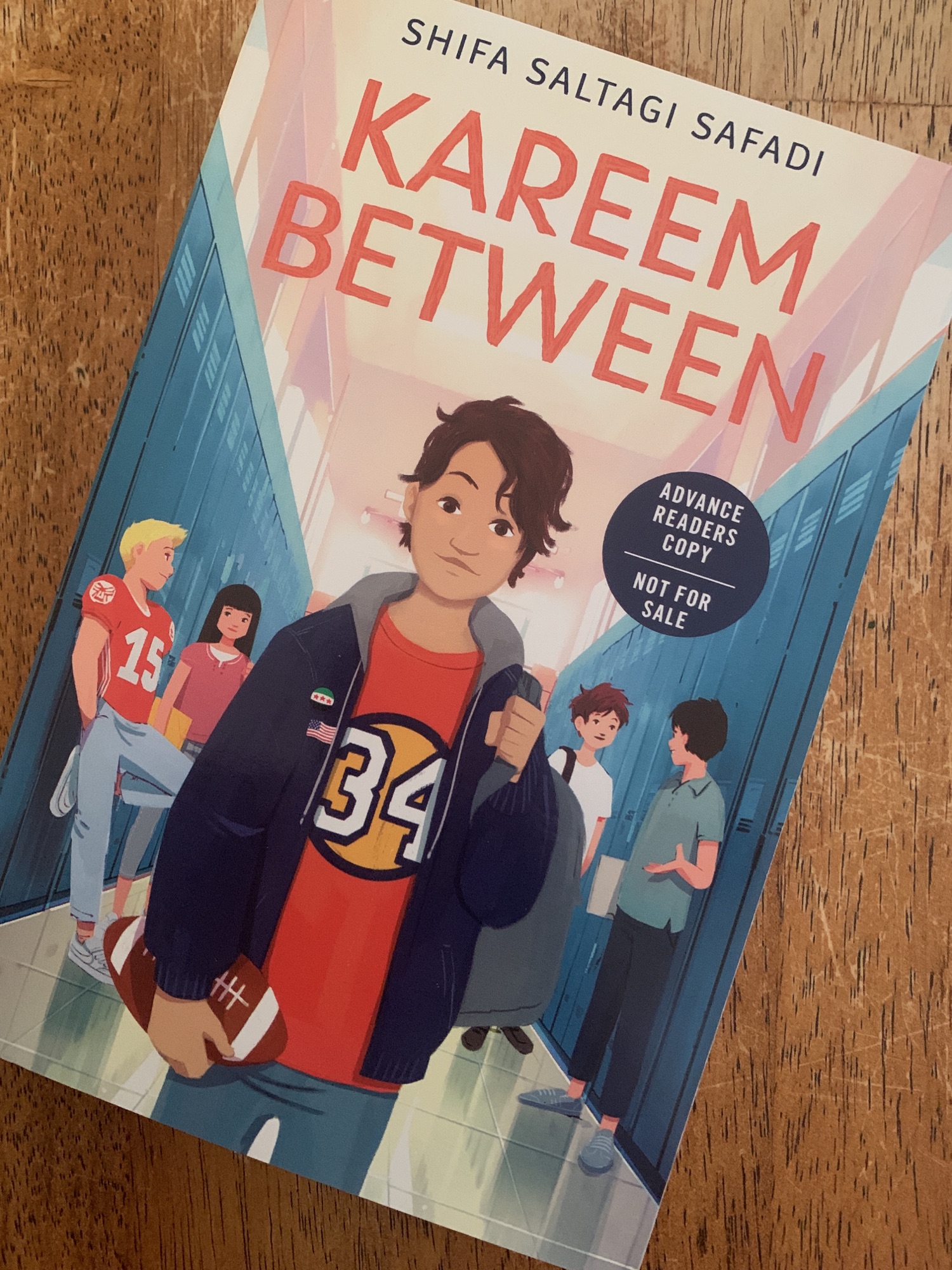
Kareem Between By Shifa Saltagi Safadi

img_3395-1

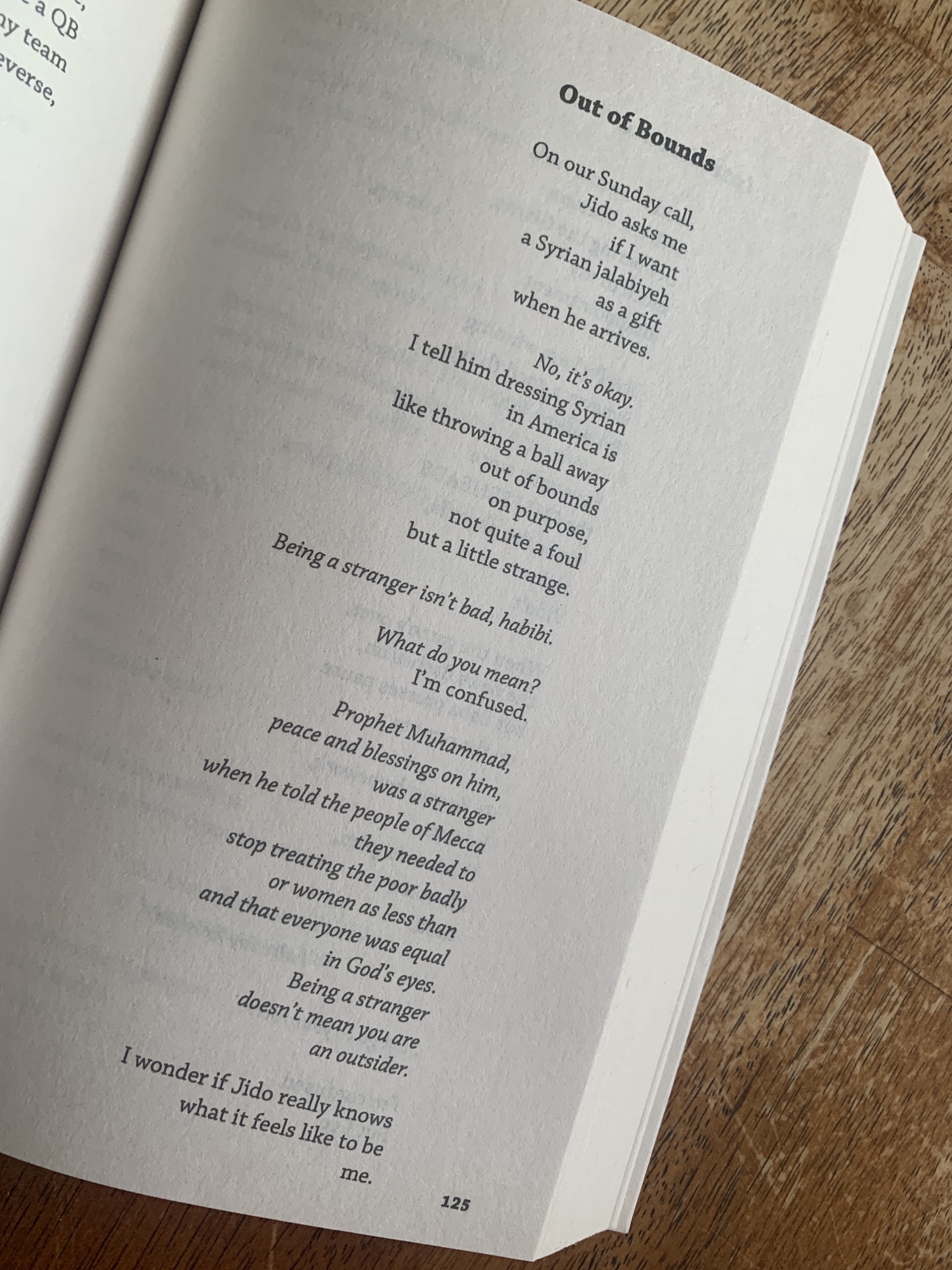
It doesn’t matter how many Word documents you read, Goggle docs you add comments to, and screen shots you revise; to hold a physical book in your hands that you have been blessed to observe from the sidelines through numerous revisions, is mind blowing.  Reading the final version from page 1 to page 324, plus the backmatter, has left me at a loss for words with tears streaming down my cheeks. I truly cannot imagine the book any other way. All past drafts and storylines, were just stepping stones to get the book to this version, and as a fan of literature my whole life, to see this metamorphosis in real time has added to my respect and admiration of authors.  Enough about me though, this review is of the middle grade novel in verse that tells the story of Syrian American Kareem, a loveable boy caught in between choices, siblings, friends, labels, and global acts beyond his control.  He makes mistakes, he tries to make things right, and at the center of it all is his Islamic identity, love of football, and genuinely good heart.  I am biased in that I have self appointed Kareem as my nephew, but even after dozens of readings, I was moved to tears three times during the course of this reading.  I made my teens read the book and they loved it, and like them, we hope we get more Kareem in the future.

img_3541-1

SYNOPSIS:

Kareem loves football, particularly the Bears, and dreams of seeing his Arabic name on an American jersey one day in the NFL.  Unfortunately, he hasn’t made the school team, his best and only friend Adam has moved away, and the coach’s son is offering to talk to his dad for Kareem in exchange for some school help.  Add in a new Syrian kid at school, his mom going to Syria to take care of his grandfather, and the fruition of Executive Order 13769 aka the Muslim Ban, and seventh grade has Kareem scrambling on every down to say the least.

img_3543-1

WHY I LOVE IT:

The football framing, the literary inclusions, the Arabic, the Islam, all combine with such tangible heart to create a seamless read both as a compelling story and as an example of literary craft.  The language is on point and intentional, that even if you don’t know the character or novel referenced, the Arabic words included, or football terminology used, you will be invested in the characters and plot, and find yourself cheering for Kareem.  Often debut authors show promise, but their stories have plot holes, or pacing issues, or inconsistencies, that is not the case with this book.  The crumbs are there that tie everything together, the depth of the characters’ personalities reveal how developed they are, and the timeline keeps the book moving forward.  There are no dry or slow spots in the entire novel, it is easily read in one sitting as you find yourself nervous for Kareem, and curious how it will resolve.

Boys and girls, Muslims and non Muslims, Arabs and non Arabs, all will find themselves drawn to this book, and thinking about the characters, particularly Kareem, long after the final page is read.

img_3544-1

FLAGS:

Some stress and anxiety with missing parents.  Death, bullying, cheating, fighting, lying, racism.

img_3540-1

TOOLS FOR LEADING THE DISCUSSION:

The book is a solid middle grade, but the quality of writing and engaging plot makes it work for a middle school book club read as well.  I cannot wait to share this book widely.

Preorders speak volumes and I truly hope if you are able that you will preorder a copy, you can do so here.  Requesting your local public library to shelve the book is also a tremendous help to signal to publishers what type of stories and OWN voice authentic representation consumers will support.

World in Between: Based on a True Refugee Story by Kenan Trebinčević and Susan Shapiro

Standard

world in between

I’ve read a lot of refugee stories over the years about people leaving a variety of countries, and while each one, no matter the quality of writing, is heartbreaking and important, this middle grades 384 page historical fiction/ fictionalized biography account stands out because it is written so incredibly well.  The story shows young Kenan’s life before the Balkan War in Bosnia, a year of the war, life in Vienna, and then in the USA.  The book is personable, relatable, and informative.  I had a very hard time putting it down despite knowing that the main character, the author, obviously survived; as the story is engaging and powerful and doesn’t rely on the horrific war to carry the character building and story arcs alone.  The character identifies as Muslim, but doesn’t actively practice or know much about Islam, sports and art are highlighted as universal activities that bridge cultures, language, and foster respect.  The book mentions drinking, kissing, hints at a crush, and features bullying, death, killing, and torture.  Suitable for mature fourth graders and up.

SYNOPSIS:

Kenan has a good life in Brčko, Yugoslavia, he is good at soccer, is an amazing artist, has a bunch of friends, a teacher he likes, loving extended family, his father owns a popular gym, and his mom is an office manager, sure his older brother picks on him sometimes and he gets called, “Bugs Bunny” because of his large protruding teeth, but when it all comes crashing down because of his religion, he is at a loss as to why it suddenly matters.  While neighbors and classmates start sneaking off in the night fearing that the Serbs are going to kill all the Muslims and Catholics, Kenan’s dad holds out hope that he is well loved by everyone at his gym, no matter their religion.  But the family waits too long to leave, and friends, neighbors, classmates, and teachers quickly turn in to enemies.  Kenan’s buddies threaten and abuse him, his favorite teacher holds him at gun point, and neighbors shoot holes in their water cans.  The family ultimately has to hunker down in their apartment without much water, food, and electricity.  They get to Kenan’s aunt’s house in a safe zone, but the men have to register and his father and brother are taken to a concentration camp.  Somehow they get released, but the family’s troubles are just beginning.  Along the way they will be betrayed by people they thought they could trust and helped by people that they thought hated them- no matter the country, no matter people’s religion.  The family will get to Austria and to Kenan’s uncle, but even being away from war doesn’t give them peace.  They don’t speak the language, they can’t work, they must take charity.  Eventually they find themselves in Connecticut, and while some American’s make their difficult lives even worse, some prove to be absolute angels to a family that is trying to make a life in a new country while the war wages on back home.

WHY I LIKE IT:

I love that stories about the Balkan War are becoming more and more available, it is long overdue, and I’m glad that through literature, authentic voices are keeping the memory of the horrific acts from being forgotten.  The story is compelling, a few threads I wanted resolved that weren’t (more information on his grandma, his uncle in Vienna, his aunt that they left behind), but the narrative is rich and does a great job staying relevant to its target audience and not overwhelming the reader with politics or sensationalized emotions.  The rawness of the experience being processed by the 11 year old protagonist is impactful enough and doesn’t need to be exaggerated.  The book is not depressing, in fact there is a lot of joy and hope and kindness.  

I love that Kenan acknowledges that he has been to the mosque once with his uncle, that they don’t fast in Ramadan, but they do celebrate Eid.  It hints that at times they may drink, but they are good about not eating pork, although they eat jell-o. In shop class in the United States his first project is a replica of the mosque in their neighborhood.  Their names are known to be Muslim in Bosnia, and that is enough for them to endure the ethnic cleansing, belief or adherence, is not a factor.

I love that sports and art are universal.  Math is too, but Kenan isn’t good at math.  He wins accolades in each country for his drawings, and gets respect from classmates for his athletic ability.  Not speaking the language is hard, but being able to prove yourself in other ways is a salvation for Kenan.  He is on teams, he goes to the World Cup, he gets in fights, he is honored in the newspaper.  Life in general grounds him, yet soccer and drawing give him a release to excel in.

I love the diversity of everyone in each country.  Heroes are seen in immigrants, minorities, Americans, a Methodist preacher, an Israeli bus driver, a Serb bus driver, a Serb soldier and his family, a .  There are awful immigrants, and white Americans, and Serbs- it really shows that some people are just good and kind, and some people are not, it isn’t linked to any faith or country or culture or neighborhood or skin tone.  I was surprised that at no point were their other Muslims.   We got to know so many wonderful Bosnians in the 90s as our family helped them get settled, that I was really hoping there would be some in Connecticut working with the churches that helped settle Kenan and his family.  That isn’t a critique of the book, though, just my disappointment in my fellow Muslim-Americans for not stepping up enough in real life to make the literary cut, I suppose.

FLAGS:

Violence, torture, death, bullying, killing, shooting, hints at sexual assault, physical assault, ethnic cleansing, genocide, war.  It mentions that Kenan’s brother got to kiss a girl and have a drink, but nothing more detailed than that.  Kenan has a crush on a girl, but it manifests periodically as him just wondering if she survived and is ok.

TOOLS FOR LEADING THE DISCUSSION:

This book is on a short list for me to use next year for middle school book club.  It is a little below grade level for my group, but book club is supposed to be fun and not a burden, so I think it will be perfect.  The kids are going to absolutely love Kenan.  He is so relatable and personable, that I don’t think any supplemental questions or discussion points will be needed.  Kids will have lots of thoughts about Islam in Bosnia, friends turn enemies, restarting in new countries again and again, anger at people that didn’t step up, glee when people did, jealousy when he gets to go to a World Cup game, and hopefully empathy for so many who’s world changed so quickly.  The biggest takeaways will be how it didn’t take much to help, and I hope all readers will recognize that we can be kind and we can help and we can respect and care enough to truly help others.  

The Victory Boys by Jamal Orme illustrated by Eman Salem

Standard
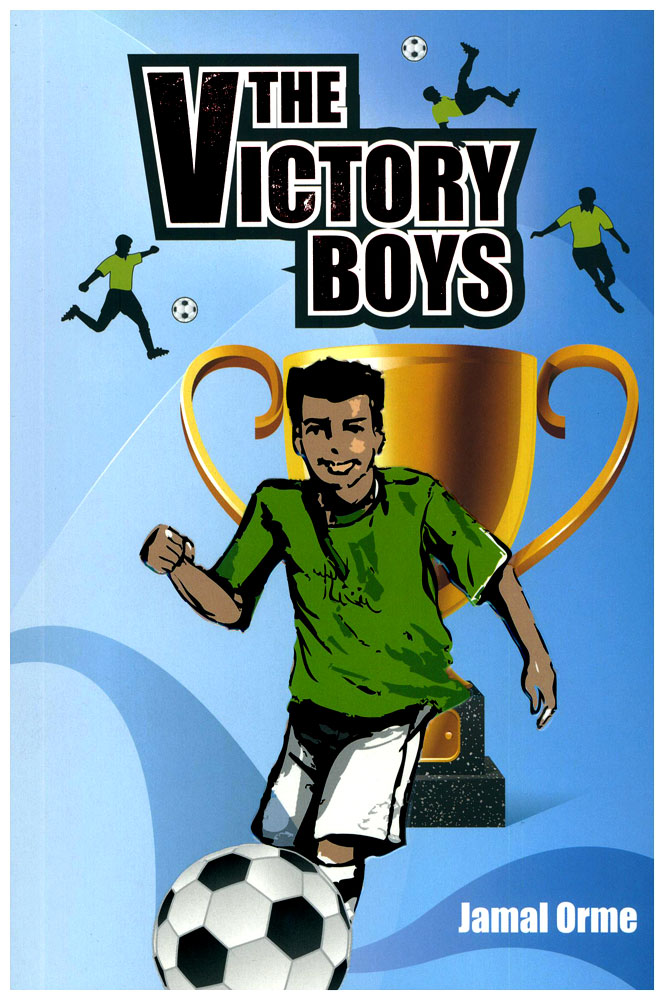
The Victory Boys by Jamal Orme illustrated by Eman Salem

victory boys.jpg

I’m not sure why Amazon states the book is for pre-school and up, when the publisher, Kube, posts this book for ages 7 and up.  I think 3rd or 4th grade soccer/football fans will enjoy the book.  There are some slightly mature ideas presented and worked through, and the soccer lingo assumes the reader knows the sport.  Plus the quality of the illustrations and the small font isn’t going to entice someone not already excited to read the book based on the content within.  My boys, ages 8 and 9, enjoyed the book, as did I, once the story got going.  It doesn’t really grip you from the first sentence, but as the story progresses and the way Islam is woven in makes for some learning experiences in the midst of a few intense football matches.

SYNOPSIS:

The boys at the Sunday Madrasa do not enjoy their time there.  They find the Imam boring and thus are not inspired to learn. When they sneak a football into break time however, they suddenly feel more engaged and present in their lessons.  A change the Imam notices and appreciates, but doesn’t know the reasoning for as he strictly forbids football and finds it a waste of time.  Outside of Madrasa, Junayd is having a hard time at home.  He has to help out a lot at his father’s restaurant and his older brother Saleem has gotten in trouble with the police.  His mom prays for the kids, but is also at a loss as to how to help with the stresses at home.

During a secret game of football in the masjid courtyard, an arrant ball breaks the neighbor’s greenhouse window, and the boys are forced to come clean about their covert game.  The Imam demands the kids stop playing and that they tell their parents what they have done, so that they may earn some money to replace the window.  As the kids come through with the money and the Imam sees the kids resort back to their lackluster attitudes to learning.  He gets an idea to start a football club after madrasa classes.  The only problem is that he knows nothing about the sport and no parents are willing to help.

Saleem by chance comes to collect his brother one day, and as he hollers advice from the sidelines, the Imam recruits him to coach the team.  In response the Imam ever so gently uses football to teach not only the madrasa kids, but Saleem as well.  When the boys learn of an upcoming tournament, the Madrasa enters an A and B squad and the Shabab Al-Nasr, Victory Boys, will be tested not only in their play, but also in their manners, and understanding of what it means to be a team and Muslim.

WHY I LIKE IT:

I love that the Imam grows and changes.  I mean it is a kids book about soccer, but really it is the adult in the story that shows the most heart.  He goes out of his comfort zone, reevaluates his opinions, and admits when he is wrong.  High five Imam!  I also like that he didn’t give up on Saleem, and the way he leads him is with such kindness and compassion, that even youngsters, will be impressed.  

The book does not talk down to the reader, which is nice, but at the same time I think it pushes the age appropriateness a bit with the detail devoted to alcohol being sold at the restaurant, Junayd’s father’s flaws, and even Adam’s dad’s tantrum of sorts.  There really aren’t any nice parents in the book.  We don’t learn much about the moms, but none of the dads seem too supportive.  Really the only nice adults are the Imam and the neighbor who’s window they broke.

The timeline isn’t entirely smooth, the kids come together and play well as a team remarkably fast for how intense the tournament is, and how well they perform. And some of the characters could have used some fleshing out, I couldn’t really tell you much about them.  The font is really small and the spacing often forgotten.  The book is about 95 pages with a glossary and an acknowledgement at the end, fortunately the 2nd book in the series seems to space the words and lines out more and is 155 pages.

The story is solid and for the most part well written.  I read it in one sitting and thoroughly enjoyed the lessons learned and then put into practice.  The book isn’t preachy, but you are glad to see the Imams words given life in the other characters’ actions.  Saleem changes quickly, but the author and story account for it in a way that is believable for the audience and the message of not giving up on one another comes through loud and clear.  There is a lot of technical detail about the sport, but it doesn’t drag on, it adds to the excitement even if you just know the basics.

FLAGS:

The talk of alcohol, of Saleem being with a group of kids and a stolen car, there is some yelling and aggressiveness from the adults.

TOOLS FOR LEADING THE DISCUSSION:

The story is a bit short for a book club selection, but I would definitely consider it for Lunch Bunch (where I read to 4th and 5th graders while they eat lunch).  And I think most Islamic School libraries and classrooms should stock the series.  

https://thevictoryboys.com/

https://www.youtube.com/watch?v=oSpK6-fNiSQ