Tag Archives: fictionalized framing

Eliyas Explains: What was Prophet Muhammad (saw) Like? by Zanib Mian illustrated by Daniel Hills

Standard
Eliyas Explains: What was Prophet Muhammad (saw) Like? by Zanib Mian illustrated by Daniel Hills

Zanib Mian once again fills a void in the literary world for our children using her easy to read and relate to protagonist’s voice.  Over 149 pages, filled with illustrated doodles, details about our beloved Prophet Muhammad (saw) flow through the fictional framing of Eliyas and his family heading to the airport to pick up their Mamoo.  It starts with the standard introduction of characters that all Eliyas books have, so while it is part of the series it can be read as a standalone as well. But really if you have children 5-14, you should invest in the entire collection.  Also, as with the rest of the series, the book is checked by a Shaykh who is named at the beginning so that the reader can enjoy the Islamic details that are to follow. I know there is some debate about the cave and the spider, a story shared briefly within the pages, but I will leave it to those more knowledgeable to decide upon.  The book works well read aloud and independently, either way I’m confident children will enjoy the story, learn something new, and grow in their love of our Rasul Allah, alhumdulillah.

SYNOPSIS:

Eliyas’s dad’s uncle, Haroon Mamoo is coming for a visit, and while Mum wants to make sure they leave at a specific time to get to the airport, Dad isn’t stressed, he had a dream about Prophet Muhammad saw the night before and the kids want to hear all about it.  The story progresses weaving in things around them with Mum and Dad tying them to the sunnah.  From a fight at the airport, to a pigeon getting stuck, to Haroon Mamoo seeming to have gotten lost. The book is preachy, in the best way possible, as Eliyas and Aasiya banter, crack jokes, and learn along with the reader.

WHY I LIKE IT:

I love Eliyas’s voice and the weaving of a fictional story to convey the non fictional sunnahs that are truly the heart of the book.  The information presents in an easy way for children to hopefully remember it, and to also see how they should be behaving and acting in their own lives. The fun fonts, illustrations, and layout make it inviting to pick up and keep reading.

FLAGS;

None

TOOLS FOR LEADING THE DISCUSSION:
This book is not a journal, like some in the series are, but provides ample opportunity to discuss points on each page.  
Solar Story: How One Community Lives Alongside the World’s Biggest Solar Plant by Allan Drummond

Standard
Solar Story: How One Community Lives Alongside the World’s Biggest Solar Plant by Allan Drummond

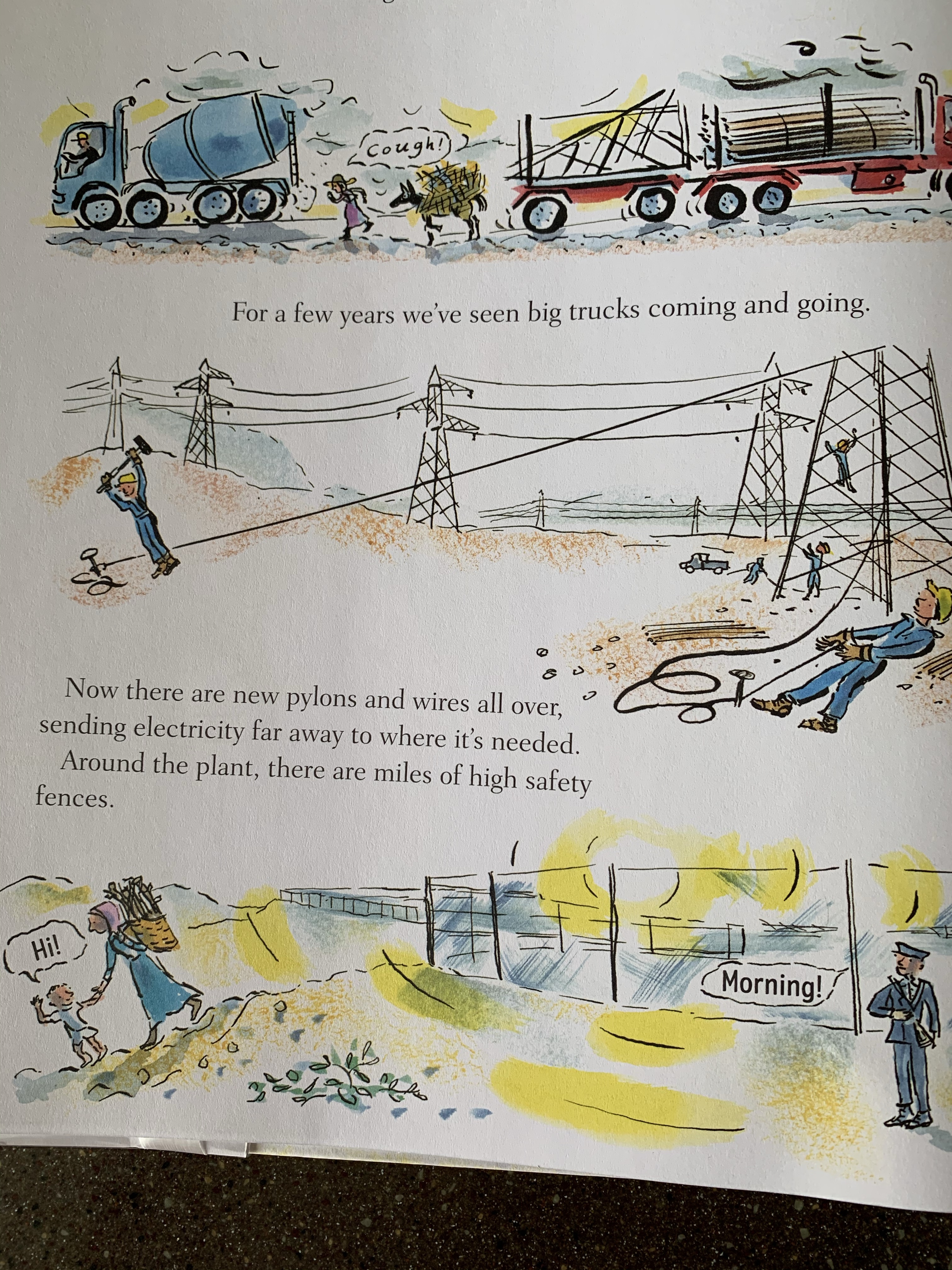
Set in Morrocco, the fictionalized framing of a children’s story about solar energy and sustainability at the the world’s largest solar plant in Ghassate will appeal to curious children in kindergarten and up. Told through the every day life of Jasmine, a little girl living near the plant, the concepts are not technical, but give a broad overview allowing readers to understand how impressive solar energy is, as well as the disparity that exists in the world. Over 40 pages with factual sidebars and an author’s note at the end, children who enjoy the story and are curious about the reality of it all will find an easy opportunity to learn more.

Jasmine and her friend Nadia live in Morocco between the High Atlas mountains and the huge Sahara desert. It is always sunny where they live.

They talk a lot about making energy from sunshine as they watch trucks going and coming from the world’s largest solar plant. Their teacher likes to ask them about the big changes happening in their world.

As the villagers tend to their sheep and cows, they cook on open fires and bake bread in clay ovens all while keeping an eye on the workers making the largest solar tower in the world. Jasmine’s dad rides a mule to work and many classmates parents work at the state of the art plant. The contrast is obvious.

The next day at school Miss Abdellam the teacher asks the students about sustainability. And the book doesn’t define the concept right away. First the class goes on a field trip to the solar plant.

At the plant the size of 3,500 soccer fields they see the 660,000 mirrors that follow the sun like sunflowers and bounce the rays to the 800 ft tower. The tower gets to a thousand degrees on top and heats water whose steam powers turbines and is turned into electricity.

The kids go home to work on their sustainability homework. With no internet or computers even, they have to think for themselves. The remaining pages define and provide examples of how solar power is changing life for the villagers and improving life for people not just in Morrocco or Northern Africa but potentially the entire world.

I love that the concept of sustainability isn’t just a definition it shows how it is in every day things, and those every day things lead to big things that are both tangible and ideological. The author/illustrator acknowledges his own surprise and bias when he learned that the largest solar power plant was in Nothern Africa. I love that some of the females wear hijab, and some do not, and that the teacher and some of the parents at the solar plant are female. There is nothing religious even mentioned in the book, but the visibly Muslim characters are empowering and honest for a story about science and Morocco.