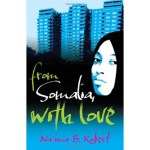
I didn’t realize the book was written in prose until I opened it up to read, and immediately taken-aback I rechecked the AR level and sure enough, this 309 page book that is written in prose and covers the genocide in Darfur, is written on a 4.2 level. And it is amazing. I forced myself to stop reading at one point so as to not rush the depth and soul of the simple words from being lost in haste. It is truly, in my opinion, a beautifully remarkable feat to convey such horrific atrocities with such hope and integrity to young adults in a palatable and inspiring way.
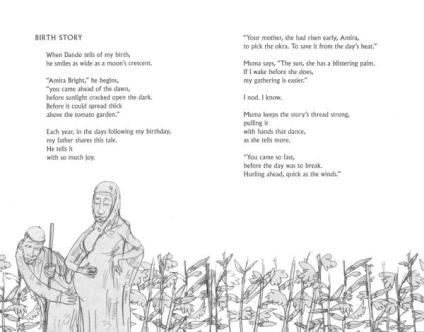
“Allah is the light,” he says.
I ask,
“How do you find Allah’s light?”
Old Anwar says,
“Take the path that shines the brightest.”
SUMMARY:
Amira’s life on her family’s farm is by no means easy, but she has loving parents, a little sister, her beloved sheep, and a dream of going to school. Her father advocates for her, but her mother, steeped in tradition, sees education only as a waste of time. The illustrations and sparse words manage to convey fairly solid understanding of Amira’s life, optimism, and relationships with those closest to her. Although warned of the dangers the Janjaweed could cause, Amira remains fairly unconcerned about the mounting political unrest around her, until it is too late. When death and the destruction of her home force the surviving members of her family and neighbors to seek refuge in a camp many miles away, the reader sees how truly horrific her experiences have been. She refuses to speak or rather cannot, when a chance encounter with an aid worker brings her the prospect of getting her voice back, through the empowerment of a red pencil. With restored determination she convinces an elder neighbor to teach her, but it is not enough for Amira Bright. Her sparrow needs to soar free.
WHY I LIKE IT:
You expect a book written in verse to have a lot of imagery and symbolism, and The Red Pencil does a good job of balancing the story and the description, to keep the book on track. The linear story line remains focused on telling the story at hand, making it attainable for elementary and middle school children. The Darfur conflict is complicated at best, and using verse to convey it from a young girl’s voice allows a lot of the politics and dirtiness of war to be side-stepped without dismissing it. Amira’s optimism and hope is at times naive, but more as a reflection of her personality then out of ignorance. She sees things, and feels things, and must deal with things, no child should, but her spirit shines through and keeps the book from being depressing, while still being sad.
Today the red pencil does more
than beg for my hand.
It makes me a promise.
It tells me to try.
The characters are Muslim and they rely on Allah, and pray, yet Amira’s thirst for knowledge includes that of learning the Koran (Qur’an) as that knowledge too, has not been readily available to her There is a lot to discuss in the book, both what is written and what the reader brings to it. I look forward to teaching the book, and re-reading it once again to savor in the rich images.
Here,
Muma stoops.
Here,
she has nothing to reach for.
FLAGS:
Their is violence when the Janjaweed attack her family. But I think it is conveyed in a manner suitable for 3rd grade and up. It is not celebrated or glorified, it is traumatic and has repercussions that are respectfully conveyed. There is also mention of a child bride, but not in so many words, that in all honesty I doubt most young readers will be as bothered by it as perhaps they should.
TOOLS FOR LEADING THE DISCUSSION:
There is a discussion guide in the back of the book along with an Author’s Note, Acknowledgements, Glossary/Pronunciation Guide, Character/Location Pronunciations, and Important Terms that Appear in the Book.
An Educators Guide: http://media.hdp.hbgusa.com/titles/assets/reading_group_guide/9780316247801/EG_9780316247801.pdf
A study guide and quiz: http://www.bookrags.com/studyguide-the-red-pencil/free-quiz.html#gsc.tab=0


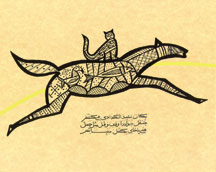
 A calabash cat in the middle of Africa wants to see where the world ends. When the road stops at the edge of the great desert he thinks it stops there. But a Camel corrects him and offers him a ride on his back to show him where the world ends. When they get across the desert, the camel puts him down on the edge of the grassland and tells him this is where the world ends. A horse corrects him, that in fact this is not where the world ends and offers to show him where it does. He climbs up on the horse and the gallop through the grassland. This continues through the jungle on a tiger, the ocean on a whale, then on the back of an eagle all the way home. Written on a 3.3 level, there are 32 pages with a author’s note about where the idea for the story came from. The book works well for story time and the repetition makes it good for bedtime too.



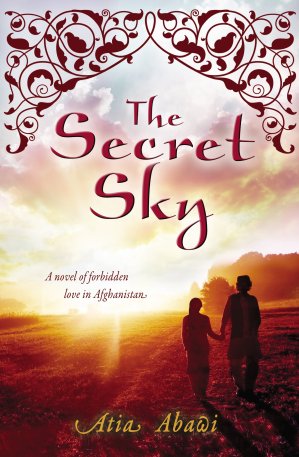
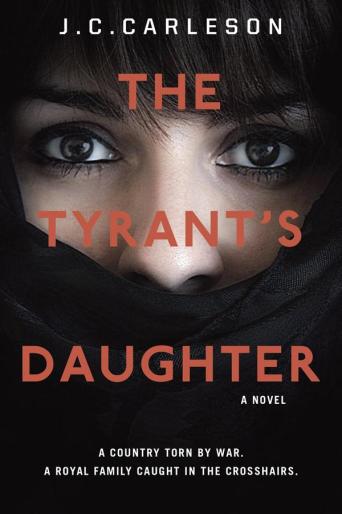 I was intrigued to see this book offered by Scholastic in the teen Reading Club Catalog as it sounded both action packed and cultural. The jacket cover summary was vague in describing the characters as being from an “unnamed Middle Eastern country,” but with the slightly veiled girl on front, I figured they probably are Muslim, and I should at the very least how they/we are being portrayed. The book is 295 pages long and that includes the story, the Author’s Note, and a Truth in Fiction section. The author is a former undercover CIA officer and the intense action, intertwined with cultural understandings, leave the reader second guessing and on the edge until the end. The AR level is 5.1, but with the profanity, sexual situations, and violence I would recommend the book to those in high school and up (15+).
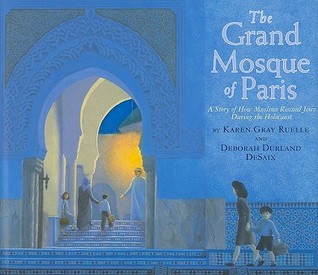 This beautiful, beautiful book tells of a little and sparsely known event in history. During the holocaust The Grand Mosque of Paris served as a place of refuge for many North African Jews. Many who passed through the vast gardens and beautiful Mosque were given fake documents of conversion, tombstones with their family names inscribed, and access to truly underground passageways (subterranean mazes), as the Muslims of Paris offered assistance to keep their Jewish brother’s and sister’s safe from the Nazi regime. Many of the stories were recently uncovered and with the passage of time, so much of the information has been lost. As a result the book is a bit choppy, each page tells what is known about the Muslims’ assistance in some capacity, but does not flow to the next page. So there are generalized recountings of children being hidden with other families, the efforts of the Kabyle Ressistance (Berbers from Algeria) to smuggle Jews to safety, etc.. There are also a few specific examples of Salim Halali, a young Berber Jew from Algeria, two friends one a Muslim the other a Jew seeking shelter, a Tunisian Jew who stayed at the Mosque for over two years,and a few others, but with the exception of the use of the Grand Mosque and a Doctor Ahmed Somia very little flows throughout the book. Thus making it more of a historical account than a story.


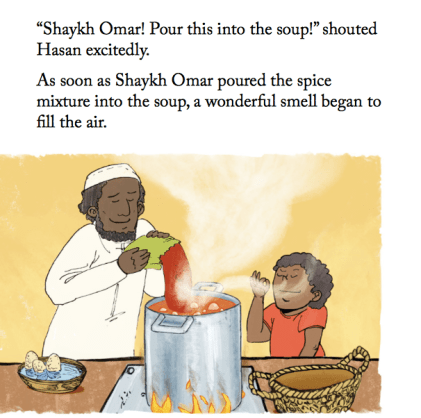
 The real treat of the book however, is how it all comes together: the words, pictures, sentence structure, font, size, and diction all compliment each other on the same level. I read a lot of books aloud as a children’s librarian, and while the rhyming ones are great for the littlest listeners, there is often a void of read-out-loud stories for the kindergarten and first grade levels. And I am talking about all books, not just Islamic ones. Most picture books in my experience are written on a third grade level, with longer blocks of texts, smaller fonts, a wider range of vocabulary and longer sentences. These books are often beautiful and very tempting, however when I read them during story time I end up “summarizing” them, and telling the story rather than reading it. Similarly, early readers often find them frustrating and too difficult to read independently. Bismillah Soup strikes a wonderful balance, mashaAllah.