Tag Archives: clean

The Breadwinner By Deborah Ellis

Standard

breadwinner

The Breadwinner is the first book in Deborah Ellis’ four book series about 11 year-old-Parvana, her friends, and her family in Taliban controlled Afghanistan.  The remarkable thing about this book is that it is a compelling story, that has moments of intensity and reality, yet never falters from being on about a 4th grade reading and comprehension level.  The AR level is 4.5 and as a teacher I taught the book as a novel study to 4th graders, and now as a librarian I presented the book for my Jr. Book Club.  In both cases, after completion, the children are arguing and fighting for the next books in the series, Parvana’s Journey, and then Mud City, and finally My Name is Parvana.  It is not a tempting book on the shelf necessarily, but once you start, it is hard to put down.

SYNOPSIS:

The book gives readers a glimpse of how the Taliban changed the day-to-day lives of the Afghani people.  Young Parvana starts out helping her father, a  former History teacher, earn a meager living by reading and writing for the illiterate in the marketplace, and selling odds-and-ends that the family is willing to do without in order to survive.  As a young girl she is allowed to accompany her father into the marketplace, her older sister and mother, however, have not left their home in a year and a half.  When Parvana’s father is dragged off to prison, the family is in need of a provider, a breadwinner, and with some of her deceased brother’s clothes, a haircut and some courage, young Parvana becomes Kaseem.  She carries on her father’s work, digs up bones to earn more, and sells items from a tray to keep her family afloat.  In the process she meets an old classmate, Shauzia, who is also disguised as a boy, an old gym teacher, Mrs. Weera, determined to fight back through disseminating journals and magazines, and other characters that bring the horrors and hope of the Afghan people to life.

WHY I LIKE IT:

I like that it doesn’t get too political, which would bog down the story and turn off young readers, and while it presents unfair imprisonment, stadium style punishments, death and pain, it does so in a way that evokes empathy not fear.  It even at times finds a way to stay light-hearted and offer up hope as the reader sees the resilience and determination of these people.

“I’ve been thinking about starting up a little school here,” Mrs. Weera said to Parvana’s surprise.  “A secret school, for a small number of girls, a few hours a week.  you must attend.  Parvana will let you know when.””What about the Taliban?” “The Taliban will not be invited.”

FLAGS:

The book is intense at some moments, such as when the father is taken by the police, the girl’s nearly see prisoners having their hands chopped off, and the characters discuss landmines.  But it is on a child’s level, too much description is not offered and for most 3rd graders and up, I think the book is a great dialogue starter about what some people have to endure in the world.

TOOLS FOR LEADING THE DISCUSSION: (There are a lot of resources for this book)

Author’s website and study guide:   http://deborahellis.com/teacher-resources/

Unit study:  http://www.teacherspayteachers.com/Product/FREE-The-Breadwinner-Unit-Guide-for-Students-365169

Lesson plan:  http://coolkidlit-4-socialstudies.pbworks.com/w/page/27715927/The%20Breadwinner%20Lesson%20Plan

The Friendship Matchmaker Goes Undercover

Standard

friendship

I’m posting yet another Randa Abdel-Fattah book that my mom stumbled upon and sent me 10 copies to do for our Book Club. I didn’t love the book, but it is clean and brings up the issue of bullying, friendship and honesty.  So, I’ve decided to do a 3rd- 5th grade Jr. Book Club and use it as a starting point to discuss this critical social realms that they are facing.  The book is a 4.4 Accelerated Reader level and has no Muslim characters or themes.

SYNOPSIS:

This book is the second in the series, and, thankfully, having not read the first book, The Friendship Matchmaker, didn’t hinder my understanding.  Told from the perspective of Lara Zany, a former friendship matchmaker of Potts Middle School, the reader gets to know the major characters at the school and their problems.  Lara now has a best friend and has retired from the matchmaking business, but old habits are hard to kick, and as a new student from Somali out plays the school bully in soccer, Lara is forced to go undercover to help her classmates.

WHY I LIKE IT:

The book doesn’t stand out in the genre, but it is fun because I think 3rd through 5th graders deal with everything in the book, every day.  The book shows restraint where a lot of books over do it.  The characters show growth, they aren’t disrespectful and they aren’t all painted with a simplistic brush stroke.  The bully has redeeming qualities and no one is perfect or hopeless.

FLAGS:

The book is clean in regards to violence, relationships, and language.  The only concern I have is there are two major instances where the characters lie, and there are no consequences.  The smaller breaches of honesty the characters in some way or another must own up to, but there are two scenarios: a forged field trip signature, and an untruthful excuse given for being late to class, that rubbed me the wrong way.  Before allowing students to check it out for the purposes of Book Club, I sent a note to the parents with these two concerns and left it to them to encourage or discourage their student’s from checking it out.  My goal is to discuss why the author included these in the book, and realistic alternatives that would promote honesty, but still allow for a happy ending.

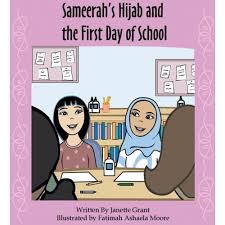
Sameerah’s Hijab and the First Day of School by Janette Grant Illustrated by Fatimah Ashaela Moore

Standard

sameerah's hijab

This book is perfect for 1st through 3rd grade girls, as it focuses on Sameerah’s first day of school in America and meeting new friends.  Sameerah and her family have just moved from Yemen and Sameerah is nervous about fitting in, however her love of wearing hijab and Islam radiate through her as her new classmates ask her questions.  Before long the students have found they have more in common than differences and Sameerah can’t wait to go back to school the next day, alhumdulillah.

This book works well for students to see how confidence, patience, and kindness can go a long way in understanding those around you.  Sameerah is articulate and confident and a great example in knowing your deen well enough to present it to others.  It is also a way to introduce Muslim children to how others may worship as Sameerah also learns about her classmates.


I’m learning about Eid-ul-Fitr By Saniyasnain Khan Illustrated by Pulak Biswas

Standard

i'm learning about eid ul fitr

I’m learning about Eid-Ul-Fitr is a really dry book.  It is written as fiction, but it is more educational, than entertaining in nature.  Siblings Farah and Faisal are fasting, then celebrating Eid.  The story is told about them, but not really from their perspective.  They are just secondary vehicles to convey the main components of Ramadan and Eid.  The language is choppy and unimaginative.  My guess is that the story was translated from another language as grammatically it is awkward to read.  A few examples: “Maria’s parents belonged to Kuala Lumpur in Malaysia” and later, “Everyone was in his best clothes.”  The illustrations are adequate, with the exception of the pictures of a couple of Mosques from Delhi, Lahore, Kuala Lumpur, and Samarqand, which are quite nice.  Overall the book is sufficient.  If it is the only book your children have access to, there is nothing wrong with it, there are just a lot better, more engaging picture books, fiction and nonfiction, about Ramadan and Eid out there.


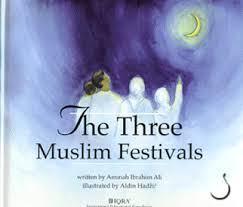
The Three Muslim Festivals By Aminah Ibrahim Ali Illustrated By Aldin Hadzic

Standard

Image

The Three Muslim Festivals is a very informative book about Ramadan, Id al-Fitr, and Id al-Adha, at over 60 pages however, it is a bit long for story time or smaller children.  Broken up into three parts, each told from a different character, the book would work well for second through fourth grade students.  It reads like a very basic chapter book, with information mixed in with a simple story.  The morals are clear, hadith, ayats and dua’as are shared and the illustrations help support the fictionalized portions.  The pictures aren’t engaging, but they do show a variety of ethnic groups and happy families.  The book is content, not character driven, but the families are supportive of the children, there are actively involved moms and dads, grandparents, and siblings.  The mom in one story is a physician and the dads help in the kitchen and around the house, showing some diversity. I like how it serves as both a review of basic Islamic principals while reinforcing elements that a child may not know or may have forgotten in a non condescending manner.  I would imagine the average seven year old could read it independently and comprehend it without being bored.  It isn’t the best written story out there, but it should be engaging enough to convey a lot of good information to an elementary aged reader.  Based on the style it is probably more intended for Muslim readers, but there is a three page glossary of terms in the back.

Eid Kareem Ameer Saab By Fawzia Gilani-Williams

Standard

This book made me laugh. It is essentially the story of Scrooge in the Christmas Carol simplified for a younger audience and switched to an Islamic perspective.  Don’t get me wrong, despite its unoriginal foundation, it is a good story.

The main character is grouchy, wealthy Ameer Saab who we see in a typical day berating his servant Raheem, refusing to help a woman and her young baby, refusing to help the poor, and neglecting his Salah.  Meanwhile Raheem is scrounging up his money with his wife to provide food, while still managing to help a widow, and others.  That night Ameer Saab has three dreams, in the first he is reprimanded by his father, the second by his mother, and in the third his money and jewels strangle him.  He wakes up a changed man on Eid morning.

This book is great for 2nd through 4th graders, with colorful pictures and well spaced text, it invites rather than intimidates this age group.  The morals are also clear and influential as the reader can see clearly which side is more desirable to Allah swt.

There is a verse from the Quran explained, and there are a few Arabic words, nothing off-putting for a newly independent reader and at just 24 pages, I think most elementary age students will enjoy and benefit from the story.

Beneath My Mother’s Feet By Amjed Qamar

Standard

Image


I was so surprised by this book, subhanAllah.  I picked it up at a used bookstore and didn’t think much of it, tossed it in my bag one day as I headed out with my children’s class on a field trip and seriously didn’t want the bus ride to end I was so caught up in the book.  An easy 200 page read if you are familiar with Pakistani culture, even more so if you have ties to Karachi (specifically Defense), the detail takes you to the streets and gullies you know and you want to stay and look around.  If you don’t have these reference points, the book might be a bit hard to connect with, but I think the Author still gets her story across if you are willing to try (there is a glossory in the back).  Beneath My Mother’s Feet is a 4.9 reading level, and because of the heavy cultural references I don’t think I would do it as a book club book, but I have already suggested it to certain students that I know will find a connection and appreciate their mothers and their opportunities in America all the more.

SYNOPSIS:

Nazia is a typical fourteen-year-old Pakistani girl in the large and bustling city of Karachi, Her working class family suddenly is thrown into chaos when her father gets injured at his construction job.  As we learn more about her father, Nazia and the reader discover how lazy, selfish, and dishonest he is, despite Nazia’s determination to see the best in him.  While the family has had hard times before, this time something more than Nazia’s mom scraping and sewing to get by is needed.  As a result Nazia is pulled out of school to help her mom be a maid, masi, in wealthy families’ homes.  The family eventually loses their home, and Nazia’s older brother steals all the jewelry and clothing intended for Nazia on her wedding.  Her father disappears and the women of the family are left to find the strength and resources to carry on.  While the cover teases the idea that Nazia is a “perfect daughter” and that she is such a “good girl” I found these to be incredibly misleading statements and pulled quotes.  I think the story, shows how determined Nazia is, but not at a rebellious level, more as a girl finding her self and willing to risk it all for what she believes, a trait very much in line with her mother’s example.  

WHY I LIKE IT:

I like that it shows self resilience and self reliance both from Nazia and her mom, Naseem.  Nazia holds on to her friendships, her dreams, and isn’t afraid of hard work.  She explores what it means to be a good daughter, good sister, good friend, and good worker. She also is emotionally sympathetic and generous to a small servant boy, all wonderful concepts to present to a 4th through 6th grade audience.  I like that although Nazia isn’t terribly religious she does rely on Allah (swt) and her faith to help her endure the various hardships she encounters.  Islam isn’t at the forefront, but clearly she Muslim.  The book is heavily steeped in culture, the concept of a dowry, how masi’s are treated are not Islamic in the least, and unfortunately the author doesn’t articulate that it is only a cultural norm.  While the women tend to be highlighted in different colors throughout the book, the men seem to be brushed over in a very negative light.  On the surface it is nice to see strong women of various socio/economic spheres coming together and making decisions, but to push all the men aside as being worthless, isn’t realistic or fair.  I liked the uncertainty at the end, usually I prefer books that wrap up all loose ends, but here i think it opens the door to imagine what would have happened and discuss it.  

FLAGS:

The book is remarkably clean, There is lying, but consequences are clear.  There is some violence in the mistreatment of the masis, but the author shows Nazia bothered by it and it is discussed.  Nazia and her friends remark at some of the cute cricket players, but nothing is done about it and it seems innocent enough.


TOOLS FOR LEADING THE DISCUSSION:

A reading guide by the publisher:  http://www.amjedqamar.com/Reviews.html

A bit about the author and where the story idea came from:     https://www.webjunction.org/content/dam/WebJunction/Documents/ohio/Beneath_My_Mothers_Feet_toolkit.pdf

Amjed Qamar’s official website:  http://www.amjedqamar.com/

Interview with Amjed Qamar from A Year of Reading:  

    http://readingyear.blogspot.com/2008/05/sneak-peek-keep-your-eye-on-this-new.html


Nabeel’s New Pants: An Eid Tale Retold by Fawzia Gilani-Williams

Standard

Image


Nabeel’s New Pants: An Eid Tale retold by Fawzia Gilani-Williams and illustrated by Proiti Roy is a silly story about a shoemaker getting ready for Eid.  He goes to buy gifts for his wife, mother and daughter and gets a new pair of pants for himself.  The pants, however, are four fingers too long, and no one has time to hem them for him: Not the shop keeper, not his wife, not his mother, not his daughter, so he does it himself.  Nabeel then goes out to visit the poor and hand out charity and all the women in his life feel guilty andsneak over to hem his pants for him.  Luckily Nabeel has a sense of humor and there is just enough time to fix some seriously too short pants.

The book is 32 pages and an AR level 2.9.  It reads well out loud, with simple, yet colorful pictures for even the littlest ones to look at and enjoy.  The story is simple, and probably has a lot more relevance to a Muslim audience than a non Muslim one.  Eid is not described in any great detail, other than gifts are given, charity distributed, new clothes are worn, and lots of food is prepared, so it might put off those not familiar with the holiday.  Islam isn’t mentioned by name, but is obviously assumed.  Culturally the characters are Indian sub-continent based on the food’s being prepared.  Some of the women fully cover, some a little and some not at all.  And I particularly like that Nabeel can sew his pants himself.  The kids enjoy seeing themselves and their families in a silly story.  Even the three-year-olds get the punchline and all around it is just a fun book.  Alhumdulillah!

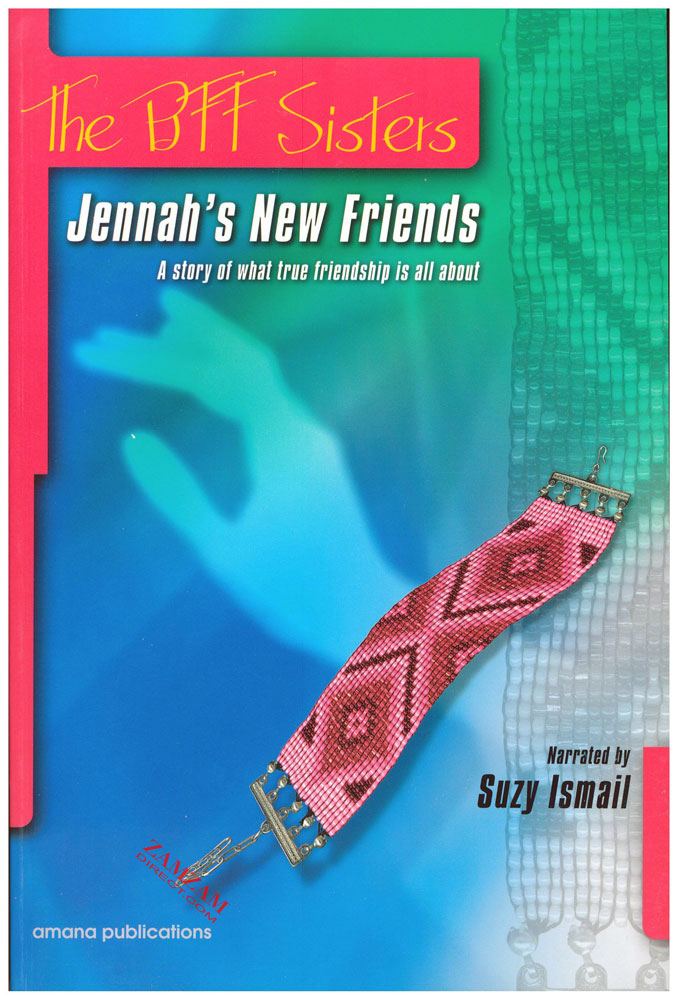
Jennah’s New Friends By: Suzy Ismail

Standard

ImageThis book is presumably book one of the BFF SISTERS series, however, the author’s website doesn’t list any other books in the series and it was published in 2001, so it is unknown if more books are in the works.  At 64 pages, the intended audience is girls between ages 7 and 12, but I would note that there are no illustrations and while it is broken into chapters (on average about 10 pages long) the text and layout would be daunting to the average 2nd and possibly 3rd grade student. 

SYNOPSIS: 

Jennah lives in a neighborhood with lots of Muslims and lots of friends, but when a new girl moves in, Jennah is afraid that her best friend Yasmeen would rather be best friends with the new girl, Mariam.  Jennah not only is afraid of losing her friend, but there is a lot going on at home too, her mom is about to have a baby, her younger sister is always bothering her, and her dad is constantly away on business.  Alhumdulilah, Jennah is surrounded by supportive adults, forgiving and generous friends, and an Islamic foundation that allows her to sort out her feelings and create a Hadeeth club with All her new friends.

WHY I LIKE IT:

I love that it is a clean book for the elementary age group, the girls do not have boyfriends and while hijab is mentioned in passing, the girls are a group of kids that are dealing with the constant struggle of all girls that age: friends.  Each girl in the BFF club is from a different background, Arab, Pakistani, African American, one’s parents are converts, and at the end a non-Muslim joins the group, truly someone for every reader to identify with.  I think most every girl reading this book can relate to the struggles amongst friends, being the new kid, having younger siblings, trying to fit in, and jealousy, all topics touched on, however the book is an awkward read.  I can’t decide if the book is a short story that got too long, or a novel that wasn’t fleshed out.  The beginning drags on as the foundation of who all the characters are is established, and at times Jennah seems very whiney and immature with problems that wrap-up with little explanation or insight.  Everything often seems too “perfect” and Jennah’s problems petty when all the surrounding characters are so over the top forgiving and generous.  The book left me wanting to know more about the backgrounds of the supporting characters, and more about how Jennah felt.  I think readers may get lost with all the characters, but if they can sort it out, I think they will see themselves and their friends in the pages dealing with the same issues they deal with every day.

FLAGS:

Clean

TEACHING THIS BOOK:

I probably wouldn’t teach this book for the intended audience, or share it as a book club, however, one-on-one the book would be a great starting point for a discussion with a girl having problems with friends. 

Ibrahim Khan and the Mystery of the Roaring Lion by Farheen Khan

Standard

Image

Perhaps it was timing, or maybe the book just lacks a lot, but having just read Rashid and the Missing Body, did not do this book any favors. This book also features an elementary boy working to solve neighborhood crimes,. who just happens to be Muslim.  The target audience would probably be any 2nd to 4th grade student, girl or boy, as it is a quick, clean 45 pages.  The book is beautiful from the outside, the font and pictures inside are spot on, the story itself isn’t half bad, but the rationale for the crime and the conclusion, just seem  weak and forced.

SYNOPSIS:  

Ibrahim Khan and his cousin Zayn are third graders that solve crimes in their part time.  One day they get a call from Yusuf that there are lions in his backyard, he can hear them, but can’t find them.  The Khan boys are on the case and with support from parents picking and dropping them off at each other’s homes around salat times, and their trusty brown bag, they figure out what is really in Yusuf’s backyard.  

WHY I LIKE IT:

The book is clean, it is perfect for a young or struggling reader in terms of presentation and writing style, and is a decent foray into Islamic fiction for elementary aged students. There is no unnecessary religious, or family, or boy/girl drama, but the reason for the perpetrators scaring Yusuf is very, very unbelievable and weak.  Without giving it all away, it may work to talk to your child at the end about the moral, but I think any student in a school setting would find the ending a bit disappointing.

FLAGS: 

None. Clean and framed well to give the reader a sense that Ibrahim comes from an Islamic family and environment, he is a Muslim, and at the same time he has friends and adventures just like any other character in any other book.