Tag Archives: ball

Aya and the Star Chaser by Radiya Hafiza illustrated by Kaley McKean

Standard
Aya and the Star Chaser by Radiya Hafiza illustrated by Kaley McKean

Most people probably don’t read as much Islamic rep fiction as I do. Add in I’m an adult reading MG, who consistently shares thoughts on books that fit a slim criteria, and the result is I’m nitpicky and hard to please.  But, because I read a lot of a very small niche genre, the stark contrast to books with Islamic representation done well, compared to those done poorly or somewhere in the middle is hard to ignore. This 213 page book has an all Muslim cast, but has very little Islam, and what is there is terribly presented. It has one Assalamualaikum, one mention of salat, a reference to shoes worn on eid, and the mother sings Quran.  Yes the characters wear hijab, but it is only ever called a headscarf, so while the pieces are there they don’t add up to much, which I predict leaves Muslim readers disappointed and non Muslim readers chalking it up to more pointless details that serve as filler, and provide no real fleshing out of the characters on the page. I forced myself to read it, the desire at page 12 when stars and meteors are used interchangeably to dnf was strong, and to the book’s credit, I was mildly rewarded with the last 65 pages or so being slightly better written. The plot holes, repetition, inconsistencies, the reliance of the mother simply refusing to answer the daughters questions, and overall surface level of the book makes it regrettable, but can I see young readers that love quirky characters, balls, royalty, and happily ever afters enjoying the read? Yes. And being there is nothing blatant in the book that would warrant you not letting them dive in, you can take my criticisms with a grain of salt, or stardust.

SYNOPSIS:
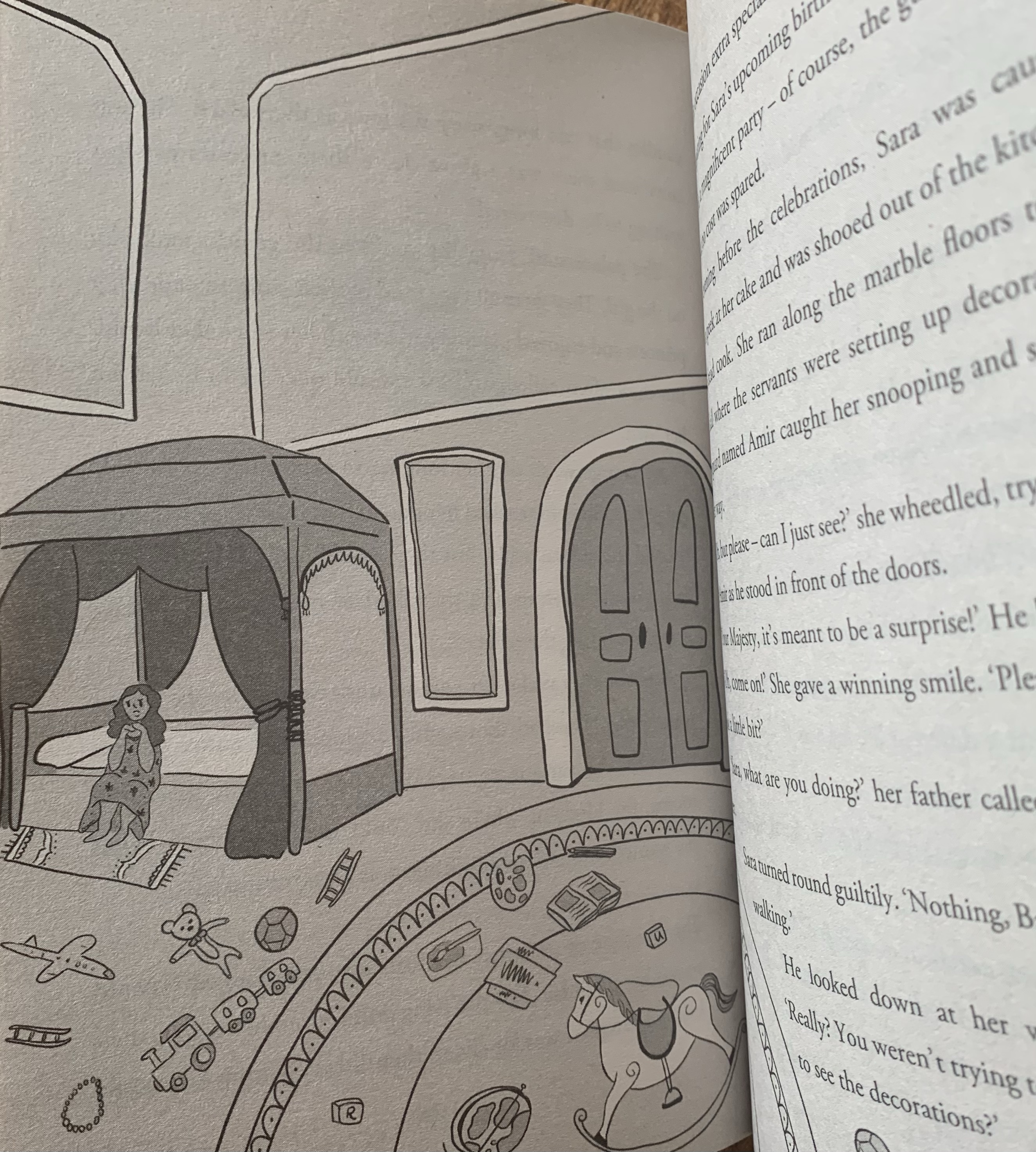
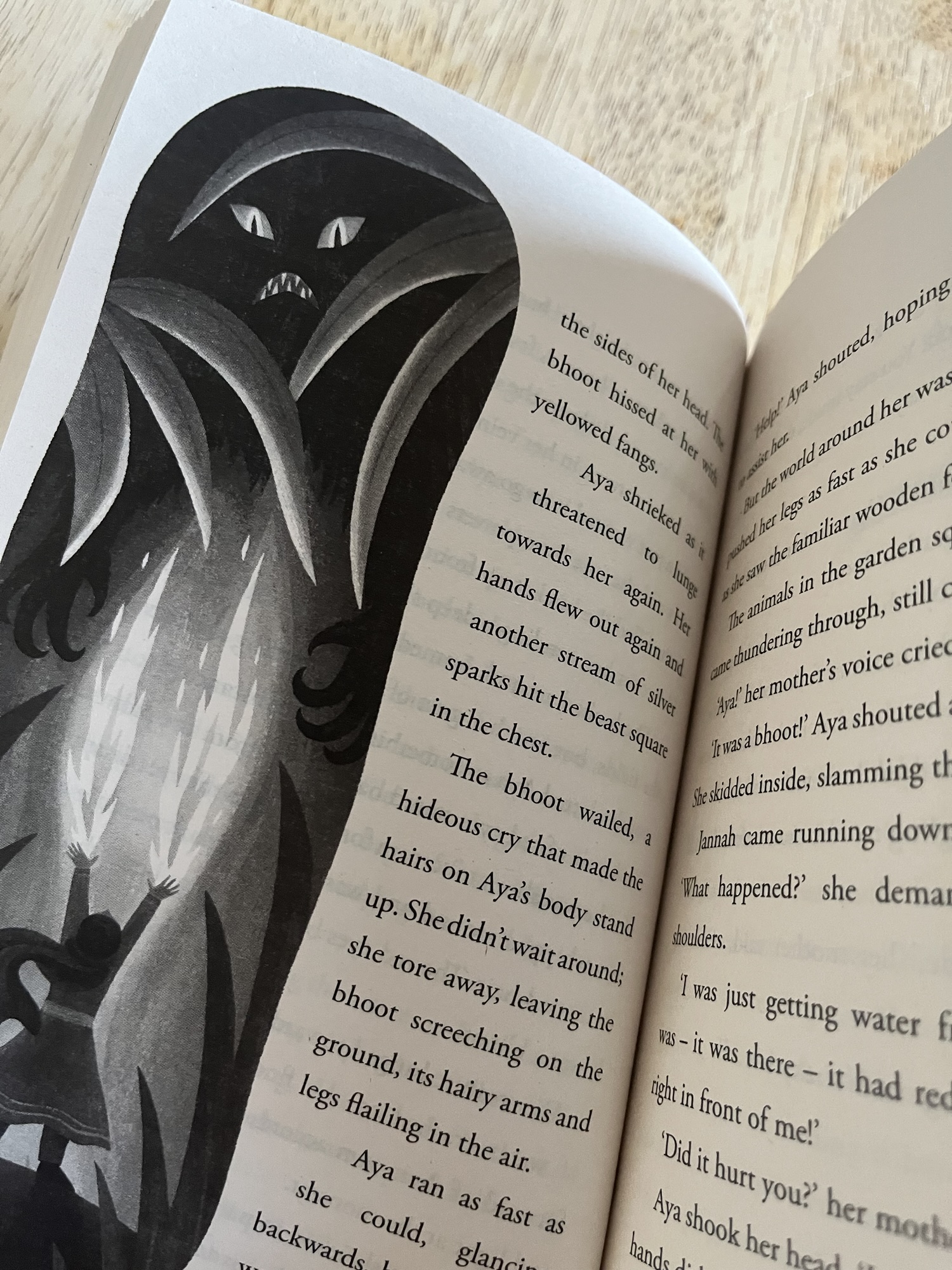
Aya and her mother, who is “stern with a big heart” live in kingdom of Alferra.  Her father has been gone for seven years, she doesn’t even know his name, as Aya and her mother, Jannah, have a strained relationship. Aya loves the ocean and the night sky and dislikes school, the only friend she has is Naznen, and on the night of the Perseids meteor shower the two girls meet in the middle of the night to watch the sky.  One star (is it not a meteor?) hits Aya and give her powers: she can shoot fire and cry flowers. Desperate for answers Aya and Jannah head to the Somerfest Ball at the palace to meet a seer.  When they do they learn of a prophecy and the remainder of the book is Aya and her mother running away to avoid the prophecy, before Aya reluctantly has no choice, but to face the villain, and thus see the prediction through.  I don’t want to spoil spoil it, but there is an Evil queen and demons of sorts with red eyes referred to as bhoots, and a battle that takes place in true fairytale format before the happily ever after occurs.
WHY I LIKE IT:

I do like that Aya is strong and determined, her strength however, is undermined by her sickness, sleepiness, and lack of determination to find the answers her mother refuses to give though, which is unfortunate.  The biggest problem with the book is the writing quality just isn’t great.  Even the religious representation aside.  Why have a whole conversation about wearing matching clothes to the ball between Aya and Naznen for Jannah to gift Aya a gown of a different color and no mention of wanting to match with her friend revisited. Why have Naznen sneak through the window just to have Aya go through the door using the spare key under the mat? Why mention a strange lady at school dismissal, that is never explained? Why is everyone scared to be out because people are missing, just to have Naznen alone, show up with Aya’s homework? I could go on and on, the book brings things up and then dismisses them using them to be page filler it seems. So many details do not provide insight in to the story or the characters or the setting, they are just random fleeting observations.

I didn’t like that the prince is described as having a “lover,” there are better less abrupt identifiers that could have been used, or perhaps in British vernacular it isn’t as pointed as it is in the US.  I also didn’t love that they bowed down to the Evil Queen Abnus. This highlights a place where an Islamic lens would have fleshed out that the characters are Muslim, not wanting to bow, as we bow to Allah swt alone, but perhaps being struck and forced.  Other easy inclusions of Islam would be seeing the meteor shower and saying SubhanAllah, being so sick from the star hitting you and asking Allah swt to heal you, asking Allah swt for strength in a dozen scenarios the book presents.  Duas before leaving the house with people going missing, it really seemed blaringly absent given the nature of the book to not have little sprinkles woven in, yet it halts the story early on to have those labels noted. It definitely could have used some polishing to make it part of the story or characters or taken out all together.

TOOLS FOR LEADING THE DISCUSSION:

I wouldn’t rush out to buy this book for your school, library, or home book shelf, but if you have it, there is no need to remove it.  There is not enough Islam nor literary value.  There is not even enough character development or details to show the change in the mother-daughter relationship to foster conversation.  One page they claim they have no secrets when the mother and her secrets is the bulk of the backstory, to the next page where the mother simply discloses all the letters and answers that Aya needs to move forward.

FLAGS:
Lying, sneaking out, scary evil villains, disowning, abandonment, disobeying parents, death, killing, prophecy, fortune tellers/seers, magical powers, abuse, imprisonment,

Rumaysa: A Fairytale by Radiya Hafiza illustrated by Rhaida El Touny

Standard
Rumaysa: A Fairytale by Radiya Hafiza illustrated by Rhaida El Touny

rumaysa

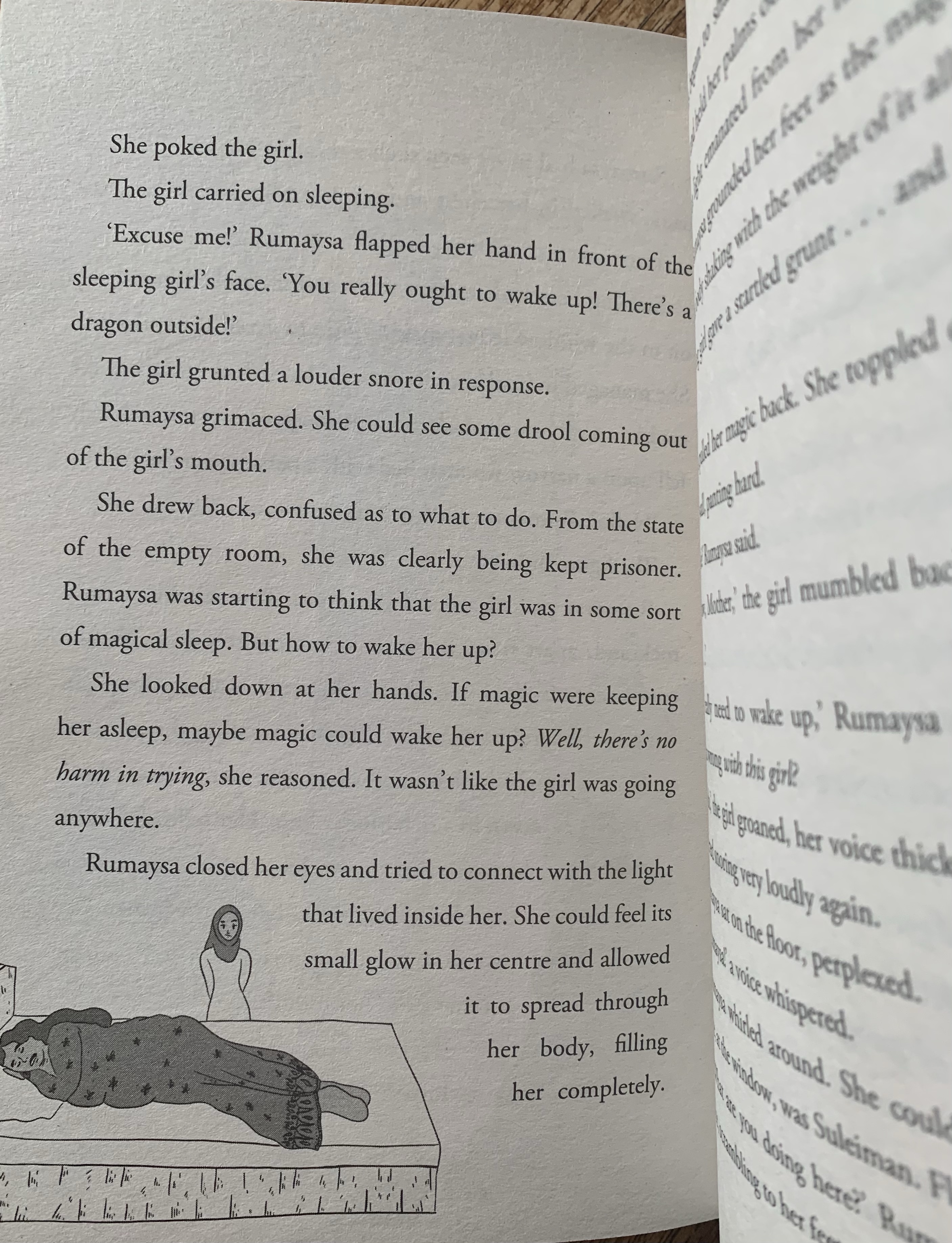
This middle grades retelling of the classic fairytales: Rapunzel, Cinderella, and Sleeping Beauty, replaces white characters with diverse Desi characters, reclaims female characters’ empowerment, and weaves the stories together with Rumaysa first freeing herself, and then using a magic necklace that takes her to those in need  (Cinderayla and Sleeping Sara) in her quest to find her long lost parents.  After a few chapters, I started writing a list of gaping-huge-ginormous plot holes, they are frequent and laughable, then I took a deep breath and recalled the similar eye-rolling inconsistencies that plague perhaps all fairy tales, but specifically Disney-esque ones. Once I let go of trying to understand why Rumaysa is wearing hijab while locked in an isolated tower, or how the witch can’t remember her name, but Rumaysa knows the name her parents gave her when she was kidnapped on the day of her birth, or that she knows she was kidnapped and her whole backstory, just to name a few, the book was much more enjoyable.  I still have major issues with some of the forced Islamization and cultural tweaks, but not because they existed, but rather because they weren’t strong enough.  Why have an Eid ball for all the fair maidens in the land.  It was awkward to read all the young people showing up to pair off, and then people asking the prince to dance, and him saying he didn’t know if he could.  Why not just make it an over the top Desi wedding with families, where dancing and moms working to pair their kids off is the norm. Having it be a ball for the maidens in the land, just seemed like it was afraid to commit to the premise of twisting the fairytales completely.  There are a few inconsistencies, however, that I cannot overlook.  This is a mainstream published books and there is at least one spelling error and grammar mistake.  I could be wrong, as it is British, and I am by no means competent in even American English, but I expect better.  Even content wise, Prince Harun for example, is wearing a mask, but the text comments on his blushing cheeks, eyes, eyelashes, and smile, not a typical mask perhaps? And don’t get me started on the  illustrations, the same awkward ball has Ayla leaving, and in the picture not wearing a mask concealing her face as the text states.  Overall, the inside illustrations are not well done.  The cover, by artist Areeba Siddique is beautiful with the shimmery leafing on the edges, that would have brought the inside pages a lot more depth and intrigue than the ones it contains.  Despite all the aforementioned glimpses of my critiques to follow, I didn’t hate the book and quite enjoyed the light handed morals and feminism that was interwoven with clever remarks and snark. The first story has Rumaysa wearing hijab, finding a book about salat and praying.  The second story takes place on Eid and Ayla eats samosas, discusses Layla and Majnun, and has a duputta. The third story I don’t recall any culture or religious tidbits other than keeping with the consistency of cultural names.  There is mention of romance between an owl who has a crush on a Raven, but the heroines themselves are learning to be self sufficient from errors of their parents/guardians and are not looking for any males to save them.  Other than that the book really needs an editor and new illustrations, I can see fairytale loving middle grade kids reading the book and finding it enjoyable, or even younger children having it read aloud to them a few chapters at a time, and being drawn in to the stories and eager to see what happens next. It would work for that demographic, but perhaps no one else.

img_0394

SYNOPSIS: (spoilers)

Rumaysa’s parents steal vegetables from a magical garden when there is no food or work to be found, as a result when Rumaysa is born, the owner of the garden, an evil witch, takes Rumaysa and places her in a tower protected by an enchanted forest and a poisonous river.  No one can get in, and Rumaysa cannot get out.  In the tower Rumaysa reads, no idea how she learned, and spins straw in to gold as she sings a song that channels the magic she consumed in utero from the stolen garden.  With only rations of oats to eat, a friendly owl named Zabina frequents Rumays daily and brings her berries and news .  When he brings her a new hijab, Rumaysa has the idea to lengthen the hijab with bits of gold over time, so that she might escape.  When she finally gets her chance, she is met by a boy on a magic carpet named Suleiman, and is both shocked and annoyed that someone got close to the tower, and only after she saved herself.  The two however, and Zabina, are caught by the witch and must escape her as well.  When that is all said and done, Suleiman gives Zabina a necklace that takes one to someone in need of help.  His parents want him to save a princess, he wants to study in his room, so he hands off the necklace hoping it will help Rumaysa find her parents, and he heads off on his flying carpet.

The necklace doesn’t transport Rumaysa to her parents, however, it takes her to a street where a girl is throwing rocks in desperation having been denied attending an Eid ball after her dress was torn to shreds.  The story starts with Ayla’s back story before Rumaysa arrives, but the two girls befriend each other, Rumaysa uses her magic gold weaving abilities to conjure up a new and beautiful dress and golden shoes and the girls head to the ball.  When Ayla heads off to get samosas she meets the prince, but doesn’t know he is the prince.  They argue about the play Layla and Majnun and when her stepmother asks about the dress, Rumaysa and Ayla make a run for it.  A shoe is lost, the stepmother comes to know, the guards search for the missing girl, and all is well.  Except Harun is incredibly shallow and superficial and only interested in Ayla’s clothes and status, so she rejects him and points out that she is much too young for marriage.  She instead reclaims her home, fixes her relationship with her stepsisters and begs Rumaysa to stay.  Rumaysa makes her excuses and is whisked away to a land that is being ruled by a man and his dragons.

Originally the land of Farisia is ruled by King Emad and Queen Shiva, but they have become unjust and disconnected from their people.  When Azra gets a chance to steal Princess Sara and take the kingdom, he does.  Rumaysa arrives to free a sleeping Sara from the dragon and restore apologetic and reformed leaders to the thrown.

img_0397

WHY I LIKE IT:

I do like the spinning of familiar stories and either updating them, or twisting them, or fracturing them, so I am glad to see an Islamic cultural tinge available.  I feel like the first story was the strongest conceptually even if the details and morals weren’t well established.  The second story was strong in the messaging that Ayla, and any girl, is more than just a pretty dress, but the premise was a little shaky and not that different from the original.  The third story was a little lacking developmentally for me and all three I felt could have gone stronger in to the religion and culture without alienating readers or becoming heavy.  There are characters illustrated in hijab, some in saris, some in flowing robes. Princess Sara is noted to be a larger body type and I appreciated that in elevating the heroines, other’s weren’t put down.  Even within the book, there is diversity which is wonderful.  

img_0398

FLAGS:

There is lying and stealing with consequences.  “Shut up” is said.  There is magic, death, destruction, and a brief mention of an avian crush.

img_0395

TOOLS FOR LEADING THE DISCUSSION:

I could see this being used in a classroom for a writing assignment to urge students to write their own tales.  I think it is fourth or fifth grade that children read fairytales from different points of view: think the three little pigs from the wolf’s perspective or the Stinky Cheese Man and Other Fairly Stupid Tales, and this book would lend itself easily to that lesson as well.