Tag Archives: adventure

Ticket to India by N.H. Senzai

Standard

In terms of plot and and believability, this 274 page 6.3 reading level book has moments of unrealistic twists, but the historical flashbacks and context make up for it as it delves into Pakistan, India partition without getting overly bogged down in politics and bitterness.  You can tell that the author writes from a place of love and warmth, as she talks about all sides involved: Pakistan, India, Great Britain.   The stories, fictional and historical, that weave through the novel make it informative and entertaining irregardless of one’s prior knowledge.

SYNOPSIS:

Maya is 12, and a little shy, especially compared to her older sister Zara.  The book starts with her writing a journal entry about her visit to Pakistan in an airplane somewhere over the ocean.  Maya, her older sister Zara, and their mother are heading to Karachi from America because of the death of Maya’s beloved grandfather.  Frequent visitors to Pakistan, Maya is familiar with the sights, traditions, and language.  As other family members arrive, Maya and Zara overhear their elderly grandmother planning to runaway to India to retrieve family heirlooms that were left during partition.  The plan had been in the works for the whole family to go, visas were already obtained, but with the unexpected death, the urgency is amplified.  Grandma wants to find a ring to bury with her husband.  In Islamic custom burials happen very very quickly, often the same day, so the delay and sending the body to America, is something you just have to go with as the reader.  Rather than convince Grandma to stay, the girls threaten to tell their mother if she doesn’t take them along, and the next thing you know the trio are off to India and on a treasure hunt.  There is a map at the beginning of the book, which is very helpful.  However, the adventure isn’t straightforward, not only in the trio’s adventures, but in that grandma ends up in the hospital, Zara and Maya decide to pursue the lost items on their own, and then Zara and Maya get separated.  Twelve-year-old Maya then is forced out of her shell as she is kidnapped, and running for her life, trying to keep her promises, and also in desperately trying to save her family from having to pay a ransom to save her.  A lot happens, and the intensity amplifies as it starts out as a elementary aged family story and turns into a middle school adventure.  A long the way are beautiful passages about the scenery, amazingly simplified, but factually and emotionally accurate explanations about partition and ultimately, through Maya, about finding your voice. 

WHY I LIKE IT:

The framing of the fictional story and the historical context is wonderful.  Partition, is such a pivotal moment for those that lived through it, but has less and less relevance to today’s generation that lives abroad.  So, to find a book that makes the gist of the events come through, is why I love using fiction to connect people and ideas.  I am making my daughter read this tomorrow, no question. She needs to know what her own grandmother endured, what decisions her family had to wrestle with, and this book allows us to have those discussions in an informed way.  I’m sure many would disagree and say that the reader should know about partition before reading the book, but I think the tidbits and delicate way the author convey the horrors, the agony, the manipulation, and the struggles in todays time, is far better than I could do to a sixth grader. 

Maya’s abilities seem to grow overnight, so while she was an ok protagonist, she might annoy some.  I actually had to google in the middle of reading how old Maya is, at times she seems like she is eight or nine and at other times like she is 15.  I do like that Maya constantly remarks how alike India and Pakistan are, a reality that today’s generation definitely agrees with, but is often afraid to voice to their parents.  I also like that there are good and bad everywhere, a theme that doesn’t get old, especially in books that deal with cultural and religious elements as presented to a wide audience.

There isn’t much religion in the book, the characters don’t stop and pray or wear hijab, but the setting does allow for mention of masjids, and a kind Imam back in California, the characters identify as Muslim and they discuss Muslims as a minority and political entity regularly.  One of the treasures the grandma is looking to retrieve is an old Qur’an with the family tree drawn within.  The book talks about how intertwined the two countries and many religions of India are, and Maya’s name articulates many of these crossroads.  In the end, perhaps the best lesson from the book, is how much alike we all really are.

There is a wonderful Author’s note in the back, along with a glossary.

FLAGS:

The book has some violent images as it discusses trains coming from India to Pakistan with only a few living aboard and vice versa.  The intensity as Maya is robbed, and then kidnapped, and then held hostage, could also be jarring for some younger readers. 

TOOLS FOR LEADING THE DISCUSSION:

Like all her other books, I would absolutely include this in a Book Club, there is a lot to discuss, lots to understand, and lots to enjoy.

Author’s website: http://www.nhsenzai.com/ticket-to-india/

Reading Group Guide: http://www.nhsenzai.com/wp-content/uploads/2017/09/Ticket-to-India_ReadingGuidePDF.pdf

YouTube book trailer:
The Gauntlet by Karuna Riazi

Standard
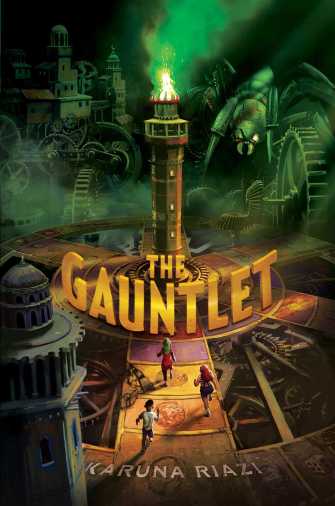
The Gauntlet by Karuna Riazi

the gauntlet

Take Jumanji, turn it into a chapter book, flavor it with steam punk, set it in a Middle Eastern inspired marketplace, and have the protagonist be a Bengali-American, hijab wearing Muslim on a quest to save her little brother with her two BFFs from New York. Bam, you now have a 298 page AR 5.4 reading level booked called The Gauntlet.  

Published by Salaam Reads (Amina’s Voice) this book is written for all kids, the main character’s religion and culture just add depth and a connection to the game they have fallen in to.  I found this book on Scholastic, and when I got it, I handed it to my daughter to screen for me.  I asked her once she finished if it had any Muslims in it and how were they presented, to which she gaped at me and said, “umm mom the whole thing is about a Muslim girl and it is awesome!” So naturally I moved it higher up in the “to be read pile” and while I agree with her assessment, the book is more plot than character driven, and there isn’t a lot of theology in it, just a race against time to get out of the game alive.

SYNOPSIS:

It is Farah Mirza’s 12th birthday and while she should be downstairs visiting with her guests from her new school, she is holed up in her bedroom with her little brother Ahmad and her best friends from the old neighborhood, Essie and Alex, playing board games, the Mirza family’s favorite pastime .  When Aunt Zohra tries to coax them from the room she mentions a gift for the birthday girl is in her room, and the kids sneak off to get it.  Only it isn’t the book she brought to give Farah that they find, it is a bewitched game called the Gauntlet of Blood and Sand that lures kids in, and keeps them if they cannot out play the Architect.  When Ahmed falls in, the trio has no choice but to follow him in to try and rescue him and escape, before time runs out.

Once inside the game, they are in a city called Paheli. It resembles an old Middle Eastern city with large souks, market places, even a small masjid, surrounded by sand and levels absolutely breathtaking in both their beauty and in their threat to the children.  The inhabitants are those that played the game and lost. The challenges the kids must face range from a life size game of mancala to a taste test of Bengali/Indian sweets.  As they rush from challenge to challenge they meet a kind tea shop owner, giant lizards, spies and police of the architect and see fairly detailed descriptions of different parts of Paheli. The gamemaker/designer known only as the Architect senses that the kids will win, so he starts to cheat, and then feels bad and arranges to meet the players.  When the children meet him, and hear his story, they feel some sympathy for him, but not for the Jinn that holds the ultimate power over the game.  Obviously they do escape, but I won’t spoil the fun the process is, nor the sweet surprise of the reunion.  

WHY I LIKE IT:

I like that at the core, the story is driven by love for a sibling and requires the teamwork and cooperation of friends.  The rest is just frills from this central and clear message that is woven throughout the book.  While it is idealistic, there are hints that it isn’t overly so.  Yes Ahmad with his ADHD is a lot to handle at times, and the friends do have their squabbles, but ultimately both friends and family are worth risking it all.  I love that Farah is Bengali, many of the foods are Indian, and they are set in the Middle East, but yet somehow it seems interchangeable, this made me laugh, and while in other instances might have annoyed me, I liked how connected it made everyone seem, more alike than different.  Essie and Alex know some of the foods and cultural lexicon from growing up in New York.  They don’t find things different, they had lots of kids in school that wore hijab. Readers unfamiliar with some of the words and names found in the subcontinent and Islamic history might be put off a bit by the regular use of these words and the lacking glossary, but if you identify with any of it, you will celebrate seeing yourself in this book, just as Farah relished in seeing something of familiarity in Paheli.  

The book is fast paced and the detail given to the setting and cultural aspects are fun, but I really don’t feel like I connected much with the characters as a result.  There is very little character development and I actually had to look back in the book for some of the names to write this review.  There also isn’t much religion in terms of belief or practice.  The buildings and the food and the tone all hint at Islam, but I would have loved to hear an athan, or even her pausing to pray.  Not even that is there.  She wears hijab and that is about it in terms of religion.  

Ultimately I love that it is a mainstream book, with a strong storyline that is action packed and fun for older elementary and early middle schoolers that is clean and familiarizes and thus normalizes a culture not often seen in young adult fiction.  

FLAGS:

None, it is clean, at times possibly a bit scary with human bones, but not anything overly haunting.

TOOLS FOR LEADING THE DISCUSSION:

This would be an amazing book for a book club, and I would play the games that they play in the gauntlet at the meeting.  There isn’t a ton to discuss in terms of introspection and growth, but there is enough, and it is fun.  Plus, there aren’t a lot of books like this for Muslim kids to see themselves in, that I think it would be a blast for them to read, and enjoyable for the adults to watch them get swept away.

Interview with the Author: http://ew.com/books/2017/03/27/karuna-riazi-gauntlet-jumanji/


The Treasure at Bayan Bluffs by Farah Zaman illustrated by Kim Zaman

Standard
The Treasure at Bayan Bluffs by Farah Zaman illustrated by Kim Zaman

img_2961

At 231 pages this book claims to be for ages 9 to 18 and that’s a pretty large spread for a mystery, yet alone an Islamic fiction one by a first time author.   In a tone reminiscent of Nancy Drew and the Hardy Boys,  it should really should just say 9 and up, I was hooked!

SYNOPSIS:

Adam and Layla along with their younger twin brothers Hassan and Hakeem from America are visiting their family home of Bayan Bluffs in Midan for the summer.  Their grandfather and great aunt and a few long time servants aren’t much entertainment for the children, so their parents arrange for their college friends kids’ Zaid and Zahra from Crescent City, a few hours away, on the other side of Midan to join them.  The children get along right away and decide to try and solve a mystery of a hidden treasure that they have heard bits and pieces of over the years.  Their search for the Moon of Masarrah starts innocently enough, but quickly escalates as they learn they aren’t the only ones searching for the missing gem.  As they learn more about the jewel and the circumstances of its disappearance the gem and the murder of Adam and Layla’s great grandfather get further entwined.  With a few of the suspects still alive and many of their family members still in the city, the children soon find they themselves in danger as well.

WHY I LIKE IT:

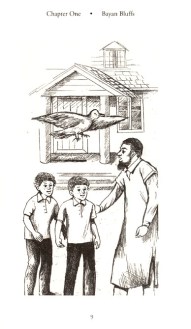
The biggest reason I like it, is it is well written.  There aren’t confusing passages, or too many characters or boring preachy paragraphs.  The plot is good, the dialogue believable and the fact that they are Muslim children, just depth to the story.  They plan to meet after asr or before Jummah, and they say inshaAllah and mashaAllah, and its just a really good balance of who they are, but not all they are.  In retrospect, maybe they all get a long a little too well, but it isn’t syrupy and they have some minor annoyances, so it doesn’t hinder the story.  The only thing I caught myself looking back on was the age of the twins.  At times they seem like toddlers and at other times much, much older.  Even the author says they are “about six years old,” and having a six year old myself, I do believed that they can vacillate to both extremes in any given moment and thus I accepted their antics and let it go.  Additionally I wish she included a map.  It isn’t confusing, but it would have been great to look back upon as the action speeds up, and would definitely help younger readers visualize the details.  The terrain vocabulary for anyone younger than nine might need some explanation.  There is a glossary at the end for some of the Arabic words, and for some of the specific ships and weapons mentioned.  Their are a few illustrations that I think help the younger readers, they aren’t needed for the story, but they don’t impede it either.  I wasn’t crazy about them within the story, but I did appreciate that they show the girls in hijab and the illustrator clearly put a lot of work in to them.

bayan.jpeg

I wish that the cover was more appealing, for a story that was so good, I wish it begged to be picked up.  InshaAllah word of mouth will carry the book, so that more like it are written and published.

FLAGS:

None, mashaAllah it is clean and wholesome.  There are good and bad Muslims and no judgement is put in a religious context.  There is some violence, but it is nothing even a seven year old would find offensive.  Alhumdulillah.

TOOLS FOR LEADING THE DISCUSSION:

I would love to do this as a Book Club book for 5th through 8th grade.  The writing quality and the different characters the students would be able to identify with, would make it a lot of fun.  There isn’t any deep or though provoking discussion points to accompany the book, but I think the genre is hard to come by and Muslim kids seeing Muslim kids solving a crime and going on a treasure hunt, is just exciting.  I couldn’t find any study guides or even much information on the book or author, but none is needed to enjoy the story.  Farah Zaman if somehow you see this review, know that I hope you keep writing, and I thoroughly enjoyed your book!  Happy Reading Everyone!


Jannah Jewels by Umm Nura illustrated by Nayzak Al-Hilali

Standard

Strong muslim girls  (check)

Historical fiction (check)

Elementary level chapter book (check)

Beautifully illustrated (check)

Action, adventure, fun (check, check, check)

Really what more can you want from a book, or better yet a series of books?

The premise of Jannah Jewels is four Muslim girls each with specific skills that travel back in time to various places in the world to retrieve artifacts to save the world before the “villians” do.  Along the way they share knowledge of hadith, Quran, and Muslim achievements and advancements while meeting with influential Muslims.  I mean really, what is there not to like.  This is historical Islamic Fiction for 2nd through 5th grade at its finest, yay!

So far there are nine books in the series, and based on the premise that they must find 12 artifacts to put in a golden clock, I would assume there will be 12 books.  I decided to review only the first two as I think they set the stage and give the reader a good feel for the series’ standards, the tone, and direction the consequent books will follow.  The series is to be read in order and they range in length from 69 pages to 165.  Each book has a description of the main characters, a visual of the supporting characters and is followed after the story by a sneak peek at the next book, a glossary, and some manga anime of the heroines.  Some of the books are co authored (Ustadha S. Karim & Tayyaba Syed), but based on the website http://www.jannahjewels.com Umm Nura is the main author and creator of the series.

SYNOPSIS:

Hidayah sees a woman with a bow and arrow and watches her for many days until finally she musters the courage to meet her.  This meeting is the start of Hadiyah’s training in present day with the Master Archer.  The story however, starts with a prologue of the past and how different approaches to archery have lead to a rift between those entrusted to keeping evil at bay.   The collision of those actions and today occur as Hidayah and her friends Jaide, Sarah, and Iman are chosen to retrieve artifacts scattered around the world and throughout time.  They must bring these artifacts and place them in the golden clock before Jaffar and his son Khan do, to obtain a secret locked away inside.  Each girl has incredible skills and strength as well as fears and doubts.  The stories are action pact as well as enlightening and empowering.  The girls are smart, strong, and supportive of one another and they use team work to make for a smart inspiring read.

In the first book the foundation is laid and the details of time travel and the task are put forth, it is a tiny bit cumbersome, but is quickly believable and accepted as the action picks up.  The Jannah Jewels travel to Timbuktu and meet with Mansa Musa to rescue a lost manuscript.  In the second book they journey to China aboard the ships of Chinese Muslim Admiral Zheng He to recover a medicinal plant.  The recap of the first book and the premise of what has to be done is seamless and quick.  Thus allowing the story to move further below the surface to provide more insight into who the four girls are, and understanding into what occurred in the past that made the Jannah Jewel adventures necessary.

WHY I LIKE IT:

I love historical fiction, so Islamic historical fiction is like a gift, when done right.  To give young muslims a glimpse at some of the remarkable accomplishments and contributions Muslims have made throughout time, in a manner they don’t even know they are learning it, is so needed.  Our kids should know about Mansa Musa, Al-Kindi, Fatima Al-Fihri, Sultan Muhammad II, and more, and sadly many are not tempted to pick up a non fiction book to learn about them.

The Jannah Jewels are also admirable and have the ability to inspire our girls to be better Muslimah’s through their examples of intelligence, strength, and deen. Each book reveals more about their hobbies, passions, and past, and does a good job of giving them each their own personalities. That being said, these books are engaging for both boys and girls.  My own children have read the first four multiple times as have I.  Initially I didn’t think my son would be interested as it seems like a very “girl power” type read, but the story is strong enough and the characters have depth that they work well for all kids and their parents.

In addition to the stories, visually the books are absolutely gorgeous and appealing.  The manga anime style of art is bright and colorful on the covers, and detailed and complimentary throughout the text.


FLAGS:

None, alhumdulillah

TOOLS FOR LEADING THE DISCUSSION:

The website is engaging for those wanting to know about the characters and writing team.  The FAQ section is good background as well.  www.jannahjewels.com

The books aren’t complicated as they are for elementary aged children, that anything more than the story is not needed.  If your readers are like mine, however, you will need some reference books or google on hand for those that would like to learn more.  I think these books would be great in a classroom setting to get students reading.  I also think they would work well in 1st grade for read a loud story time.  I don’t know that they would be ideal for book club, but definitely could be used to compliment lessons in Language Arts and Social Studies.

Invincible Abdullah: The Deadly Mountain Revenge by Haji Uthman Hutchinson

Standard
Invincible Abdullah: The Deadly Mountain Revenge by Haji Uthman Hutchinson

invincible-abdullah-the-deadly-mountain-revenge-workbook-aziza-and-uthman-hutchinson-2

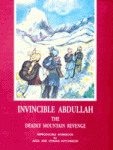
I’m pretty sure I’ve seen and handled this book hundreds of times in my involvement in four Islamic Schools, as a teacher, a librarian, and host of book fairs.  So, it is a little embarrassing to admit that this is the first time I actually cracked open the cover and read the book.  Written in 1992 with a less than attention grabbing cover, I had minimal expectations, but with a newborn and down time, I thought I needed to give it a chance, and I’m glad I did.  The book is definitely geared to boys (there isn’t even a female character in it), and is pretty action packed and quick paced.  You know the boys will get out of the predicament at hand, he is “Invincible” after all, and there are three more books in the series, but you don’t feel bad reading it anyway, because it is sufficiently entertaining.  The book isn’t amazing, but it holds its own largely because it doesn’t talk down to the reader.  The characters are independent and thoughtful and yes they are teenagers battling drug carriers in the tribal areas of Pakistan, and yes they are wielding guns and hiking over glaciers, but mind you they never miss their salat or fail to thank Allah (swt) for their success which kind of makes the book that much more fun.  The book is 218 pages with a glossary at the back.  It is not an AR book, but I probably will make it into one at about a fourth grade fifth month level (4.5).  I also am considering doing it for book club, but might wait and read the rest of the series to see which one will have a wider appeal.

SUMMARY:

Abdullah travels to Pakistan from England to visit his cousin Hasan.  At the airport Abdullah’s bag gets switched with someone else’s and the boys find themselves getting accosted by the rightful owners who have a half a million dollars in their suitcase.  The boys talk to the police and learn that the money is part of a heroin operation going on in the tribal areas and that the inadvertent switch messed up the police’s sting to catch the criminals.  The boys run in to the drug runners again in the bazaar, and after an all out brawl decide when an opportunity to go into the tribal areas presents itself, that they should take it and do what they can, to put a stop to the criminal’s drug ring.

WHY I LIKE IT:

There is drugs, violence, and guns, but it is all done for the right reasons, in an action filled manner.  The “good” guys are all religious, and while the “bad” guys have religious sounding names, clearly are not, which lends it self to a decent discussion about what makes a good person and what makes one religious, clearly not just their name or culture.  It also lends itself to a realistic conversation about drugs, their effects on the users, and on drug culture as well.  The guns, well the guns are there to make threats, and to hurt people, at best it gives you a seg-way to discuss your views on guns with your children, but in the book, it is what it is, not a moral or religious issue as the drugs are made out to be.  The boys, the heroes of the book, are all very devout mashaAllah, and their actions, manners, and thoughts reflect this.  I like that this is consistent with their character.  They are respectful to their families, to each other and are ever mindful of themselves as Muslims in all facets of their adventures.

FLAGS:

Just the content of drugs, violence, and death. Mild compared to most TV shows or movies, but present, none-the-less, nothing a third grade and up can’t handle. (Spoiler, only one person dies and it isn’t directly at the hands of anyone, nature steps in to save the day).

TOOLS FOR LEADING THE DISCUSSION:

There is a workbook that apparently can be purchased to accompany and teach the book: http://www.islamicbookstore.com/b9648.html

The author gives pause as the characters have to decide what to do next and to weigh the pros and cons and possible repercussions of their decisions.  These moments would lend themselves well to a book club discussion to find out what the students would do, what they would be willing to risk, and at what cost.