Tag Archives: Aamna Qureshi

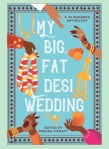
My Big Fat Desi Wedding by Prerna Pickett, Aamna Qureshi, Syed M. Masood, Tashie Bhuiyan, Noreen Mughees, Payal Doshi, Sarah Mughal Rana, Anahita Karthik

Standard
My Big Fat Desi Wedding by Prerna Pickett, Aamna Qureshi, Syed M. Masood, Tashie Bhuiyan, Noreen Mughees, Payal Doshi, Sarah Mughal Rana, Anahita Karthik

EDIT: I have been made aware that some/many of the included authors in this anthology have chosen to stay silent or “both side” the ongoing genocide in Palestine. Please be aware and be intentional and informed with your support

This 288 page YA short story anthology features eight stories of Desi weddings threaded together by an auntie with a bob haircut and a mole on her lip that appears and disappears into stories with magical realism, Tamil Brahman vampires, competing food dynasties, high school debate rivals, gorgeous clothes, delicious food, and sparks of romance.  Usually collections are hit or miss with writing quality and interest, but I found this collection enjoyable from start to finish.  My only real critique is that of the YA label and as a result some stories read more juvenile and at least one a bit more mature.  As a whole, the book, particularly for the genre, is fairly clean.  It is YA, it is romance, there are a lot of Muslim characters, with five of the authors being Muslim, but I would not classify any of the relationships or stories as halal.  That being said, I think mature teens 16 and up won’t find anything too alarming in the pages. There is music and dancing, close male female friends, secret relationships, a few kisses, some dances and hand holds, and a few that mention sex, condoms, and LGBTQ+ possibilities in passing, but most focus on weddings, culture, parental relationships, strong women, caste ideology, and hinting at happy every afters.  Many of the stories are simply set during a wedding or wedding prep, others are the bride or groom themselves, I don’t have a favorite or even a least favorite, as each has its own flavor, writing style, and focus.

SYNOPSIS:

Framed from an Auntie embarking on the wedding season, the short stories begin and follow one after another until the Auntie returns to conclude the book.

The Disaster Wedding by Prerna Pickett:  In a family where the words the females speak can come to fruition, an erroneous slip, claiming that her sister’s wedding will be a disaster brings on the challenges for the enemies to lovers side characters trying to not upset the marital couples multicultural Indian/American dream wedding.

A Cynic at a Shaadi by Aamna Qureshi follows a young Muslim girl nursing her broken heart from a recent breakup with her secret boyfriend.  Set during her cousins wedding, an upbeat optimistic boy makes her smile and gives her heart hope.

Sehra by Syed Masood involves a Muslim marrying a non Muslim girl that has the family refusing to attend.  The groom-to-be’s brother is torn and wants to attend, but he never goes against his parents.  His best friend who has grown up with the family and is facing her own community othering because of her “Mickey Mouse” hijab style, is planning to go, and together the two friends help wrap the groom’s turban.

Fates Favorites by Tashie Bhuiyan features magical realism with the words of soul mates appearing on skin.  The words appear and disappear sometimes unseen and possibly even as a result of one’s subconscious, thus the couples don’t always find one another, but when they do, the relationships can be magical.

The Wedding Biryani by Noreen Mughees is possibly the most religious of the short stories with high school debate rivals finding themselves cooking at the masjid for a couple that doesn’t have a family to celebrate the marriage.  Themes of losing a parent to death and simply leaving are present, as well as some internal reflection of boundaries, Allah swt, and body image.  The conclusion is the teens meeting up to dance.

A Confluence of Fates felt like the longest short story, and while many Zoroastrians it notes did come to India, the story focuses on Iranian Zoroastrian culture.  It is almost a story within a story as a couple gets a second chance at their relationship with the backdrop of a marriage play during the wedding unfolding in the background.

A Wedding Recipe for Disaster by Sarah Mughal Rana has competing family businesses: one Punjabi and the other of Pashtun culture, coming to a head when the offspring of the rival companies decide at the girl’s wedding to someone else, that they should be together.  With vibes of a Romeo and Juliet style family feud, the happy ending has readers craving achar and contemplating racism within the community.

And finally, A Very Bloody Kalyanam By Anahita Karthik goes gothic with a Tamil Brahmin vampire wedding occurring when offspring from two enemy cults imprint on each other.  This story is more mature with talk of sex, but has an emotional forgiving between the bride and her parents that makes the vampires lovable.

FLAGS:

It focuses on romance, and none of the stories are “halal.”  Music, relationships, boy girl friendships, Talk of sex, hints at LGBTQ+ identities, mention of condoms, vampires, magic, magical realism.

TOOLS FOR LEADING THE DISCUSSION:

Probably not a book to seek out for an Islamic school shelf, high school can probably handle it and understand it is not halal.

When a Brown Girl Flees By Aamna Qureshi

Standard
When a Brown Girl Flees By Aamna Qureshi

when a brown girl flees

I was both nervous and excited to read this contemporary book having loved the author’s fantasy, but unsure how a Brown Muslim Pakistani American girl running away from home would be presented.  Alhumdulillah, the author approached the story from a place of love.  There is no internalized Islamophobia, self othering, or in broad strokes even an identity crisis. The protagonist has made decisions, drastic ones, and is trying to piece her life back together on her own terms, but the love of culture, family and faith, is always upheld.  It reads like Islamic fiction, with very didactic passages and moral positioning, I’m still quite surprised that it is traditionally published.  The version I read had grammar errors, so I’m hoping that they will be corrected when the book releases in a few weeks.  The story is engaging, but the writing a bit monotone.  Much of the story is telling, not showing, and because of the surface level spoon feeding of so much of the plot, when the catalyst or rationale is not provided, the book seems underdeveloped, or lacking, unfortunately.  I would not recommend this book for the target audience of YA readers (12/13 and up) it contains sex, slut shaming, self harm, depression, suicidal thoughts, physical and emotional abuse, profanity, and mentions drug use.  I do think though, early college age readers will enjoy and benefit from reading the book.  At a time in the reader’s life when they are defining themselves on their own terms, owning up to their own mistakes and laying out a future path, this book will provide relatability amplified by religious and cultural touchstones.  The heart of the story is the connection of a girl with Allah swt after she has sinned, the guilt and regret she feels, and how she finds herself, and returns to try and fix things with her family.  The characters are flawed and the overall messaging beautiful, hopeful and uplifting.  Unfortunately, it just reads like an early draft and I wish it had a bit more refinement.  Keeping that in mind though, it does have a place, and I’m glad to see our “new adults”  can find reflections of  themselves in a piece of literature that amplifies their Islamic identity instead of criticizing or questioning it.

SYNOPSIS:

The book starts with Zahra deciding to run away from home.  She parks her car, leaves her phone and catches a flight to New York from California.  The reader doesn’t exactly know why she is running, only that a few days after high school graduation she is escaping a toxic home life, an impending wedding, and misery.  As the story peels back layers we start to see some of the nuance of what she is running from as characters from her past find her and physical space allows her some perspective to see her own role in her “old” life.  When she arrives in New York, it isn’t the city life that she seeks, but rather the nature and pace of Long Island that offers her a fresh start.  She heads to the masjid, makes a friend, and starts to put her life together without parental obligation, outside interference, and self loathing.  She cannot run forever though and she cannot escape herself.  She must confront her past, own her mistakes, be honest with her new friends, and find peace with her family, not because she has to as a Brown daughter of immigrants, but because she trusts Allah, loves her family, and wants to “fix” things.

WHY I LIKE IT:

I’m a sucker for books that show redemption through the love and mercy of Allah (swt).  Yeah her new friends were idyllic in their family life, relationships and worship, but we all want friends that make us better Muslims, so I let it slide. Islam is centered, she wears hijab, she reconnects with salat, it is her identity even when she is just going through the motions. The author at times conflated culture and faith, but it never issues blanket statements or falls into universal stereotypes for Desi culture or Muslims.  She does a good job of keeping the negatives to the people and the critiques to the failure to push back on dangerous expectations. My issues weren’t the character flaws either, I’m onboard with the messiness of being human and the ability to seek and receive forgiveness from our creator.  I just wanted to feel things more.  So much was just told when it should have been shown.  I wanted to see the stress and anguish of her family life, not simply told it was depressing.  I wanted to see her cutting life long friends out and being isolated, not told she had lost her friends.  The book focuses on her running, and why she ran, but a big plot point for why she ran, having sex, needed more fleshing out.  Why was she driven to such an act? I know that she was depressed, I’m not belittling that, but what pushed her to such a strong stance, when she was already allowed on the school trip, she hadn’t yet been given the ultimatum and over and over the book says “I miss my family,”” I miss my home,” “I miss my mom.”  I didn’t feel the connection or understand what she was feeling, thinking, and it seemed like a huge hole in the book.  For all the themes of mental illness, faith, generational trauma, misogyny, abuse, expectation, depression, lying, culture, life choices, higher education, family dynamics, self harm. the book never quite felt rich with emotion or deeper than the surface level story.  At the beginning the author says she first wrote the book when she was a senior in high school, and while that may have made the main character’s perspective and voice ring true, as a successful author now, I wish she would have added the nuance, the insight, the subtlety that would have drawn the reader in and allowed them to get inside Zahra’s head and heart to see her and perhaps even themselves.

FLAGS:

The author and book identify triggers in the book “please be mindful of TWs: depression, anxiety, emotional abuse, physical abuse, self-harm, suicidal ideation, slut-shaming, PTS.”

There is also music, boys and girls alone in cars together, lying, cursing, generational trauma, misogyny, abuse, expectation, depression, anxiety, guilt, life choices, higher education, family dynamics, cutting, a brother who is often high or smells like weed/pot, it mentions partying, a sexual event, deceit, physically assaulted by a parent.  Nothing haram is glorified, but it is there and it is detailed, and not everything is resolved.

TOOLS FOR LEADING THE DISCUSSION:

I would not be able to shelve or teach this book in an Islamic school library, but in a college MSA book club or a youth group of a similar age this book would be incredible to read and discuss.