Category Archives: Leveled Reader

Meet Yasmin! by Saadia Faruqi illustrated by Hatem Aly

Standard
Meet Yasmin! by Saadia Faruqi illustrated by Hatem Aly

yasmin.jpg

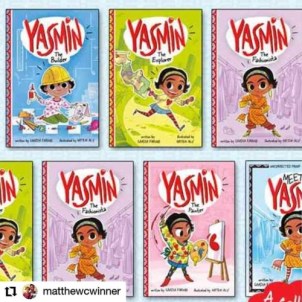
Yes! Yes! Yes! A strong and relatable 2nd grade, Pakistani-American Muslim girl, with stories written on a AR 2.4 -2.5 level, learns lessons and grows in everyday scenarios.  Seriously, this book is overdue and so well done, I can’t wait for the author, illustrator, and publisher, to team up to do more.  The book I have, Meet Yasmin! contains all four stories: Yasmin the Explorer, Yasmin the Painter, Yasmin the Builder, and Yasmin the Fashionista. You can buy each of the books separately in a larger format, and possibly a longer story.  The version I have is 5.5 x 7 and 96 pages long which includes a Think About It, Talk About It section at the back as well as a glossary of Urdu words, some facts about Pakistan and a recipe for Mango and instructions to make a bookmark craft .  The individual stories are 6 x 9 and 32 pages, and whether you buy the collection or the individual stories, they are under $6. Fabulous all the way around.
lots of yasmin

SYNOPSIS:

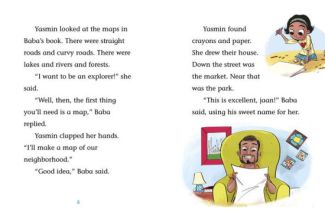
Yasmin the Explorer:  The book starts out with Yasmin’s dad telling her about explorers and maps.  Inspired, Yasmin decides to make her own map of the neighborhood, which gets really exciting when her mom asks her if she wants to join her on a shopping trip to the farmer’s market.  While they stop at different stalls and Yasmin adds to her map, the temptation of a playground draws Yasmin away from her mom, but luckily her map can guide her back.

Yasmin the Painter:  Yasmin’s school is having an art competition and Yasmin is nervous because she doesn’t consider herself a very good artist.  Her parents show her videos and gift her supplies.  Unhappy with how her attempts are turning out, she decides to find her own style and with the support of her parents she enters her painting and waits nervously to see who wins and what the mystery prize is.

Yasmin the Builder:  I think this story is my favorite because she really had to rely on herself when the class is building a city and Yasmin can’t figure out what to build.  She perseveres and works hard, and ends up connecting the dots and making the city come to life by finding a way to make her favorite part of the city, going for walks, a part of the class project.

Yasmin the Fashionista:  Mama and Baba have gone out for the evening, so Yasmin is hanging out with her grandparents.  When Nani and Yasmin play dress-up and Mama’s shirt gets ripped, Yasmin and Nani have to solve the problem!  Not only that, they get inspired to transform Yasmin’s pajamas, and when Mama and Baba come home they are treated to a fashion show!

meet-yasmin_1

WHY I LIKE IT: 

There is a lot to love about these stories.  Yasmin is not great at everything, and things don’t necessarily come easy for her.  But she is bright and surrounded by people that love her, and she is allowed and encouraged to shine in her own way.  I like that her painting wasn’t great, and that she stayed in from recess to figure out what to build.  I love that her dad is involved in her projects and ideas as much as her mom, if not more.  I love all the little nuances that accurately show a Pakistani-American family and a Muslim one; not an exaggerated version, or a dumbed down one either.  Yasmin has to wait for her mom to put on her hijab, it doesn’t explain that she isn’t wearing a hijab in the home, but it is shown.  It shows the characters in ethnic clothes and in western clothes.  It shows Yasmin’s classmate building a church, and one building a castle.  Yasmin is spunky, she makes mistakes, she works hard, and she is a breath of fresh air, that I think kids of any and all backgrounds will relate to her and enjoy the stories.

The pictures are bright and colorful and detailed. They are age appropriate and make the chapters within the stories really come to life and keep new readers engaged.  The font and binding and layout is well done.

meetyasmin1

FLAGS:

None.  

9781684360222_p1_v2_s550x406

TIPS FOR LEADING THE DISCUSSION:

I honestly think little kids could read this and discuss it and might actually enjoy having a discussion about Yasmin: what they like about her, what things they have in common, what she does that makes them laugh.  It might come across as a girl book, but really, it isn’t she is relatable for everyone. 

There is nothing Islamic mentioned, just depicted in her mother’s and grandmothers hijabs.


My Own Special Way by Mithaa Alkhayyat retold by Vivian French translation by Fatimah Sharafeddini illustrated by Maya Fidawi

Standard

FullSizeRender (83).jpg

A mainstream Early Reader book with a cute little muhajaba on the cover and a premise that she’ll be a big girl when she wears hijab seemed like a book I should adore.  And while it isn’t bad, and I’m glad it was in the library,  really I’m not sure how I feel about it.

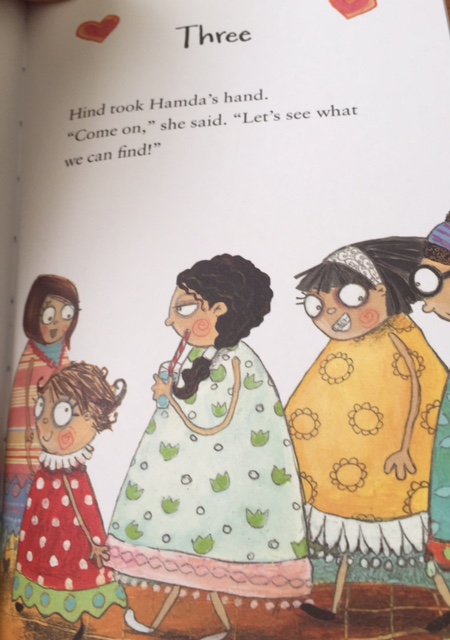
In someways, I’m just confused.  Why would you pick one of the characters to be named Hind, in a book urging readers away from picture books and into chapter books, it isn’t going to be pronounced with a short i sound, it is going to be pronounced like a “be-hind,” umm not so good for the age demographic you are trying to show another culture to, there will just be giggles and jokes.  Also, many of the illustrations are cute, but what is wrong with the dad and with Jamila’s sleepy eyes, they kind of border on creepy. And not the creepy, in a cool way, more like creepy in an awkward way.  And finally, with an author, a retold by, and a translator, and presumably a ton of editors and proofers at Orion Children’s Books, I found veil to be a very formal word to use throughout.  It does say it is a scarf at one point, but the word of choice throughout is veil, and I think to be culturally accurate, hijab would have been a better choice.  Even for English readers, scarf would have been a better fit.

The book is 62 pages, there is no glossary and it is not AR, but is a transition early reader book for kindergartener and first graders.

SYNOPSIS:

Little Hamda wants to spend time with her four big sisters, but they all say she is little and have other plans.  When her mom reminds her that they were small at one time too, she realizes that when they were small they didn’t wear hijab, or in this book, a veil, and now they are big and where one when they go out.  So, in her mind, once she starts wearing one, she too will be big, and thus the challenge of finding a way to wear it comfortably begins.  She is helped and supported by all her family and finally she finds her own special way to wear her veil.

I like that it is a mainstream book trying to include some diversity.  The family is relatable and the themes universal even if portrayed in a minority muslim framework.

FullSizeRender (80)

WHAT I LIKE ABOUT IT:

I love the premise of the book and that it is very clearly Hamda’s idea to wear a veil, no one is forcing her.  The text and illustrations align to show the girls cover when they go out, not in the home.  The dad needs help at one point finding his shoes to go to the mosque.  However, it doesn’t tell what a mosque is, or explain that the family is Muslim and wearing hijab is an Islamic act, which might be a comprehension block for young readers.

I really go back and forth on the illustrations.  On the first reading I thought they were creepy, when I went back to write the review they were kind of cute.  When I asked my kids, two said they were fine, and one said they were ugly and was positive I am the only one to have ever checked out the book.  Yeah.

FLAGS:

Fine, and Islamically nothing erroneous.

TOOLS FOR LEADING THE DISCUSSION:

Obviously not a book club level book, but I would be very interested to have some first and maybe even second graders read it and give me feedback, like I said I’m on the fence with this one.  Check to see if your library has it, read it, have your kids read it, and let me know.

FullSizeRender (82)

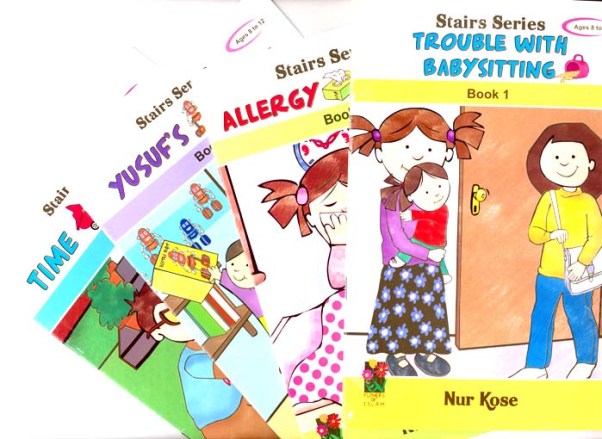
Stairs Series: Trouble with Babysitting, Allergy Attack, Yusuf’s Robot & Time Travel by Nur Kose illustrated by Shaista Asad and Ayesha Khatib

Standard
Stairs Series: Trouble with Babysitting, Allergy Attack, Yusuf’s Robot & Time Travel by Nur Kose illustrated by Shaista Asad and Ayesha Khatib

stairs series

This set of books claim to be for children ages 8 to 12, but I think they work better for 7 to 10 year olds.  They look like leveled readers, and resemble them in their simple linear story lines.  They are broken up in to chapters, that really are not necessary, but because of the volume of text on each page, allows for a young reader to take a break.  All four books in the series are connected chronologically and contain the same characters.  They more or less present a problem, bring over their friends, have one of the friends offer some advice tied to a hadith or ayat from the Quran, and the advice is tested, and then shared once more.  They are about 20 pages and have activities at the end that range from solving clues to writing paragraphs.  The sentences and vocabulary are about a second grade level, with translations of Arabic and Turkish words, along with references to the Quran and Hadith appearing in the footnotes on the page they are mentioned on.

stairs series characters

The best part of the books is that they are written by an 8th Grader, mashaAllah.  I think they teach a lesson in a simple way, and while not terribly suspenseful or comical, they do succeed in showing Islamic lessons in relatable situations for kids.  Some of the details seem excesses or meandering, but again, the fact that it is written by a kid, will inspire readers to listen differently to lessons about patience, accepting Allah’s will, recognizing one’s own limitations, and putting Allah (swt) above all else.

stairs inside

The pictures are colorful and simple.  They appear every few pages in the book and provide a nice break from the text.  They are sweet and not detailed, but sufficient for the story and level.

stairs pictute

The Lost Ring: An Eid Story by Fawzia Gilani-Williams illustrated by Kulthum Burgess

Standard

The Lost Ring.jpg

This is a good little story about Eid ul-Adha for 2nd through 4th graders.  It is not AR and at 29 pages it balances information about Islam and Eid with a simple little story that keeps the target demographic interested.  It isn’t great, but for a book that would probably be a level reader equivalent of a three, it suffices in being a bit of a mystery, a bit of a comedy, and bit of a lesson on why and how we celebrate Eid.

Rahma’s Grandma and cousin, Muslimah, are visiting for Eid. The girls start off the story trying on their beautiful dresses and feeling like princesses.  The girls and Grandma then get to work on making samosas for Eid.  Rahma sees her grandmother’s ring next to the bowl of dough and tries it on. The story moves fluidly and the girls take turns helping  with the folding of the samosas.  Some more adults come in and add tidbits to the story about giving gifts on Eid and getting ready for Salat and depicting a typical practicing family.

The story shifts to dad asking the kids what they remember about Eid-ul-Adha and what they know about Eid-ul-Fitr, the Festival of Sacrifice. On the day of Arafat the children fast, visit the hospital and take gifts to people in the community and the neighbors.  After Salat-ul-Maghrib dad reviews some of the sunnah acts for Eid as well.  It doesn’t get too preachy, or overly detailed, it is more highlights and brief summary revisions.

Eid day is fun and exciting, but when night falls and the family prepares for people to come over, Grandma can’t find her ring.  The kids want to be detectives, but Rahma suddenly realizes that the ring must be IN one of the samosas. So the children decide to eat them all to check. When the ring doesn’t turn up, Rahma and her cousins recite Ayat-ul Kursi, ask Allah for help and decide to tell Grandma the truth.  Just then Mum yells and the ring is found in her samosa, the truth is revealed and they all enjoy a good laugh and resolve to “always remember this as the Samosa Eid.”

The Lost Ring inside

There is a lot of text on the page, and a fair amount of “foreign” words that I think the book is probably meant for Muslim children, or those familiar with the basics of Eid.  There is a Glossary in the back, but it still might be a bit too much for non Muslim children to grasp without someone to answer their questions. The illustrations have the elder females with hijab and the girls uncovered when not praying.  The small pictures are detailed and complimentary, but the younger readers will wish they were a bit more engaging.  Overall, a good book to have in a classroom, and a great one to check out from the library to encourage young readers, or just to enjoy before Eid-ul-Adha.

Max Celebrates Ramadan by Adria F. Worsham illustrated b y Mernie Gallagher-Cole

Standard

Max Celebrates Ramadan

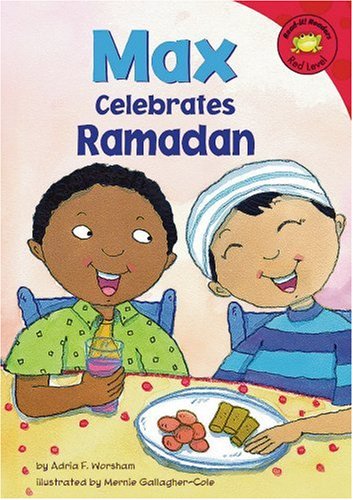
Max is a character in a series of leveled readers that explores familiar topics to build reading confidence (Max Goes to the Doctor, Max Goes to School, etc.), and introduces new ideas as the reader’s skills build (Max Celebrates Cinco de Mayo, Max Learns Sign Language, etc.).  I love that Ramadan was included and this 24 page AR 2.0 book is spot on, in what a new reader can handle without getting frustrated or bored in terms of content, and ability.

max

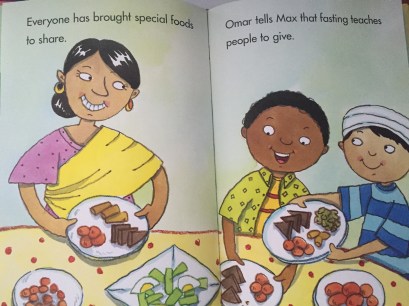
Max goes to his friend Omar’s house to celebrate Ramadan.  He learns a little about the month, what the Quran is and about Eid al Fitr too.  The foreign words are explained in the text and there is no explanation of belief or doctrine.  There are just simplified, age appropriate, descriptions of what a Muslim does and what you might see during Ramadan.  Very level appropriate for Muslim and non Muslim children.  Omar’s family is inviting and kind, and the illustrations show them to probably be of Indian decent as the mother and other females are wearing saris.  None of the women cover, but the males all wear kufis.max1

The book doesn’t stand out in any way, but most leveled readers, in my opinion, don’t.  If you have young readers check and see if your library has the book, the kids will enjoy it.  It works ok in small groups, but not for story time so well, as it is rather repetitive in a dry, not predictive way.  If you are a kindergarten through 3rd grade teacher, I think this book would be a great addition to your book shelf, as well as the others in the series as a way to learn about other people in an independent way.  My son going in to first grade read it by himself fluently and enjoyed the pictures.  Someone new to the concept of Ramadan, i think, would also be able to grasp the concepts without much outside help.