Category Archives: Kg-2nd

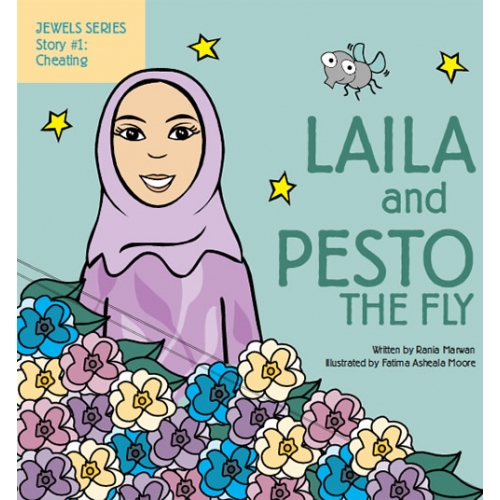
Laila and Pesto the Fly by Rania Marwan illustrated by Fatima Asheala Moore Jewel Series Story #1 Cheating

Standard

laila-and-pesto-the-fly

I ordered this book with the hopes that it would be the first book of a wonderful series teaching values in an Islamic context.   It says that it is book #1 in the Jewels Series and it focuses on cheating.  However, the book was published in 2009 and I can’t find any other books in the series.  Sadly, I can possibly see why.  The book is not great.  The illustrations make it so tempting even if all the girls are gorgeous and the illustrations simple, they would seemingly work well with a book aimed at 4 to 8 year olds, and just 24 pages long.

laila1

Unfortunately the text is lacking and doesn’t create a story worth reading more than once. The sentences are repetitive. And the same words are used over and over.  The first page alone says the word “play” four times in three sentences.  It is about 4th grade girls that play, watch cartoons and essentially hold lessons/ book clubs for each other once a week.  A lot going on for a book that on the second page says the word “flies” three times in three sentences.  Needless to say the repetition makes it hard for a story time selection, and the run on sentences hard for young readers.  The first page features a font that is probably about a size 20 and the next page it drops down to one that is about 11, the third page is about a 14 and the trend of the ever-changing font size continues throughout the book.

laila-text

Example of repetitiveness from Laila and Pesto the Fly

The story idea is a good one at its core.  A girl teaches her friends about flies.  Then the fly talks about Laila and how she is kind and honest. Then the next sections returns to Laila not being ready for a math test and she is tempted to cheat when Pesto, the fly, distracts her and writes a message for her in glitter.  I’m not sure how the glitter stays on the page, but, the message is received by Laila and emphasized by the author sharing a hadith, “He that deceives us is not one of us.” The last page of the book is a bulleted list emphasizing the harms of cheating, and how to overcome the temptation as the girls urge you to join their Cheat Deceit Foundation.

Overall, the book is awkward and doesn’t work for me.  There are a lot of better books out there.  That being said, if the author wrote another book, I may give her another chance, it isn’t hopeless. It just needs some tweaks. The fly is a silly likeable character, but the group of friends are a monolith and have no individual roles.  The message is clear and important, and we need books like this, but alhumdulillah the standards have gone up, way up, and the writing quality isn’t where it needs to be to attract Muslim children or their parents.


Nusaiba and the 5th Grade Bullies by Asmaa Hussein illustrated by Zul Lee

Standard

Nusaiba.png

As someone who deals a lot with reading and comprehension, I really misread the description of this book and assumed erroneously that it was a chapter book targeting 5th graders.  Oops, alhumdulillah, my confusion and slight disappointment didn’t last long as I got swept up in Nusaiba’s spunky imagination and endearing personality.  The message of the book is powerful.  Not only does Nusaiba have to deal with bullies, but she has to wrangle with accepting herself, even if that means being different.

nuaiba2

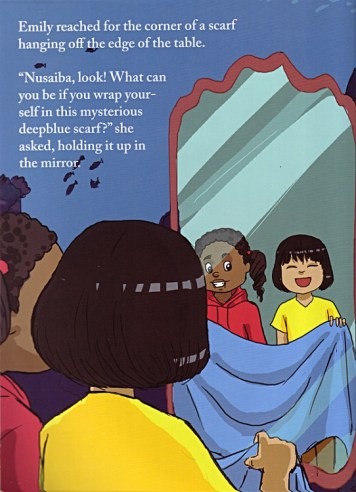
Nusaiba is almost to school when she overhears some 5th grade boys making fun of her mom and what she is wearing.  Nusaiba’s mom is wearing a hijab, and the story is set up to imply that that is what they find “weird.”  This morning encounter bothers Nusaiba all day, and while she doesn’t talk to her teacher about it when asked, she does spill the beans to her best friend Emily.  The next day Nusaiba distances herself from her mom and asks to walk to the school gate alone.  The bullies don’t say anything, but Nusaiba feels guilty about leaving her mom like that. Later that day when Mom picks Nusaiba and Emily up from soccer they swing by a local hijab shop for some clothes shopping.  I don’t know why, but I found the premise for taking the girls clothes shopping a little forced.  It seemed too words of a setup, and I couldn’t help but wonder why Emily would be dragged along.  As mom tries on skirts for work, the girls in their boredom get swept up in using the scarves as costumes and transforming themselves from queens, to underwater divers, to fisherwomen, to mountain climbers, to fantastic cleaners ready to clean up all the scarves on the display.  Her mom lets her pick one to buy, and she decides to wear it to school the next day.  It is noteworthy that Emily doesn’t try on any of the scarves.  She is an amazingly supportive friend, and even in make-believe is right there with Nusaiba, but she doesn’t put one on, and I kind of want to know the author’s reasoning or purpose as to why.  So the next day at school, Nusaiba asks her mom to again walk with her, and when the 5th grade boys call her mom an “odd-ball.” Nusaiba finds her courage to confront them.  Nusaiba and the reader discover the boys are making fun of Nusaiba’s mom, but it isn’t for her hijab.  Nusaiba and her mom set the boys straight and giggle in the process, as Nusaiba realizes she can be anything she dreams.

nusaiba1

The book is 44 pages and probably about a second grade mid year reading level.  The pictures are big and bold and beautiful making it a great option for story time to ages 4 and up.  The pictures do an amazing job complementing the story and going back through to look at them after the “twist” at the end was even more delightful.  The illustrator draws you into Nusaiba’s world and you really do cheer her on when she stands up for herself. The book easily lends itself to discussion, and there is also a question guide at the end, incase you get stumped. It reads more like a school assignment, but it could obviously be re-worded to engage a child at bedtime or in a read-a-loud environment.  The font is a nice size, however, I found it distracting. On some pages it is white on others black, on some it has a shadow and on others it does not.  I’m certain most people would not notice, but for some reason it was jarring to me.  Alhumdulillah, alhumdulillah, if that is the only negative in a book, I think everyone who reads it will be glad to have a copy of their own to read again and again and again and again and….


King For A Day by Rukhsana Khan illustrated by Christiane Krome

Standard

King-for-a-Day1.jpg

Its time for Basant, the Lahore, Pakistan kite flying festival, and Malik and his siblings are ready.  Ready to launch Falcon into the sky, ready to set other kites free, and ready to put the bully next door in his place.  While some kids have huge kites, and some have many, Malik has just Falcon, a speedy little kite that Malik prays can get the job done.

King for a day inside

Once again Rukhsana Khan does a remarkable job of taking a universal theme, adding some culture, and finding artists to empower minorities without making it an issue, all in a 32 page children’s book.  Written on an AR level of third grade ninth month, readers see characters handling a bully by beating him “on the court” so to speak, a character having confidence in his abilities, yet still asking Allah swt for help, and a boy in a wheel chair celebrating a fun spring time festival with his family.

king 1

The illustrations are rich with texture and angles, which contrasts the font and text presentation.  Little kids probably won’t be tempted to pick this book up, but as a read-a-loud first and second graders will enjoy the story and the kite flying action.  Third and fourth graders will enjoy reading the book independently, and find themselves cheering for Malik, appreciating his kindness, and wanting to pick up a kite and head out themselves.  The author includes a note at the back which provides more information about Basant and how it is celebrated.  Although it takes place in Pakistan and is a festival not celebrated in America, there isn’t a “foreign” feeling to the book, as kids can relate to bullies, wanting to be the best and the satisfaction of succeeding and feeling like a “king for a day.”

king2

Nadia’s Hands by Karen English illustrated by Jonathon Weiner

Standard

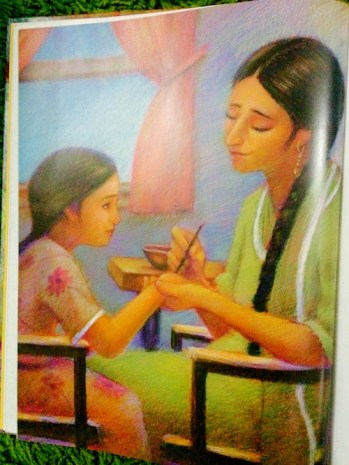
nadia's hands.jpegNadia’s aunt is getting married and she gets to be the flower girl in the Pakistani-American wedding.  She also will get mehndi put on her hands for the big event.  Her cousins warn her that she might mess up and even in the midst of her excitement she begins to worry what the kids at school will say when they see her hands on Monday.  As her aunt prepares the mehndi and the application process begins, various uncles peek in on her and her aunt gifts her a beautiful ring.  The mehndi has to sit on the skin for a while to set and as Nadia practices sabr, patience, I couldn’t help but think something seemed off in the story.  I’ve been at, in, and around a lot of Pakistani and Pakistani-American weddings, and this story didn’t seem to reflect the tone of such occasions.  The book doesn’t reflect the hustle and bustle and near chaos, it doesn’t sound like the tinkle of jewelry and laughter as the women sit around chatting and getting mehndi put on together, the pots on the stove are referenced but not described so that the reader can smell the sauces thickening and hear the pans crashing and taste the deep rich flavors.  It is lonely.  Nadia is lonely and filled with anxiety about Monday.  Durring the wedding she is walking down the aisle and suddenly freezes when she looks down and doesn’t recognize her hands.  Her cousins seem to show unsupportive “I-told-you-so” expressions as she searches for some comforting encouragement to continue on.  When she finishes her flower girl duties, her grandma asks if she understands why looking at her hands makes her feel like she is “looking at my past and future at the same time.” Nadia doesn’t understand and the author doesn’t explain.  At the end she is ready to embrace that her hands are in fact hers and that she will show her friends on Monday.  But the reader has no idea how it goes, or what exactly the significance of her painted hands are.  The book fails to give any insight or excitement for a culture bursting with tradition at a time of marriage.
 nadia's hands inside

There is a glossary at the beginning for the few Urdu words sprinkled in the book.  There is no further explanation however, of  mehndi, or weddings, of the brides clothes etc.  The illustrations are adequate, but because the text doesn’t offer much warmth or vibrance, they seem a little drab, and raise more questions about what some of the traditional items depicted are.  The book is a standard 32 page picture book and is written on an AR 3.8 level, which I think is a little high.  Granted my children are familiar with mehndi, but my first grader read it to me with little assistance.  There isn’t any mention of Islam and could probably be argued that the story reflects any wedding from the subcontinent background performed in the west.  The bride has a duputta on her head in the picture, but that is neither here nor there, and no one in the audience appears religiously covered.  I would assume they are Muslim because of the minor characters’ names: Omar, Saleha, Amina, Abdul Raheem.  Also, the word Sabr, an Arabic word, suggests that they are Muslim.  Plus they eat kabobs which the glossary defines as mincemeat, so probably not Hindu.  Overall the book is not, “bad” or “wrong,” I just wish there were more to it.


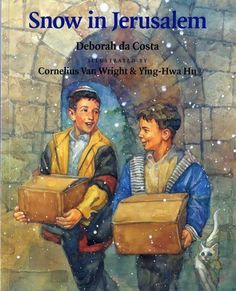
Snow in Jerusalem by Deborah da Costa illustrated by Cornelius Van Wright & Ying-Hwa Hu

Standard

Snow in Jerusalem

The world is always in need of kindness for animals and for one another, so when I saw this book written in 2001 about two boys who live in different quarters of Jerusalem coming together when they learn they are caring for the same stray cat, I was definitely excited to dive in.

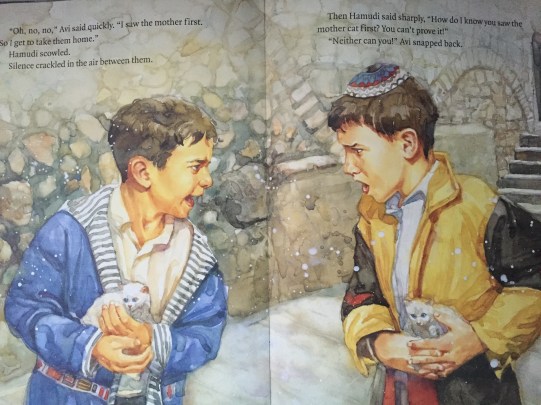
The book starts with a Jewish boy, Avi, caring for a fluffy white stray cat and his mom teasing him for caring for him.  He begins to wonder where the cat goes and resolves next time he comes around to follow him.  The reader then sees the cat journey through a market place and have the exact same interaction with Hamudi, a Muslim boy.  Both boys go days without seeing their beloved cat and when they begin to look for her, they find each other.  The boys fight over her as it begins to snow and the cat takes them to see where she has been, with her new kittens.

Again the boys fight and ultimately resolve to divide up the kittens to care for them and let the mama cat go back and forth to feed them.  Needless to say, I was a little let down by the book, I had hoped the boys would bond or see how similar they are. Instead they simply work out a solution for this one situation.  I can’t help but thinking the kitty family getting broken up and the poor mom having to go back in forth is rather selfish on the boys behalf.

IMG_0326

The book is 32 pages and written on an AR level 3.1.  Third grade and up can probably understand the similarities of the boys and how they come together to care for the cat and appreciate it with a simplistic understanding of Jerusalem’s complexities. Kindergarten and 1st graders could probably handle it as a story time selection, and understand working together to help a cat.  I’m sure fifth graders and up however, will be a little concerned for the mama cat and disappointed in the boys at a lost opportunity to provide hope in a troubled region.

There is an Author’s note and Glossary of Arabic and Hebrew words at the end, and a simple, yet valuable map of the Old City at the beginning.


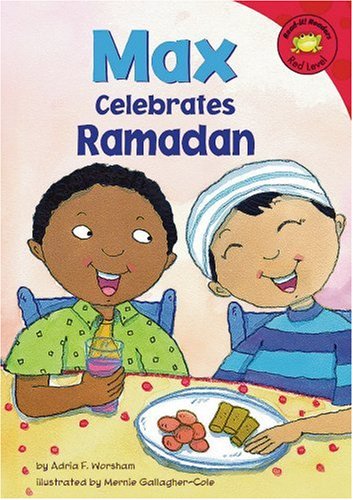
Max Celebrates Ramadan by Adria F. Worsham illustrated b y Mernie Gallagher-Cole

Standard

Max Celebrates Ramadan

Max is a character in a series of leveled readers that explores familiar topics to build reading confidence (Max Goes to the Doctor, Max Goes to School, etc.), and introduces new ideas as the reader’s skills build (Max Celebrates Cinco de Mayo, Max Learns Sign Language, etc.).  I love that Ramadan was included and this 24 page AR 2.0 book is spot on, in what a new reader can handle without getting frustrated or bored in terms of content, and ability.

max

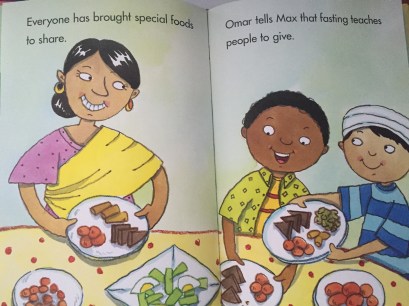
Max goes to his friend Omar’s house to celebrate Ramadan.  He learns a little about the month, what the Quran is and about Eid al Fitr too.  The foreign words are explained in the text and there is no explanation of belief or doctrine.  There are just simplified, age appropriate, descriptions of what a Muslim does and what you might see during Ramadan.  Very level appropriate for Muslim and non Muslim children.  Omar’s family is inviting and kind, and the illustrations show them to probably be of Indian decent as the mother and other females are wearing saris.  None of the women cover, but the males all wear kufis.max1

The book doesn’t stand out in any way, but most leveled readers, in my opinion, don’t.  If you have young readers check and see if your library has the book, the kids will enjoy it.  It works ok in small groups, but not for story time so well, as it is rather repetitive in a dry, not predictive way.  If you are a kindergarten through 3rd grade teacher, I think this book would be a great addition to your book shelf, as well as the others in the series as a way to learn about other people in an independent way.  My son going in to first grade read it by himself fluently and enjoyed the pictures.  Someone new to the concept of Ramadan, i think, would also be able to grasp the concepts without much outside help.