Category Archives: Elementary Fiction

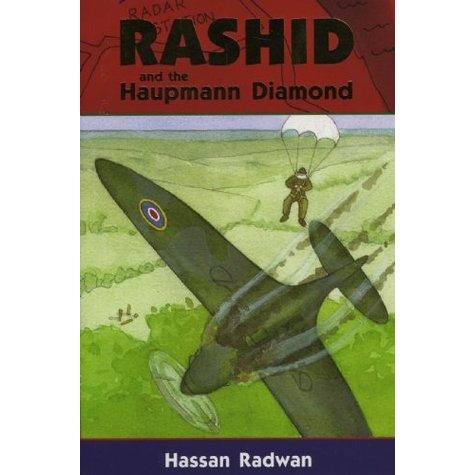
Rashid and the Haupmann Diamond by Hassan Radwan

Standard

haupmann diamond

This is the second and seemingly last book in the Rashid series, which is unfortunate, because like its predecessor Rashid and the Missing Bodythe book is a quick fun read aimed at 3rd through 5th graders with Muslim characters solving a mystery.  At just 110 pages the book reunites friends Rashid, Gary, and Chris, three boys of different religious backgrounds with plenty of respect and understanding to inspire readers of all ages.

SYNOPSIS:

Rashid and his friends hear screaming in the middle of the night and rush outside to see robbers in their neighbor’s house. Once the police come and no evidence of a break in can be found, the boys do their own investigating to see what is going on.  Pieces of information start to come together from the elderly neighbor and her stories of her father, mysterious contacts online, old WWII veterans at retirement homes, and good old fashioned library research, to lead the boys on an adventure to find a lost diamond.  Never a dull moment as the boys are chased by the burglars, family issues at home bring Rashid’s sister and baby into the story, some bullies at school and more.

WHY I LIKE IT:

The book is incredibly fast paced, it hops around from one story-line to the next.  While this format seemed more cohesive in the first book, it was a little jarring for me in this one.  I didn’t mind the side stories at school, or even the soccer matches, but the story of the sister, Huda and her marital problems with her husband Ahmed seemed a bit out of place.  I see what the author’s intent was, but in such a short book aimed at elementary aged boys, it seemed  a heavy story-line to interweave into an adventure story.  The deeper understanding of mixing cultures and expectations I am positive would be lost on all young adult readers.  Once again, the author however, does do a great job of telling a story where the character’s Islam adds to the character, and doesn’t distract from the adventure on hand.  Rashid uses islamic terms, the family prays together, they go to the masjid and laugh with the imam and congregation, they talk about proper ways to correct people and the value of intentions, overall, I’d say they convey a “normal” Muslim family.

FLAGS:

No flags, the book is clean and inspiring, alhumduillah

TOOLS FOR LEADING THE DISCUSSION:

There isn’t a lot out there about the book or the author, nor is the book in the Accelerated Reader database.  I think with its linear story, keeping track of the clues and throwing in some highlights of Islamic manners and morals, however, would make a discussion on the book easy and natural enough for all to enjoy.
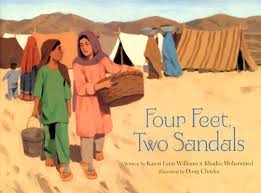
Four Feet Two Sandals by Karen Lynn Williams & Khadra Mohammed Illustrated by Doug Chayka

Standard

four feet

A beautiful hardback picture book I picked up at the Scholastic Warehouse sale, at 32 pages long and an AR level 3.2, Four Feet, Two Sandals, works well as both a story time selection to younger students and as independent reading for up to 5th grade.  The story is about two refugee girls that come to know each other when relief workers throw donated clothes for the people and Lina and Feroza each end up with one sandal each of a beautiful pair.  Rather than fighting or being ungrateful, the girls work out a plan so that they can both enjoy the sandals and in the process, become friends.  The girls share their stories with one another, and thus the reader, about how their families have been affected by war and how they came to be at this refugee camp in Peshawar, Pakistan.  The girls dream of school and their futures and show the readers a bit of their daily struggles getting water and doing chores.  When Lina’s name shows up on a list to go to America, and Feroza’s does not, the friends must part and decide who gets the sandals.

While it probably bothers some that America is seen as the saving grace to sweep Lina to a better life and pander to an American audience. I think it makes sense seeing as the book was co-authored by the executive director of the Pittsburgh Refugee Center and was inspired by a refugee girl who asked “why there were no books about children like her.”  Clearly refugees do get a chance at a new life when other countries open their borders and stories like this that give our children insight into the world they have left behind, with the hopes of fostering compassion, is something that I definitely want to share with my own children and students.

The author’s website and reading guide: http://www.karenlynnwilliams.com/files/sandals_guide.pdf

My Name is Bilal by Asma Mobin-Uddin, Illustrated by Barbara Kiwak

Standard

bilal

The other book I discussed during my Story Time theme of bullying was, My Name is Bilal, by Asma Mobin-Uddin,  The book is an AR 3.5 so I summarized parts when reading it aloud, but at bedtime one-on-one my five-year-old was able to grasp what the characters were going through and how best to handle “mean” people.

The premise of this 32 page, fairly content heavy picture book, is a new family starting at a new school.  The main character Bilal does not stand up to some boys teasing and pulling off his sister’s hijab, and then chooses to tell people his name is Bill instead of Bilal so that no one knows he is Muslim.  Fortunately, Bilal has a Muslim teacher who doesn’t jump in to “save” Bilal, but instead shares with him a book about Bilal Ibn-Rabah, the slave who was tortured by the people of Mecca in their attempts to get him to renounce Allah (swt) and Islam.  Young Bilal, finds strength in this story to stand up to the bullies as well as compassion in giving them a second chance.  He even finds there are more Muslim’s around him and being true to yourself is something even those different than you can understand and respect.

Yes, the book is to neat and tidy and it all works out in the end.  But, I think it is a good introduction to being proud of who you are and not backing down.  I like that the kids essentially handle things on their own and that no one is painted singularly as “good” or “bad,” both Bilal and the other kids are flawed and figuring things out. When I read this during Story Time we talked about it from the “bullies” point of view of what a better way to handle someone or something that you don’t understand would be, a scarf in this case, and how asking questions is always more respectful than teasing. We also talked about being the different one in a new environment and how to be prepared if someone does give you a hard time.  The characters in the book are older presumably than 4th or 5th grade allowing this to be a gateway into discussing bullying a bit abstractly, inshaAllah not once it has already begun.

The illustrations are colorful and realistic, not detracting from the seriousness of  the subject matter.  Overall the book serves a purpose and tells a good story.  Plus, the reader learns a little about Bilal and how the early Muslim’s struggled and encourages them to seek out what their own names mean and represent.

Circle of Sandcastles by Mariam Al-Kalby, Illustrated by Yee Von Chan

Standard

circle of sandcastles

The second book by Mariam Al-Kalby in The Prophet Says Series, is just as good, if not better than the first book, The Apple Tree.  Dedicated to her second daughter Maimuna, this story focuses on the hadith, “Whoever amongst you sees an evil, he must change it with his hands; if he is not able to do so, then with his tongue; and if he is not able to do so, then with his heart; and that is the weakest form of Faith” (Sahih Muslim).

The book follows shy Maimuna as she goes from stopping bullies picking on a deaf classmate within her heart, with her tongue and finally as she has to get her hands involved.  Once again the illustrator does a wonderful job bringing the story to life with joyful playful illustrations and detail.  I used this book with the preschoolers at story time when talking about the five senses and with the kindergartners when talking about bullying and being mean, in both scenarios the book had a strong impact on the students.  I’ve had students remind me in passing how we should handle bullies in our heart or with our tongue and even my own 4 year old has referenced the book when seeing people communication in sign language.  Like the first book, the discussion that follows can be different with each reading, which keeps it in regular rotation.  The bullies are not all bad, but one doesn’t feel guilty giving lots for the reader to speculate upon if they so choose. Shy Maimuna has to be courageous and assess the situation if it is something she feels she can get involved with or not.  Mu’min, the child’s whose sandcastles keep getting destroyed, shows us that Allah swt made us each different, but really the same too.

The book has four Urdu words in it, that actually kind of seem awkward and forced, I simply translated them to English when reading to students (there is a glossary in the back), if you are familiar with Urdu they are fine, but rather unnecessary in my opinion.  The book has 32 pages, is hardback and beautiful inside and out. The author’s website has a cute coloring page http://apocketfulofnotes.com/2013/11/14/circle-of-sandcastles-coloring-sheet/ and inshaAllah your kids enjoy the book as much as mine do, I can’t wait to see what she writes next.

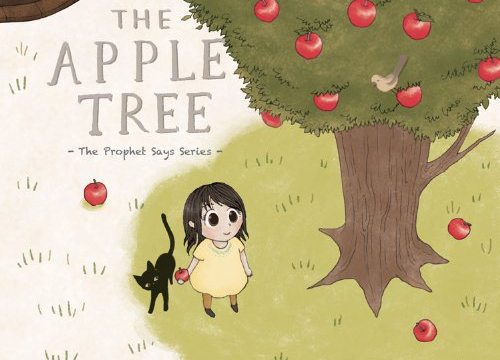
The Apple Tree by Mariam Al-Kalby, Illustrated by Yee Von Chan

Standard

appletree

I have been looking forward to obtaining this book for a while (it was back ordered on Amazon) and over all it was worth the price $16, and worth the wait.  The illustrations are absolutely beautiful.  At story time the kids constantly urge me to take my time in turning the page.  They aren’t incredibly detailed, just very whimsical and engaging, that you want to take a peek and stay a while to play with little Shaima.

The book’s moral comes from two hadiths (sayings of Prophet Muhammad (p.b.u.h.)) “When a Muslim plants a tree, whatever is eaten from it is charity from him, and whatever stolen is charity, and whatever is subtracted from it is charity” (Sahih Muslim), and ” There is no Muslim who plants a tree or sows seeds and then a bird, or a person, or an animal eats from it except that it is regarded as charity for him” (Sahih Bukhari).

The main character, Shaima, wakes up one morning at fajr to find her Baba planting an apple tree.  The two discuss what “reward of charity” means and the value of sharing.  Time presumably passes, although the tree does seem to grow and produce incredibly fast.  Once the apples are ready to be picked, Shaima finds everyone taking her apples: a little boy, a squirrel and her babies, some birds, what can she do?  The solution is both a lesson and inspiration for the character and the reader and makes for a fun book to get the discussion rolling on a wide variety of topics: patience, charity, sharing, generosity, humility and more, alhumdulillah.

The book is not AR, but is relevant to 4 year old children and up.  The book is hardcover and 32 pages. There are six Arabic words which are explained in the glossary and do not impede the story in any way.

The Breadwinner By Deborah Ellis

Standard

breadwinner

The Breadwinner is the first book in Deborah Ellis’ four book series about 11 year-old-Parvana, her friends, and her family in Taliban controlled Afghanistan.  The remarkable thing about this book is that it is a compelling story, that has moments of intensity and reality, yet never falters from being on about a 4th grade reading and comprehension level.  The AR level is 4.5 and as a teacher I taught the book as a novel study to 4th graders, and now as a librarian I presented the book for my Jr. Book Club.  In both cases, after completion, the children are arguing and fighting for the next books in the series, Parvana’s Journey, and then Mud City, and finally My Name is Parvana.  It is not a tempting book on the shelf necessarily, but once you start, it is hard to put down.

SYNOPSIS:

The book gives readers a glimpse of how the Taliban changed the day-to-day lives of the Afghani people.  Young Parvana starts out helping her father, a  former History teacher, earn a meager living by reading and writing for the illiterate in the marketplace, and selling odds-and-ends that the family is willing to do without in order to survive.  As a young girl she is allowed to accompany her father into the marketplace, her older sister and mother, however, have not left their home in a year and a half.  When Parvana’s father is dragged off to prison, the family is in need of a provider, a breadwinner, and with some of her deceased brother’s clothes, a haircut and some courage, young Parvana becomes Kaseem.  She carries on her father’s work, digs up bones to earn more, and sells items from a tray to keep her family afloat.  In the process she meets an old classmate, Shauzia, who is also disguised as a boy, an old gym teacher, Mrs. Weera, determined to fight back through disseminating journals and magazines, and other characters that bring the horrors and hope of the Afghan people to life.

WHY I LIKE IT:

I like that it doesn’t get too political, which would bog down the story and turn off young readers, and while it presents unfair imprisonment, stadium style punishments, death and pain, it does so in a way that evokes empathy not fear.  It even at times finds a way to stay light-hearted and offer up hope as the reader sees the resilience and determination of these people.

“I’ve been thinking about starting up a little school here,” Mrs. Weera said to Parvana’s surprise.  “A secret school, for a small number of girls, a few hours a week.  you must attend.  Parvana will let you know when.””What about the Taliban?” “The Taliban will not be invited.”

FLAGS:

The book is intense at some moments, such as when the father is taken by the police, the girl’s nearly see prisoners having their hands chopped off, and the characters discuss landmines.  But it is on a child’s level, too much description is not offered and for most 3rd graders and up, I think the book is a great dialogue starter about what some people have to endure in the world.

TOOLS FOR LEADING THE DISCUSSION: (There are a lot of resources for this book)

Author’s website and study guide:   http://deborahellis.com/teacher-resources/

Unit study:  http://www.teacherspayteachers.com/Product/FREE-The-Breadwinner-Unit-Guide-for-Students-365169

Lesson plan:  http://coolkidlit-4-socialstudies.pbworks.com/w/page/27715927/The%20Breadwinner%20Lesson%20Plan

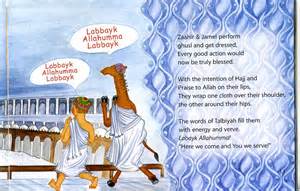
Zaahir & Jamel the Camel: Hajj by Amatullah Almarwani

Standard

hajj

This book is a great read for explaining the different parts of Hajj in a linear, easy to follow, fun way to children.  The author gives facts in a fictionalized setting with Zaahir and his camel, Jamel getting ready for, and performing the hajj.  The illustrations are also engaging and give plenty to talk about in both one-on-one reading scenarios and in larger groups.  For story time the book works well to read a page then reflect upon and discuss what it is showing and telling us. By stopping on each page the rhyme scheme doesn’t get too forced as well, as some lines are forced and awkward, making the rhythm hard to maintain.

hajj inside

Overall the book is effective and enjoyable.  The kids can see from the pictures and the simple words the importance of each step, and get an idea about how they are to be performed.  The book is not an AR book, but there is a quiz at the end to see how much they retained.

The Perfect Gift by J. Samia Mair

Standard

The Perfect Gift

Is there anything sweeter than a little girl feeling sad that she doesn’t have an Eid gift for her mother and then finding the perfect gift in nature? Probably, but it is still a great premise for a sweet story about a young girl named Sarah and how remembering the hadith “Allah is beautiful and loves beauty” starts a new Eid ul-Adha tradition for her family.

The Perfect Gift is simply written with adequate pictures that move the story along.  The text is short and clear leaving the reader or listener with a clear message about Allah’s perfection and gifts, but keeps it on a preschool to first or second grade level.  The book is 28 pages and has a few words defined at the end for clarity.  While the book takes place close to Eid ul Adha, there is no mention about what the holiday is for and how it is celebrated, the focus is on the beauty of nature and perfection of Allah (swt).

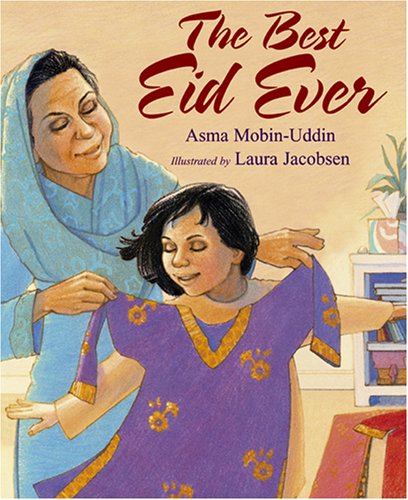
The Best Eid Ever by Asma Mobin-Uddin Illustrated by Laura Jacobsen

Standard

best eid ever

For some this book may have a lot going on it’s 32 pages: Eid ul Adha, parents at Hajj, refugees, charity, Pakistani culture, but if you are reading this book to Muslim children (or they are reading it independently, it has an AR level of 3.8) i think it is delightful.

Aneesa wakes up on Eid morning missing her parents who are in Saudi Arabia performing Hajj. Her grandma, Nonni, surprises her with three new outfits complete with bangles and shoes for each of the days of Eid and is preparing her favorite dinner, lamb korma, for them to eat after Eid prayers.  At Eid prayers Aneesa meets some refugee girls and wants to do something to make their Eid a little brighter.  Nonni and Aneesa come up with a plan and the result is “the best Eid ever!”

I love that it has morals and plot and sparks dialogue.  The message is so simple yet beautiful, that it stays with the reader, adult and child alike.  The illustrations are beautiful and warm providing a nice balance to the long passages.  There is an author’s note and Glossary in the back, but I think this book is really intended for a Muslim audience familiar with Hajj, Eid, and Paksitani culture.  It wouldn’t be lost on someone new to the vocabulary and customs, but definitely wouldn’t be as magical or memorable.

My 3rd grader loved the book and we were able to talk about it and reflect upon it long after the initial reading.  My younger boys enjoyed it, but didn’t get as much out of it.  I think this book works better in smaller groups rather than story time, or simply to have on the shelf to sweep the reader up and allow them to draw their own conclusions on what it means to do something for someone else.

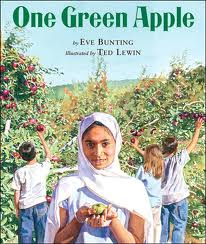
One Green Apple By Eve Bunting Illustrated by ted Lewin

Standard

one green apple

One Green Apple is a great story that really puts the reader in the shoes of a new immigrant that doesn’t speak English.  Farah, a young Muslim girl goes on a field trip to an apple orchard her second day of school and as they go for a hay ride and pick apples and make cider she and her classmates develop a connection that shows the reader how easy it is to reach out to someone new.

The sunny pictures and delicate words aptly describe Farah’s frustration in not being able to articulate her thoughts, and knowing where she belongs.  Similarly as she asserts her self and the others accept her you cheer her on and feel optimistic that she will find her place just fine.  

This story works well for new kids and for students with someone new in their class.  Being able to imagine what someone else is going through and discovering ways to help is a great lesson at any age.  The AR level is 2.6 and I read it to many of the classes the first week of school with new students, and even the older elementary grades were engaged and drawn to the message of the story and young Farah.  I don’t know that classes younger than Kindergarten would truly understand the story, maybe one-on-one, but I don’t think clothing and communication skills are a big deal with the younger ones.