
In terms of plot and and believability, this 274 page 6.3 reading level book has moments of unrealistic twists, but the historical flashbacks and context make up for it as it delves into Pakistan, India partition without getting overly bogged down in politics and bitterness. You can tell that the author writes from a place of love and warmth, as she talks about all sides involved: Pakistan, India, Great Britain. The stories, fictional and historical, that weave through the novel make it informative and entertaining irregardless of one’s prior knowledge.
SYNOPSIS:
Maya is 12, and a little shy, especially compared to her older sister Zara. The book starts with her writing a journal entry about her visit to Pakistan in an airplane somewhere over the ocean. Maya, her older sister Zara, and their mother are heading to Karachi from America because of the death of Maya’s beloved grandfather. Frequent visitors to Pakistan, Maya is familiar with the sights, traditions, and language. As other family members arrive, Maya and Zara overhear their elderly grandmother planning to runaway to India to retrieve family heirlooms that were left during partition. The plan had been in the works for the whole family to go, visas were already obtained, but with the unexpected death, the urgency is amplified. Grandma wants to find a ring to bury with her husband. In Islamic custom burials happen very very quickly, often the same day, so the delay and sending the body to America, is something you just have to go with as the reader. Rather than convince Grandma to stay, the girls threaten to tell their mother if she doesn’t take them along, and the next thing you know the trio are off to India and on a treasure hunt. There is a map at the beginning of the book, which is very helpful. However, the adventure isn’t straightforward, not only in the trio’s adventures, but in that grandma ends up in the hospital, Zara and Maya decide to pursue the lost items on their own, and then Zara and Maya get separated. Twelve-year-old Maya then is forced out of her shell as she is kidnapped, and running for her life, trying to keep her promises, and also in desperately trying to save her family from having to pay a ransom to save her. A lot happens, and the intensity amplifies as it starts out as a elementary aged family story and turns into a middle school adventure. A long the way are beautiful passages about the scenery, amazingly simplified, but factually and emotionally accurate explanations about partition and ultimately, through Maya, about finding your voice.
WHY I LIKE IT:
The framing of the fictional story and the historical context is wonderful. Partition, is such a pivotal moment for those that lived through it, but has less and less relevance to today’s generation that lives abroad. So, to find a book that makes the gist of the events come through, is why I love using fiction to connect people and ideas. I am making my daughter read this tomorrow, no question. She needs to know what her own grandmother endured, what decisions her family had to wrestle with, and this book allows us to have those discussions in an informed way. I’m sure many would disagree and say that the reader should know about partition before reading the book, but I think the tidbits and delicate way the author convey the horrors, the agony, the manipulation, and the struggles in todays time, is far better than I could do to a sixth grader.
Maya’s abilities seem to grow overnight, so while she was an ok protagonist, she might annoy some. I actually had to google in the middle of reading how old Maya is, at times she seems like she is eight or nine and at other times like she is 15. I do like that Maya constantly remarks how alike India and Pakistan are, a reality that today’s generation definitely agrees with, but is often afraid to voice to their parents. I also like that there are good and bad everywhere, a theme that doesn’t get old, especially in books that deal with cultural and religious elements as presented to a wide audience.
There isn’t much religion in the book, the characters don’t stop and pray or wear hijab, but the setting does allow for mention of masjids, and a kind Imam back in California, the characters identify as Muslim and they discuss Muslims as a minority and political entity regularly. One of the treasures the grandma is looking to retrieve is an old Qur’an with the family tree drawn within. The book talks about how intertwined the two countries and many religions of India are, and Maya’s name articulates many of these crossroads. In the end, perhaps the best lesson from the book, is how much alike we all really are.
There is a wonderful Author’s note in the back, along with a glossary.
FLAGS:
The book has some violent images as it discusses trains coming from India to Pakistan with only a few living aboard and vice versa. The intensity as Maya is robbed, and then kidnapped, and then held hostage, could also be jarring for some younger readers.
TOOLS FOR LEADING THE DISCUSSION:
Like all her other books, I would absolutely include this in a Book Club, there is a lot to discuss, lots to understand, and lots to enjoy.
Author’s website: http://www.nhsenzai.com/ticket-to-india/
Reading Group Guide: http://www.nhsenzai.com/wp-content/uploads/2017/09/Ticket-to-India_ReadingGuidePDF.pdf
YouTube book trailer:




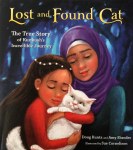

 One could argue that countless people are misplaced each day due to war, and we overlook it because it is easier than dealing with it, so why care about a cat. And to that I challenge the skeptic, animal lover or not, to read this book and not have your heart-strings tugged.
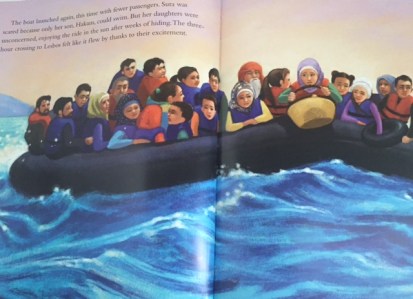
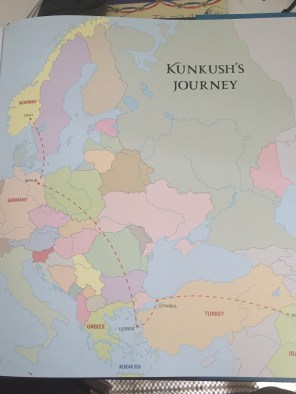 The book is done beautifully. The pictures are warm and endearing and are the only proof that the family is Muslim, by their hijabs. The love the family has for their pet is expressed in the illustrations, and even more so by the real photographs at the end of the book following the Note from Doug and Amy. At 48 pages the book works really well for 3rd grade and up (it isn’t AR) who can marvel at the cat’s journey. I particularly think this book is a great way to show children another aspect of refugees. There are a fair amount of books that talk about the refugee experience or show refugees getting adjusted to a new home. But, this is a great way to show that refugees are not just defined by a word. They are vibrant individual people just like everyone else. By focusing on the cat and his journey, the reader sees what a refugee goes through, particularly this family, and hopefully will stop and think about it. But it doesn’t just show the family in that capacity, it shows them as a vibrant family who loves and desperately misses their cat- something more children may be able to relate to.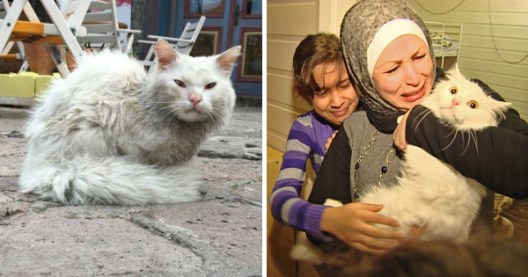


 Islamic School Librarian