Tag Archives: pashtun

Music of the Mountains: A Story in Pakistan by Sabrina Shah illustrated by Manal Mirza

Standard
Music of the Mountains: A Story in Pakistan by Sabrina Shah illustrated by Manal Mirza

Set around an Eid concert in the North-West Frontier in Pakistan, a young girl must find her courage to play the rabab in front of an audience, even though she is still learning her first song. The beautiful illustrations of Manal Mirza and focusing on an under represented population, made me hopeful that this book would transcend the musical focus and weave in Islam and culture. Sadly, though, the book falls victim to cliche lines that mean nothing, and a story that doesn’t make a lot of sense once you move past the superficial attraction. The backmatter infographics about the rabab, where it can be heard, details about the Pathan/Pashtun people, What Eid is, the traditional clothing, and a Pashto Glossary, add to the vibe of the book, but still fail to offer any specific “hospitality, courage, and rich traditions,” that are only ever referenced in generalized terms and statements.

The book starts with Roohi’s favorite time of day, the sun is settling behind the snow capped mountains and her family is gathering around to listen to her grandfather, Neeka Baba, play the rabab. No they aren’t praying maghrib, or breaking their fast, so presumably it is not Ramadan.  When Neeka Baba plays, “songs full of rhythm echo through the cherry blossom hills.  Songs from long ago tell stories of folklore, heroes, and love. . . songs of Roohi’s ancestors.” A beautiful sentiment, but it is not a thesis statement or main idea of the book as we, the reader, never learn about her ancestors, or folklore, or about the culture.” We are just told they all had courage, and she needs to channel that strength.

She will need strength to play the rabab at her school concert, except remember “she hasn’t even learned a whole song yet.” She also worries she won’t be as good as her grandfather, but presumably he has been playing longer and she is just starting, so I never connected why she felt she should be as good as him.  No one in the story compares them, or says she should be as good as him, or even strive to be as good as him.  There is nothing that hints that this is even a part of the characters development other than the repetitive refrain that she must “play with the courage of those who came before her.” So the cathartic release of being told “to play like yourself” also seems forcefully contrived and not a natural arc of growth and understanding.

As Eid creeps closer, Roohi has lessons with her grandfather on the rabab, and then Neeka Baba coughs and is in the hospital. The reader has no idea how this man falls ill, or recovers, if it was sudden or a known affliction, but he is no longer the focus, the rabab is, and so the story continues.

At the school concert, Roohi is introduced as playing music from the North-West Frontier Province.  Hold up, yes I thought I skipped a page.  They live in the North-West Frontier, don’t they, this is a school concert? What an odd introduction, did they travel? At the end there is a “smile as wide as the lush valleys back home.”  When did they leave home? And why a silent prayer, why not a “bismillah.” Isn’t the point of OWN voice to have the little details and the voice that can’t be imitated by researched work?

I am going to spoil the ending, she freezes, Mama and Neeka Baba help her find her beat in the audience and she steals the show so to speak. The ending is sweet, but not anywhere near as heartfelt as it should have been if the audience would have been shown the strength and courage of the Pashtun culture, not just repeatedly told it, felt the warmth of their hospitality, the rich ancestral values that would be threads that manifest in the music that she is hoping to share with others. Sadly we are just expected to know that they all exist and cheer for Roohi to succeed.

Disappointing, considering how fantastic the illustrations are, sigh.
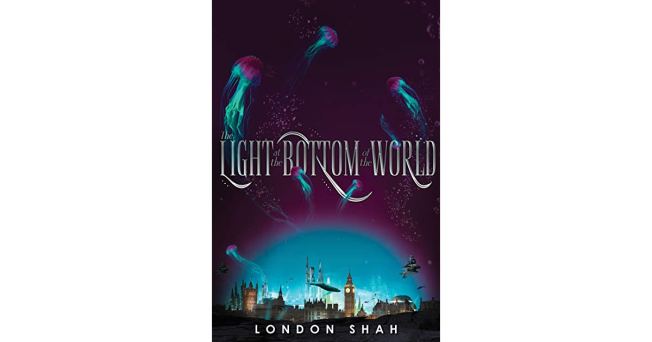
The Light at the Bottom of the World by London Shah

Standard
The Light at the Bottom of the World by London Shah

light at the bottom

At the risk of sounding pretentious or like I have written a book before, sadly this really reads like a debut novel.  At 311 pages, there is a lot to love about this Muslim authored, Muslim protagonist sci-fi/dystopian adventure, but I have so many more questions about everything after reading the book, than I did before I started, that unless the next book (assuming there will be one), really steps it up- all the world building will have fallen flat with the lack of character connection I felt. At times I had to force myself to read through the lulls in the story, while at other times, I sacrificed precious sleep to read just a bit more.  The story is pretty clean and would have no problem letting my 5th grader read it, even while knowing it will have more appeal to my 8th grader.

SYNOPSIS:

It is 2099, and Earth has flooded forcing everyone to live underwater.  Set in London, 16-year-old Leyla McQueen, a submersible racer, lives alone with her dog Jojo.  Her mother has passed away and her father has recently been taken away to an unknown place for an unknown reason.  It is Christmas, and Muslim Leyla spends the day with her best friends, twins Theo and Tabby.  With futuristic technology, the wealthy twins show the reader what life under the sea entails and the world the characters now inhabit.  Pausing to recall the day the Earth flooded, New Years brings a huge race, the London Marathon, and Leyla somehow gets one of the 100 spots to enter the dangerous submersible race.  The winner gets whatever they want, and Leyla hopes to win, so that she might ask for her father to be released.

By opting to not harm someone, Leyla’s last minute reactions earn her the championship title of the race, however, her request to have her father freed is denied and instead she is gifted a submarine and the attention of the authorities who have ransacked her apartment, and stolen and destroyed her home.  Feeling like she has no reason to stay in London, she plots to escape the borders and go search for her father alone.  A family friend, she calls Grandpa, knows more than he has ever let on, and forces a friend’s son to keep an eye on Leyla, Ari.

Ari and Leyla explore the ocean, while Leyla whines and makes poor decisions, narrowly getting out of each situation, but not seeming to really learn her lesson.  As people appear and help them along the way, she finds where her father is being held, but not much else, and then poof, a few action scenes later to try and rescue her father, and Ari is captured and the book ends.

WHY I LIKE IT:

You have to respect the author who’s bio on the back flap of a Disney, Hyperion published book starts off with, “a British-born Muslim of Afghan descent,” and who dedicates the book to “my fellow Pathans.  We too are worthy of taking the helm.” I love it! Seriously, way to be so confident in who you are, and your story, that you own it and wear it with pride.  Truly, I felt empowered and can only imagine what Pathan girls everywhere would feel opening the book.

Similarly, Leyla, owns her Islam by praying, reading Quran, saying Bismillah before she races, and inshaAllah when she hopes in for things in the future.  She does get a bit close to Ari and doesn’t find that a problem.  She doesn’t cover, and there are no other Muslim characters in the book, but she is definitely religious, and it is seamlessly woven into her character without mentioning anything about what Islam is or stands for, but giving it authentic attention.

There are a few twists, one particularly large one, but not a whole lot of answers, or details.  There is no understanding as to why Leyla’s father has been taken, what happened to everyone other than those in the UK (especially Afghanistan, where Leyla presumably would have family), why so many people are willing to help Leyla find her dad, why Grandpa tells Leyla nothing at all, about Ari’s friend who died, and so much more.  So often it just feels that Leyla is whining and getting no where in her rash and stubbornness, but everyone seems to love her. Perhaps, everyone but me.  I really never felt connected to her, and her annoyingly ever-present dog.  There is more telling about how great she is or her father is, and very little showing.  I think if there is a second book, it could really elevate this one, but as it stands, so little is resolved, explained, or emotional resonance, that I don’t know that the characters or book will leave a lasting impression.

FLAGS:

Some language and a kiss.  There is death, and disease, and battles and government lies.

TOOLS FOR LEADING THE DISCUSSION:

I’m tempted to do this as a middle school book club selection, despite the one-dimensional characters, simply because it is clean and might introduce students to a genre they might not otherwise read.

Author’s website: https://www.londonshah.com/