Tag Archives: Oil

Hilwa’s Gift by Safa Suleiman illustrated by Anait Semirdzhyan

Standard
Hilwa’s Gift by Safa Suleiman illustrated by Anait Semirdzhyan

img_6526-1

I’ve read a few children’s picture books about harvesting olives, and even some about Palestine’s olives, but this one really stands out because it is just so very joyful.  There is information about picking the fruit, processing, and making soap and oil with olives, but the book’s take away is just sore cheeks from smiling, and a full heart from feeling the importance, love, and tradition of olives, family, and being together.  The text and illustrations combine beautifully allowing the story of Hilwa, the olive tree, Ali and his Seedo to say a lot without having to spell it all out. And that it is traditionally published at such a critical time, is truly a gift.  There is nothing religious in the text, there are a few #Muslimsintheillustrations, and the author is Muslim. Additionally there is nothing about the current situation, the politics, the upheaval, or the occupation. The book follows Ali as he arrives after a long journey to his Grandparent’s home, it is harvesting season and  he is about to see all of the gifts that come from olives with the guidance of his grandfather, the cheering of his cousins, and the offerings of his beloved Hilwa.

The book starts with Ali and his parents arriving exhausted after their long flight to Palestine.  Greeted by Seedo, when Ali sees Hilwa, the olive tree his grandfather planted with his grandfather, the tiredness disappears.  When he hears Sitty whacking the trees and his cousins singing, “Zaytoon, ya zaytoon.”  He is ready to help harvest.  But, he doesn’t want to hurt Hilwa and decides to pick the olives one by one.  After his arms are tired and the basket is empty, he gently tries the traditional method and makes the zaytoon rain down with his grandparents and cousins cheering him on.

Hilwa has many gifts, and the next day they load up the olives to be taken to the press, they then prepare and enjoy the olives being pressed in to oil.  They bring the oil home to cook with, eat, turn in to soap, and the pulp is used to build the fire.  The best gift of all however, is the family, friends, and neighbors gathering to share and be together.

I read an early copy, and hope that the beginning will be smoothed out a bit.  It actually read as if a page was missing.  If the family had just arrived from overseas, and the grandfather was so excited, why wouldn’t the grandmother and cousins also leave what they are doing to great the just arrived family? It seemed a bit off, but once the story recovered, the text and story flowed without incident, so perhaps the disjointedness has been resolved.

img_6527-1

It is so important to show the richness of cultures to those that might be unaware, for a culture that is relentlessly villainized, even more so.  This 40 page picture book is great for ages 3 and up, and while it doesn’t detail Palestinian culture, it highlights a central component and shows the vibrancy and warmth of a people and their relationship to the land and the importance of olives and olive trees.  There is a glossary at the end with words in English and written in Arabic scripts as well as an Author’s Note.
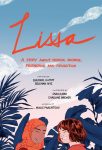
Lissa: A Story about Medical Promise, Friendship, and Revolution by Sherine Hamdy & Coleman Nye illustrated by Sara Bao & Caroline Brewer

Standard
Lissa: A Story about Medical Promise, Friendship, and Revolution by Sherine Hamdy & Coleman Nye illustrated by Sara Bao & Caroline Brewer

lissa-1440x2122

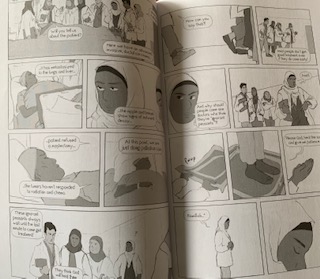
When I first started teaching I wasn’t a big fan of graphic novels, slowly I saw their benefit for struggling readers, and eventually I came to appreciate them as an enhanced tweak in story telling for everyone.  This book however takes the concept to the next level, for me anyway.   As the inside flap claims, it is a book “that brings anthropological research to life in comic form, combining scholarly insights and accessible, visually-rich storytelling to foster greater understanding of global politics, inequalities, and solidarity.” As a coming of age story of two friends at its core, yet taking on breast cancer, kidney failure, parental loss, different cultures, different religions and with a back drop of the Egyptian revolution, I’d say the book is meant for high school and up.  Not so much for content as for understanding and appreciation of all that went it to creating this ethnographic book.

SYNOPSIS:

Unlikely friends Anna and Layla cross economic, religious, and cultural differences to build a life long friendship.  The book is divided into three parts: Cairo, Five Years Later, and Revolution.  In the first part we see Layla’s family serving as the caretakers of a building and the two young girls bonding over pranks, arrogant tenants, and just being silly.  Anna’s family is American and the father works for the oil companies, thus they are financially very well off, however, the father is rather distant and the mother is dying of cancer.  The section concludes with the passing of Anna’s mom and the family going to Boston for the funeral.

Five years later finds the girls in college.  Layla in medical school and Anna at a university in Boston.  Layla’s father is suffering from renal failure and is unwilling to consider a transplant.  While Anna is trying to see if she carries the same genes as her mother and if insurance will cover it.  She also has to decide if she would want to have a complete double mastectomy, if she would want her breasts reconstructed, if she should do it now or later.  She gets a lot of opinions, but ultimately decides to find a way to pay for it and have it done.  Her father doesn’t understand, and Layla dismisses it forcing Anna to have to handle it alone.  But when news come that Layla’s father isn’t going to make it, she rushes back to Egypt to offer her support.

In the final section, the revolution has spread and Dr. Layla is helping those injured in Tahrir Square during the protests, and Anna is helping to identify bodies despite being attacked for being a foreigner and part of the problem.  Anna has kept the secret of her mastectomy from Layla and Layla assumes she has cancer.  At odds with their roles in the revolution, and with keeping secrets from each other and their differences in financial opportunities coming to a head, Anna returns to Boston.  When Layla’s brother is shot and loses an eye, however, Anna returns to Egypt and the two friends work to keep their relationship.

IMG_8951

WHY I LIKE IT:

The book is grounded in so much conflict and turmoil, but fights hard to keep a character based narrative.  With two illustrators and two authors trying to convey medical approaches, two cultures, two religion, two friends, and a revolution, the last 70 pages of the 302 page book are details about how the book came about, interviews with the various contributors, a timeline of the revolution, discussion questions, key references and a teaching guide.  The book at times was confusing to me, and I’m not sure why, it quickly resolved itself or a flip back a few pages would clarify it, but I think some of the illustrations were just off enough that it complicated things.  Anna by and large is depicted oddly on a few pages along with her family as well.

IMG_8950

Layla’s family is definitely religious and at times has to challenge their thoughts to understand Anna and their own circumstances too.  I think it is handled really well and allows the reader to consider things without answers being clear cut, is it Allah’s will to not have a transplant and accept death as being written for you or to have the transplant and ask Allah to make it successful?  By and large the book poses questions through the juxtaposition of the two characters and the experiences they endure, and while it shows the choices they made, it draws the reader in to wonder what they would do in their shoes without judgement.  The book provides a lot of facts and leaves them there making it more thought provoking than a simple story.

The characters are often composites of real characters the academic author’s learned about, yet some are directly based on activists and leaders of the revolution.  The graffiti artwork is attributed and powerful.  There is a lot of information in the notes after the comics end.

FLAGS:

There is death and revolution, Layla’s brother is taking Tramadol, and their are sketches of breasts as Anna learns about her disease and prognosis.

TOOLS FOR LEADING THE DISCUSSION:

I wouldn’t do this as a book club as I don’t know how much middle schoolers would get out of it and the book is pretty pricey.  I would recommend people read it though as it gives a different perspective on numerous things many of us take for granted.

Home