
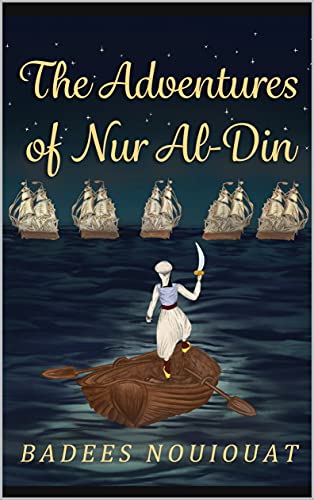
I really enjoyed this book. It is self published, and the expectation was zero and I honestly read all 214 pages in two sittings. I probably could have read it faster, but ahh kids and dinner, and my middle school son somehow got to it to read when I put it down. We both enjoyed the quick pace, the strong Islamic presence, and the historical fiction based plot. The book has a bit of language, hell and damn a few times, mentions prostitution and a brothel in two instances, and alcohol is present, but it is always crystal clear on Islamic and Muslim behavior. The book is linear and straight forward and probably YA readers will appreciate it, but I think it really is a middle school aged read, I think technically that makes it Young YA or Lower YA. My only small grievance is the modern slang. I appreciate that it isn’t written like Treasure Island and that you understand what the pirate crew is saying in plain modern English, but the few mentions of “idiot,” “chill out,” and “awesome” stick out very obviously and could easily be “fixed.” Overall, so very impressed by the consistent pacing, historical references, writing quality, and internal reflection on our ummah’s strengths and weaknesses.
SYNOPSIS:
Farid is a young boy in Tunisia, and as the Spaniards start to flex their influence, his life begins to change. The son of a fisherman, the family can barely enter the waters under the watchful eyes of the Spanish fleets. When approached after a fight to join an Islamic pirate crew by Captain Aruj of the Barbarossa and his brother Khidr, he decides to leave his family and stretch his wings. Having always dreamed of being in a leadership role, his optimism, and eagerness is quickly put to the test as the crews’ first mission in Northern Africa fails and sends the pirates scrambling on land. They journey to the Mosque of Uqba (Great Mosque of Kairouan), and get help from the Emir in Tunis to replenish their losses. It is then onto Tripoli where friendships and internal issues of race, and nationality threaten the cohesion of the Muslim pirates. But it is in Spain where things really come to a head and Farid finds himself separated from his crew, in-prisoned for years, and tested both physical and emotionally that the story finds its climax before ending, and leaving the reader ready for more.
WHY I LIKE IT:
I have a soft spot for historical fiction, the original American Girl books for me were treasures to behold. So the setting of this book really won me over: the mention of rulers, historical landmarks, the pain of the Inquisition on Spanish Muslims, the fact that there was a not just one map in the book, but two, all great things. Like I mentioned above the pacing of the book is quick, from start to finish, and it is a pirate story so there is death, violence, battles, killing, and treason, but seeing as often in books about these type of things, I find myself glossing over the long detailed battle scenes, I was grateful that they are short and quick and possibly overly simplified. It discusses weaponry, but it is not detailed, no glossary is needed, although there is one of the Islamic words at the beginning. As for the Islam presence, it is very much a part of the story. They raid a ship, the alcohol goes in the sea, they call athan differently, the characters discuss different madhhabs, just rulers are just even if they aren’t Muslim, and terrible rulers can also be Muslim, it doesn’t shy away from internal reflection and I appreciate that. The only thing that caught my attention of being unaccounted for Islamically was when Farid puts on red and gold pants to head in to battle. One- that seems the opposite of camouflage, and two- many Muslim don’t find it permissible for men to wear red and gold, obviously different people feel differently, but it seemed odd that the colors were specifically mentioned in such a quick moving book to no end.
Character-wise, I wanted a little more insight into Sameer and his racism, I also would have liked a little more about Farid’s first day in the sun after imprisonment. I liked that the Jewish struggles under King Ferdinand in Spain weren’t just mentioned, but were brought in to the story. And while I appreciate the reasoning for showing that Muslims were hiding behind a brothel to participate in learning and worship and thikr, that and the mention of a woman trying to seduce Farid in the street, both make the target audience a little more mature than the rest of the book might warrant otherwise.
FLAGS:
There is killing, fighting, raiding, stealing and there is plenty of physical violence. The book mentions prostitution, seduction, and there is a fleeting glance at a woman that the main character pauses for, knowing he should lower his gaze, but then she is rescued and never seen or heard from again. There is mention of alcohol as it is captured, as non Muslims stagger around drunk, etc.. There are a few curse words used a few times each: damn and hell and God.
TOOLS FOR LEADING THE DISCUSSION:
I think I would absolutely do this for a middle school book club amongst a mature group of girls and boys. It is an easy read, but the discussions would be phenomenal as history and context would all come in to play.
For the sake of buzz and growth and attention, I hope the author will shop the book around, if he hasn’t already, see if it can be published on a larger platform and gain some traction. We need books like this, solid Islamic fiction books, that aren’t shy to show our strengths and weaknesses and inspire our youth.



 Islamic School Librarian