Tag Archives: Muslim Characters

Invincible Abdullah: The Car Theft Kidnapping by Haji Uthman Hutchinson

Standard

invincible

 I don’t usually post a review of the second book in a series so close to the original, but I wanted to read this one and see if it would be a better fit for Book Club being it takes place in England.  Nothing against  Invincible Abdullah and the Deadly Mountain Revenge, but we’ve done a lot of books for Book Club set in Pakistan and Afghanistan, and I want to make sure that the students see Muslims in a variety of settings. This book has the same main character, but is not dependent on the first book for understanding in any way.  Writing style is about a fourth grade level and it is just 152 pages, with sporadic pictures and a glossary of terms at the back.

SUMMARY:

Abdullah and his Malaysian friend Zaki are karate buddies that train and worship together while attending college.  The book opens with the two sparring and Abdullah going home to a letter from an old karate friend, John, who got mixed up with drugs and stealing cars and is now in prison.  John asks Abdullah to come visit him to answer some questions he has about Islam.  After a few visits John takes shahada and changes his name to Abd ur-Rahman. When Abd ur-Rahman gets out Abdullah and his family support him and the sensei even lets him back in to the dojo.  However, things don’t stay calm for long and when Zaki’s car gets stolen, and Abdullah is kidnapped, the boys friendship, loyalty and faith is tested.

WHY I LIKE IT:

The story is face paced and action filled, it also never waivers from being a strong Islamically based book.  The characters balance religion, and day-to-day living in a realistic and inspiring way that engages the reader and makes the character’s morality seamless and believable.  I love that the characters forgive a convict in words and actions and that the friends are from a variety of ethnicities that again, seem realistic and not preachy and forced.  The twists and turns in the story keep the reader’s interest and although you know things will end up alright, the author does keep you curious.

FLAGS:

Obviously there is an element of criminals and drugs that while presented in a negative light is central to the story.  There are not a lot of details about the drug use, but there is some violence that the characters go through, and mention of guns.   There is also brief mention of a bar in the book that is visited to make a few phone calls from.  The only concern that I have, was that it could be perceived that John had to change his name when he takes shahada and I don’t know if I agree that, that is mandatory.  In the book it weaves a little bit of a side story and is presented very positively, but it is something to be aware of none-the-less.

TOOLS FOR LEADING THE DISCUSSION:

I will probably use this book for the 3rd to 5th grade Book Club selection later this school year, because I think there is a lot to talk about. Topics of rehabilitation, taking shahada, and being a good friend are prevalent through out and something I think kids can wrap their heads around and have opinions about.  There doesn’t seem to be a lot of information about the book online and I’ve heard from one distributor that the book is out of print, but on some sites there are still copies available and there is also a workbook.

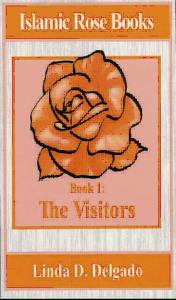
The Visitors by Linda Delgado (Book #1 of Islamic Rose Books)

Standard

Islamic Rose Books The Visitors

I first read this book in 2004 and it was pretty much my first introduction to what elementary aged/young adult Islamic fiction could and should be.  It set the standard and I think subconsciously I’ve held every other Islamic fiction book up to this series as a comparison.  I’ve taught it to 4th graders and 5th graders, I’ve purchased the series and left it for the students at every school I’ve ever been a part of, I’ve even exchanged emails with the author with students’ questions and been impressed by her responses.  So, after reading so many other books in putting this blog together, I thought it is finally time to revisit a book and series that is dear to my heart, and see if my memories are accurate.

Alhumdulillah, they are.

The book is a bit bumpy at first with the chattiness of the main character Rose, but either like real children, you grow accustomed to her and find her endearing, or the author pulls back as the story progresses and the book finds a more readable and engaging rhythm.  Either way, I still felt a pull to keep reading the book, and feel confident that those that read it, and the entire series (I haven’t read the latest book, “Reunion”) are better for it, alhumdulillah.

SUMMARY:

Nine-year-old Rose is excited that her grandparents, who live next door, are going to be hosting two Saudi Arabian Police Officers who are coming to America to learn English and train with the Arizona Police Department.  In anticipation of their arrival Rose and Grandma do what they can to learn about the food, culture and religion.  Rose’s dad however, is not comfortable with Abdul and Fahd being so close to his family, and for Rose to be so curious about Islam.  Rose works on PLAN after PLAN to try and help her dad and the officers connect, but will it be enough?

WHY I LIKE IT:

The book actually addresses some harsh realities of how Muslims are perceived, yet does so in a tender way.  When Rose wants to go to the Islamic Center and her father objects, or she talks about Muslims at school and her teachers get mad, it opens the discussion for why people may have negative views of Muslims, how to deal with such negativity and how to move past stereotypes.  The book also does a really good job of introducing Islam and Saudi culture to its readers in a fairly non preachy manner.  The inner workings of Rose’s family are also surprising raw and relatable.  Her Mom is not in the picture and Rose must deal with the stresses of a single parent home, luckily her grandparents are next door, but even then, there are stresses and issues that arise.  Rose also deals with a friend moving away, teasing at school, and disappointment.

FLAGS:

None, just some of the stereotypes from Rose’s Dad that may introduce some negative views non Muslims have of Muslims, such as: Muslims as terrorists, Muslim’s being abusive and controlling to women, etc.

TOOLS FOR LEADING THE DISCUSSION:

There are a few different versions of the book, mainly just cover changes depending on the publisher, but this version:

The Visitorshas appendixes in the back that include a glossary and recipes and facts about Islam as well as Arizona.  The newer version (as pictured at the top of the post) doesn’t include everything and refers those looking for more to see a website.  That website however and all other links to online study guides and reader guides are no longer available or now have different owners.  I’m not sure what happened to Linda Delgado, and if anyone knows how to contact her, I’m hoping you will let me know.
So as of now there are no links to suggest for teaching the book unfortunately.

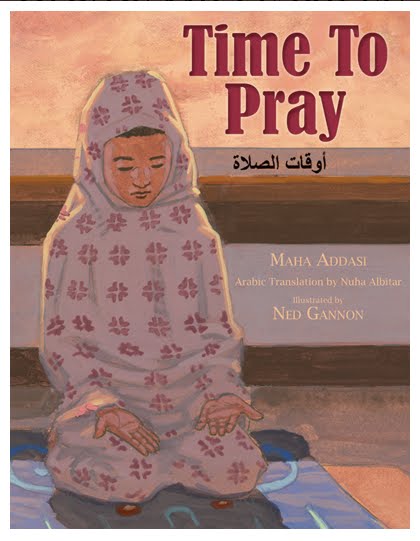
Time to Pray by Maha Addasi, Arabic translation by Nuha Albitar, illustrated by Ned Gannon

Standard

Time to Pray by Maha Addasi

On the surface this book presents itself to be fabulous: the large size, the dual language, the length (32 pages), and concept.  But alas, sadly, I was a little let down with the story, the characters, even the pictures.  The details about the characters are vague, the reader doesn’t know where the story takes place, where the girls parents or the rest of her family are (until the end), why she doesn’t know how to pray, and the climax isn’t really much of a surprise.  After reading this post from the author I appreciate that she left the location vague, to as not be burdened by one specific country, and I can see the origins of why the call to prayer from her own childhood is what the story focuses on.  I can also imagine the wealth of information and details that she had to sort through to decide what is needed to carry the story and what would ultimately repel a young reader.  All that in to consideration however, still didn’t connect me to the story of young Yasmin and her Grandma. Not to mention I didn’t have all the author’s justifications or rationale before reading it.

 IMG_3163

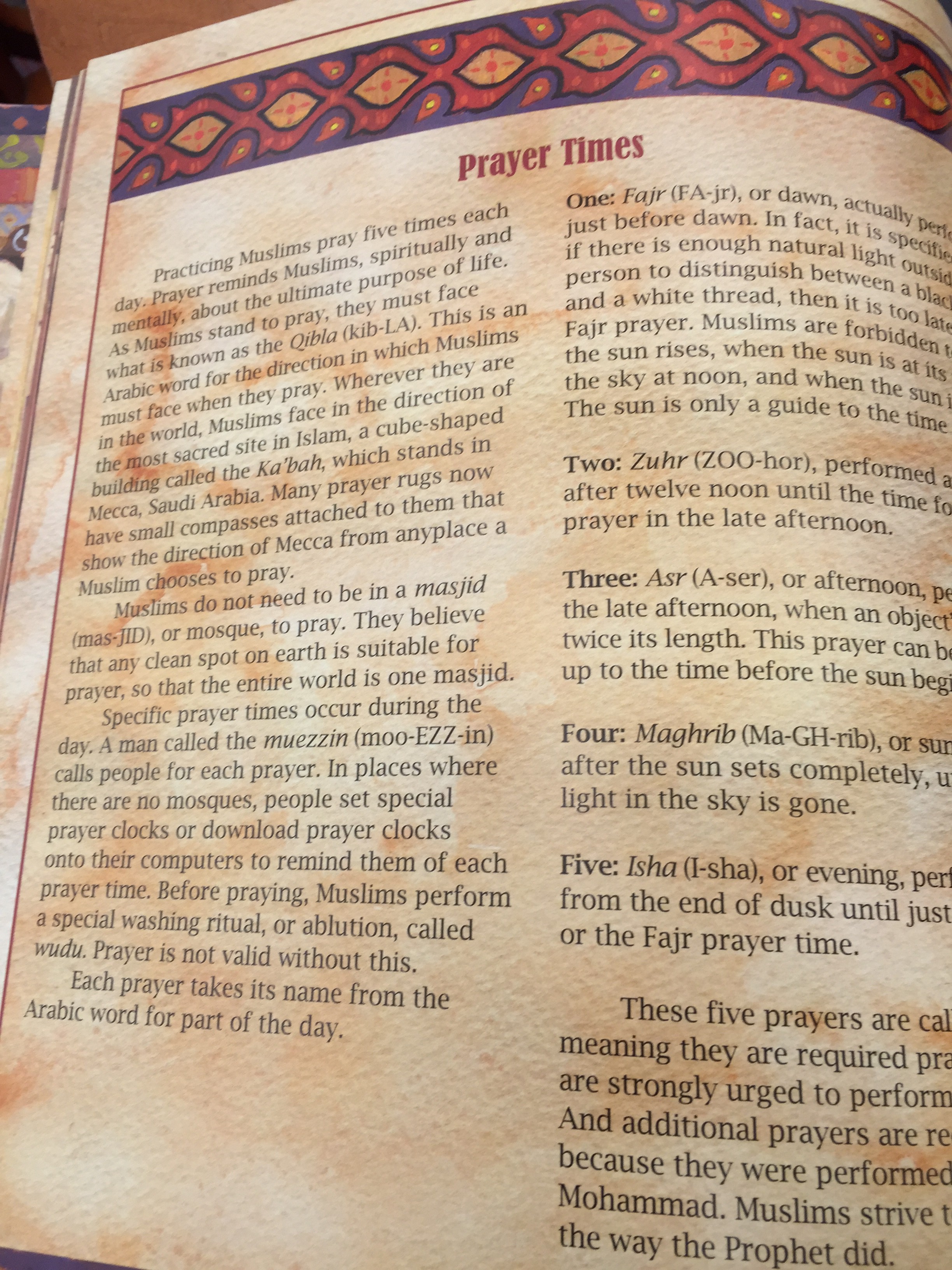
The pages have both English and Arabic text and is written for older children. Despite the initial appearance of being a children’s picture book, it has an AR level of 4.2 and has some Arabic words in the text, an Author’s Note in the back and detail of Prayer Times in the back, as well.

IMG_3164

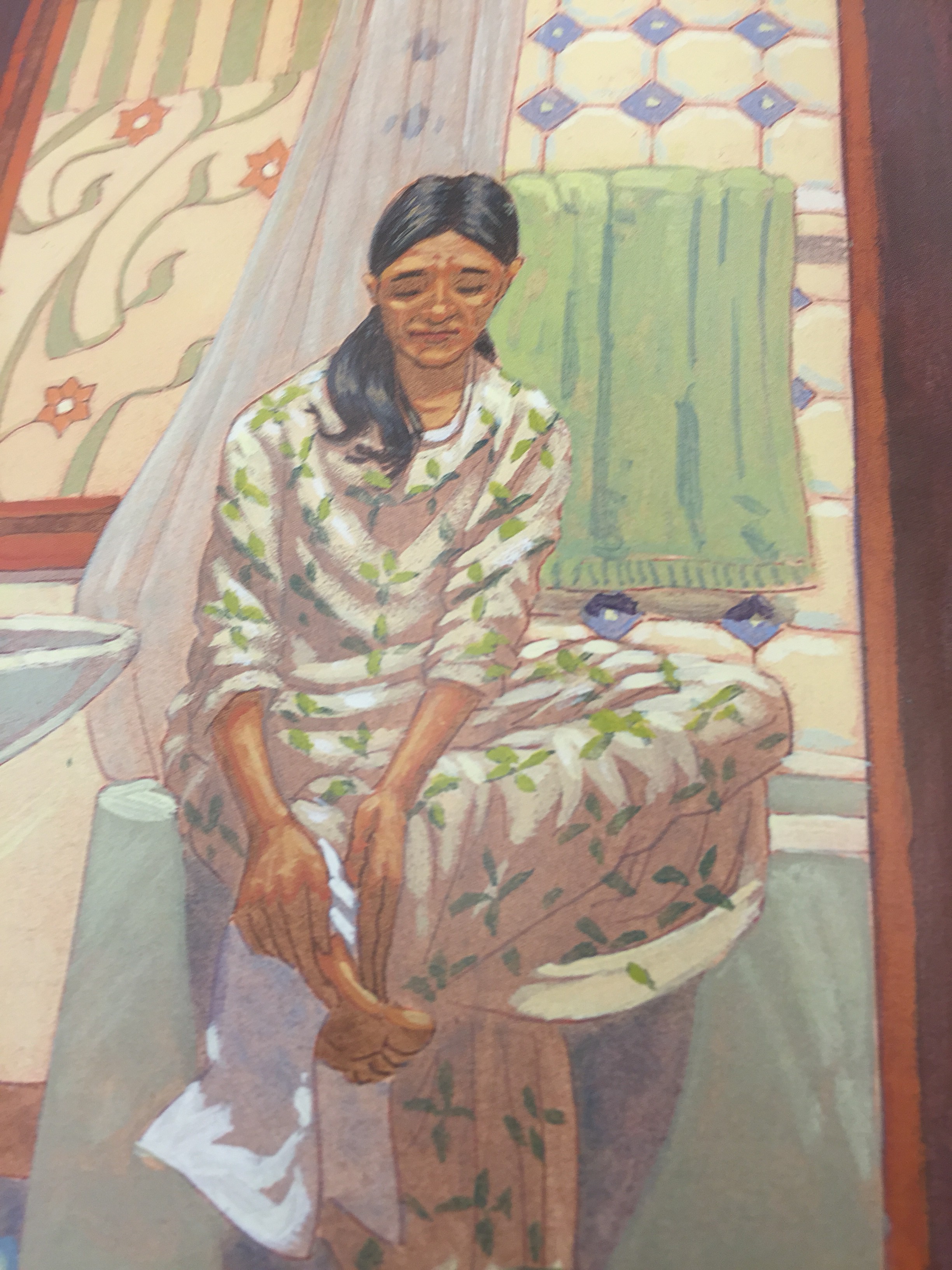
The pictures I want to say are beautiful, but for some reason I didn’t love them.  I am no art critic and they are detailed and large and I should probably ask a child, but here is one for you to decide your thoughts about them on your own.

IMG_3162

Additionally I’m not sure if she is washing her foot her, as part of Wudu, the obligatory cleansing before prayer, which in this case, would be portrayed erroneously, or if she is drying her foot, either way Grandma looks sad to me and not content or excited to prostrate to her creator.

All is not lost though in this book about a girl learning about prayer with her grandma and being surprised by a prayer outfit. prayer rug, and Athan clock when she gets home and finds while unpacking.  But some of the best parts are subtle and might not be gleamed by unassisted readers.  For example how Grandma dresses at home versus when she is out, that because Yasmin is young she is not reprimanded for not praying, or how patient and loving the Grandma is in a slower paced environment.  Overall, the book is unique in that it gives an introduction to Muslim’s prayers to both Muslim and non Muslim readers alike, but for such potential I felt it fell short of being fabulous.

Burning Boats by Zaynab Dawood

Standard
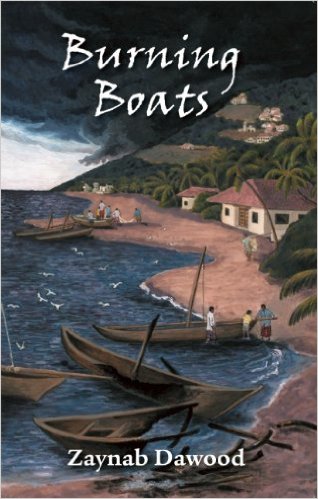
Burning Boats by Zaynab Dawood

burning boats

This book came highly recommended from a friend that read it aloud to her Kindergartener and I ordered a class set based on her raving review.  After trying to get into the book on three separate occasions I concluded that yet again I should have waited and read the book myself before ordering it.  So I handed it over to my avid reading eight-year-old who read it in a day and said it was pretty good, asked a few questions, and continued on her way confused as to why I couldn’t finish it.  So, I started it again determined to get through it and with Ramadan quickly approaching I thought I could motivate myself to do so.  However, I could not, and it sat on the shelf for the entire month with a book mark only a few chapters in.  At the prodding of my guilty conscious to return the book to my friend, I continued reading from where I left off, rather than starting over, again, and found that by dismissing completely who any of the characters are and how they are related, the story does get off the ground and I was able to finish it.  That being said, I think the story might have appeal if read aloud one chapter at a time. To read it in one setting did not help the story that can’t seem to decide it if wants to be character driven or action driven.  The sheer number of characters is completely over the top, there are at least 20 characters mentioned by name and the book is only 137 pages.  And honestly I never bonded with any of them.  There is action in the book, but the details seem misplaced.  The author details characters all saying salam and walaikumasalam to one another and giving moral reproaches based on Quran and Sunah, but I never felt I understood why the main characters were leaving, why the villain was so bad, or how (spoiler alert) a pivotal character in the book died. I guess by never connecting to the characters or feeling an emotional tie, positive or reproachful, the book didn’t live up to it’s potential.  The book is recommended for ages 12 and up, but I think younger children could read it and even younger could listen to it being read to them without any major concerns.  With guidance the book is by no means a waste of time, but if you recommend it to a child and they struggle to get into it, you might just have to let them find something else to read.

SUMMARY:

A small fishing village is being harassed by a corrupt businessman’s attempts to take over the entire industry in Tobay.  The principal of the school and a few close friends are trying to stop him, but have decide they cannot and thus are planning to move elsewhere.  The children are forbidden to go to the harbor as boats are being burned and crimes committed to persuade the local fisherman to abandon their solo endeavors.  With few places to play, the loss of the harbor affects the children greatly as well.  A tropical storm complicates matters as it tears through the village destroying the poor inhabitants meager dwellings as well as the damaging the school and the mosque.  With friends taking in homeless neighbors and the main family planning to leave the children plan one last game that turns dangerous when all the boats in the harbor are set a blaze.

WHY I LIKE IT:

There are some definite good qualities in the book, despite the holes.  It opened up a good discussion between my daughter and I about preparing a body for ghusl and Janaza.  It does show that people can change and that when people are sincerely apologetic and are striving to correct their behaviors, those around them should offer forgiveness in not just their words, but in their actions as well.  It also shows that good kids can make bad choices, and that the consequences can also be very real.  Similarly it shows that adults also don’t always know what to do, and that they can be forced to reconsider as well.

FLAGS:

There is violence in the book and death.  Nothing too graphic, but one might have to explain to younger, more sheltered reader,  that just because someone has a Muslim name doesn’t mean they are practicing Islam and are good people.

TOOLS FOR LEADING THE DISCUSSION:

There aren’t any online tools, but I would suggest having the readers keep a character journal.  Every time a new name appears, write down who they are, (and who they are related to), so later they can look back on it if they become confused.

Because of the “holes” in the story I would probably ask the students to give their thoughts as to what happened or why the characters decided to do what they did and then turn it back on them and ask them what they would do.

Why was Ibrahim leaving? Would you have left? What made Nasser change? Would you have forgiven him? How do you think Ayesha died? Etc.

Jameela’s Great Idea by Surriah Igram

Standard

jameela's great idea

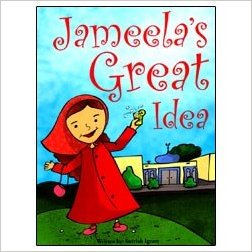
Jameela’s Great Idea by Surriah Igram is a good read-a-loud story for small groups.   A simple story of a girl seeing her father give sadaqa, charity, on a nightly trip to the masjid, wants to also give charity.  But, to do so, she must first find a way to acquire some money.  Her ideas are lavish, over the top and  silly, but her ever patient mom let’s her pick one idea to bring to fruition, which luckily, alhumdulillah, is the only reasonable one presented.  I feel like discussion is needed with this story to provide commentary on why the ideas are not practical even though her intention is so noble.  The story is very simple, linear, and age appropriate.  It works well for preschool and kindergarten age groups with big colorful pictures, large font, and its oversized presentation.  The message is beautiful as are the pictures.  Little Jameela has a supportive involved family, they enjoy going to the mosque, they behave in the mosque, yet have fun outside in the yard, and images of covered and uncovered characters are present.  Arabic and English signage decorate the landscape and the book isn’t too long at 30 pages.  After reading it, I think children will enjoy going back to look at the pictures, however, I don’t see it being a high demand repeat read request.  Once through is pretty sufficient in getting the message, chuckling, having a little talk about it, and then moving on.  The book is a great introduction to the importance of charity in Islam, but would need to be supplemented to fully convey to even the little ones, the value of giving to others.

The Great Race to Sycamore Street by J. Samia Mair

Standard

the great race to sycamore street

A fun book for elementary aged children looking for a fast paced, energetic read, with Islamic morals and lessons.  Overall a great book about character, being a good neighbor, and never giving up, The Great Race to Sycamore Street is not in the AR database, but I estimate it at about a 4.3 level and think even for higher readers there is plenty to learn about archery and peach trees, and plenty to enjoy as Amani and Hude take on bullies, grumpy neighbors, dogs, and making the most of a summer with their grandma in the country.  There are 180 pages followed by acknowledgements, references, and glossaries explaining archery terms, Islamic terms, and where the hadith and Quranic ayats come from, theoretically making the book accessible to Muslim and non Muslims alike.  I however, think the book would be a bit preachy to non Muslims or to those unfamiliar with Islam.

SUMMARY:

Siblings Amani and Hude arrive in Fairfax County, Maryland to spend the summer with their Grandma Hana in the quiet town of Cherry Hill, for what they think will be a slow laid back summer of reading, swimming in the lake, and preparing for the County Fair.  Grandma Hana has the undisputed best peach tree in the county and makes the best pies to enter in the pie competition at the fair, and this year Amani gets to help.  Hude is a budding archer and with his recently deceased grandfather’s journal and old archery regalia he is determined to compete and win the archery competition.  But their simple plans quickly meet twist after twist: from bullies on the train, to swarms of cicadas greeting them on arrival, to a new neighbor who discovers the beloved peach tree is actually on his property and he wants it gone, to the bullies on the train ruling over the lake and proving to be great archers themselves.  Can the  peach tree be saved? Can they be victorious at the fair? With lots of stories about Prophet Muhammad (Peace be upon Him) woven in, and ayats from the Quran used to emphasize points, not only is the book a quick action packed story, but it is also poignant, educational, and memorable as well.

WHY I LIKE IT:

I love that it is clean and requires the brother and sister duo to work together to do something that is bigger than themselves.  I also love the way that Islam is given practical uses for the children, it isn’t taught in the abstract they must pull on their understanding of their deen to decide what to do, how to act and what the next step should be.  I also like how the fast paced story is set in contrast to the slow thematic ideas of a peach tree, baking, archery, and a stereotypical summer with grandma.  Most readers I would assume don’t know that much about fruit trees and county fairs and archery, and I think the author does a good job of introducing the audience to these concepts and weaving Islam into it while keeping the story exciting and moving along.

FLAGS:

Clean, alhumdulillah.

TOOLS FOR LEADING THE DISCUSSION:

The plot is pretty linear, and a quick discussion of what every one liked and perhaps what surprised them would be a sufficient review of the story. From there I would probably go through the reference of hadith and ayats from the Quran to guide the discussion, you can get the online reference of that here:

http://www.kubepublishing.com/the-great-race-to-sycamore-street-free-reference-sheet/

scroll to the bottom and click on the link to download the text.

The Cat at the Wall by Deborah Ellis

Standard

The Cat at the Wall

 I had really high hopes for this book after reading and loving all of Deborah Ellis’s Parvana books and thoroughly respecting her ability to take highly complicated world events and presenting them in a compassionate palatable manner for elementary aged students to digest and benefit from.  The premise of the book intrigued me, a reincarnated 13 year-old-girl comes back as a cat in the middle of Bethlehem and is soon in the middle of a village conflict between Israeli soldiers in a Palestinian’s home.  I wanted to love it, but ended up just liking it and wishing there was more substance.  I was hoping for more understanding of the conflict and the history not just of an arrogant bratty girl, reflecting back on her life as a human now that she is a cat in a volatile region. The book is a fairly easy read as you really have only three main characters that you get to know, the others just transparently breeze through, and the book is only 144 pages and an AR level 4.8.

SUMMARY:

Clare is an incredibly abrasive teen that bullies students at school, lies to teachers and her parents, constantly berates her sister, steals, cheats, and who is not someone you would want to be around or be like in any way.  So while her dying is sad, in and of itself, when she comes back as a cat with the exact same characteristics, she is still hard to like and root for as a whole.  As a cat, Clare understands all languages and finds herself in a home that is being commandeered by two Israeli soldiers, Simcha and Aaron.  Simcha is an American who has come to Israel, joined the IDF, knows little about the Palestinians and is full of hostility.  Aaron is Israeli and speaks Arabic and has more compassion. Clearly Ellis was trying to show that while both are soldiers their attitudes are vastly different, even if their actions are more or less the same.  While scrounging for food, Clare realizes, with her heightened cat smell, that there are more than just the two soldiers in the small home, there is a boy hiding in a trap door in the floor.  The soldiers are at a loss what to do with this small terrified seven or eight year-old-child who recites the same poem over and over and rocks back and forth.  As the soldiers spy on the neighbors, their presence is uncovered and a stand-off between the angry villagers, the people inside the home and the Israeli army ensues.  What can be done to prevent the loss of life? What can Clare the cat do? What is she willing to do, if anything at all?

WHY I LIKE IT:

The words and sentences are simple, which balances out the flashbacks that could be confusing to students younger than fourth grade.  The story flows between the current situation, Clare’s life as a human, and Clare’s life as a cat before coming to the home with the soldiers and boy.  I like that it isn’t made a black and white issue, but I don’t know if based on the book alone the reader truly understands why the villagers would be upset, how much of a reality it is to be berated by soldiers, to have your home taken over, to have kids being beat by soldiers and the dehumanization of checkpoints.  Ultimately the story is about Clare and if she can change, if she wants to change and can she make a difference in the world, the backdrop is simply the Israel Palestine conflict.  Obviously I would be nervous to introduce the concept of reincarnation in an Islamic school setting, but I have recommended the book to certain students who are mature enough to respect that some people do believe this, that the book is fiction, and are aware of the daily oppression of the Palestinians, and the violence that is a reality for so many.   I think as a teaching tool the book offers a lot in terms of teaching point of view, personification, and organization.

FLAGS:

There is violence and the threat of violence, but it is handled respectfully.There is talk of Christianity and Jesus that most students would be fine with.  Reincarnation is present, but played down at the end leaving the door open for interpretation. The human Clare is rather despicable, but she is painted as such and her flaws are not celebrated.

TOOLS FOR LEADING THE DISCUSSION:

There is a nice question and answer section with the author at the end of the book.

The author’s website: http://deborahellis.com/books/#cat-at-the-wall

An educator’s guide: http://groundwoodbooks.com/wp-content/uploads/2015/01/9781554984916_guide.pdf

Sophia’s Journal by Najiyah Diana Maxfield

Standard

Sophia_s_Journal_Final_large

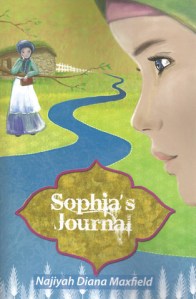
It is not terribly uncommon for my mind to remain stuck in books long after I have read the last page, but it has been a while since an Islamic young adult book has held me hostage.  This book was recommended to me by Anse Tamara Gray whose Daybreak Press published the book, and while I tried not to have any expectations, even if I had, the book would have blown them out of the water, mashaAllah.  The book is not in the Accelerated Reader database, but I added it to our school’s so that the students could read it, test on it, and then gather together during our next book club to discuss it.  I estimated it at about a sixth grade level fifth month, and would recommend it for middle school, high school students, and adults alike.

SUMMARY:

Sixteen year-old Sophia is on a family bike ride when she finds herself falling into the Missouri River and waking up in 1857 Kansas.  The acclamation of a 21st century Muslim girl in to what history will name Bleeding Kansas is both heart warming and inspiring in its details of every day life.  Sophia takes a hands-on active approach to helping the kind family, the Sampsons, that takes her in, and she learns everything from shooting to cooking to riding a horse.  As she learns the skills needed to survive, she truly becomes one of the family.  The beautiful way that Islam is woven in as such a seamless part of Sophia, whether she is in the present or the past, is inspirational for readers of all ages and made me at least question if I would be that strong.  Sophia’s relationships with the other characters is what makes the story so magical, getting to see the humanity and strength of people coupled with the same emotions of heartache, longing, and love we can relate to, in our own lives, draws the reader in and makes the story fascinating and hard to put down.  In addition to the story, the historical setting of slavery and relations with the native populations add depth that many students should already know about, and will enjoy seeing in a fictionalized account.  The twists and climax keep the reader engaged, and keep me from spoiling too many plot details in this admittedly vague summary.

WHY I LIKE IT:

I enjoy historical fiction and to blend that with a Muslim character is a great premise in my eyes.  Seeing a strong Muslimah lead in a quality entertaining book that is tactfully done is such a rare find.  Sophia’s strength is quiet, yet powerful, and the slower pace forces the reader to analyze themselves as they discover the characters.  It reminded me of Anne of Green Gables in its tone and style and I think that our middle schoolers need this change of pace and I can’t wait to see how Book Club goes.  I love how strong Sophia is with her deen, her convictions about slavery, her determination to help others, and to learn.  She easily could whine and complain that her cell phone is dead and she misses her family, but she doesn’t, she has a tenacity and attitude that elevates her to a status that you want the readers to look up to her and emulate her.

I also like that Sophia is respectful of other’s religions and they are respectful of hers, the author draws on similarities and discusses Islam in a way that shows it as a living breathing part of life, that is truly a breath of fresh air.  The climax and ending are not predictable and I appreciate that as well.

FLAGS:

There is referred to violence violence, slavery, racism, a tinge of  romance (in an 1857s kind of respectful way), but nothing overly graphic or sensationalized.  Overall nothing a middle school student and up could not handle.

TOOLS FOR LEADING THE DISCUSSION:

There are no reading guides or outlines to teach the book, however, I think there is PLENTY in the book to discuss and if you are like me and the few students I’ve already asked to read the book, not talking about it is harder than finding meaningful points to discuss.

Rashid and the Haupmann Diamond by Hassan Radwan

Standard

haupmann diamond

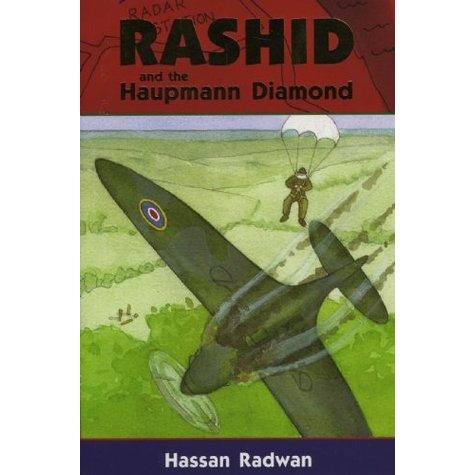
This is the second and seemingly last book in the Rashid series, which is unfortunate, because like its predecessor Rashid and the Missing Bodythe book is a quick fun read aimed at 3rd through 5th graders with Muslim characters solving a mystery.  At just 110 pages the book reunites friends Rashid, Gary, and Chris, three boys of different religious backgrounds with plenty of respect and understanding to inspire readers of all ages.

SYNOPSIS:

Rashid and his friends hear screaming in the middle of the night and rush outside to see robbers in their neighbor’s house. Once the police come and no evidence of a break in can be found, the boys do their own investigating to see what is going on.  Pieces of information start to come together from the elderly neighbor and her stories of her father, mysterious contacts online, old WWII veterans at retirement homes, and good old fashioned library research, to lead the boys on an adventure to find a lost diamond.  Never a dull moment as the boys are chased by the burglars, family issues at home bring Rashid’s sister and baby into the story, some bullies at school and more.

WHY I LIKE IT:

The book is incredibly fast paced, it hops around from one story-line to the next.  While this format seemed more cohesive in the first book, it was a little jarring for me in this one.  I didn’t mind the side stories at school, or even the soccer matches, but the story of the sister, Huda and her marital problems with her husband Ahmed seemed a bit out of place.  I see what the author’s intent was, but in such a short book aimed at elementary aged boys, it seemed  a heavy story-line to interweave into an adventure story.  The deeper understanding of mixing cultures and expectations I am positive would be lost on all young adult readers.  Once again, the author however, does do a great job of telling a story where the character’s Islam adds to the character, and doesn’t distract from the adventure on hand.  Rashid uses islamic terms, the family prays together, they go to the masjid and laugh with the imam and congregation, they talk about proper ways to correct people and the value of intentions, overall, I’d say they convey a “normal” Muslim family.

FLAGS:

No flags, the book is clean and inspiring, alhumduillah

TOOLS FOR LEADING THE DISCUSSION:

There isn’t a lot out there about the book or the author, nor is the book in the Accelerated Reader database.  I think with its linear story, keeping track of the clues and throwing in some highlights of Islamic manners and morals, however, would make a discussion on the book easy and natural enough for all to enjoy.

Four Feet Two Sandals by Karen Lynn Williams & Khadra Mohammed Illustrated by Doug Chayka

Standard

four feet

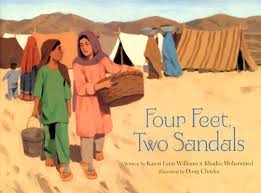
A beautiful hardback picture book I picked up at the Scholastic Warehouse sale, at 32 pages long and an AR level 3.2, Four Feet, Two Sandals, works well as both a story time selection to younger students and as independent reading for up to 5th grade.  The story is about two refugee girls that come to know each other when relief workers throw donated clothes for the people and Lina and Feroza each end up with one sandal each of a beautiful pair.  Rather than fighting or being ungrateful, the girls work out a plan so that they can both enjoy the sandals and in the process, become friends.  The girls share their stories with one another, and thus the reader, about how their families have been affected by war and how they came to be at this refugee camp in Peshawar, Pakistan.  The girls dream of school and their futures and show the readers a bit of their daily struggles getting water and doing chores.  When Lina’s name shows up on a list to go to America, and Feroza’s does not, the friends must part and decide who gets the sandals.

While it probably bothers some that America is seen as the saving grace to sweep Lina to a better life and pander to an American audience. I think it makes sense seeing as the book was co-authored by the executive director of the Pittsburgh Refugee Center and was inspired by a refugee girl who asked “why there were no books about children like her.”  Clearly refugees do get a chance at a new life when other countries open their borders and stories like this that give our children insight into the world they have left behind, with the hopes of fostering compassion, is something that I definitely want to share with my own children and students.

The author’s website and reading guide: http://www.karenlynnwilliams.com/files/sandals_guide.pdf