Tag Archives: Dubai

Odd Girl Out by Tasneem Abdur-Rashid

Standard
Odd Girl Out by Tasneem Abdur-Rashid

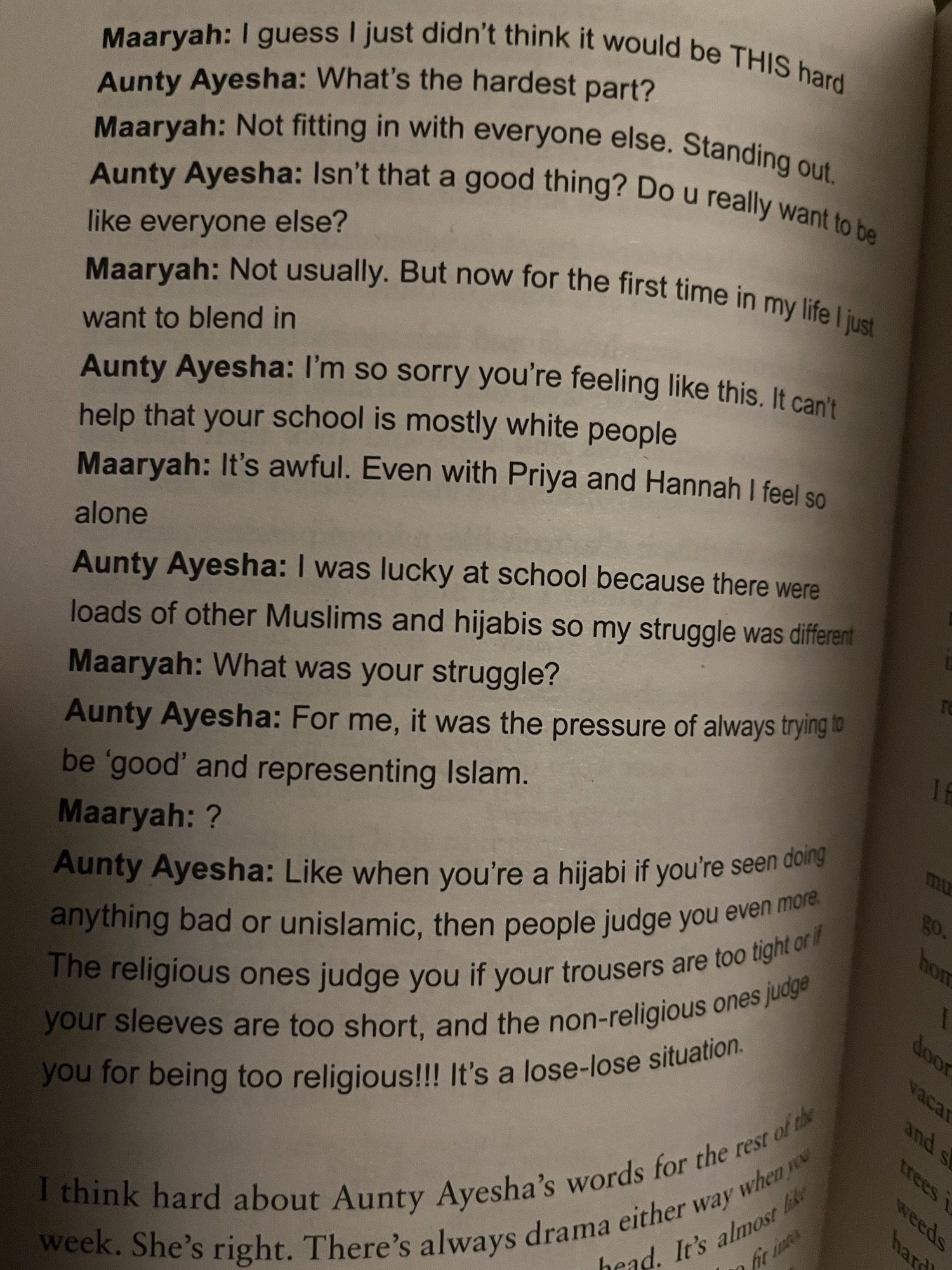
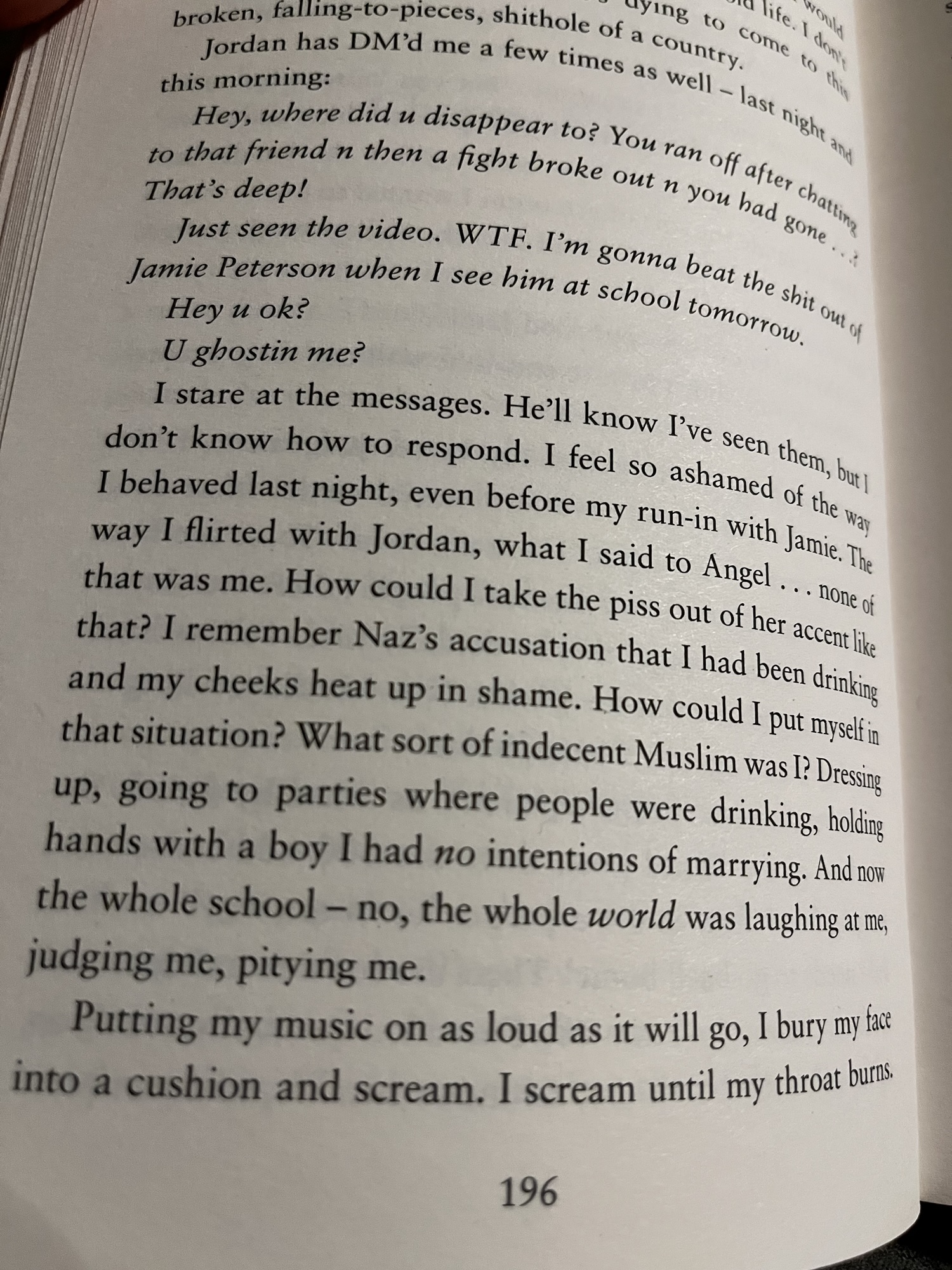
At 368 pages this identity centered mature YA book really hooked me and had me invested, which is impressive because Islamophobia stereotypes and being the new kid in a new place tropes are pretty frequently done, and often after a while, feel repetitive.  For me the charm of this book is actually not Maaryah and her peers/friends/bullies storylines, but the protagonist’s relationship with her parents and what caused her mom and dad to divorce.  Obviously as a mom of teens, I’m not in the target audience, but I feel like I benefited from the Muslim authored, Islam centered book, and think older teens, perhaps 17 and up, will also find the book enjoyable and reflective of views they have, challenges they face, and boundaries they have to establish.  I don’t want to spoil it, but SPOILER, had my dear friends that have read the book clued me in that the book will toe and slightly cross the haram lines, but ultimately show Maaryah deciding to re-establish her boundaries after being tempted not to, i.e. making a poor choice to attend a party with boys and alcohol present, and dressed in a way not typical to her hijabi style, I wouldn’t have read the last hundred and twenty pages or so with my jaw clenched in fear. The book shows a lot of Islam in practice, salat, duas, discussions about hijab, but not everyone will agree with decisions Maaryah makes or the rationale behind them as they vacillate between culture, religion, and family expectations.  I love that Maaryah is fallible and never abandons her faith, and that who we are is more than a singular mistake or instance of poor judgement. The book is not preachy, most will just take it as a girl finding her place in her new family dynamic in a new country, who happens to Muslim.  I think, an assumption really, based on what the author has said about her previous adult books, something along the lines that they are not meant to be Islamic fiction, but are stories with Muslim characters, and I think this book should probably be viewed the same.  There is swearing, hand holding, a side hug, normalized boy girl friendships, lying, running away, deceit, cheating, alcohol, mention of hookups, dating, vaping, music, flirting, hijab questioning, bullying, physical assault.  My biggest concern about the book is that it brings up Palestine, but doesn’t discuss Palestine. A side character is a non practicing Jew that visits Tel Aviv and Maaryah wants to discuss the occupation with her, but hesitates and the moment passes.  It is never revisited which I really wish it would have.  It could have modeled a bit how to have those conversations, I know it isn’t that type of book, but Maaryah mentions repurposing kaffiyehs in her designs and so it hints that it matters to her, but never pulls on that thread.  At one point it also mentions another character posted something pro Isr@*l during the genocide, which I can only assume the author thought that by the time of publication would have ended.  SubhanAllah ya Raab.

SYNOPSIS:
The tag line on the cover “From Dubai Girl to London Nobody…” very succinctly summarizes the plot.  Maaryah had an idyllic life in Dubai with her parents and close friends, spending her holidays with her mom’s family in London, and securing an internship with a famous designer.  All is going well until her parents get divorced, her mom moves her to the UK, not near her extended family, and the lack of Muslims, let alone hijabis, at her high school has her bullied with no friends to have her back.  With her mom in survival mode, their once close relationship is non-existent, and the 15 year old is left to sort through it all on her own.

WHY I LIKE IT:

There is a little pulling of punches so to speak of asserting that the boundaries are Islamic, but for the most part I think Muslim readers will see that Maaryah does view a lot of what she experiences through an Islamic lens which I appreciate. I also like that the protagonist’s connection to salat and faith is hers, it isn’t forced on her and I think for this demographic that is good micro messaging and framing.

I was very grateful that the book answered the questions about Maaryah’s family dynamic, so often parental problems are pushed to the void and let to be resolved or understood off the page. And while in the first half it was teased a little as we aren’t having that conversation right now, I did ultimately by the end feel like it was sufficiently resolved.  I also felt the mom was blaringly absent at weird times and I get that it was a plot device to get her out of the way, but if you are dragging at the 100 page mark, I do encourage you to keep reading, it does pick up.

This book isn’t meant to be didactic, and I recognize I’m putting that on it a bit, but I do think the Gaza framing missed an opportunity to show readers how to navigate that very real scenario through the power of fictional characters.
FLAGS:

Copied from above: There is swearing, hand holding, a side hug, normalized boy girl friendships, lying, running away, deceit, cheating, alcohol, mention of hookups, dating, vaping, music, flirting, hijab questioning, bullying, physical assault.

TOOLS FOR LEADING THE DISCUSSION:

I would shelve this in an upper high school classroom, I think that decision to be at the party is clearly shown to be a mistake, to put herself in that situation is something she regrets, and I think showing that she comes out from it offers a lot to be discussed.

The Secret Diary of Mona Hasan by Salma Hussain

Standard
The Secret Diary of Mona Hasan by Salma Hussain

mona

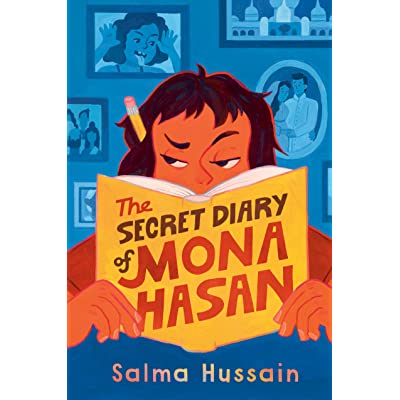
I really don’t know how to review this book. Is it funny and engaging, yes at times, but I am a 41 year old, and I can attribute it (hopefully/possibly) to satire, hubris, character voice, and commentary, except it isn’t written for me, it is written for 10-14 year olds.   There is no way would I put this in the hands of a fourth grader, let alone a high schooler.  The book starts on New Year’s eve with a “Muslim” family drinking alcohol, later the 11 year old drinks to get brave enough to meet up with her boyfriend (he wanted to wait until after Ramadan), after a bad haircut she starts wearing hijab and later takes it off, her period starts and she is baffled at which hole it comes out of, she is no longer allowed to be alone in a room with a boy because that is how babies are made, but it is ok to go to a school dance and kiss them, women are rather useless, old people (31 year olds and up)  should know their place and act their age, dark skin is bad, chests need to be big, slut is both something you are and something you can do,  Aisha (RA)’s age of marriage is criticized as is Khadeeja (RA)’s, no one is as good at her, Ramadan is annoying because she has to hide when she eats in public for a whole month, Friday prayers even though they rush through them limit their fun time, the Tablighi Jamaat have to be lied to and hidden from, her mom is pregnant months after coming out of her bedroom smiling, her father claims he will only ever enter a mosque horizontally, you can see the list goes on and on.  Yet at the same time, there are true moments of strength, such as when she fights back against the creepy sexual assault vibes from “uncle annoying” and then protects her sister when her parents dismiss it, when she sticks up to a bully to protect her gay friend in Canada, the dad getting caught one day praying salat, the love of family felt despite her perceived privilege while visiting Pakistan, her constant reference to Allah swt as she asks Him and tries to understand the world around her, and her terrible, terrible poetry.  The diary style is both brilliant in trying to show the world through Mona’s eyes, and irritating as NONE of the aforementioned concerns are given any context, explanation, reflection, anything.  The thoughts pour out of her head, onto the paper, and the reader is left to figure out if this is how things are, is this her naïve view, is she commenting on society, is the author, is this fact, is it satire, is it someone with an axe to grind on culture and religion, is it showing the ridiculousness of so many stereotypes? And to be honest, I have no idea.  Which is why I can’t say that the book is good or bad, I think it is well written, my problem with it is, I don’t know who it is written for.  I think it would be very damaging to young children, the vulgarity, misogyny, racism, arrogance, will hurt both those that see parts of themselves in Mona and those that read it and assume too much about what Mona represents.

SYNOPSIS:

Mona is an 11 year old girl, and this is her diary.  She is arrogant and opinionated, but she grows and mellows as her view of the world moves from privilege in Dubai to immigrant in Canada with a bit of an awakening in Pakistan in between.  It is her view of her life, her place in the world, and the greater society around her.  It is an easy read on the surface of her living through the war without getting any days off of school, friends, maturation, first loves, hoping for a bigger chest, pulling a fire alarm to get time with a boyfriend, feminism, and the annoyance of being better than everyone else in everything she does.  There are side characters that flit in and out and family members that shape her, but the point of view is uniquely hers in all matters regarding leaving the Middle East as a Pakistani living there, spending time with her mother and father’s families in Pakistan and the rift her parents’ love marriage caused on their acceptance of her, their move to Canada to start a more peaceful life that ends up being grueling and difficult and through it all threads of Islam, fitting in, and growing up.  It is a snapshot of so much that the reader is left to connect the pieces, assign them value, and understand the larger message, if one exists.

WHY I LIKE IT:

I still don’t know if I like it or dislike it.  I dislike it for kids.  I like it for adults as a light over the top snarky read, but I think my opening paragraph is sufficient and the 296 page book doesn’t need my concerns and praises rehashed here.

FLAGS:

Misogyny, anti Islam, sexism, racism, ageism, lying, vulgarity, cursing, crude talk, lying, disrespect, lack of religious respect, kissing, sexual assault (attempt), deceit, pulling a fire alarm, physical fighting/assault, family trauma, arrogance, pettiness, stereotypes, bullying, sexual innuendos,

TOOLS FOR LEADING THE DISCUSSION:

I have suggested a few ADULT friends read the book so we can chat, but no kiddos, no teens, no early twenties, old ladies (31 plus according to the main character)!

No True Believers by Rabiah York Lumbard

Standard
No True Believers by Rabiah York Lumbard

believers

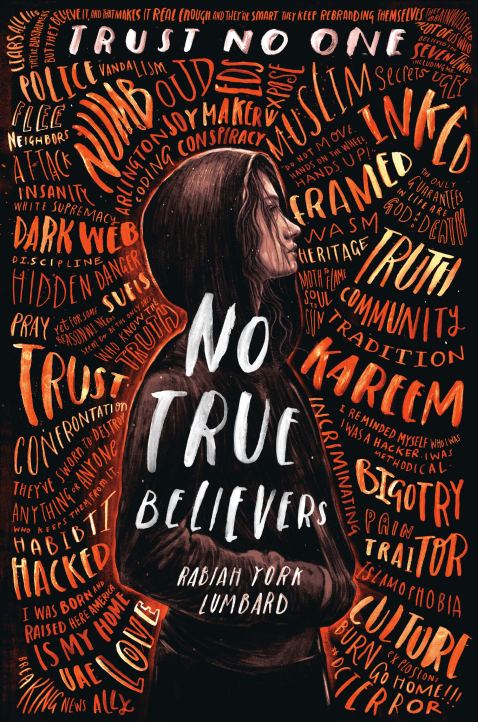
This YA Fiction book by a Muslim author filled with many Muslim characters has a lot going for it, and while I didn’t love it, and felt that it was trying to do too much in 304 pages, I think most early high school readers will enjoy the cyber hacking plot, the islamaphobia and white supremacy themes that keep the book fast paced, relatable and timely.  The main character is a Muslim and has a Muslim boyfriend and all family members are fine with it, she also gets a tattoo with her mother’s permission and breaks the law, but usually with worthy motives.

SYNOPSIS:

Salma Bakkioui is the high school aged daughter of a North African father and convert mother.  They go to the mosque a few times a year, but don’t really practice, it is more heritage than actual intentional praying five times a day, yet somehow ayats from the Quran and hadith do float in and out of the story.  It is Ramadan, and the Muslims in the book are fasting except for Salma, who suffers from EDS (Ehlers-Danlos Syndrome) a connective tissue disorder, her best friend Mariam, who lived next door has just moved away because her father’s chiropractic business was failing due to racism and Islamaphobia.  Salma tried to use her hacker skills to send him more business, but ultimately they moved to the UAE.  Amir, the supportive boyfriend, oud player, and fellow Edward Norton fan is steady and good and constant.  As are her partying friend Vanessa, her physical therapist and her daughter, unfortunately, things are about to get really crazy, really fast.

When Salma and Amir go over to meet the new neighbors that have moved in to Mariam’s old house the blaring TV broadcasts a terrorist bombing nearby in DC.  The neighbors seem nice, but something is off about them, and Salma can’t quite figure it out.  From the dad and son’s matching number tattoos, the mom’s nervous behavior, and snippets of overheard conversations, it becomes apparent that something infact fishy is going on.  Salma and her younger siblings start getting bullied by classmates, and teachers and administrators turn a blind eye, cops interrogate Salma at school, and illegal snooping on the dark web reveal that the neighbors aren’t as innocent as they claim. As more and more is uncovered about the neighbors, Salma learns that she better have a plan to get out, as she is about to be framed for a lot of destruction as the new face of Islamic extremism.

WHY I LIKE IT:

I like that Salma is relevant and relatable, and while I know a lot about her family and friends, and illness, for some reason I don’t feel invested in her, and I am totally willing to conceded that that is on me, and others would really identify with her, but for some reason as much as I wanted to connect with her, I didn’t.  The supporting cast is fairly fleshed out, I’m not entirely sure why Dora and Boots are highlighted so much and I didn’t feel a tug on the emotional heartstrings of Mariam leaving, of Amir leaving, of Salma possibly saying good-bye.  I felt like even Salma and Amir being a couple and being connected through Edward Norton and Fight Club was a bit forced.  I didn’t feel it was organic or natural, it was almost like the author was trying to make a point of Muslim youth having relationships, and finding imams that were ok with tattoos. Rather than it being a plot point it seemed like it was trying to voice the author’s perspective whether it fit smoothly into the storyline or not.

I do like the tech and and the parallels between extremism whether Islamic or Christian, foreign or domestic, that drove the action of the book.  The unraveling of pieces and connections seemed a bit rushed, with unnecessary tangents affecting the pacing overall of the book, but at least there were answers to help it all make sense at the end, and make the story feel complete.

Having never written a book, I don’t know if some of the hiccups are first novel related, but I really hope the author keeps writing and keeps changing up what the mainstream Muslim protagonist lead consists of.  I love that Salma is smart and level headed and aware of her world, while still growing and owning up to her faults.  It isn’t a coming of age story, but she sets a great precedence for continued growth, loving your family and trusting yourself too. I particularly like the nuances in racism.  Some of the kids at school are jerks and bullies, some staff and teachers are bigoted and prejudice, but the right wing conspiracy groups are actively working, and their level of hatred and intelligence to mask it is great to see in a YA book.

FLAGS:

Relationships, kissing, references to marijuana brownies being consumed, violence, cursing, lying, illegal activity.

TOOLS FOR LEADING THE DISCUSSION:
I can’t use this book as a book club selection since the two main characters are making out in the first chapter, but the book really is more than a relationship story and I would be ok with my young teen reading it.  The illegal hacking is more problematic then helpful in the end, and the language, and other deviant behaviors exhibited aren’t done for shock value alone, I think a discussion after the book would be great: privacy, hate, conspiracy, faith, religion, friendships, etc.