Tag Archives: cancer

If You’re Not the One by Farah Naz Rishi

Standard
If You’re Not the One by Farah Naz Rishi

I suggest one reads my ENTIRE review of this book before deciding if it is right for you, because just the first few lines might signal that I liked this book, and honestly it was just ok, but I really liked parts of it. The protagonist is Muslim, it isn’t something that guides her view of the world or dictates her actions, but she is unapologetic, and it is not something she is grappling with. She prays, makes duas, it mentions a hadith, so I appreciate that it is there and always just below the surface. The “romance” might not be halal, halal, but it definitely isn’t raunchy and stays close to the line even when it crosses it. The male and female character are very close friends, and spend a lot of time alone together even before SPOILER there is hugging and a kiss, it is a rom-com after all. I loved the annotations, especially reading an e-version flipping to the protagonists commentary of her thoughts and then flipping back was easy and fun. I think my favorite line in a long time in the book is her translating rice to chawal (see images). My biggest frustration though, with the book is how close it mirrors the author’s biography, Sorry for the Inconvenience, which I read just over a month ago. Truly, it was like the biography was the book and this was the movie adaptation. Sure the younger brother was switched out for a younger sister, and this wasn’t as gritty or traumatic, but the romantic literary beats were all more or less the same: childhood betrothed, falling for a friend who made a bad first impression, dad being sick, parents and their on again off again divorce, medical diagnosis, it really is two versions of the same story, which meant I was never invested in the fictionalized characters, or on the edge of my seat to see what would happen next. When you have seen the behind the scenes inside scoop so to speak, it is hard to get on board with the faded carbon copy. Add in the consistent lack of communication, telling instead of showing, unlikability of the protagonist, and the non existent foundation of any of the relationships, and it made it hard to get lost in the fluff of the moment.


Side note: I had a whole paragraph rant about the cover, but when I went to post my review on Goodreads (still banned from Amazon) I saw that there is a newer cover with Marlow wearing yellow crocs. I have no idea why the illustrator and publisher would have arcs with the male lead in flip flops, but I think by now it is common knowledge there is often a lack of communication between authors and illustrators. sigh.


SYNOPSIS:
Anisa is in college, she has worked hard to get in to the all girl’s school near where her almost fiancé Isaac is already enrolled. When she takes a class on Isaac’s campus she meets Marlow, who makes a poor first impression on the very “perfect” Anisa. When Marlow and Anisa get paired up for a class paper, Marlow also offers his services as a “love coach” to help Anisa reconnect with a drifting away Isaac. The more time Anisa and Marlow spend together, and the more Anisa learns about Isaac , the more she ultimately learns about herself and what she wants out of a partner.


WHY I LIKE IT: (SPOILERS)
I’ve read a few of the author’s books, so I know she can write, which irritated me even more that this book felt so flat. Anisa and Isaac have been “together” for over six years, but know nothing about each other, don’t talk or text, and as much as the book wants to make it seem like it is an all of the sudden thing, it provides no real tangible suggestion that they have ever had any sort of connection. So why did they decide to be potentially engaged???? All the parents are on board, but how did the two of them set this into motion? With the exception of Isaac visiting her one late night before he went to school, there is so little for the reader to be emotionally invested in. Anisa has terrible communication with every character in the book, not just Isaac, even with Marlow and her family, the side characters all keep in touch just fine, and it is never addressed as a quirk, it just is accepted. If your dad was sick, or your parents divorcing, wouldn’t you be texting them periodically, or non stop? And text between characters are shown on the page, so how is Anisa texting Marlow throughout the 352 pages, but then goes MIA the last 20? It didn’t work for me clearly.

Additionally, I was so tired about hearing how perfect Anisa is, when it never seemed to show it, sure the duplicity with her outward appearance and home appearance was well done, but it never really shows up in any other facet of her life. She is unorganized, has few friends, doesn’t seem to be a very present daughter and sister, the repetitive telling and lack of showing, gave the book no foundation. I know romance-y type books often have to fudge common sense at times, but with no foundation at all, it was hard to be invested in any twists or swooning gestures. I think I just didn’t really like Anisa, and I weirdly feel guilty about it, because she so closes mirrors the author, and I liked the author’s self portrayal in her earlier memoir.


FLAGS:
Close male/female friendships, hugging, kissing, lying, “cheating,” talk of titillating role playing video games (otome) not details so much as shaming and teasing about Anisa playing them (the word porn is tossed in a few times).

TOOLS FOR LEADING THE DISCUSSION:
I think I’d shelve this book in an Islamic school library for high school students. I don’t think I would promote it, but I think those romance loving high school girls will enjoy and be able to handle this story. It won’t work for a book club, but it does make clear that Anisa “dates” with intent to marry, there is reassurance that she wants to marry a Muslim, that Marlow has been reading about Islam, but that Anisa isn’t going to force him, and that societal expectations and appearances aren’t impossible to push back on- which I think are good considerations for 16 and up readers to see fleshed out.
Lissa: A Story about Medical Promise, Friendship, and Revolution by Sherine Hamdy & Coleman Nye illustrated by Sara Bao & Caroline Brewer

Standard
Lissa: A Story about Medical Promise, Friendship, and Revolution by Sherine Hamdy & Coleman Nye illustrated by Sara Bao & Caroline Brewer

lissa-1440x2122

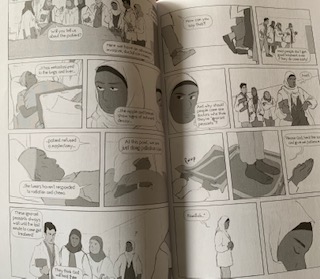
When I first started teaching I wasn’t a big fan of graphic novels, slowly I saw their benefit for struggling readers, and eventually I came to appreciate them as an enhanced tweak in story telling for everyone.  This book however takes the concept to the next level, for me anyway.   As the inside flap claims, it is a book “that brings anthropological research to life in comic form, combining scholarly insights and accessible, visually-rich storytelling to foster greater understanding of global politics, inequalities, and solidarity.” As a coming of age story of two friends at its core, yet taking on breast cancer, kidney failure, parental loss, different cultures, different religions and with a back drop of the Egyptian revolution, I’d say the book is meant for high school and up.  Not so much for content as for understanding and appreciation of all that went it to creating this ethnographic book.

SYNOPSIS:

Unlikely friends Anna and Layla cross economic, religious, and cultural differences to build a life long friendship.  The book is divided into three parts: Cairo, Five Years Later, and Revolution.  In the first part we see Layla’s family serving as the caretakers of a building and the two young girls bonding over pranks, arrogant tenants, and just being silly.  Anna’s family is American and the father works for the oil companies, thus they are financially very well off, however, the father is rather distant and the mother is dying of cancer.  The section concludes with the passing of Anna’s mom and the family going to Boston for the funeral.

Five years later finds the girls in college.  Layla in medical school and Anna at a university in Boston.  Layla’s father is suffering from renal failure and is unwilling to consider a transplant.  While Anna is trying to see if she carries the same genes as her mother and if insurance will cover it.  She also has to decide if she would want to have a complete double mastectomy, if she would want her breasts reconstructed, if she should do it now or later.  She gets a lot of opinions, but ultimately decides to find a way to pay for it and have it done.  Her father doesn’t understand, and Layla dismisses it forcing Anna to have to handle it alone.  But when news come that Layla’s father isn’t going to make it, she rushes back to Egypt to offer her support.

In the final section, the revolution has spread and Dr. Layla is helping those injured in Tahrir Square during the protests, and Anna is helping to identify bodies despite being attacked for being a foreigner and part of the problem.  Anna has kept the secret of her mastectomy from Layla and Layla assumes she has cancer.  At odds with their roles in the revolution, and with keeping secrets from each other and their differences in financial opportunities coming to a head, Anna returns to Boston.  When Layla’s brother is shot and loses an eye, however, Anna returns to Egypt and the two friends work to keep their relationship.

IMG_8951

WHY I LIKE IT:

The book is grounded in so much conflict and turmoil, but fights hard to keep a character based narrative.  With two illustrators and two authors trying to convey medical approaches, two cultures, two religion, two friends, and a revolution, the last 70 pages of the 302 page book are details about how the book came about, interviews with the various contributors, a timeline of the revolution, discussion questions, key references and a teaching guide.  The book at times was confusing to me, and I’m not sure why, it quickly resolved itself or a flip back a few pages would clarify it, but I think some of the illustrations were just off enough that it complicated things.  Anna by and large is depicted oddly on a few pages along with her family as well.

IMG_8950

Layla’s family is definitely religious and at times has to challenge their thoughts to understand Anna and their own circumstances too.  I think it is handled really well and allows the reader to consider things without answers being clear cut, is it Allah’s will to not have a transplant and accept death as being written for you or to have the transplant and ask Allah to make it successful?  By and large the book poses questions through the juxtaposition of the two characters and the experiences they endure, and while it shows the choices they made, it draws the reader in to wonder what they would do in their shoes without judgement.  The book provides a lot of facts and leaves them there making it more thought provoking than a simple story.

The characters are often composites of real characters the academic author’s learned about, yet some are directly based on activists and leaders of the revolution.  The graffiti artwork is attributed and powerful.  There is a lot of information in the notes after the comics end.

FLAGS:

There is death and revolution, Layla’s brother is taking Tramadol, and their are sketches of breasts as Anna learns about her disease and prognosis.

TOOLS FOR LEADING THE DISCUSSION:

I wouldn’t do this as a book club as I don’t know how much middle schoolers would get out of it and the book is pretty pricey.  I would recommend people read it though as it gives a different perspective on numerous things many of us take for granted.

Home


More to the Story by Hena Khan

Standard
More to the Story by Hena Khan

more to the story.jpg

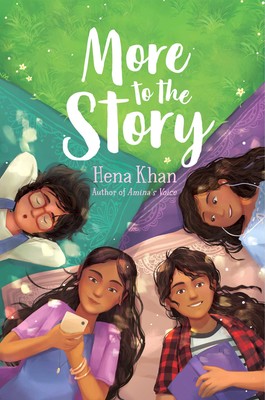
For a book written by an accomplished author for 3rd to 7th graders focusing on a Muslim family, I was surprised at how despite wanting to absolutely love this book, I only kind of liked it.  For the first 100 of 271 pages, I really kept hoping there was going to be more to the story.  Luckily the story did pick up, but I couldn’t get passed how much crushing all the sisters were doing on the one boy in the story, and how much stronger I wanted the main character to become.

SYNOPSIS:

Told from Jameela, “Jam’s” perspective, the second of four daughters living with their parents in Georgia, the story focuses on the interpersonal relationships of the members of the family and their parents’ close friends who’s nephew has moved in with them from England, Ali.  All the kids are close in age and of Pakistani ethnicity, and are Muslim.  As the reader gets to know Maryam, Jam, Bisma, and Aleeza, you see the characters develop pretty well and their quirks and personalities emerge.  Jam is more tomboyish than the gorgeous Maryam who likes to bake.  Jam and Bisma share a room and are closer than Jam and Aleeza, the baby of the family who Jam finds is becoming a brat.  Jam also enjoys watching football and eating spicy food with her dad and desperately wants to be an award winning journalist like her grandfather.  She puts out a family newsletter and is ecstatic to be named the feature’s editor as she starts 7th grade.  Ali is a year older and has moved to stay with his aunt and uncle until his mom and sister can join them.  He spends a lot of time with the sisters and in Little Women inspired fashion the little ones want his attention, Jam is a little jealous to learn he finds himself tongue tied when talking to the beautiful Maryam and Maryam in 9th grade is drawn to Ali, but doesn’t vocalize it too much.  And then as the story picks up speed, Jam says, “In a matter of weeks, Baba got a new job and moved across the world, Bisma got sick and has to be in the hospital, and I messed up everything with Ali and the paper. How did my whole life get turned upside down so quickly?”  

The rest of the book is dealing with Baba working in the Middle East, Bisma being diagnosed with lymphoma, Jameela learning some journalistic basics, and Ali and Jameela becoming a bit more than just friends. 

WHY I LIKE IT:

I love that a Muslims desi family is being represented in an own voice novel that mentions religion as a natural part of their life, and doesn’t apologize or overly explain it.  That being said, I feel like the book is trying to present “us” to the outside so to speak, rather than empower our own.  And I point this out, because I feel like it could have done both.  Dialogue between Ali and Jameela about how they might date as they get older, how Ali can’t see any of the sisters having an arranged marriage.  How when Maryam gets asked to a dance her mom doesn’t mention any religious reason her daughter should say no.  None of the girls wear hijab, and they mention that they don’t wear hijab, at one point Jam knows she should get up and pray, but doesn’t.  I don’t expect a fictional story to teach our upper elementary age kids how to behave that is a parent’s job, but to have some basic Islamic tenants brushed aside after being mentioned is worth noting.  Had the book just been more cultural, maybe I wouldn’t be so critical, but Muslim girls are going to be excited to see themselves in this book and some of the messages might tilt a little more liberal than some parents would expect.  It is one thing when our girls read a book with a romantic twist and we say that, that is not for us, but when a book celebrates us not just crushing, but vocalizing those crushes and moving in to a gray area (they hug but it could be an innocent friend hug) and they make a point to be next to each other, Muslim parents should be aware.  In the larger society it wouldn’t even register on the radar, hence I point it out.

Another thing that kind of bothered me and was again related to Jameela and Ali’s relationship was that when Jameela cut her hair in support of Bisma losing hers with chemo treatments, she seems to need Ali’s approval.  I get that she wanted him to see her and all that, but I really wanted her to be strong enough in and of her self that even if she looked awful she would own it and not let it define her and not let a boy’s opinion about her physical appearance weigh that heavily on her.  Again I know 4th grade girls start noticing boys and having crushes and middle school is only worse, but I just was hoping that her strength and confidence would come from her own growth arc, not from someone else, let alone someone she likes. Side-note here too about the hair, it is donated to make a wig, which I know might also be a sensitive subject regarding if that is allowed in Islam or not.

In terms of the cancer and the sister’s rallying together all that I thoroughly enjoyed and found the most interesting passages in the book.  I think the understanding of a real subject and finding a way to help and deal with this was executed expertly and powerfully without sensationalizing the concern or simplifying the experience either.

FLAGS:

The book is clean, but there is a lot of mention of how Ali affects the girls.  And potentially depending your own opinions on the hair being donated.

TOOLS FOR LEADING THE DISCUSSION:

I wouldn’t do this as a book club book, I’m actually hesitant in even recommending it to my 12 year old daughter.  I know she has read worse, but again me handing her a book about Muslim girls might make her understanding of what we expect regarding boy/girl interactions to be a bit muddled.