

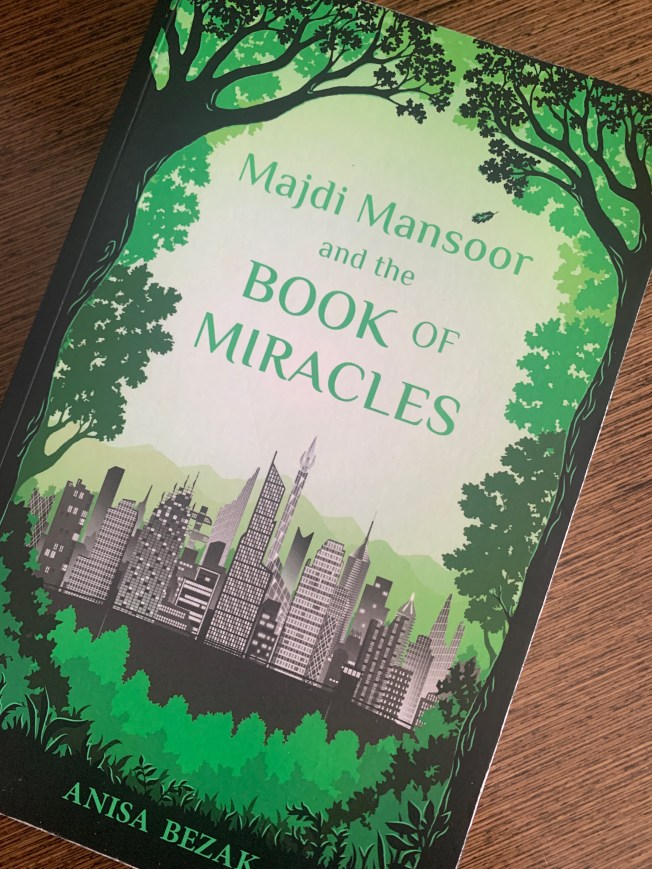
This 323 page middle grade fantasy written by a Muslim author features Muslim characters in a jinn filled adventure, but is not very Islam filled. Jinn are widely accepted these days in western literature even by non Muslims, so it doesn’t hold the Islamic rep weight it perhaps once did, and while the characters mention prayer once or twice, they are never shown to rely on faith, practice it, or have it be a central part of their identity. None-the-less, at times I truly could not put the book down, the fast paced adventure coupled with the compelling characters really hooked me and pulled me in, until it didn’t. I’m not entirely sure of why the rapid unravel of my connection to the book happened, but I’m guessing it is because of A: I struggle with fantasy. B: the plot was really kind of weak. C: the “Alice in Wonderland” style world building is not a style I enjoy. D: So much of the tension in the book is predicated on conversations not happening because the time is not right, but ultimately I’m pretty sure it is E: A little bit of all of the above. The book is fun, I think kids will like it even though so much wasn’t clarified, resolved, and seemed unnecessary to me, I’m not the target audience, and I recognize that. It is worth noting that the premise of the book stems quite heavily on the fact that Farrah is a “harami” as it is called, she is a child born out of wedlock. The details of the parents’ relationship prior to her birth are glaringly absent, but that stigma affects her relationships and is central to the story.
SYNOPSIS:
Farrah only sees her father one day a year on her birthday, Yalda, the winter solstice. While hiking and climbing her father presents her with a gift, a ring, and when she hears a voice and makes a wish, her world will never be the same. Her father, who she thought was a judge in the UAE, is actually a jinn king, who is now trapped in the ring that Farrah wished upon. When he is imprisoned, a jinn boy named Idris is freed and together the two of them set out to free her father and get some answers. They journey to the jinn world where they meet the other jinn kings and learn they are next to be imprisoned by the ring. While there they meet Farrah’s half brother Yaseen, who joins Farrah and Yaseen before returning to Earth, picking up Farrah’s human friend Arzu, and heading to battle Azar in the underworld. New friends, new worlds, and new perspectives give readers a lot of reasons to cheer for Farrah and her found family as they take on jinns and try to make sense of it all.
WHY I LIKE IT:
I like the main characters: Farrah, Yaseen, Idris and Arzu. I need more answers and more development of Farrah’s mom, dad, their relationship, Yaseen’s mom, Idris’s parents and situation, though a lot was resolved plot wise in the last 19 pages, the unresolved character arcs nagged at me. I’m guessing there is going to be a second book, so perhaps some insights will come, but for as enjoyable as the main character’s voice is in understanding her own motives, and those of her friends, the lack of development for the remaining characters was quite a contrast.
I felt that the plot was a little weak as well, why did they go to the jinn world, just to return, whey did they seek the protection charms but then abandon them, why was Idris imprisoned in the first place, even if they got the ring back at the mall what were they going to do with it, what was the answer to the first riddle, who was making the rules about the riddles and the trades? I’m not saying some of that wasn’t answered and I just didn’t get it, but it is a sample albeit a small sample of all the unanswered questions I had about what was going on, at all times.
I’m biased against Alice in Wonderland type stories where the reader is just taken from one climax to the next without any world building showing or hinting at why this is now happening. Like falling down a rabbit hole, it seemed like each event was building the fantasy world for Farrah and the reader in real time and I would have like a little grounding. It worked for a large part of the book, but I think not understanding enough about the jinn and jinn world, is what made the climax fall a little short for me unfortunately.
I needed people to have conversations, I know when characters are fighting shadow creatures, they can’t explain their family dynamics, but when the same literary device happens again and again, and the characters never have conversations, never get answers, it gets a little frustrating for the adult reader reading a middle grade book, i.e. me. Maybe kids don’t care, but mom and dad and the grandparents all needed to have a conversation, and that sadly never came.
FLAGS:
Lying, poisoning, entrapment, fighting, mention of being born out of wedlock, sneaking out, near death experiences, stealing.
TOOLS FOR LEADING THE DISCUSSION:
I don’t think I understand the book well enough to teach it, but I would absolutely have it on a classroom, library, and home shelf.

 Islamic School Librarian