Tag Archives: Khadijah VanBrakle

My Perfect Family by Khadijah VanBrakle

Standard
My Perfect Family by Khadijah VanBrakle

Oh Dear. The very premise alone of this book requires the author to expertly thread the needle of numerous pitfalls, which in my opinion did not occur.  A girl, Leena, learns about family members at age 16, who are Muslim, and the practice of Islam being the “reason” her mother ran away from her family when she herself was 16, means that for Muslim readers the representation needs to be clear that the family’s interpretation is to blame and not the religion itself.  It also means that as Leena learns the reader learns, and non Muslims (or honestly even Muslims) are not going to want a heavy handed preachy 256 page YA book. The Islam “taught” to Leena has to align with the readers interpretation or show why the characters believe as they do, and the conclusion regarding religion and identity needs to make sense for the character aside from what reader wants to have happen.  Unfortunately the copy I read contained numerous errors, repetitive paragraphs, a weak resolution, dropped plot threads, and had me cringing at how harsh Islam was being presented through the great aunt character, that honestly if Islam was just presented as no dating and dressing modestly, or else you will get married off, I can see why one would run away.  The book contains a lot of cursing, and features dating, having a child out of wedlock, death, and gambling by non Muslim characters.

SYNOPSIS:
Leena has always wanted a big family, but her and her single mom, Asiyah tackle life together.  Leena and her best friend Deidre are employed by Asiyah’s in home daycare and are as close as sisters, but she wants more.  When Asiyah finds out her father has had a heart attack, Leena learns she has a grandfather and great aunt that live an hour away, in Santa Fe.  From the moment Leena sets foot in the hospital, under the gaze of her Aunt Samira, the judgmental overtones begin regarding clothing, education, food choices, and dating.  As a result Asiyah is reassured that she made the right decision all those years ago to leave Islam and her family.  Leena however, has had her entire world changed, and is willing to endure the abrasive Samira to get to know her grandfather Tariq.
WHY I LIKE IT:
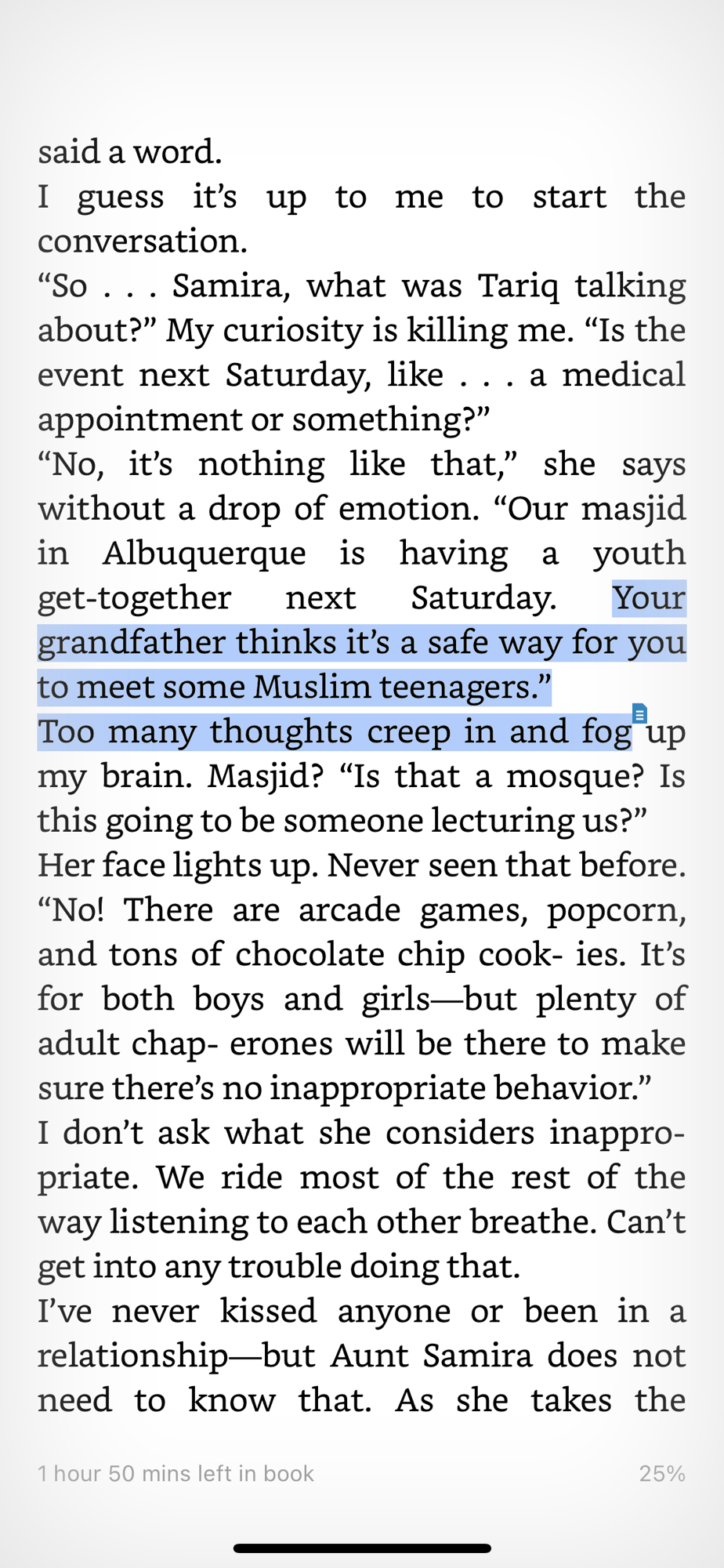
I like that family drama and secrets were teased, even if I didn’t think that they were presented and resolved well. I wish they took more of the focus and that Islam being a reason for the animosity was downplayed.  I think religion could and should have been one of many factors, having it be the ONLY factor put a lot of pressure on the presentation, which fell short.  It also means that the resolution needed to resolve the Islam hanging in the air, SPOILER,  it didn’t.  The conclusion has Asiyah realizing her father never stopped loving her, but how did that resolve the relationship with her and Samira? And suddenly Samira just backed off her singular Islamic identity? A bit of whiplash with it all happening off the page, left me unsatisfied.  Speaking of pages, the book spends a lot of page space having characters drive the one hour one way to have conversations that are less than 15 minutes and could have been done over the phone or even texted.  Nothing exciting or revealing comes from these drives, they just make the story drag. Tariq should have ridden along, so we could see why he was “such a great man,” see why Leena kept enduring the harshness of her Aunt to get to know him, and have the family she always dreamed of.

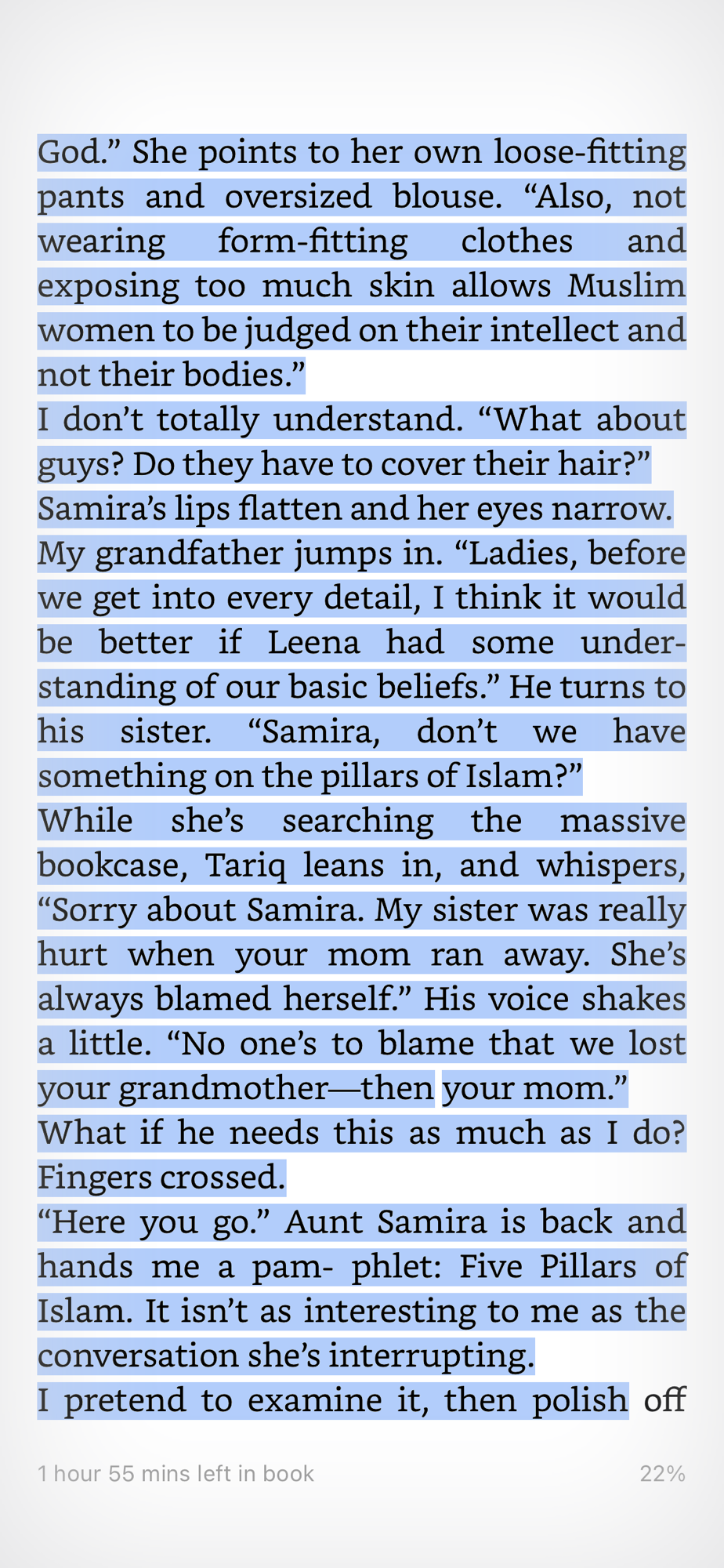
Islam is presented through the harshest of harsh characters, a few side characters are brought in that make Islam more realistic in practice and fleshed out, but it really feels like it is too little too late.  I think a non Muslim would feel Islam is just modest dress, no interacting with boys, marrying early, and rigid rules.  Leena is harassed from the first moment she meets her family, no easing in to it, she is even handed brochures on her first visit to her grandfather’s home.  Yet, Leena never shows any interest in learning about Islam, she could Google it if she was curious, even when at the masjid, she doesn’t go and watch them pray, no connection to Allah is ever discussed, it is just dos and do nots.  Consistently throughout it feels like Islam is weaponized and perhaps that is the author’s experience or intent, but it is odd coming from a Muslim writer in a fictional setting.  We get enough of that stereotyping from the non Muslim real world.

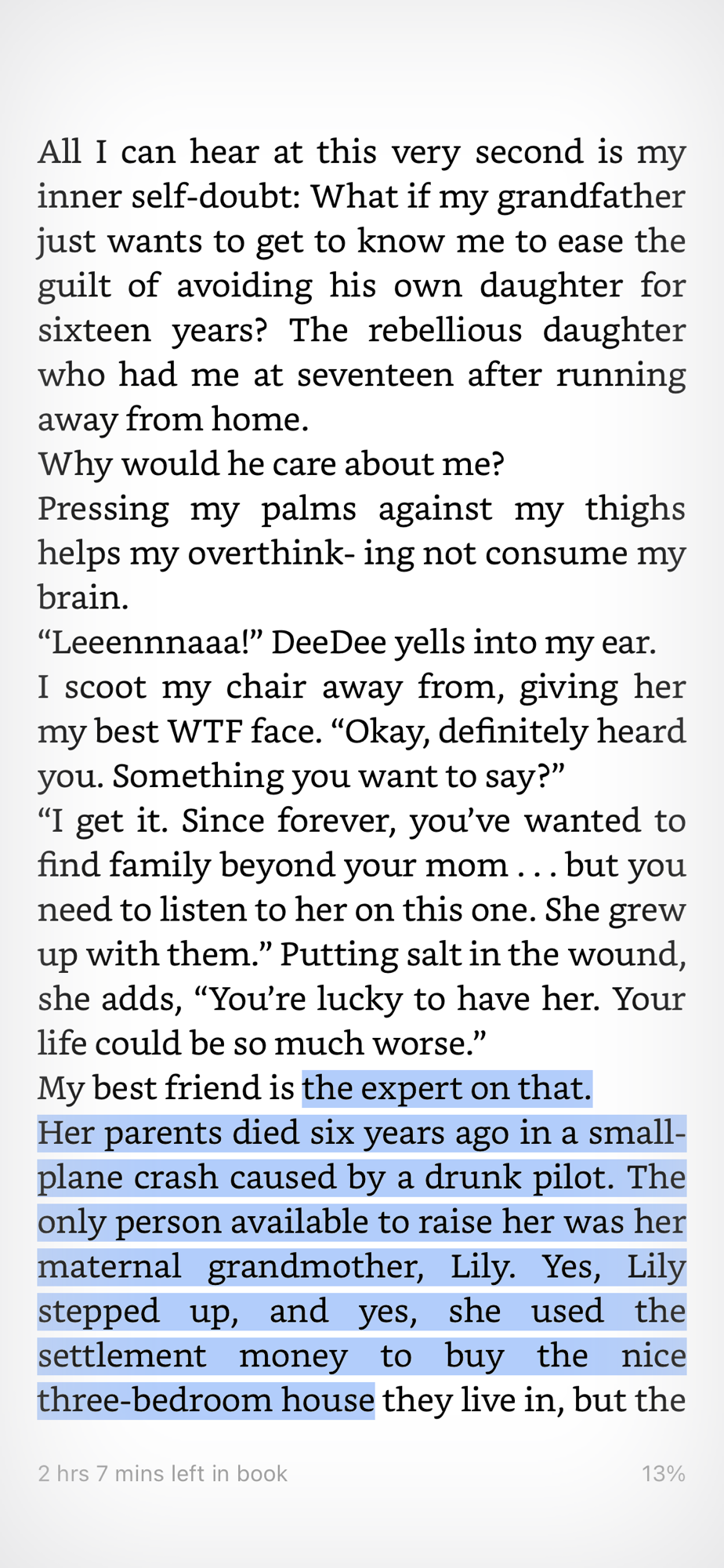
The emphasis on Islam being the only thing that matters for these characters means that whether they are religious or not, the characters are painted very one dimensional. Leena is a terrible friend, she counts on Deidre to drive her around, she never follows up on asking about her dates or reciprocating the effort for her other than feeding her.  Asiyah has an ex-boyfriend show up, and then goes out with a friend, but there is no context for their abrupt arrivals and then departures from the story, they do not serve as a foil to reveal any pertinent information or connection. A plot device used quite often in the book, and one I am not a fan of, is when things can be solved by characters simply having a conversation.  It is never the right time, they will talk later, even the fruition that started the family fracturing could have been eased by, you guessed it, the characters talking, not even agreeing, just talking.  While I’m running through my top gripes, might I add, that I have spent a few too many minutes on the cover as well.  Presumably Leena is in the middle, her young single mom Asiyah on the right, but who is the young hijabi? Her aunt does not read young at all, and she would not have her neck showing, that would go against her core characterization. So before you come at me that I have no right to my opinions and that I’m too mean, please solve the mystery of who is on the cover, thank you.

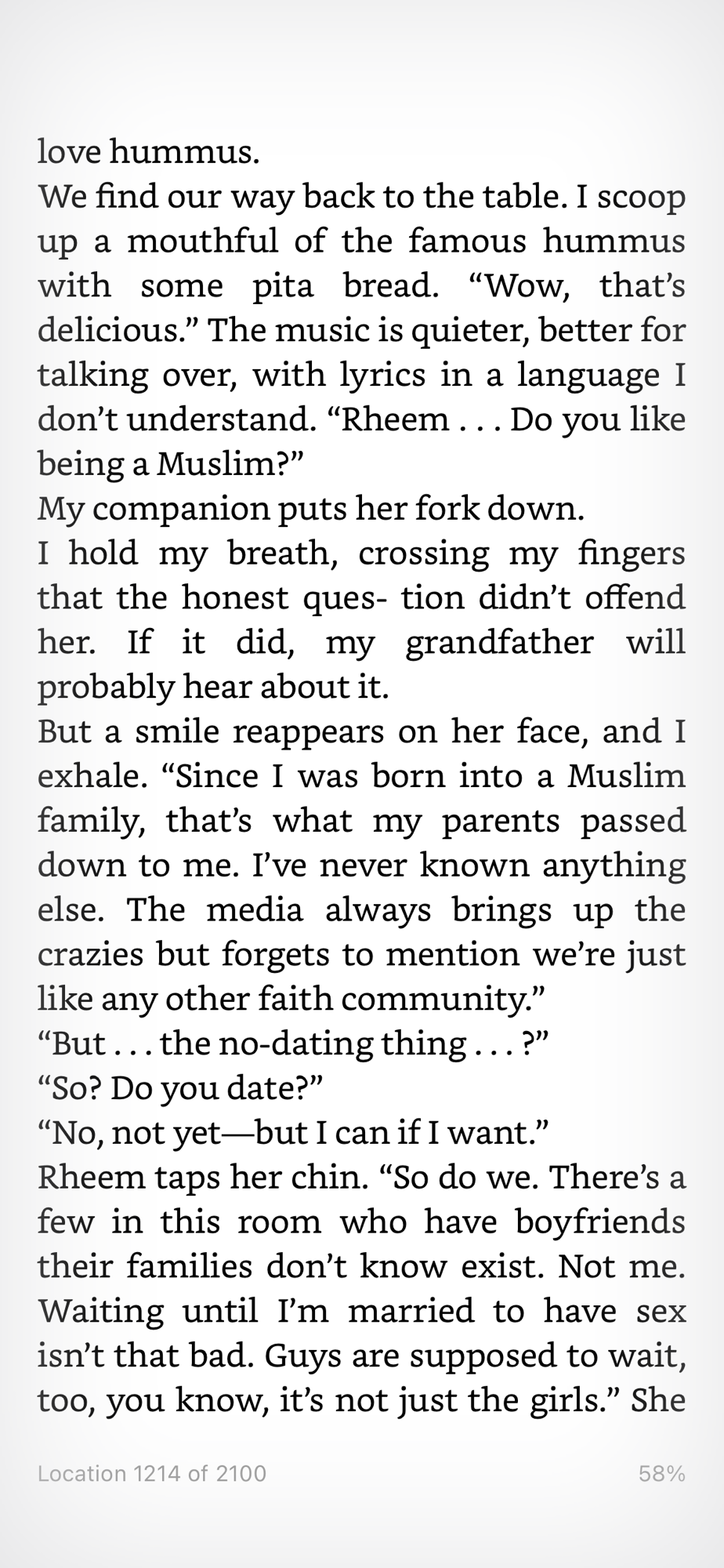
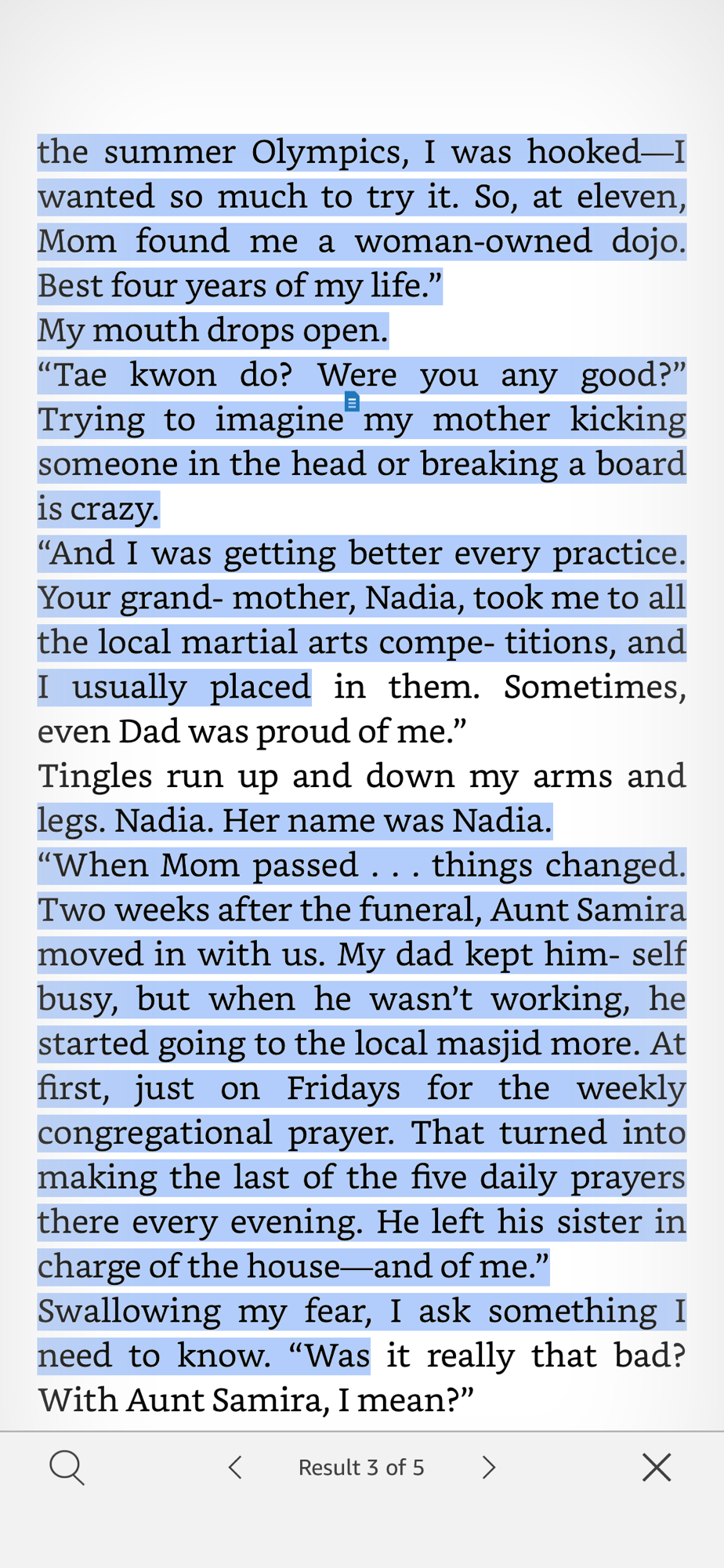
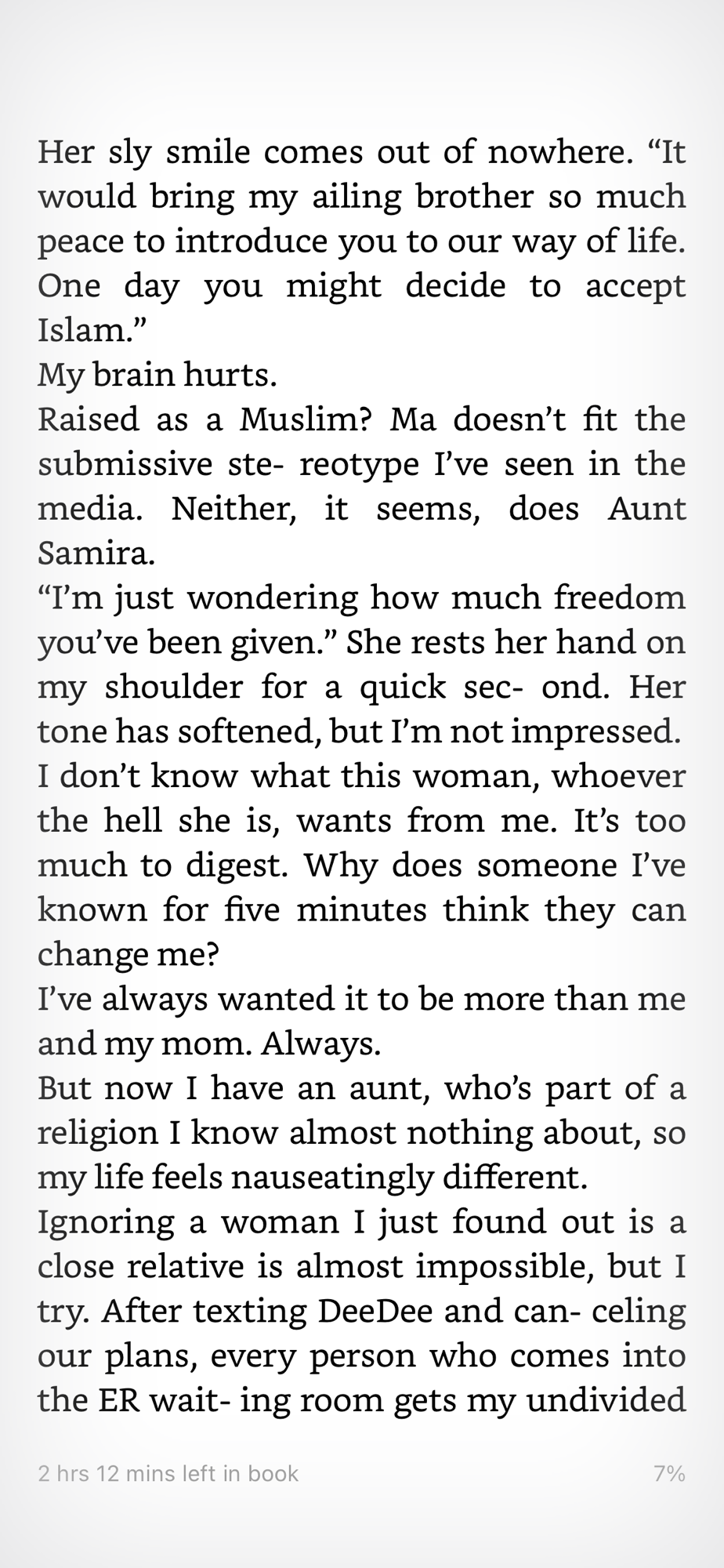
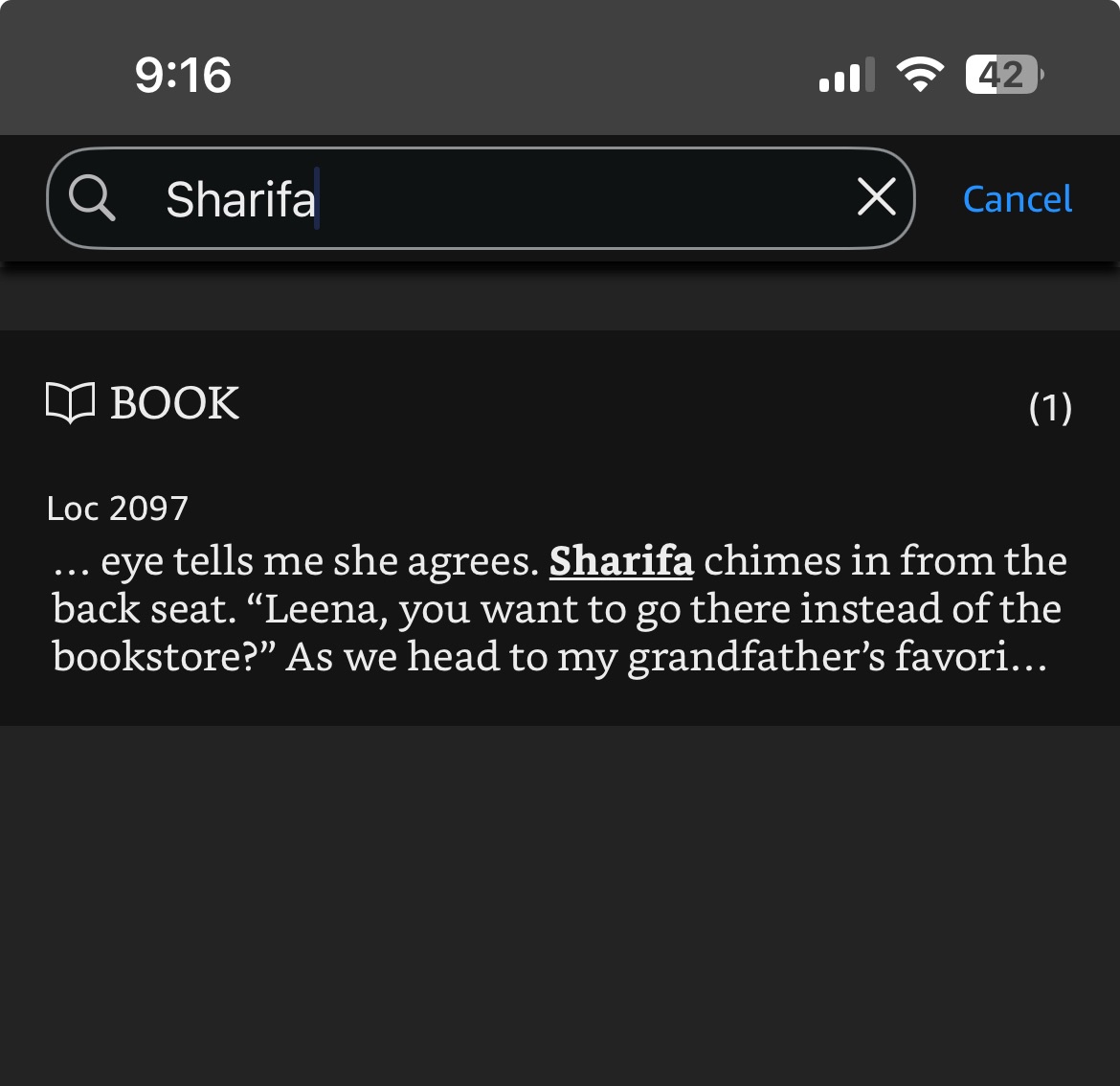
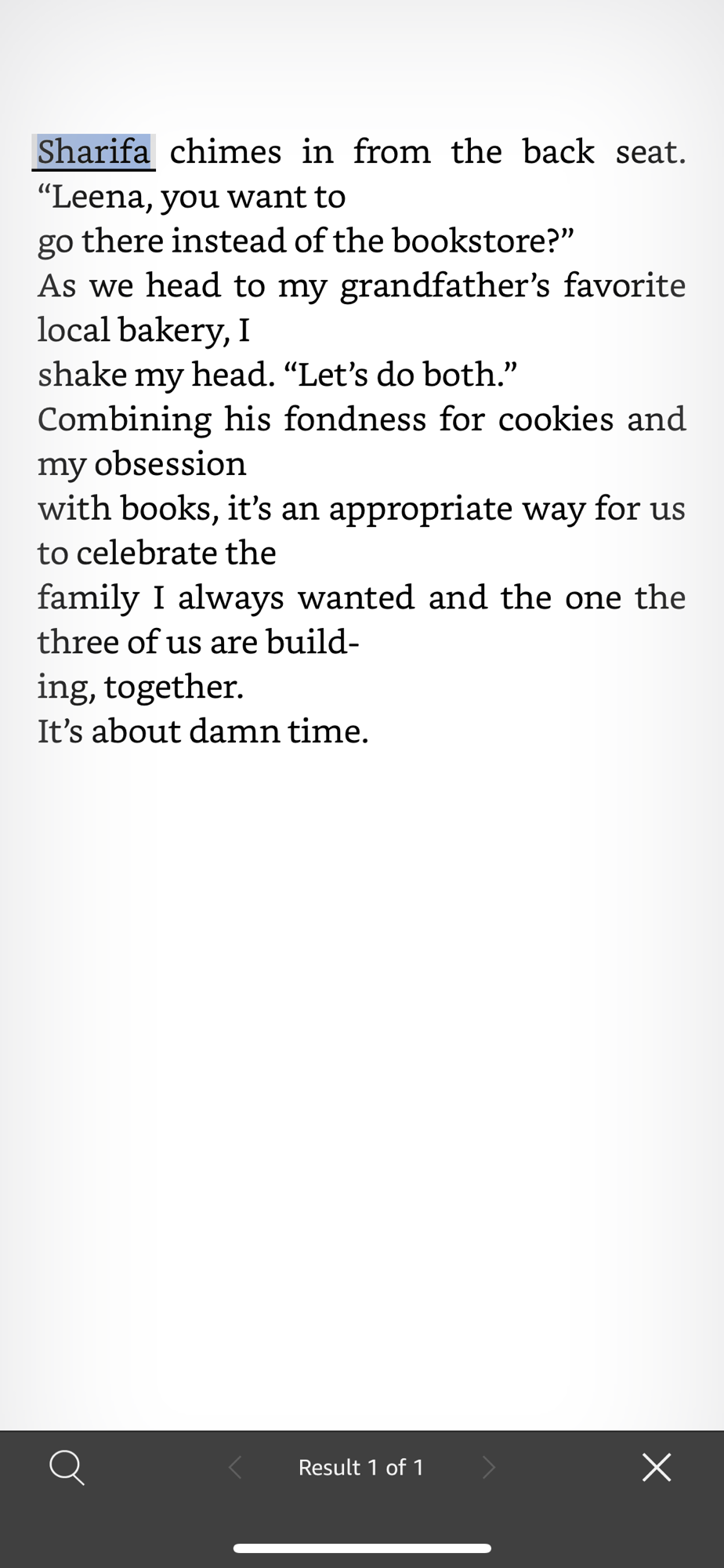
I read an ARC so I am aware that changes could have occurred, I’ve requested the book from my library and it is on order, and I will come back and correct this paragraph if needed.  The story of tae kwon do is repeated in two different spots almost word for word as if the information that Asiyah was good at tae kwon do both times is news to Leena.  Clearly it is in error.  It also has Deidre’s grandmother getting their house with the insurance money from Deidre’s parents dying and then a few lines later saying how the grandma doesn’t let Diedre forget that the spare room was changed to a bedroom for Diedre when she moved in.  A friend, Rheem, is brought in guide Leena academically, and is described as being homeschooled and changing to an online program for her senior year to also take dual enrollment classes, a few chapters later they are going to her Islamic High School for a party.  Side note, the sign on the high school says, “ALHIDAAYAH ISLAMIC SCHOOL: Grades sixth through twelfth.  We want our children learning it’s okay to be both American and Muslim.” The last page of the book also has a “Sharifa” in the back seat, and there is no Sharifa previously mentioned in the book.
FLAGS:
Cursing, judgement, dating, running away from home, anger, death, loss, lying, flirting, gambling, child out of wedlock, cutting family ties, clothing shaming, music, othering.

TOOLS FOR LEADING THE DISCUSSION:
I wouldn’t shelve or use this book for a book club read.  I think Muslim kids would be annoyed by the way Islam is presented.  I think they would be ok that Leena SPOILER didn’t take an interest in Islam, but I think they would be bothered by the flat, angry portrayal that it has in the book.

Fatima Tate Takes the Cake by Khadijah VanBrakle 

Standard
Fatima Tate Takes the Cake by Khadijah VanBrakle 

fatimatate

I really want to be raging furious and upset by the lying, premarital hetero sex, normalized/celebrated lesbian Muslim, internalized Islamophobia, gaslighting, abuse, and labeling of Muslims as “conservative” and Islamic principles as “ancient and ridiculous” (keep in mind the characters and author are all Muslim). But honestly, the writing is so terrible that to feel that much emotion is just not that warranted for what the story is. I’m so disappointed in the entire writing quality of the book, that I couldn’t appreciate the characters or story as written.  I know elements of the story probably ring true, my privilege and arrogance don’t blind me to recognizing that, and whether I agree or relate or identify with the Islamic representation is subjective, but it is not a good sign when reading- that screen shots are not enough, and I have to break out paper and pens to note the contradictions, plot holes, and inconsistencies.  The cover is the best part, with its beautiful Black Muslim inviting YA readers to crack open the book and spend time with Fatima who dreams of following her culinary dreams despite family and toxic relationship obstacles.  Sadly though, the text does not live up to the expectations the cover sets forth.  It reads like a very early draft where the plot points, the climax, and the conclusion are laid out, but the dialogue, backstories, and relationships are yet to come in this very mature 304 page book.

SYNOPSIS:

Fatima Tate dreams of culinary school, but her mother demands a more practical degree of nursing.  The only child of a nurse and mechanic, Fatima goes to a virtual charter school and has a best friend since 5th grade, Zaynab. who goes to a private school, yet constantly chauffeurs her around, covers for her, and whose relationship with Amber is a major thread in the story.  One day, when Zaynab fails to pick Fatima up from her shift at the soup kitchen, Raheem, her crush who she has never really spoken to, offers to drop her off, he uses the excuse of not wanting to miss Asr salat to get in her house, and by the time the prayer rug is put away the two are kissing and holding hands.  It has been a busy day for Fatima, she was also invited to join a teen cooking competition, and with that, all in the first chapter, the direction of the story is set.  Add in the twist that her parents don’t know about her joining the cooking competition, Raheem being revealed as a narcissistic, controlling, wealthy, manipulator who has his mom properly meet Fatima’s parents resulting in the two quickly become engaged, and Fatima at some point having to finalize her college plans and you have most of the plot and spoilers of the book.

WHY I LIKE IT:

I wish there was more OWN voice Black Muslim culture inclusions.  As with all the potential themes of the book, the writing just feels so superficial.  The only thing quicker than the instant romance, is the reader’s (my) instant disdain for the creep that Raheem is: from his arrogance to his ghosting, his hypocrisy to his gaslighting.  There is no angst, attraction, sympathy, intrigue, nothing in his character makeup or in the relationship he and Fatima have.

The cooking thread is equally lackluster, I think most bakers have heard of refrigerating cookie dough, and where I should have been hungry or had my senses tingling, I found myself annoyed by the almost childish portrayal of the food scenes.  If it was meant to show passion or a divide with her parents, it was all talk and no show.  At times the text says how close Fatima is with her parents, how much she respects her mother’s strength and her father’s kindness, but lie after lie to them and their distance from the heart of the book, definitely do not show a complicated relationship, it once again, yep you guessed it, reads really flat and one dimensional.

Islamically there are concerns with the premarital relations, but even before that with the male and female being alone, the lying, the lgbtq+ relationships.  I never understood why Fatima refuses to pray in congregation and attend Jummah it just says she doesn’t join the community prayer, but she also doesn’t pray with Raheem, which might have actually been sweet.  She is noted to pray fajr late and it is a point of contention, she wears hijab, and says a lot of inshaAllahs, but while the text sprinkles in these touchstones, they don’t seem to shape her identity, it feels like it is just the paradigm that she knows.  She finds the mahr concept to be “ancient” and “ridiculous.” The one character that speaks out against same sex relationships wears abayas, black abayas to be exact. She is also labeled the “haram police.”  Zaynab doesn’t pray, doesn’t cover, but presumably identifies as Muslim.  Raheem says he is fine with her lesbian identity, but fears Fatima’s relationship with her will ruin his future political career.  The book never has any substantial commentary on the Islamic view of queer relationships and labels any one that has a problem with them as being “strict” and “conservative.”  The book says “love is love” and leaves it at that.

Constantly the reader is told that Fatima and Zaynab are best friends since 5th grade, no backstory as to why Fatima left for virtual school and Zaynab for private.  We never see Fatima add anything to the friendship, Zaynab drives Fatima, feeds Fatima, consoles Fatima, it is all very one sided.  So many story lines just fall off the page without resolution or insight.  At one point Fatima is angry at Zaynab and doesn’t want to share her with Amber, but then is mad that Raheem is wanting to take her away but nothing is ever done or explained or internally pondered over, it is just forgotten.  I really despise how we are also told that Zaynab and Amber are the ideal couple, but nothing ever shows it. NOTHING. They are always fighting, Fatima is always on edge to even ask Zaynab about Amber.  Zaynab and Amber fight about their graduation party and it magically all works out.  Amber is shocked to know that Muslims won’t accept them, and they seem to break up, but then they are together at the end so how did that get resolved?

Major plot holes: When Fatima’s mom asks Fatima if she knows Raheem, she says no and four pages later her dad asks her what she thinks about Raheem and she answers him.  This inconsistency mitigates the “reveal” at the end that they knew each other at the soup kitchen.  Speaking of soup kitchen, the reader sees she goes once and then stops for finals and never resumes going, so how is it such and important part of her or Raheem’s life? Does he return? Fatima gets driving lessons and a car, and is then driving alone, time line doesn’t work, nor does what she is driving get articulated if she returned the Lexus.  Extravagant gifts aside, it never fully explains where Raheem’s grandfather made his wealth, it seems lacking because he doesn’t want Fatima to work, but his mother does, in managing her father’s inherited wealth.  At the walimah it is very awkward between Zaynab and Fatima’s mom, almost to the point I thought they might not know each other, or might have issues with her lifestyle, but by the end it is clear they know each other well, so I think the scene is just written poorly.  I went back and read it and the familiarity of the families is definitely unclear and not consistent throughout.  For Fatima’s graduation Raheem gets permission to take her to dinner alone, for someone who is constantly watching money and loves cooking, it felt like it would be a big deal to be able to go out alone with her finance, to a fancy restaurant and savor all the flavors and ambiance.  Nope, the scene is skipped, no details, no nothing.  Lots of little details are skipped quite often, for example five people are qualified for the finals, only three names are given, just throw two more names in there, nope we get dot dot dot- it reads unfinished.  At one point when Zaynab once again saves the day and picks up Fatima, they come back to Zaynab’s house with Starbucks and meet at the fridge to get Pepsi’s out, like three sentences later, Starbucks on the table forgotten.

Zaynab does have a slight character arc, but throughout needs someone to constantly side with her, and I don’t know that she is very independent at the end.   I don’t think there is a decent relationship in the book between any of the characters, which is unfortunate, and religion and the masjid (labeled “patriarchal”) are often portrayed in a negative light. The internalized Islamophobia was hard to swallow.  At one point Fatima shakes a man’s hand and says that she isn’t one of those Muslims that has issues with that.  It seems like this book checked a lot of boxes and for whatever reason didn’t get the polishing it needed.  It is unfortunate because OWN voice Black Muslim books with authentic rep and joy and complexities and nuances are so desperately needed, and this one just felt underdeveloped and raw.

FLAGS:

Language, closed door premarital sex, talk of sex, talk of condoms, child out of wedlock, cheating, lying, hetero and same sex couples, dancing, music, physical abuse, verbal abuse, gaslighting, controlling, stereotypes, internalized Islamophobia, male and female friendships, manipulation, blackmail, judging, deceit, hypocrisy.

TOOLS FOR LEADING THE DISCUSSION:

The cover will tempt younger readers to pick up the book, my only hope is the poor writing will cause it to be abandoned before the haram is glorified, normalized, and celebrated.