Tag Archives: drama

Always Be My Bibi by Priyanka Taslim

Standard
Always Be My Bibi by Priyanka Taslim

I had pretty low expectations going into this 368 page YA romcom- as often YA is really “adult” and if the characters/author are Muslim in a “romance” it tends to become a heavy handed rebellion against Islamic principles. So imagine my surprise when the book really is meant for teenage readers. The protagonist loves her culture, and it is established really early on that they are Muslim, but aren’t religious.  Sure as an “Islamic School Librarian,” I wish the characters practiced Islam, and that the the kissing and hugging was labeled as haram, but for the fictional story on the page, that is cultural based, it is a delightfully chaotic and fun read.  Note, the kissing and haramness occurs when they are “sneaking out,” and reads as if they are sneaking out from parental rules, not Islamic ones, as they do not view the world through an Islamic lens.  The protagonist’s sister is presented as religious in that she wears hijab, and left a prestigious private school to attend a local Islamic one, but it is not a major plot point, and if anything shows that Islam is not a monolith or something forced, really though it just shows how different the siblings are.  Does that mean the writing is some literary genius? No, not really, but it is a quick light summer read that I enjoyed. The main character, Habiba, aka Bibi, reads as a Bangladeshi Cher from Clueless through and through, and while at the start it was a bit annoying, I ultimately found her endearing by the end.  There are plot holes, but I didn’t care too much given the quick pace and the nature of the book. The ending though, was drawn out and too long, and the book could have been easily 50 pages shorter. All in all it was fun to be transported to a tea estate in Bangladeshi for a wedding, and I wouldn’t have a problem with 15 – 16 year olds or so reading the book.

SYNOPSIS:

Bibi is in hot water with her father for sneaking off to prom with a boy, the deal has always been no dating until her older, perfect, law school bound, sister Halima gets married.  And her punishment for the summer is working at the family restaurant, one of the many Royal Fried Chicken locations in the chain they started that makes her family, chicken royalty. When hijab wearing, no haram dating Halima springs on her family that she is getting married, the family all heads to Bangladesh for the summer to get to know the groom’s family on the massive tea estate, and celebrate the wedding. Oh and Bibi’s punishment will be transferred from working fast food, to working in the fields under her new brother-in-law to be’s grumpy, serious, younger brother, Sohel.  Bibi also holds her father to his end of the deal and when the big book of biodatas arrives, she is ready to have her chaperoned dates as promised.

As the prickly family of inlaws look down on Bibi and her family, Bibi and surprisingly, Sohel join forces to break the pair up. As the book unfolds their mission changes, the bio data book causes drama, old flames are sought after, and the wedding takes some surprising turns.

WHY I LIKE IT:

As I write this, I’m rolling my eyes at the fact that I really did read it in two sittings and was amused. Bibi is spoiled and clueless and yet does have a good heart.  As with most romantically inclined books, a whole lot of suspension of reality takes place and side characters are not fully fleshed out.  Halima and Sunny met in college, and there families are from the same part of Sylhet, infact Baba worked on the Rahman’s tea estate before coming to America.  The grandma is woefully underdeveloped, I get that she is a side character but the girls spend so little time with this woman they love so dearly is a blaring hole. I really didn’t get some of the scenes after the midpoint, they felt like filler and they felt forced: friends coming from America, the bachelorette party turned amusement park trip, Sohel not sticking up for Bibi, the half hearted love triangle, and the Bibi Baba multiple rehashings.

I did like that the title of the book though comes from something Baba says to Bibi, and not from a love interest, that made me smile. And I liked that the “dates” were supervised, it is vague if the dates in America would have been, or if once Halima was married she would have been allowed to “date” with a western definition, but I kind of liked that it wasn’t defined.

FLAGS:

Disrespect, sneaking out, kissing, hugging, close boy girl friendships, sneaking out, language.

TOOLS FOR LEADING THE DISCUSSION:
Definitely not a book to spotlight as a book club selection, but one that I would have on the shelf and not mind older high schoolers reading.

The Djinn Waits A Hundred Years by Shubnum Khan

Standard
The Djinn Waits A Hundred Years by Shubnum Khan

img_8259-1

I didn’t realize how many characters this 308 page adult book has until I sat down to write this review.  The slow peeling back of layers into their backstories, motivations, perspectives, and insecurities, makes you get to know them in a way that feels real and deep, but in no way can be succinctly explained in a review.  First off to clarify, I feel the title is a bit of click bait, the djinn is there, but not a big part of the book, there is also a ghost, who is a more impactful character, so the vibe is more haunting than Islamic lens.  In fact, a few characters are Muslim, but that is about it.  The writing though, oh the writing is quite lovely and immersive.  The culture of desi characters in South Africa, the slivers of colonization and caste that get commentary, and the heartache of all those who have called, and do call Akbar Manzil home, will linger even if the details fade over time.  I listened to the audio book, so it is possible that triggers or flags might have been missed, for the most part the book is relatively clean, death, murder, attempted murder, and supernatural beings being the most obvious.

SYNOPSIS:

The main character is very much the grand estate of Akbar Manzil, a palatial home off the coast of South Africa that shaped lives and futures and hid horrors and loss.  In modern times it has been subdivided into apartments where lives and futures are still shaped and horrors and loss are also hid, and hid from.  When Sana and her father arrive to take up residence, the past and the present begin to unite, a djinn that has never left the house is stirred, and the more Sana pokes and prods, and the more she understands about the original inhabitants of the home, the more the house pushes back.

I don’t know how much to tell, as spoilers aren’t so easily defined in this book.  The family in the past is a man from India, Akbar, who falls in love with the area, builds a house despite his wife hating it all and desperate to leave, opens a sugar factory, his mother comes to live with them, they have two children, servants, friends, he stocks the gardens with monkeys, giraffes, a lion, and then one day he is enamored by a Hindu worker, Meena, at the factory and takes her as his second wife.  The jealously and family drama reaches a crescendo when she is pregnant and has a little boy.  Beyond the family storyline is a djinn also enamored by Meena, who takes up residence in the house to be close to her.

In present times, the other tenants in the house have their own baggage, loss, regret, and fears that cause daily squabbles and plottings.  Sana deals with the loss of her mother who hated her, and a dead sister who haunts her.  There is also Pinky in love with Shah Rukh Khan, Zuleikha a former famous pianist who has lost her edge, the Doctor who owns the home, a mother waiting for her son to visit, a parrot named Mr. Patel, Fancy, Razia Bibi, and so on. The house is occupied, but hollow, not full, and the the lingering djinn seems to always lurk just beyond the surface, in the corners and shadows that haunt them all.

WHY I LIKE IT:
I like that the writing keeps you hooked, even at times when there is no rising action, or conflict, you are genuinely drawn in and invested in just learning about the characters and how their lives, both those in the past and the present, intersect.  I didn’t like the fact that there is a djinn and a ghost, I feel like the ghost negates the realness that djinn.  It is possible that the ghost was a metaphor, or symbolism, but it was a little off to me, to have both as I understood it.  I don’t know how I feel about the vagueness of the final climax, yes I’m trying not to give anything away, but SPOILER: who set the fire?

FLAGS:

Loss, death, ghosts, djinn, murder, attempted murder, lying plotting, manipulation, music.

TOOLS FOR LEADING THE DISCUSSION:

I don’t know that this would work for an Islamic school book club, that doesn’t mean it wouldn’t work, but rather I need someone to discuss with me, so that I feel like I understood some of the lingering threads that are unresolved.  Basically, I would need to have someone explain parts to me, before I could help 15-16 year olds and up make sense of it all.

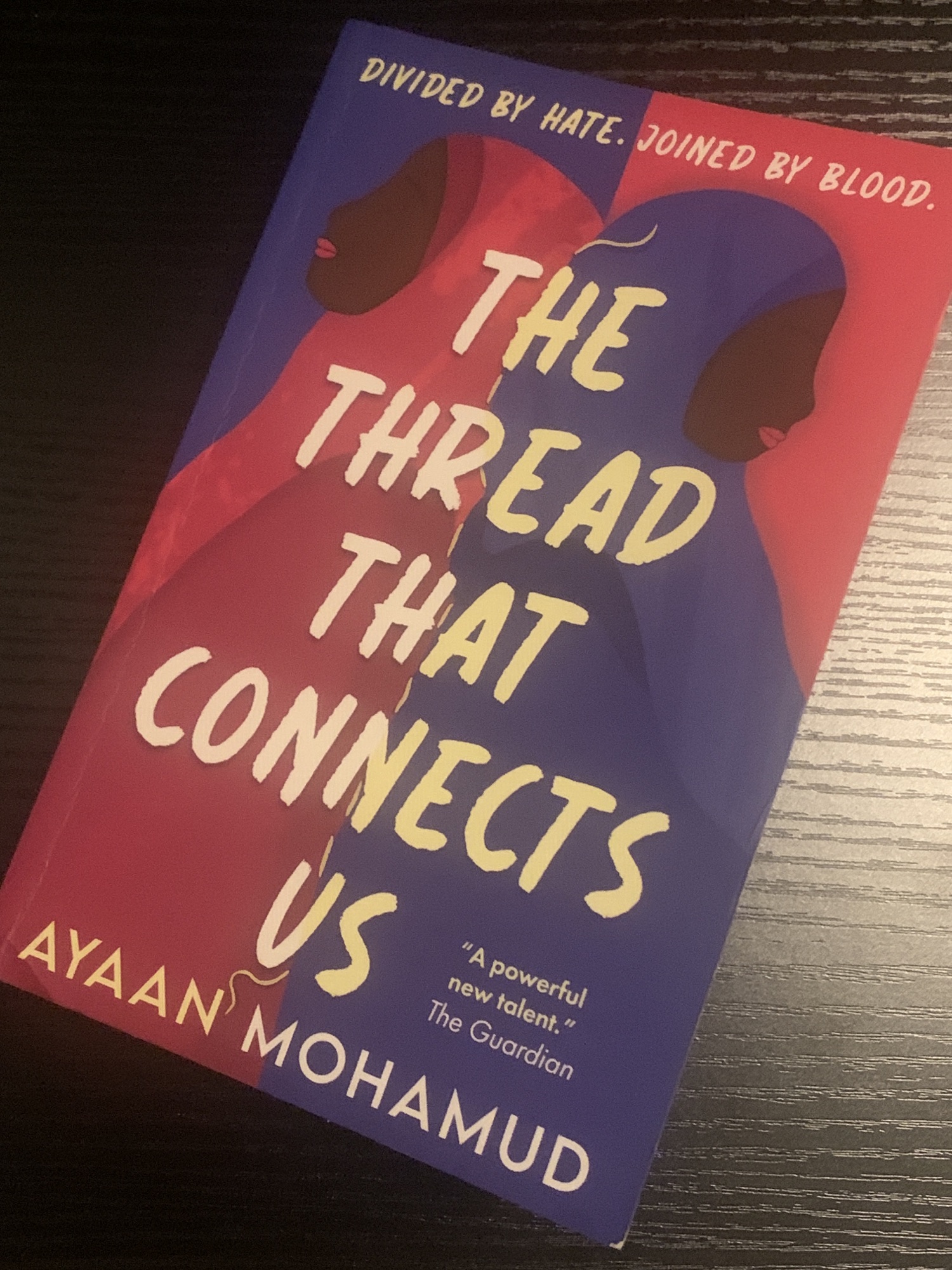
The Thread that Connects Us by Ayaan Mohamud

Standard
The Thread that Connects Us by Ayaan Mohamud


At just over 400 pages this book expertly blends the stresses of school, bullies, and friends in the UK with the twists and secrets of broken families, shattered hearts, and a past that needs to be reckoned with.  Told in dual perspectives from girls thrown together by the actions of their parents, Safiya and Halima maintain distinct voices that are rich with Somali culture, Islam, vulnerability, and ultimately love and hope.  The book is YA, but the premise is a bit mature and is better suited to older teens in my opinion, I think a high school book club would be wise to consider this book, as once you start reading, it is difficult to put the book down. 

SYNOPSIS:

Safiya is mature beyond her years.  Since her father abandoned her and her mother five years prior, she has managed the bills, the upkeep of the home, and for the most part her grades. Hooyo checked out and is rarely more than a silent being curled up unable to care for herself, much less her daughter.  With the the help from the community, particularly her best friends and neighbors Muna and Yusuf, Safiya has a found family that helps her weather the tough times.  When her dad moves back to London with his new family from Somalia, Safiya is forced to deal with not only all the painful memories of her past, but also the very real presence of her family living in her neighborhood, showing up to Eid prayers, and taking over the safe haven that school has often served as when home life has been so cold and lonely.

Halima’s father died when she was young, and life with her Hooyo in Mogadishu was good until her mother remarried, Safiya’s dad.  Her two younger half brothers that came further added to the rift between her and her mother, and now that they are moving to England with the husband, despite her protests, has her plotting a way to return to her home.  The language, the culture, the weather, are all added stresses to finding her way, and are compounded when she gets paired up to have Safiya show her around and help translate for her in school.  

The two girls hate each other, at least they have that in common, but their inability to avoid each other forces them to interact more than either wish to do.  As questions, and secrets are voiced, the two girls realize that they might have to work together to get what they want, and figure out their past.

WHY I LIKE IT:
I really enjoyed the owning of the characters’ language and culture and faith and how easy it was to be invested in their world.  Nothing pulls you out of the story, it is rich and lush and the reader can figure out why even though there is a crush, nothing is going to happen, and why they are wearing hijabs, and waking up to pray fajr, the balance is both inviting and educating, without the reader even realize it is happening, because hello, we are to busy trying to figure out what these two girls’ parents have done. 

The story has layers, and the emotional attachment I feel to both these girls, made me glad the story was over, they deserve some peace, but also desperate to know that they are going to be ok in the future too.  I can’t say too much without the risk of spoiling, but the writing is strong, the plot solid, the details intentional and relatable, and the characters very real.

FLAGS:

Lying, bullying, fighting, assault, crush, drug use, arrest, accusation, gossip, abandonment, relationships, edibles, affairs.

TOOLS FOR LEADING THE DISCUSSION:
This would be such a great upper high school read, the way the story unfolds will keep readers hooked from the first page and motivate those that start, to finish.  Students will see themselves in the characters, and be sleuths themselves trying to uncover what secrets are true and how do the pieces of the puzzle fit together.