Tag Archives: cordoba

The Magical Moroccan Rug by Naveed Mir illustrated by Anisa Mohammad

Standard
The Magical Moroccan Rug by Naveed Mir illustrated by Anisa Mohammad

img_4186-1

I really like the premise of the book, a Muslim Magic Tree House so to speak, two kids that magically go back in time, in this case to Andalucía. At times the book did make me smile, but really it feels like a missed opportunity.  The writing needs tightening, it feels early reader at 94 pages long with a few full page illustrations, but the vocabulary and text filled pages support the suggested reading level of middle grade.  It takes way too long to build up to the “action,” and when it gets to the plot it doesn’t seem to know what to do with itself.  It is a lot of walking this way only to turn around and walk back for no development, character growth, or enriching reason.  As an adult I had to force myself to keep reading, my eight year old who loves Magic Tree House books had basic foundational questions and couldn’t’ get past page 24.  Honestly it just needed some proof reading and some trimming, which is why I found it so frustrating; it really had so much potential.  Example, if the little boy is so excited to see his grandfather after 8 years, why didn’t he go with his dad to the airport, why did his elderly tired grandfather immediately go to a community event after arriving in the UK from Morocco, why wouldn’t Yusuf go with his beloved grandfather to the masjid.  And this is all within the first few pages.  If the logic isn’t there for the mundane set-up, it is hard to get on board for the fantasy aspect of a flying carpet going back in time.  The historical figures are introduced in passing and don’t leave much of an impression, so yes it is good to give readers a bit of information on people they may not have heard of before, but it doesn’t give them enough connection to make them memorable.  The backmatter sadly is not more information about the three historical figures presented: Abdur Rahman (The Falcon of Andalus), Lubna of Cordoba, and Abbas Ibn Firnas, it is a glossary and a Quick Quiz.  The answers to the quiz are not provided, there are additional facts shared but no sources given, and there is urging to find out more about Muslim Spain, but no directions, links, or book suggestions are provided.  The publisher should have proofed the book, it reads like a pitch, maybe a first draft, and our children and their purchasing adults deserve better.  We have growing options of stories with historical Islamic OWN voice framing, and unfortunately this book had a lot of potential, a few pages of interest, but not ultimately enough intrigue to win me, or my kids over.

img_4187-1

SYNOPSIS:

Yusuf and his friend Jack live in the same neighborhood, but don’t go to the same school.  They spend a lot of time together though, and have known each other since they were babies.  When Yusuf’s grandfather comes to visit from Morocco, he brings an old carpet and gifts it to his 10 year old grandson.  Unsure what to do with it, Yusuf puts it in his room, and feigns gratitude.  With a history project looming, and a dislike for historical study, Yusuf and Jack find themselves heading on a magic carpet ride into the past.

They arrive in Cordoba in 856 CE, disoriented and dizzy, Omar, their guide, greets them, walks them through the mosque answers one question then walks them back to the carpet to take them to a different time, 786 CE and they see diverse people living together peacefully.  They first observe “one of the greatest rulers that Andalus ever had,” The Falcon of Andalus, aka Abdur Rahman.  He is a humble leader that freely interacts with his subjects.  They then head to the 10th century to see Lubna with a crowd of scholars in Cordoba  learning from her in the library.

When Yusuf remembers his history project about flight, Umar guides them to 875 CE with a pit stop in CE 852 to see Abbas Ibn Firnas take flight, well fail and then eventually take flight in 875.  The boys then say their goodbyes and are whisked away home. Where they can’t believe what transpired, and are determined to figure out how to make it happen again.

img_4188-1

WHY I LIKE IT:

I like the concept, and that Jack is not Muslim, and Yusuf is unapologetically Muslim.  Seeing the two interact is enjoyable and both good modeling, and mirroring.  The heart of the book is truly not bad, it is the tangents that get long winded for no advancement of the story that take away from the flow.  As stated above the relationship between Yusuf and his grandfather doesn’t align with what is said and what is shown.  The end suffers the same lack of editing.  How can grandpa and Yusuf live in the same home, but they can never find a moment to talk.  Nothing is gained by delaying their conversation, so why delay it, and go on and on about delaying it?

If the point is to share not just with Yusuf and Jack about key historical figures, but with also the reader.  Then there needs to be more interaction with the characters, not just watching them from afar.  Interact with other observers or students or colleagues, convey information from a “personal level” not just drop a snippet here or there from what feels like a vague Wikipedia page.  If the book is not sourced, why not take some fictional liberties and flesh out Abbas, Lubna and Abdur Rahman, so that they are remembered. Include more information about the three real characters in the backmatter, reinforce the idea that a magic carpet is not real, but these remarkable people were, and they changed the world.

I don’t know that kids will have issues with how the carpet worked, but because the set up was so weak, I had a hard time going along with any of it.  I wanted to know why it had to be a grandson, not a son or daughter, how grandpa or his grandpa figured that out when it wasn’t a relative that gave the first Yusuf the carpet, but a storyteller.  How Umar knew to look for them at that moment.  Why did they go to 856 CE and then go to 786 CE why couldn’t they just meet Umar on the first stop? Seems unnecessarily dragged out, for no reason.  When was grandpa’s last trip? Could you get stuck out of your time? If no one can see or feel the rug, why do they keep hiding it? Can people see and hear them, or only their guide?

I like that Yusuf prays and Jack knows that Yusuf prays, and what a mosque is.   I didn’t like that they hear the athan, and went with everyone to pray, but then just left without praying.  The book seemed to do that a few times.  Have the kids walk through a crowd presumably toward something or for some purpose only to turn around and return to the place of origin having gained nothing, learned nothing, or seen anything, again just drags the book out and frustrates readers.

There really is not conflict in the book, no climax either, there is no really stress about getting back, stress about figuring out how to go on the next adventure, it is there, but not heightened, and it is unfortunate, because the book really could be adventure filled, and it just isn’t.

img_4189-1

FLAGS:
None

img_4190-1

TOOLS FOR LEADING THE DISCUSSION:
If you are learning about Abbas Ibn Firnas, or Lubna, or The Falcon of Andalus or Spain, and have access to supplemental material, the book has value.  I don’t know that if a kid picked it up off the shelf even with interest in history, that they would finish reading the book.  It doesn’t provide a solid feeling of learning or understanding about the time and place and people seen in the time travels, nor is it action packed on its own.  So if you can motivate a child to read it and then look further into it, the book would help connect the past as being interesting and engaging, but on its own, the book does not achieve that.

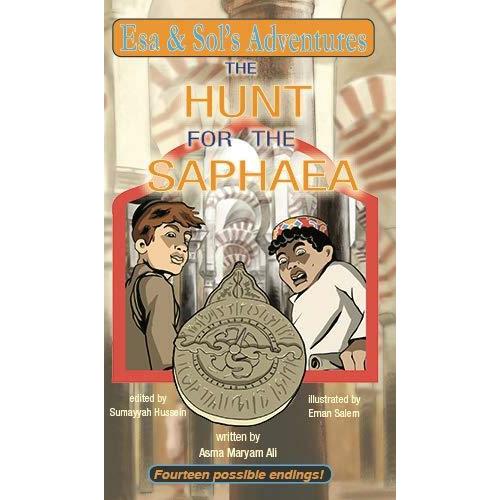
Esa & Sol’s Adventures: The Hunt for the Saphaea by Asma Maryam Ali, illustrated by Eman Salem

Standard
Esa & Sol’s Adventures: The Hunt for the Saphaea by Asma Maryam Ali, illustrated by Eman Salem

It is a bit tricky to review a choose-your-own-adventure style book, as each story twists and turns and leaves the reader with a different ending and thus, a different impression. I tried to explore every story line in a book that I had little expectation of, it is an intentionally splintered story after all, but even at that, this fell really short. The core of the story: a Muslim and Jewish boy in Cordoba, Spain in 1080 exploring real facts in a fictionalized story about hunting down a missing astrolabe, really had a lot of potential, unfortunately the tiny size (maybe 3.5 x 5.5 inches) and only being 76 pages, the frightening cover, and the misprinted footnote glossy right at the start, set the tone for a weak forgettable book, and by the time you get to the actual story and plot, you really have very little substance to change your mind.

SYNOPSIS:
Two nine-year-old boys start off the story chasing after their donkey who has run off and sent their oranges spilling over all around the square. They should clean up the chaos, but they remember that they are supposed to meet Zarkali, the greatest astronomer in all of Spain, as he finally has a job for them after months of waiting. His latest work is a brilliant astrolabe, but when they get to his workshop he isn’t there. When he finally arrives with his assistant Aleho they are frantic as the astrolabe, the Saphea, is missing. The boys were to be asked to help transport it, as they would blend in unnoticed, but now that it is missing what should they do? Should they search for it? Investigate if it was stolen? Accept their punishment for the mess with the oranges and their donkey? Let the first choice of many begin the adventure.

WHY I LIKE IT:

I love the author’s knowledge about Muslim Spain and how she tries to introduce it to children perhaps unaware of the rich history. The inside illustrations are wonderful, the cover truly misleads readers, and naturally I wish the book was larger in size and longer in length. The foundation of the story, the getting to know the characters and their world, needs to be longer. The story should be established before you have to make decisions. It is historical fiction, but needs the world building attention that a fantasy book would require, and this book just doesn’t have it. As a result the choices and endings, are all over the place, not just twists in the stories, but huge changes. Some of the paths no longer focus on the astrolabe that is missing, and seem to offer both threads of something far more sinister at play and choices that keep the boys lives mundane. The book counts on the reader re-reading the tale and making different choices, otherwise your interaction with the book could truly be over in nine pages, nine tiny pages at that. And like I said above regarding the cover and size, they don’t entice one to pick it up and read, then if your adventure is only a few pages long, and you already notice the repeated definition on pages 4 and 6 (before any choices are offered), chances are you won’t revisit the book, learn about real people, marvel at scientific discoveries, travel the region, appreciate interfaith harmony, and get swept up in a historically fictionalized tale that puts you in the drivers seat.

FLAGS:

Fine for middle grades and up.

TOOLS FOR LEADING THE DISCUSSION:

I highly doubt the book would even be looked at on a classroom library shelf, I have been trying for days to get my own children to read the book: they love to read, they love history, they love books with options, but they have yet to open the front cover.

Ayesha Dean: The Seville Secret by Melati Lum

Standard
Ayesha Dean: The Seville Secret by Melati Lum

seville.jpg

This is the second middle grade mystery story for globe trotting sleuth, Ayesha Dean, and much like her first adventure in Istanbul, this Spanish setting is infused with rich history, delicious food, relatable characters and quick paced action.  

SYNOPSIS:

Once again Ayesha and her two friends Jess and Sara are tagging along on a business trip with Uncle Dave, Ayesha’s uncle who has raised her since her parent’s passing.  As they wait in line to board the final flight of their lengthy journey from Australia, a young man drops his contents and Ayesha and him chat, later they are seated next to each other on the plane where he discloses his travels from England to Seville are to help locate his missing grandfather.  Ayesha volunteers herself and her friends to help him and they hit the ground in Spain determined to solve the case.

The boy, Kareem, is staying with the friends his beloved grandfather was staying with when he went missing, so that is where the detectives start their work.  In searching his room, Ayesha uncovers a 400 year old diary written in Arabic, and a pamphlet from the Archeology Museum with a necklace circled, the Collar de Pajaros.  Just enough to get them started and set their adventure in motion.

The group of teens rely on Kareem to translate the Arabic in the diary and Ayesha’s wit to decide what to follow up on and how to incorporate their sightseeing with the task at hand.  As they journey through the city of Seville, learning the history and tasting the food, nefarious characters start to notice the group and things get intense.  From Cathedrals, to cafes, to Museums, and even to an ancient city uncovered in Cordobo, Madina Al-Zahra, the chase is on, not only to find Kareem’s grandpa, but to also avoid being caught themselves and maybe even solving a centuries old mystery about treasure and a necklace along the way.

WHY I LIKE IT:

I love that Ayesha in any situation stays true to her self.  She wears hijab, she prays, she is aware of the good looking guy, but doesn’t cross her own line, she is a good friend, an inquisitive person, and confident.  All amazing attributes for a fictitious hero and real ones too.  

Much like Nancy Drew and other middle grade novel series, the books don’t need to be read in order, and while they reference other adventures, they stand alone sufficiently too.  Also, like the aforementioned books there is definitely a formulaic pattern to how the author writes her books.  And while reading it I didn’t notice it intensely, as I write the review I do.  Ayesha travels abroad, she has her sidekicks that are not developed at all and truly have no barring on the story plot wise or as comic relief, they are simply foils to bounce conversation off of, there is a cute boy who could be pursued, but isn’t, someone passes out while she and her friends are sight seeing, and the spouses provide added clues, Ayesha gets locked in a small dark space, there is a twist and a surprise, a trap, and they all live to repeat the adventure in another city another day.  I don’t think I have a problem with it, but maybe because I am not the target audience age, I might get bored with it about book four or so.  As it stands right now, I’m anxiously waiting for book three.

While reading I was a little irked that Sara and Jess weren’t any more developed in Spain than they were in Turkey.  One of them could have been the one to administer CPR or to stumble on the diary in the room, something to give them some plot significance, but alas, the books do not bare their names.  I wish Kareem would have at least said “Salam” on occasion.  I like that the author shows he doesn’t know much about Islam and shows that his grandfather admits its been so long since he has prayed, but the boy is a Morisco and his parents immigrants from Algeria, he translates Arabic, he should say Salam when he meets Ayesha in her hijab wrapped head. 

The author does a much better job in this book staying with the characters and showing the city through their eyes rather than pulling them out of their scenes to convey something.  Only once at the end of a chapter did I feel there was some forced foreshadowing that was not needed, as the book is quick and chapters may end, but the pages still turn until the end is reached.  I had more trouble putting the book down than picking it up, and that is saying something as I read it online and I definitely favor physical books.

I wish there was an afterword or author’s note explaining what was real and what was fiction.  I googled Madinat al-Zahra and found it fascinating, but couldn’t find anything in English about the Collar de Pajaros.  Also a map or two would be great.

FLAGS:

None.  This book is clean and even the fights are not gory or over the top. Yay!

TOOLS FOR LEADING THE DISCUSSION:

I would absolutely do this as an elementary book club selection, and can’t wait to get a copy to my children’s school library and their classrooms.  The book is an easy read and the history and culture is seamlessly interwoven in to the story that kids will enjoy the action and find they learned something about a culture along the way.   I think boys and girls will enjoy it, even if it appeals more to the girls.   The cover, the binding, the font is all spot on for the age group and I eagerly await Ayesha’s next adventure.