

Oh Dear. The very premise alone of this book requires the author to expertly thread the needle of numerous pitfalls, which in my opinion did not occur. A girl, Leena, learns about family members at age 16, who are Muslim, and the practice of Islam being the “reason” her mother ran away from her family when she herself was 16, means that for Muslim readers the representation needs to be clear that the family’s interpretation is to blame and not the religion itself. It also means that as Leena learns the reader learns, and non Muslims (or honestly even Muslims) are not going to want a heavy handed preachy 256 page YA book. The Islam “taught” to Leena has to align with the readers interpretation or show why the characters believe as they do, and the conclusion regarding religion and identity needs to make sense for the character aside from what reader wants to have happen. Unfortunately the copy I read contained numerous errors, repetitive paragraphs, a weak resolution, dropped plot threads, and had me cringing at how harsh Islam was being presented through the great aunt character, that honestly if Islam was just presented as no dating and dressing modestly, or else you will get married off, I can see why one would run away. The book contains a lot of cursing, and features dating, having a child out of wedlock, death, and gambling by non Muslim characters.


SYNOPSIS:
Leena has always wanted a big family, but her and her single mom, Asiyah tackle life together. Leena and her best friend Deidre are employed by Asiyah’s in home daycare and are as close as sisters, but she wants more. When Asiyah finds out her father has had a heart attack, Leena learns she has a grandfather and great aunt that live an hour away, in Santa Fe. From the moment Leena sets foot in the hospital, under the gaze of her Aunt Samira, the judgmental overtones begin regarding clothing, education, food choices, and dating. As a result Asiyah is reassured that she made the right decision all those years ago to leave Islam and her family. Leena however, has had her entire world changed, and is willing to endure the abrasive Samira to get to know her grandfather Tariq.
WHY I LIKE IT:
I like that family drama and secrets were teased, even if I didn’t think that they were presented and resolved well. I wish they took more of the focus and that Islam being a reason for the animosity was downplayed. I think religion could and should have been one of many factors, having it be the ONLY factor put a lot of pressure on the presentation, which fell short. It also means that the resolution needed to resolve the Islam hanging in the air, SPOILER, it didn’t. The conclusion has Asiyah realizing her father never stopped loving her, but how did that resolve the relationship with her and Samira? And suddenly Samira just backed off her singular Islamic identity? A bit of whiplash with it all happening off the page, left me unsatisfied. Speaking of pages, the book spends a lot of page space having characters drive the one hour one way to have conversations that are less than 15 minutes and could have been done over the phone or even texted. Nothing exciting or revealing comes from these drives, they just make the story drag. Tariq should have ridden along, so we could see why he was “such a great man,” see why Leena kept enduring the harshness of her Aunt to get to know him, and have the family she always dreamed of.
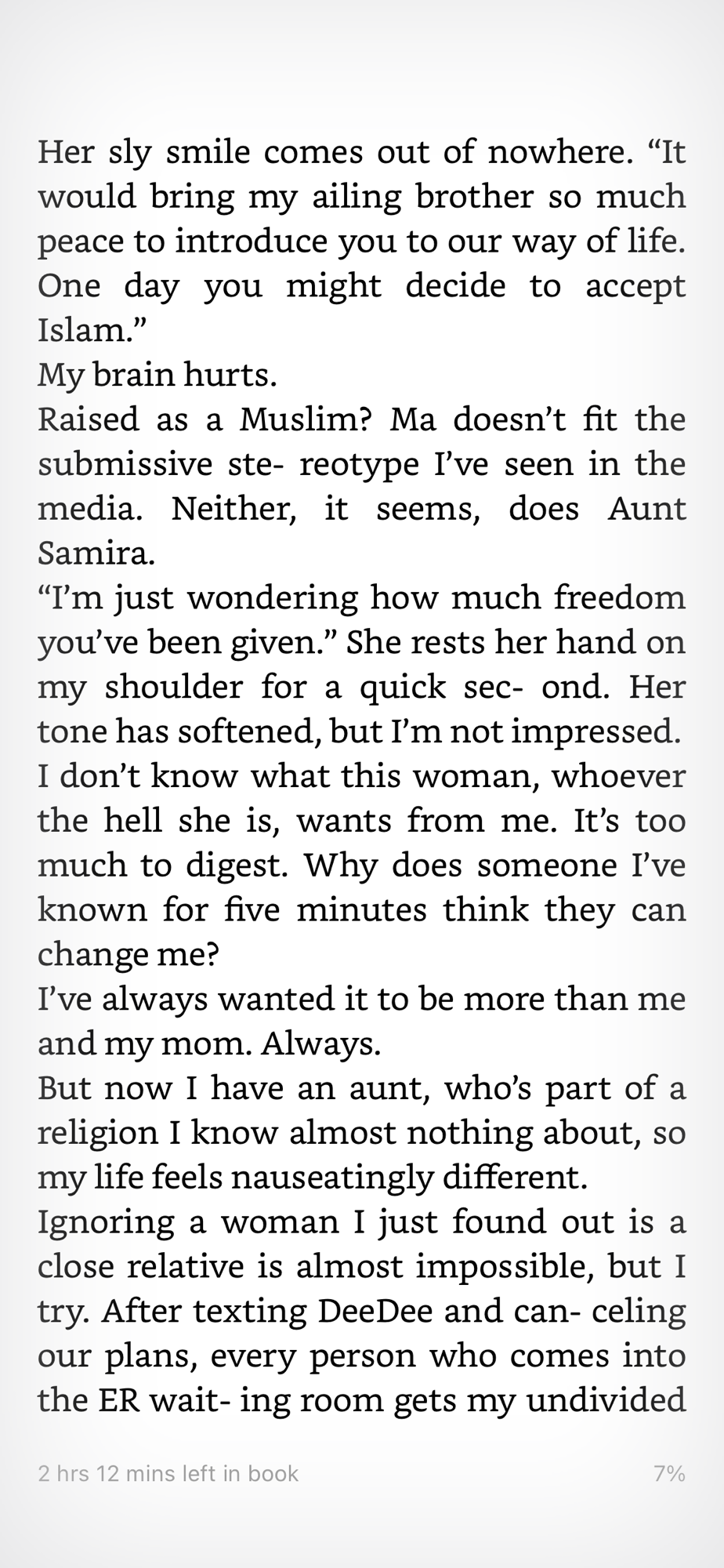
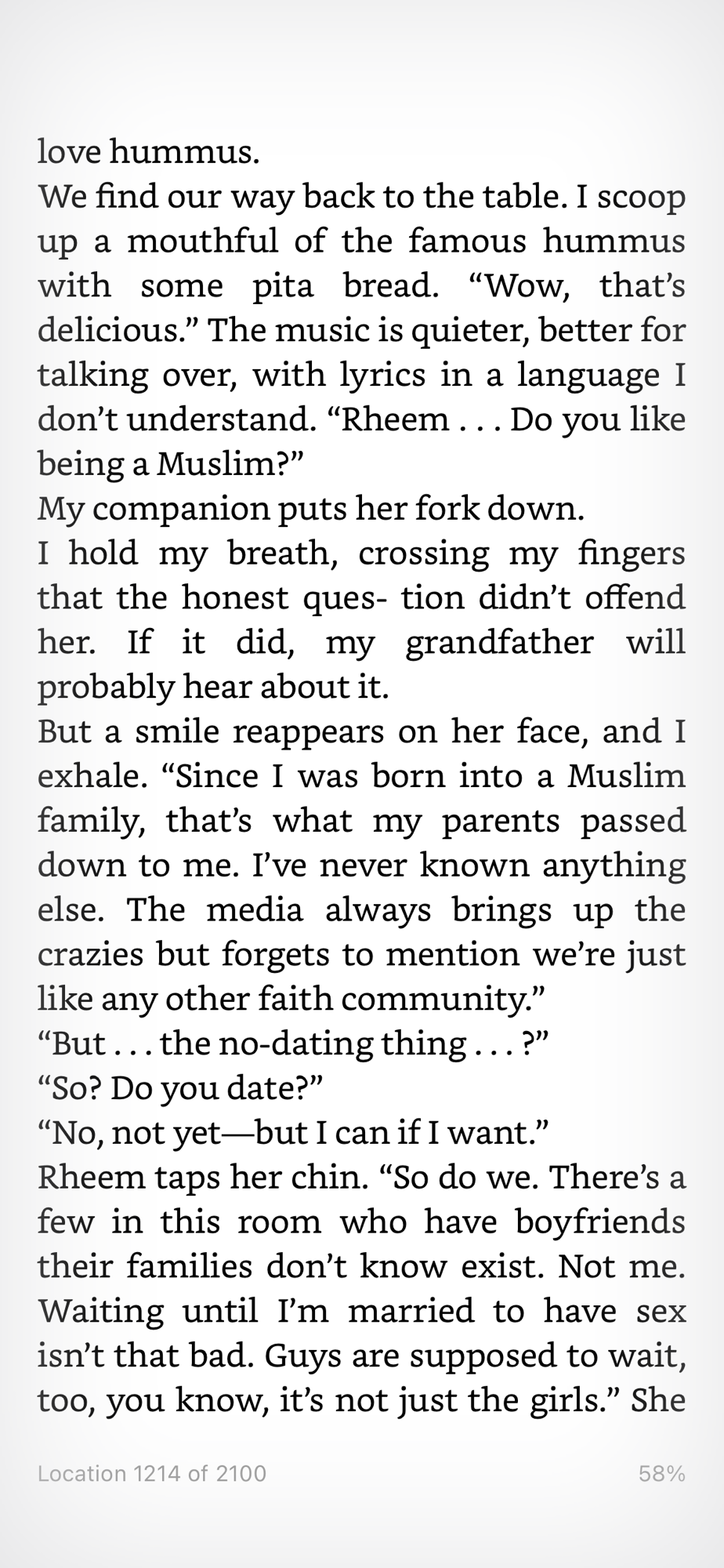
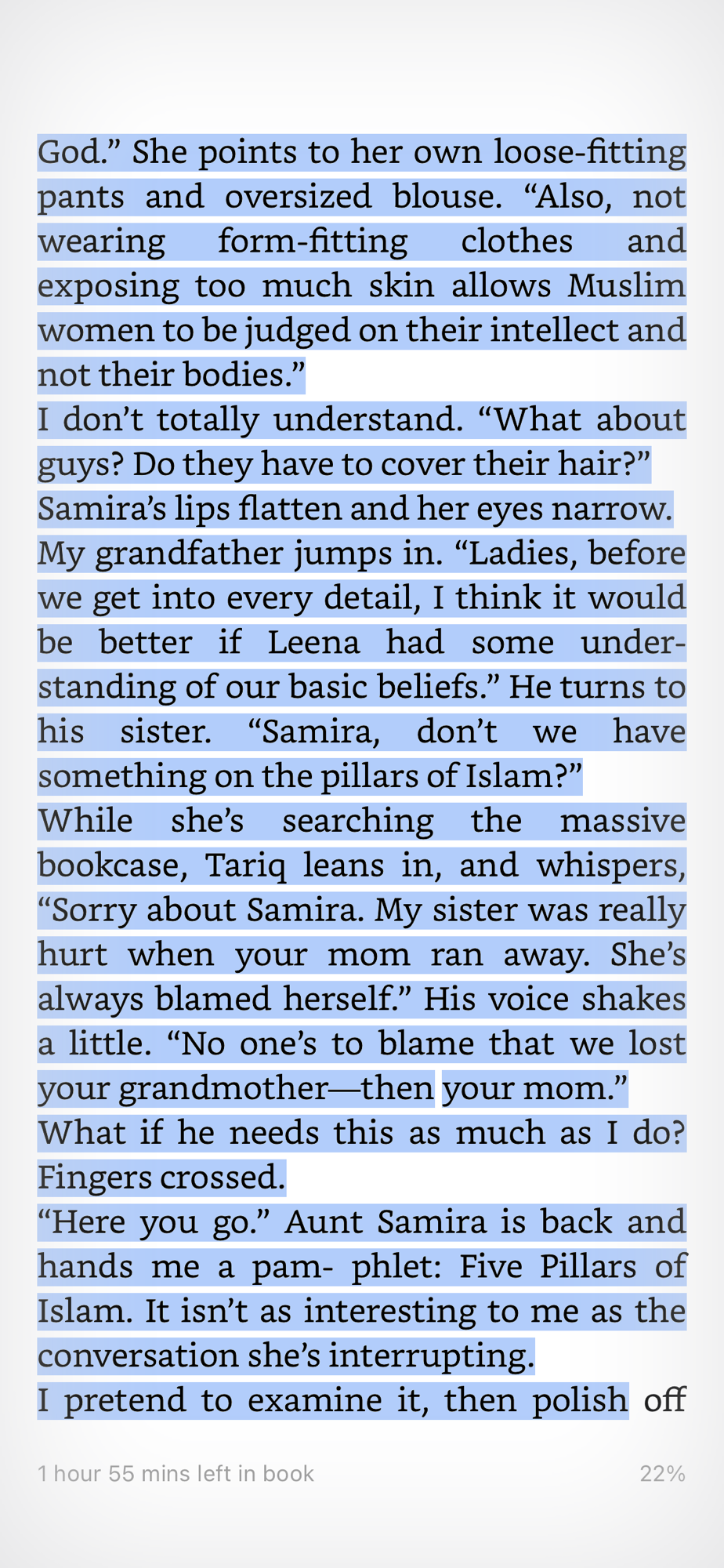
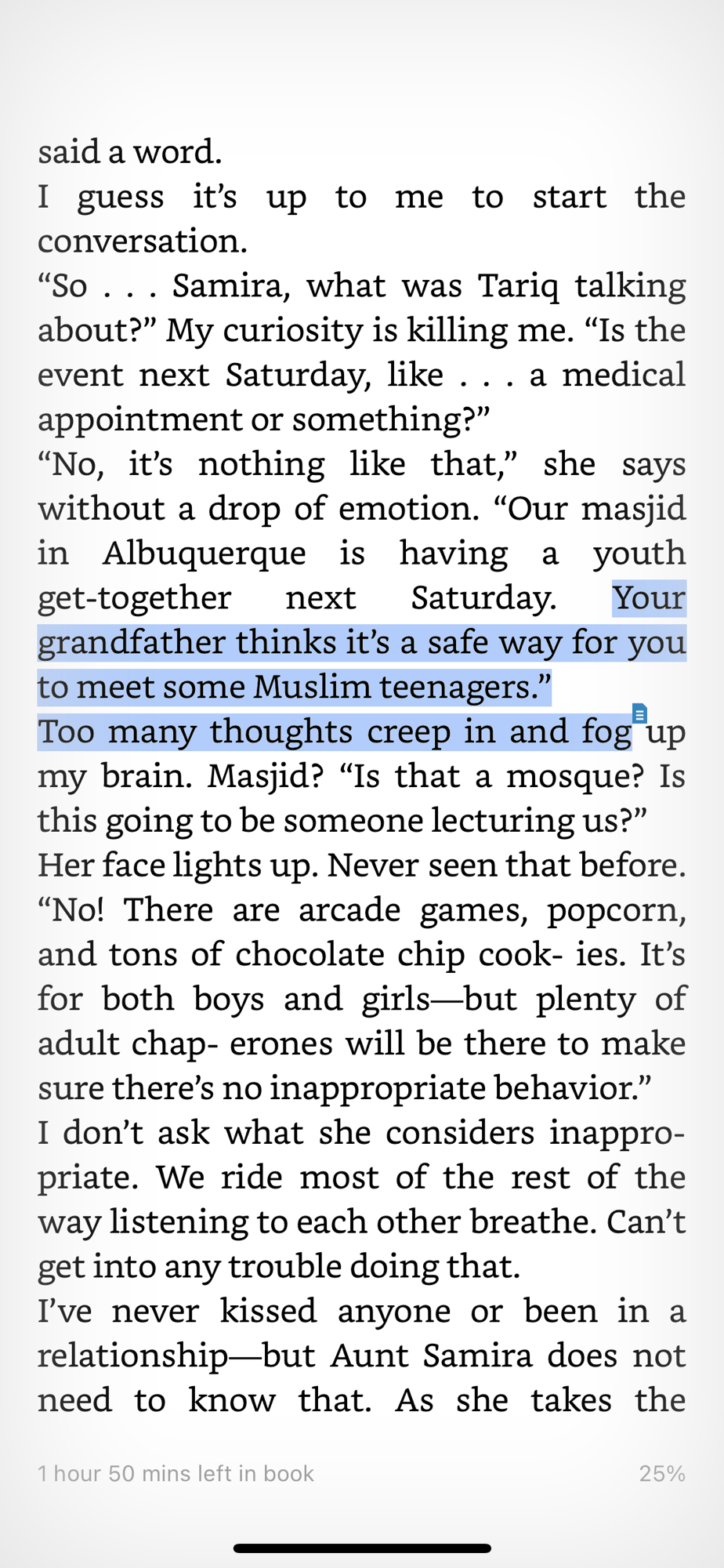
Islam is presented through the harshest of harsh characters, a few side characters are brought in that make Islam more realistic in practice and fleshed out, but it really feels like it is too little too late. I think a non Muslim would feel Islam is just modest dress, no interacting with boys, marrying early, and rigid rules. Leena is harassed from the first moment she meets her family, no easing in to it, she is even handed brochures on her first visit to her grandfather’s home. Yet, Leena never shows any interest in learning about Islam, she could Google it if she was curious, even when at the masjid, she doesn’t go and watch them pray, no connection to Allah is ever discussed, it is just dos and do nots. Consistently throughout it feels like Islam is weaponized and perhaps that is the author’s experience or intent, but it is odd coming from a Muslim writer in a fictional setting. We get enough of that stereotyping from the non Muslim real world.
The emphasis on Islam being the only thing that matters for these characters means that whether they are religious or not, the characters are painted very one dimensional. Leena is a terrible friend, she counts on Deidre to drive her around, she never follows up on asking about her dates or reciprocating the effort for her other than feeding her. Asiyah has an ex-boyfriend show up, and then goes out with a friend, but there is no context for their abrupt arrivals and then departures from the story, they do not serve as a foil to reveal any pertinent information or connection. A plot device used quite often in the book, and one I am not a fan of, is when things can be solved by characters simply having a conversation. It is never the right time, they will talk later, even the fruition that started the family fracturing could have been eased by, you guessed it, the characters talking, not even agreeing, just talking. While I’m running through my top gripes, might I add, that I have spent a few too many minutes on the cover as well. Presumably Leena is in the middle, her young single mom Asiyah on the right, but who is the young hijabi? Her aunt does not read young at all, and she would not have her neck showing, that would go against her core characterization. So before you come at me that I have no right to my opinions and that I’m too mean, please solve the mystery of who is on the cover, thank you.
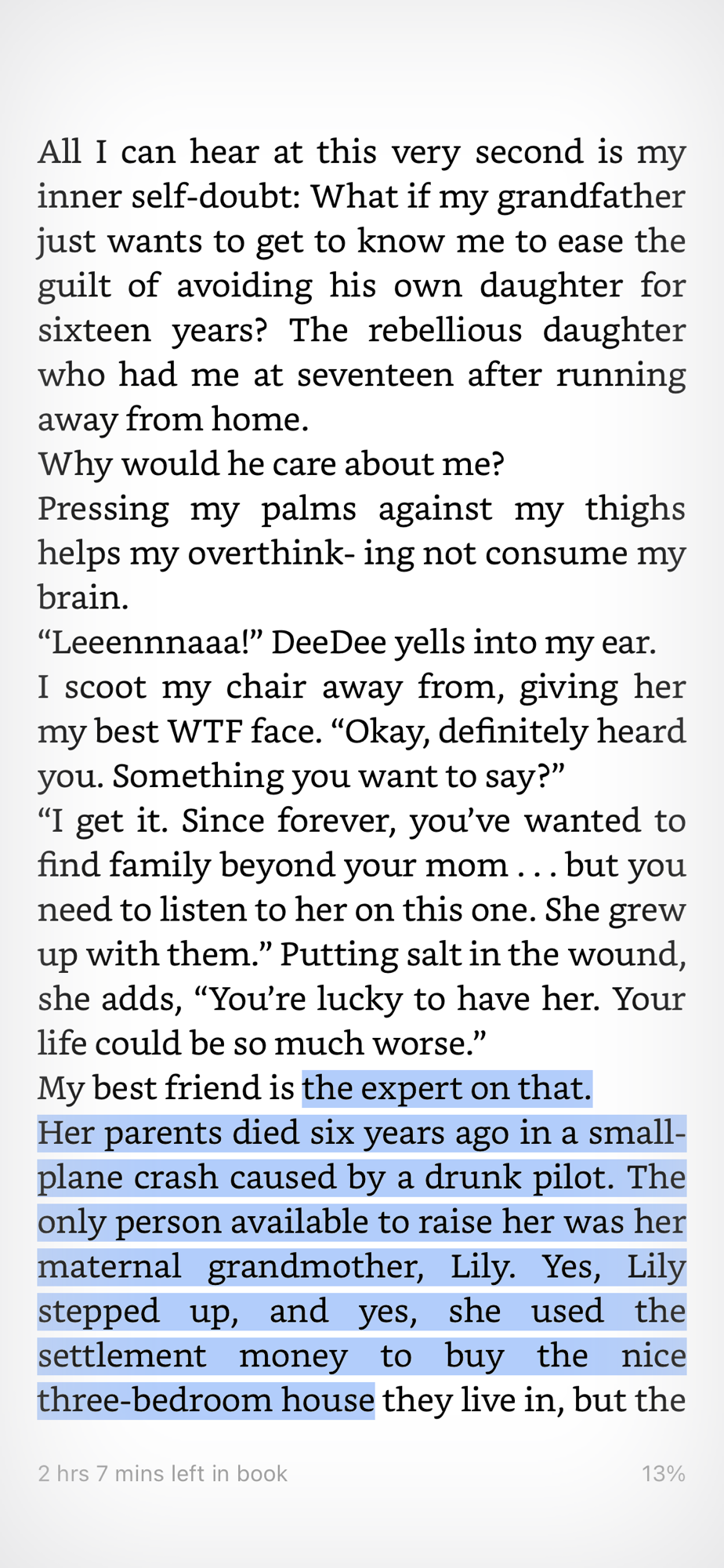
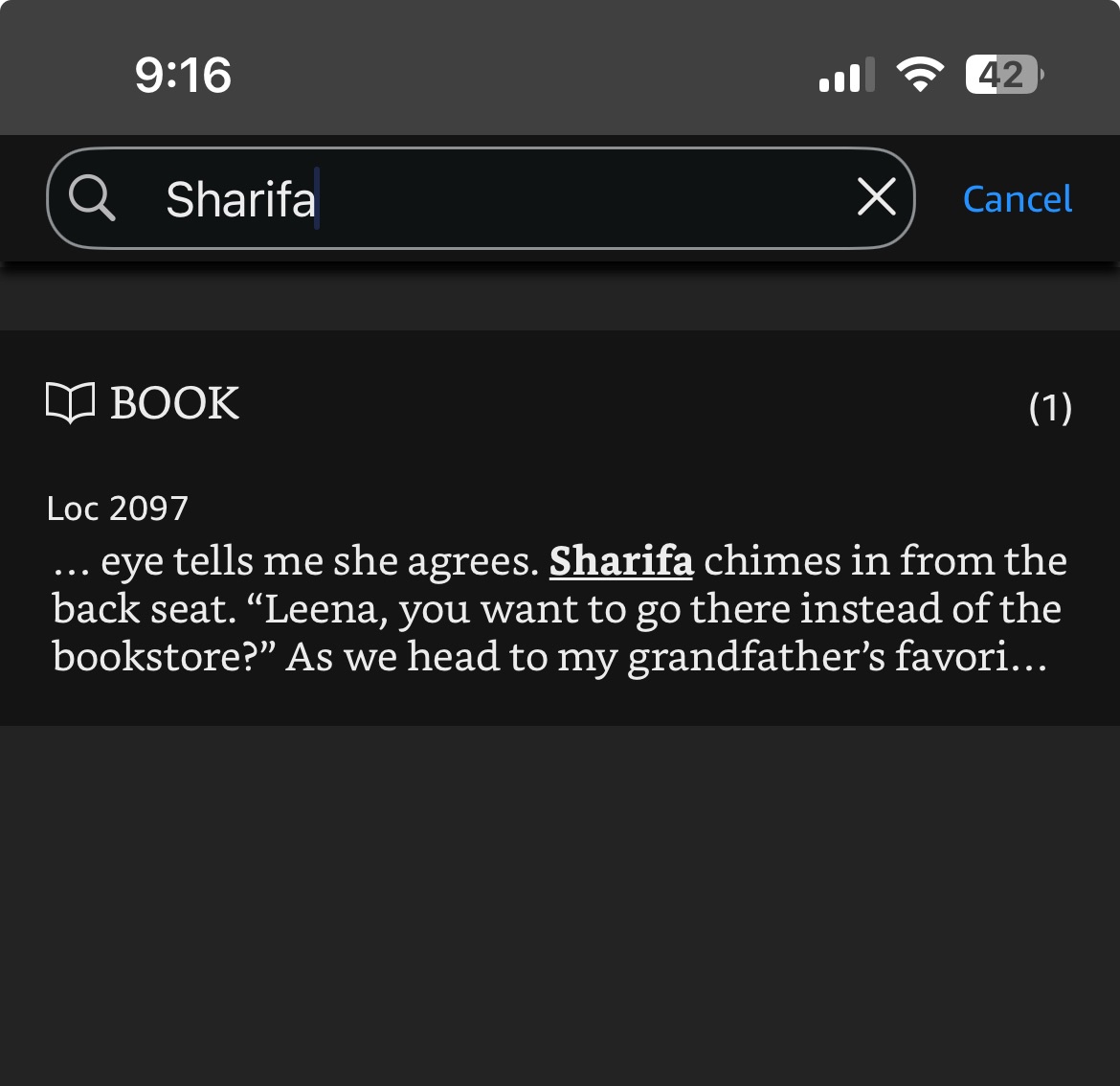
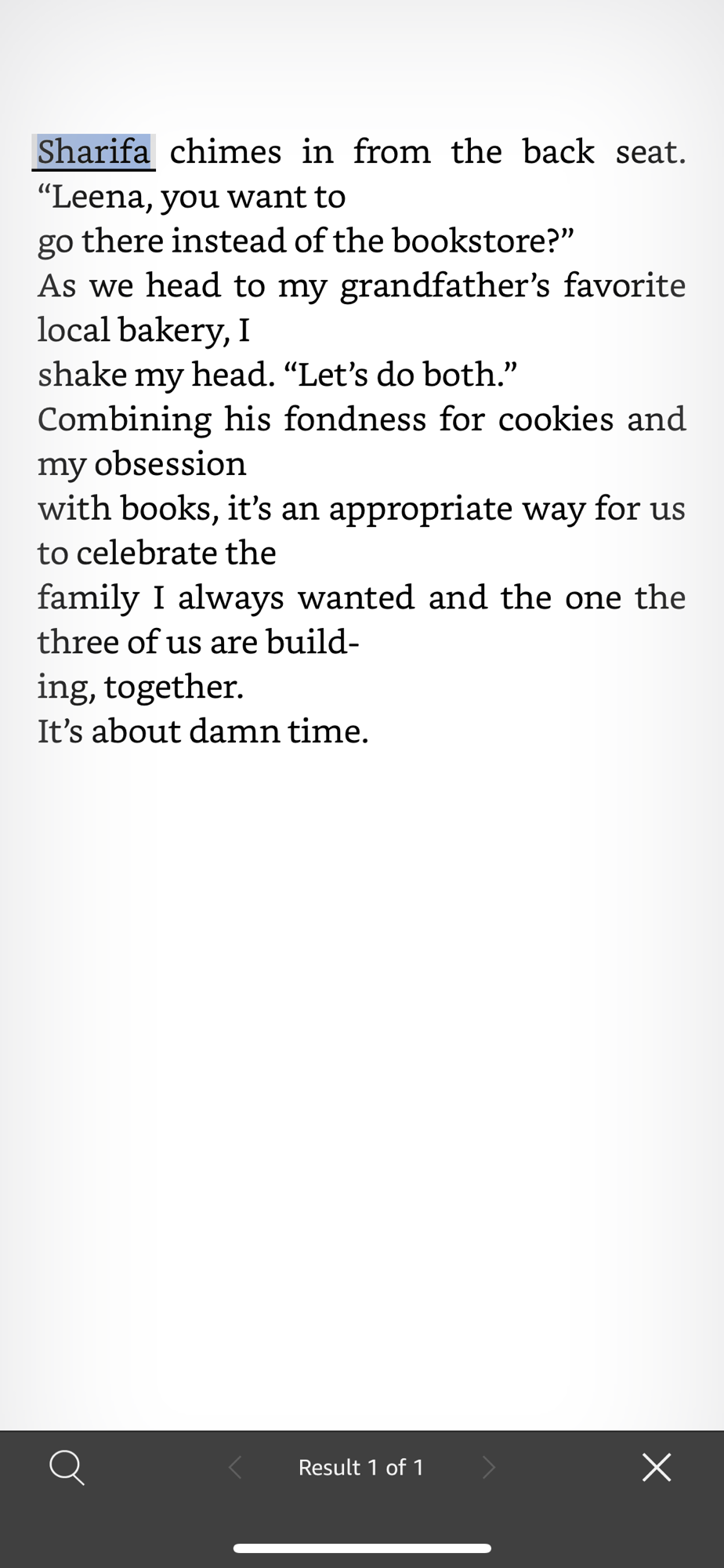
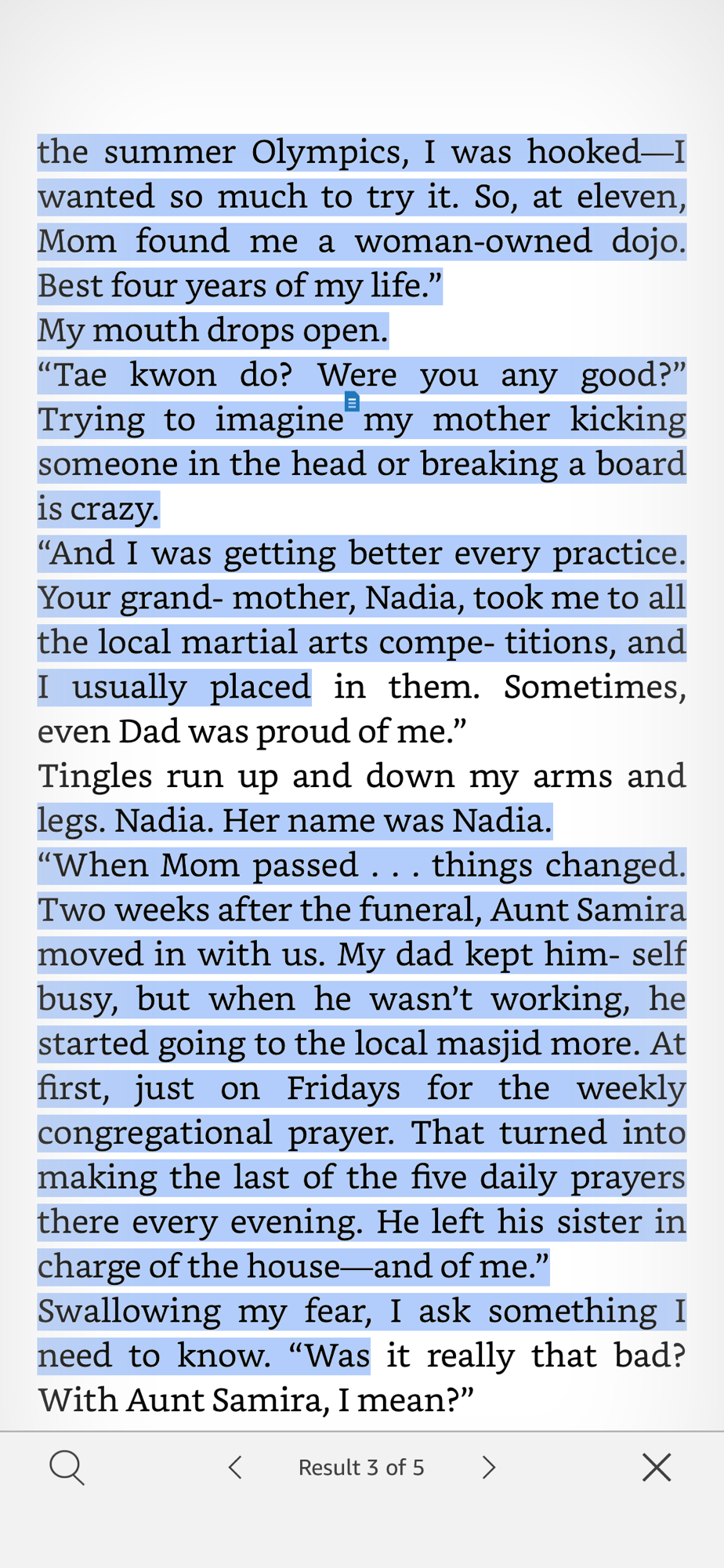
I read an ARC so I am aware that changes could have occurred, I’ve requested the book from my library and it is on order, and I will come back and correct this paragraph if needed. The story of tae kwon do is repeated in two different spots almost word for word as if the information that Asiyah was good at tae kwon do both times is news to Leena. Clearly it is in error. It also has Deidre’s grandmother getting their house with the insurance money from Deidre’s parents dying and then a few lines later saying how the grandma doesn’t let Diedre forget that the spare room was changed to a bedroom for Diedre when she moved in. A friend, Rheem, is brought in guide Leena academically, and is described as being homeschooled and changing to an online program for her senior year to also take dual enrollment classes, a few chapters later they are going to her Islamic High School for a party. Side note, the sign on the high school says, “ALHIDAAYAH ISLAMIC SCHOOL: Grades sixth through twelfth. We want our children learning it’s okay to be both American and Muslim.” The last page of the book also has a “Sharifa” in the back seat, and there is no Sharifa previously mentioned in the book.


FLAGS:
Cursing, judgement, dating, running away from home, anger, death, loss, lying, flirting, gambling, child out of wedlock, cutting family ties, clothing shaming, music, othering.
TOOLS FOR LEADING THE DISCUSSION:
I wouldn’t shelve or use this book for a book club read. I think Muslim kids would be annoyed by the way Islam is presented. I think they would be ok that Leena SPOILER didn’t take an interest in Islam, but I think they would be bothered by the flat, angry portrayal that it has in the book.


 Islamic School Librarian