Tag Archives: islamic fiction

The Great Race to Sycamore Street by J. Samia Mair

Standard

the great race to sycamore street

A fun book for elementary aged children looking for a fast paced, energetic read, with Islamic morals and lessons.  Overall a great book about character, being a good neighbor, and never giving up, The Great Race to Sycamore Street is not in the AR database, but I estimate it at about a 4.3 level and think even for higher readers there is plenty to learn about archery and peach trees, and plenty to enjoy as Amani and Hude take on bullies, grumpy neighbors, dogs, and making the most of a summer with their grandma in the country.  There are 180 pages followed by acknowledgements, references, and glossaries explaining archery terms, Islamic terms, and where the hadith and Quranic ayats come from, theoretically making the book accessible to Muslim and non Muslims alike.  I however, think the book would be a bit preachy to non Muslims or to those unfamiliar with Islam.

SUMMARY:

Siblings Amani and Hude arrive in Fairfax County, Maryland to spend the summer with their Grandma Hana in the quiet town of Cherry Hill, for what they think will be a slow laid back summer of reading, swimming in the lake, and preparing for the County Fair.  Grandma Hana has the undisputed best peach tree in the county and makes the best pies to enter in the pie competition at the fair, and this year Amani gets to help.  Hude is a budding archer and with his recently deceased grandfather’s journal and old archery regalia he is determined to compete and win the archery competition.  But their simple plans quickly meet twist after twist: from bullies on the train, to swarms of cicadas greeting them on arrival, to a new neighbor who discovers the beloved peach tree is actually on his property and he wants it gone, to the bullies on the train ruling over the lake and proving to be great archers themselves.  Can the  peach tree be saved? Can they be victorious at the fair? With lots of stories about Prophet Muhammad (Peace be upon Him) woven in, and ayats from the Quran used to emphasize points, not only is the book a quick action packed story, but it is also poignant, educational, and memorable as well.

WHY I LIKE IT:

I love that it is clean and requires the brother and sister duo to work together to do something that is bigger than themselves.  I also love the way that Islam is given practical uses for the children, it isn’t taught in the abstract they must pull on their understanding of their deen to decide what to do, how to act and what the next step should be.  I also like how the fast paced story is set in contrast to the slow thematic ideas of a peach tree, baking, archery, and a stereotypical summer with grandma.  Most readers I would assume don’t know that much about fruit trees and county fairs and archery, and I think the author does a good job of introducing the audience to these concepts and weaving Islam into it while keeping the story exciting and moving along.

FLAGS:

Clean, alhumdulillah.

TOOLS FOR LEADING THE DISCUSSION:

The plot is pretty linear, and a quick discussion of what every one liked and perhaps what surprised them would be a sufficient review of the story. From there I would probably go through the reference of hadith and ayats from the Quran to guide the discussion, you can get the online reference of that here:

http://www.kubepublishing.com/the-great-race-to-sycamore-street-free-reference-sheet/

scroll to the bottom and click on the link to download the text.

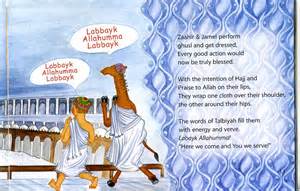
Zaahir & Jamel the Camel: Hajj by Amatullah Almarwani

Standard

hajj

This book is a great read for explaining the different parts of Hajj in a linear, easy to follow, fun way to children.  The author gives facts in a fictionalized setting with Zaahir and his camel, Jamel getting ready for, and performing the hajj.  The illustrations are also engaging and give plenty to talk about in both one-on-one reading scenarios and in larger groups.  For story time the book works well to read a page then reflect upon and discuss what it is showing and telling us. By stopping on each page the rhyme scheme doesn’t get too forced as well, as some lines are forced and awkward, making the rhythm hard to maintain.

hajj inside

Overall the book is effective and enjoyable.  The kids can see from the pictures and the simple words the importance of each step, and get an idea about how they are to be performed.  The book is not an AR book, but there is a quiz at the end to see how much they retained.

Where the Streets had a Name By Randa Abdel-Fattah

Standard

streets

This is the second book I have read by Randa Abdel-Fattah, and I still don’t know if I love her as an author, but I did enjoy the content of Where the Streets had a Name, much more so than I did with Does My Head Look Big in This?  The timeliness of this book is also as apparent as ever with the genocide and occupation occurring in Palestine, had I read it years ago I don’t know if it would have had the pull that it had on me, reading in now.  With all the images on social media and the news, this book really does a remarkable job of showing the daily struggles for Palestinians in terms of settlements and check points and just basic day-to-day living that is hard to imagine from anywhere outside of Palestine.  While some may find it slow moving I enjoyed the detail and childlike perspective of the world as seen through the 13 year-old characters in the book.  Despite all the material for it to be a preachy, political, and gruesome, it is not, it is undoubtedly told from a Palestinian Muslim perspective, but the supporting characters come from all backgrounds and focus on the humanity contained with in us all: Muslim, Christian, Jew, and even Israeli.

SYNOPSIS:

Hayaat’s family has been kicked out of their home by Israeli soldiers and are living cramped up in Bethlehem, struggling with no jobs, curfews, and the impending wedding of Hayaat’s sister to a boy on the other side of the checkpoint.  When Hayaat’s beloved, albeit farting, grandama, Sitti Zeynab, falls ill Hayaat believes that she needs to touch her ancestral land to recover.  With a curfew free day, her best friend Samy at her side, and an empty hummus jar, the kids sneak out from school to try and bring back a handful of dirt.  The journey is only a few miles, but with checkpoints, a protest, soldiers and documents, the chances that Hayaat and Samy will retrieve the dirt is minimal, as their priority becomes to make it out safe.  The book is fiction, but from all reviews that I’ve read, it very well could be real, it’s accuracy of the struggles endured and the hope that still remains are not completely fabricated.

WHY I LIKE IT:

I like that Hayaat is a Muslim Palestinian, Samy is a Christian Palestinian, along their journey they meet kind Israeli’s fighting for Palestine, they meet horrible people and soldier’s too, but it is never a black and white issue.  Zionism is what makes life so painstakingly difficult for Samy and Hayaat and all those around them, all the while tourists are flocking around as if walls and checkpoints are the norm.  The first 50 pages of the book are a mess, I don’t know if it is because it is translated from Arabic or if it is just the author’s style to overload and stuff everything in at the beginning that might possibly be interesting or funny to hook the reader. Either way, it doesn’t work and once you get through those 50 pages and the adventure with Samy and Haayat begins and Sitti Zeynab’s story starts to be woven through and we learn more about how Hayaat’s face was scarred, the story starts getting good.  Similarly the book is about 50 pages too long, after the adventure I was ready for the story to end, but I suppose the wedding of Hayaat’s sister, Jihan, has to take place.  Even though it is critical to see the logistical nightmare of having a West Bank girl marrying an Israeli Arab from Lod, the story gets muddled and loses its flow both at the beginning and end with the details of living in Ramallah and figuring out what roads to take to have the ceremony.  Adults may appreciate it, but with an AR reading level of 4.8, the target audience gains a better appreciation for the struggles of the Palestinians through the main story.  In total with the glossary and acknowledgement the book is 313 pages.

FLAGS:

The book is remarkably clean, there is a slight joke about birth control pills, but Hayaat doesn’t understand it, and her companions on the service (bus) don’t explain it to her, so I doubt the young readers will get it either.  (Hayaat thinks her sister shouldn’t get married if it is making her sick and she can’t understand why every day at the same time her mother makes her take a tiny pill.)

There is some violence, but it is not explicit, it is more emotional when Hayaat’s friend is killed and Hayaat’s face marred.  Similarly she blacks out during the protest, so there isn’t much description

TOOLS FOR LEADING THE DISCUSSION:

I do plan to do this as a book club book, I think the students are well aware of the situation and it might be a good place to let them voice their thoughts and emotions.  I may also have a Palestinian sit in on the discussion, to help keep it accurate.

Discussion questions:  www.panmacmillan.com.au/resources/RA-WhereTheStreetsHadAName.pdf

Author’s website: http://www.randaabdelfattah.com/

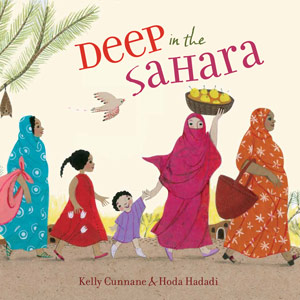
Deep in the Sahara By Kelly Cunnane Illustrated by Hoda Hadadi

Standard

deep-in-the-sahara

SubhanAllah, how absolutely wonderful to walk into your public library and find such a treasure of a book.  So simple and beautiful in appearance, in its poetic text, and in its message.  Set in Mauritania, West Africa and sprinkled with Hassaniya (an Arabic dialect), young Lalla wants to wear a malafa, a beautiful, colorful cloth that some Muslim women in Mauritania wear to cover their clothing and heads when they go out in public.  She wants to wear it to be beautiful like her mother, mysterious like her older sister, a fine lady like her cousin, and a long-ago queen like her grandmother but it isn’t until she understands what the malafa means and why the women wear it does she receive a beautiful blue one from her mother.

The illustrations and descriptions take you to a far a way land, with eager anticipation at what you will see, hear and experience.  Culture is shared, tidbits about Islam’s traditions are shared and a wonderfully simple, yet thought provoking story is conveyed.  With an AR reading level of 3.7 this book would be wonderful for story time listeners as well as independent readers.  Also because it is probably not a culture most are familiar with I think students up to 5th grade would enjoy the book and close the last of the 40 pages with a smile on their face and a light happy heart.  Alhumdulillah

Words in the Dust by Trent Reedy

Standard

20140629-172415.jpg

I probably should not have read this so close to the book Wanting Mor, as it too is about a girl in Afghanistan, and with a cleft lip none the less.  The similarities fortunately pretty much end there.  Words in the Dust by Trent Reedy is a fictional story that sprung from his own military service in Farah, Afghanistan and brief encounter with a girl named Zulaikha, who he and his comrades pulled money together to fund her transport for surgery.  He clearly states in his Author’s Note that he had preconceived notions on Afghanis when he deployed and how those changed as he got to know the people, he also states his disadvantage in writing the book as he is neither an Afghan or a girl.  Such honesty and care with the subject matter shines through the pages and creates a glimpse at everyday life for the characters without being overshadowed by judgement.  The first 50 pages or so of the 264 total are a bit overwhelming, but if the reader plugs through, the rest is smooth sailing and hard to put down.  It has an AR level of 4.6 although there are a few items mentioned in passing that would make me nervous to let someone that young read it.  A main story plot is the marraige of Zulaikha’s sister Zeynab and preparations include her receiving marital advise that makes her blush, and following the wedding night, a cloth with Zeynab’s blood is brought to Zulaikha’s family.  No explanation is given and many readers may just brush over it, however, if asked, it could be awkward to explain to a fourth grader.  Additionally during a conversation between Zulaikha and Zeynab, Zeynab says about some of her marriage difficulties, “Every night. . .He wants me to have a son, but I don’t know, , ,”.  Definitely something to consider when recommending this book to someone younger. 

SYNOPSIS:

Thirteen-year-old Afghani girl, Zulaikha, has a tough life.  Born with a cleft lip and having lost her mother to the Taliban she spends her days with her older sister Zeynab caring for her two younger brothers, prepparing food for her father and older brother, and constantly being berrated by her step-mother.  Set in a post Taliban setting, Zulaikha stumbles across a woman in town that remembers her as a child and used to teach her mother.  Drawn to Meena, Zulaikha begins fullfilling her mother’s dream by meeting secretly with Meena to learn how to read and right and understand the poetry of her homeland.  Things really start to look up as the American army rolls in and hires her father, a welder, on some of their new buildings, and offers to fund reconstructive surgery for her lip.  Arrangements are also made for her sister to marry a prominent man in the community.  However, things don’t go exactly as planned, and Zulaikha and her family must evaluate what they want and how much they mean to each other.

WHY I LIKE IT: 

The story doesn’t assume anything about the characters or society, American and Afghan alike, which to me seems authentic.  It doesn’t feel as if stereotypes are perpetuated or intentionally broken down, there is simply diversity of thought, opportunity and action. The book doesn’t shy away from American arrogance (offering the Muslim character’s pork and shaking hands with those of the opposite gender), nor does it make them seem cold hearted (they are genuinely helping Zulaikha’s family), similarily the Afghan men are loving to their wives and children, but doemstic violence is also shown.  Some of the Afghan women are educated and independent others are illiterate and dependent.  I like that the characters are religious, and hopeful that Allah will provide what is best for them.  As the characters put their trust in Allah, and endure with sabr (patience), the reader too is relieved at the ending which is both cathartic and sweet.

FLAGS:

Reference to married life, domestic violence

TOOLS FOR LEADING THE DISCUSSION:

Depending on the audience this book could be a GREAT book club book, it would probably need parental consent for the few items mentioned regarding marital life, but I think middle school girls would gain appreciation for their own lives and opportunities after reading about Zulaikha.

The author’s website: http://www.trentreedy.com/book-witd.html

Interview with the Author and his Publisher http://www.wow-womenonwriting.com/downloads/printable/49-FE2-CaseStudyWritingMulticulturalFiction.html

The book includes an introdction by Katherine Paterson (Author of Bridge to Terabithia and numerous other books), a pronunciation guide, a glossary, an author’s note, acknowledgements, information about the poetry used in the book, and recommended reading about Afghanistan.


Wanting Mor By Rukhsana Khan

Standard

Image

SYNOPSIS:

Jameela has a lot of obstacles as the book opens: poverty, her mother, Mor, has just died, a cleft lip, and an angry  father that returns to drugs and alcohol.  As the book progresses however, things don’t get better in fact they get worse.  In war-torn Afghanistan Jameela and her father move from their small village to the bustling city of Kabul, recently freed from Taliban control. With only her faith in Allah and her memory of Mor, Jameela endures being a virtual slave in one home, before being whisked away for her father’s inappropriate actions with the lady of the house.  Desperate for a place to live, Jameela’s father marries a widow for her money and Jameela becomes a slave to her new stepmother.  When her stepbrother Masood, tries to teach her how to read and write her name, her stepmother convinces Jameela’s father to take her to the busy market place and leave her.  Alone, lost, and with no where to go a kind butcher tries to help her, but ultimately she ends up in an orphanage.  Prospects look up for Jameela as she finally is allowed an education, friends, and security, however, issues with her father and stepmother must be resolved and ultimately this serves to be the biggest test for Jameela.

WHY I LIKE IT:

The story in a nutshell, is heartbreaking, yet Khan never seems to diminish the hope felt for Jameela and the belief that she will find a way to have a full life.  Based on a true story, it is hard to put the book down and the 183 pages fly by quickly.  Jameela is very devout in her prayers, her modesty and her imaan, illuminating  a story where so much sadness prevails. Her faith in Allah swt brings her peace and strength and Khan successfully passes that message on to the reader.  Jameela not only has to navigate her family issues, but also the challenge of making friends, dealing with her appearance, taking control of matters regarding her education, and so much more than most student’s coming of age have to endure.  I think Jameela’s strengths and faults will inspire and serve as lessons to the readers, most likely girls who have it much, much easier.  And who after reading the book, inshaAllah, will appreciate how much harder their lives could be.  

This is the second book I’ve read and blogged about by Rukhsana Khan, the first was a children’s fiction book My Big Red Lollipop.  The two books are both well written and I enjoy her voice as an author, this book however, Wanting Mor, while only an AR Level 3.7, I would reserve for a more mature audience.  The reading is easy and fluid, the story is powerful and well told and I think would be fine in a 7th or 8th grade and up environment.  I would be nervous to recommend this book blindly to a young adult reader without context, direction, and some background.  The incident after a party, with alcohol, where Jameela’s father enters a married woman’s room, implies more than I would want a 3rd or 4th grader inquiring about.  Details aren’t given, but it causes a huge turning point in the story and is thus critical.  At one point a character is groped in the street and Jameela laughs, highly inappropriate that it happens and equally inappropriate that Jameela laughs at her friend.

Another point I would want to discuss with anyone reading the book before hand is the concept that, If you can’t be beautiful, you should at least be good.”  Mor tells it to Jameela, presumably because of her birth defect, but I think that a young girl reading the book shouldn’t take it at face value, I would want to explain the culture, the environment, and talk about such a statement on many levels.

FLAGS:

 Implied sexual violence, drug and alcohol use

TOOLS FOR LEADING THE DISCUSSION:

Given the right group of older students, this book would make a decent book club selections with plenty to discuss and plenty of emotion.

The author’s website page:  http://www.rukhsanakhan.com/books/wantingmor.html

Teacher’s guide:  http://www.rukhsanakhan.com/teacherguides/Wanting%20Mor%20Teacher’s%20Guide.PDF

Wanting Mor Presentation:  http://www.rukhsanakhan.com/teacherguides/Wanting%20Mor%20Presentation%20Guide.PDF


Beneath My Mother’s Feet By Amjed Qamar

Standard

Image


I was so surprised by this book, subhanAllah.  I picked it up at a used bookstore and didn’t think much of it, tossed it in my bag one day as I headed out with my children’s class on a field trip and seriously didn’t want the bus ride to end I was so caught up in the book.  An easy 200 page read if you are familiar with Pakistani culture, even more so if you have ties to Karachi (specifically Defense), the detail takes you to the streets and gullies you know and you want to stay and look around.  If you don’t have these reference points, the book might be a bit hard to connect with, but I think the Author still gets her story across if you are willing to try (there is a glossory in the back).  Beneath My Mother’s Feet is a 4.9 reading level, and because of the heavy cultural references I don’t think I would do it as a book club book, but I have already suggested it to certain students that I know will find a connection and appreciate their mothers and their opportunities in America all the more.

SYNOPSIS:

Nazia is a typical fourteen-year-old Pakistani girl in the large and bustling city of Karachi, Her working class family suddenly is thrown into chaos when her father gets injured at his construction job.  As we learn more about her father, Nazia and the reader discover how lazy, selfish, and dishonest he is, despite Nazia’s determination to see the best in him.  While the family has had hard times before, this time something more than Nazia’s mom scraping and sewing to get by is needed.  As a result Nazia is pulled out of school to help her mom be a maid, masi, in wealthy families’ homes.  The family eventually loses their home, and Nazia’s older brother steals all the jewelry and clothing intended for Nazia on her wedding.  Her father disappears and the women of the family are left to find the strength and resources to carry on.  While the cover teases the idea that Nazia is a “perfect daughter” and that she is such a “good girl” I found these to be incredibly misleading statements and pulled quotes.  I think the story, shows how determined Nazia is, but not at a rebellious level, more as a girl finding her self and willing to risk it all for what she believes, a trait very much in line with her mother’s example.  

WHY I LIKE IT:

I like that it shows self resilience and self reliance both from Nazia and her mom, Naseem.  Nazia holds on to her friendships, her dreams, and isn’t afraid of hard work.  She explores what it means to be a good daughter, good sister, good friend, and good worker. She also is emotionally sympathetic and generous to a small servant boy, all wonderful concepts to present to a 4th through 6th grade audience.  I like that although Nazia isn’t terribly religious she does rely on Allah (swt) and her faith to help her endure the various hardships she encounters.  Islam isn’t at the forefront, but clearly she Muslim.  The book is heavily steeped in culture, the concept of a dowry, how masi’s are treated are not Islamic in the least, and unfortunately the author doesn’t articulate that it is only a cultural norm.  While the women tend to be highlighted in different colors throughout the book, the men seem to be brushed over in a very negative light.  On the surface it is nice to see strong women of various socio/economic spheres coming together and making decisions, but to push all the men aside as being worthless, isn’t realistic or fair.  I liked the uncertainty at the end, usually I prefer books that wrap up all loose ends, but here i think it opens the door to imagine what would have happened and discuss it.  

FLAGS:

The book is remarkably clean, There is lying, but consequences are clear.  There is some violence in the mistreatment of the masis, but the author shows Nazia bothered by it and it is discussed.  Nazia and her friends remark at some of the cute cricket players, but nothing is done about it and it seems innocent enough.


TOOLS FOR LEADING THE DISCUSSION:

A reading guide by the publisher:  http://www.amjedqamar.com/Reviews.html

A bit about the author and where the story idea came from:     https://www.webjunction.org/content/dam/WebJunction/Documents/ohio/Beneath_My_Mothers_Feet_toolkit.pdf

Amjed Qamar’s official website:  http://www.amjedqamar.com/

Interview with Amjed Qamar from A Year of Reading:  

    http://readingyear.blogspot.com/2008/05/sneak-peek-keep-your-eye-on-this-new.html