

Assalamualaikum,
It is with great joy that I was able to ask my dear friend, and favorite author Shifa Saltagi Safadi a few questions about her upcoming book KAREEM BETWEEN and offer her answers, insights, and wisdom with all of you. To sweeten the deal we also have an ARC to give away to one lucky US reader.
KIRIN: Kareem Between is a middle grade novel in verse that tugs at your heart without compromising action, relatability, and joy. It is in simple terms, a coming-of-age story of a boy between, as it says on the back of the book: “Between countries. Between friends. Between football, between family- and between right and wrong.” Yet, somehow it is so much more than all of that, what do you want readers to take away from the book?
SHIFA: What a great question.
There is absolutely so much for readers to find in Kareem in terms of themes, but the one that probably means the most to me is the one about belonging. I think we all have felt a little lost in this world at times, both as tweens in Middle School, and even as adults! And I want readers to know that it’s okay to not always fit in this perfect box- that being in the middle, being in between, can be a position of strength. The world seeks to categorize people into labels, and especially marginalized people- and in Kareem’s and my own case, Muslims and Syrians, can be put in this box of “outsider” and “foreigner”, and honestly, many times even “terrorist”. And I wanted to challenge these labels. Both in terms of what it means to be Arab, as in the character Fadi’s case, he is a Christian Syrian- and in terms of being American- what does it mean to be a citizen of this country.
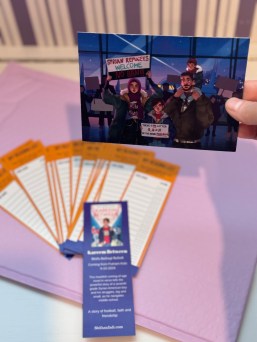
 Ultimately, I want young readers to know that they can embrace the full complicated different facets of who they are without having to conform to peer pressure or labels. That even if it seems easier to step away from parts of yourself to fit in, it isn’t worth it when you erase your feelings. That pride in yourself and confidence in using your unique voice and story will be your asset in this world. And just as Kareem uses his voice at a protest in the O’Hare Airport against the Muslim Ban, and to speak on his local news outlet- I hope young readers use their own voices to stand up for justice, and stand up for themselves.
KIRIN: Many OWN voice writers often say they write the books they wish they had when they were younger, is this your motivation as well? What does authentic, OWN voice, unapologetic representation mean to you?
SHIFA: Oh absolutely! Kareem contains so many different parts of me. I genuinely open up my own heart and pour my emotions onto the page when I write- it is very much an emotional experience and I cried while writing Kareem. And honestly, even every reread- I feel like I go through his character arc with him, especially with the recent news dehumanizing Palestinian lives and how it has become so controversial in some spaces to even call for a ceasefire!
Own voice representation is so important to me. As a reviewer, I often find myself flipping to read the Author’s note to check that the book is authentic. And as a reader- I find myself being moved so much more when the book is written from a writer’s heart.
But also, as a writer- I honestly think I was just tired of the same narrative I have seen my whole life as a Muslim growing up in America- the tired trope of “Islamist terrorist” that makes its way unto movies and media TO THIS day. Of this label that somehow being a practicing Muslim means you are dangerous, strict, mean, inhumane.
I want readers to meet Kareem. To see our humanity. To see how much peace Islam brings me. To take a pause- and maybe even cause a transformation inside of them on how they perceive Muslims and Arabs. To see that we are all connected in our humanity- that laws like the “Muslim Ban” are harmful because not only does it other a whole group of humans, but it strips part of the very principles that America claims to be founded upon.
KIRIN: This is your first middle grade novel, what made you decide to write it in verse, and what was the process like? What was the most challenging part of the process?
SHIFA: Interestingly enough- I didn’t start writing KAREEM in verse. It was very much a story in prose, about a kid who wants to make the football team and faces school bullies. I was taking a mentorship with Storyteller Academy (I am a huge fan of writing courses!) when my mentor Sage Blackwood told me the voice of my prose wasn’t working. And suggested trying another format.
I have always adored verse, but I honestly did not think I was talented enough to try it! But I attempted a few pages, interestingly enough, from the middle of the book- and Sage immediately told me they clicked into place! (Thank you Sage). And so then I rewrote the whole book into verse!
The most challenging part was to probably believe in myself- that I could actually write poetry- and once I got over that hurdle, the words just flowed!!
I feel like the verse format was also helpful for me in crafting the emotional arc. I remember being SO SCARED when Trump won the 2016 elections. Being terrified for myself and my kids’ future. And I remember the devastation of the Muslim Ban and how it affected our communities, both here and abroad. And verse helped me with using language, as well as the empty space on the page, to really show these deep emotions of emptiness and loss, but in a way that wasn’t too heavy for children.
The sparse verse on the page helps kids be able to digest these very real themes in a way that they can still find hope and life, and the lyrical language and words of poetry helped me infuse beauty even in the darkest moments of the book. And I wanted to be able to offer that lifeline to readers- that even when things get tough and difficult- the hope in those moments is in finding your words.
KIRIN: Kareem is confident in his Muslim identity, praying at school is normalized, and while he loves his Syrian and American cultures, he does try and find his footing in being both. Why was the distinction between faith and cultural identity important in the story and why is it important to you?
SHIFA: Thank you for this question!
Faith is so important for me. Islam has been my lifeline, my rope of hope in this world, my very heartbeat that I live with. And being Muslim for me is very much a full complete experience, one I embrace with every facet of my being.
And I think part of the reason that Islam is so very important to me is probably a result of my feeling so between two cultures.
I was always between Syrian and American growing up- but I knew my faith and my Creator had space for my whole self, my imperfect, between, flawed heart. And that’s why Islam for me has always been a non-negotiable part of my identity. I am a Muslim. It is my life. I have never considered removing my hijab- even when it gets tough and I get stares. I have never considered not praying, even when I used to get weird stares at sticking my foot in sinks at school or praying in public view. This is me.
And Kareem is the same way. He prays, goes to Jummah, reads Quran, turns to Allah in duaa- and not for one second does he ever consider letting go of being Muslim. Because its who he is, and it’s the rope he holds onto in navigating his two cultures.
It is very important for me to distinguish culture and faith for another reason. There is this common misconception that Muslims and Arabs are the same. But this is not true! So many Arabs are Christians, Jews, Druze, Armenian- and so many Muslims are South Asian, Eastern European, and even white!! The country with the most Muslim population is not even an Arab country. And I also have many white American friends who embraced Islam who tell me how much it hurts for them to feel like the world erases their own identity as Muslims as well.
I wanted to challenge these labels, and especially when Kareem tells his dad that the Muslim ban doesn’t only affect Muslims, but would have affected Fadi, I wanted the reader to pause. To think.
And to realize that othering and stereotyping is in its very essence flawed.
KIRIN: Most western middle grade readers in 2024 probably don’t spend much time thinking about Executive Order 13769, “The Muslim Ban” what do you hope Kareem and his family provide for readers in understanding how it impacted families.
SHIFA: When I started writing this book, I remember having one wish for it. That it gets published in 2024. And there was one reason for that- I wanted it out before the elections this year.
And the reason for my wish is because I want my book to make a difference. The closer we get to elections, the more this book feels so important for people to read. This year’s elections somehow feel just as stressful as the 2016-year elections, and the same issues of Islamophobia and Anti-Arab racism are propping up again everywhere on media and campaign speeches. And I want readers to really think on the very real effects of how American elections can impact marginalized groups in the world.
I really wanted the book to be a peek into what it was like to be Muslim and Syrian in America in 2016/2017 to inspire readers to feel compassion, to think about how politics are automatically part of your identity when you are marginalized.
I also wanted to take back the narrative. I want readers to be brave. Don’t feel silenced anymore- refuse the fear or helplessness of not being able to control who will be President. Because as 2017 showed us, when unfair laws based on racism are signed- WE DO HAVE POWER as citizens. We resisted the Muslim ban, we protested, Americans stood up for justice- and it proved that we can make change.
And more than anything- that’s what I want readers to think about when it comes to the Muslim ban. It is about SO MUCH MORE than Executive Order 13769. It is about standing up for justice, whether that is against systemic racism, against book banning, against border deportations, against funding wars with our tax dollars.
It is about using our voice. I want young readers to know they are powerful, and to use their privileges to make change.

KIRIN: Is this the end for Kareem? Do you see him making a cameo in future books perhaps? My kids read the book, and really want to know what Kareem is like in high school? Where he is going to college, what his future looks like.
SHIFA: As of now, I don’t have any future plans, but hey, if my editor and publisher request more, I would jump on that immediately!!
As for Kareem’s future- he was actually born the day of the Superbowl in 2004 (obviously lol) – so February 1st. He’s now 20 years old in 2024!
He’s in football training in college, in Chicago of course. And although he wanted to be the youngest player ever drafted to the NFL, he got beat by another former Chicago Bears player- Amobi Okoye, who played at 19!!
But it’s okay- life might not be perfect, but Kareem is still persevering towards his dream. And when he’s not organizing his MSA’s Jummah prayers or practicing football (or reading the latest books at his library), he’s at a downtown Chicago protest for ine, holding up posters and using his voice to call for a ceasefire!
KIRIN: What are you currently working on, and what future books can we look forward to seeing from you?
SHIFA: I have more books lined up in 2025- a picture book titled Gift of Eid coming in February, and a whole chapter book series titled Amina Banana coming mid-year! I cannot wait to share my sweet Yasmine (Gift of Eid) and my spunky, sassy Amina! I have a feeling readers are going to adore these books!
As for Middle Grade:
I love writing novels in verse, and I am actually currently finishing up writing my second one, eeek- this one is a bit wild and fun, but still containing emotion and heart as well. And of course, using verse language and lyrical words on the page to create art.
I don’t want to spoil it, but it’s been such an experience to write and revise my second book, and I am excited and slightly scared about how it’s turning out. Will I ever kick imposter syndrome to the curb?
It’s still not ready to share, so I won’t say anything more- but I am hoping I can share it with the world someday insha Allah!
JAK Kirin for interviewing me! Thank you so much for reading KAREEM over and over, your beautiful review, and all your support!
Be sure and check out Shifa’s website and sign up for her newsletter https://shifasafadi.com/
For GIVEAWAY details head over to INSTAGRAM @muslimmommyblog and @islamicschoollibrarian

Giveaway ends and winner will be chosen and announced on Friday, Jummah May 3, 2024! Click here to enter.
KAREEM BETWEEN RELEASES SEPTEMBER 10, 2024
You can Pre Order Kareem Between here


 Islamic School Librarian