Category Archives: YA FICTION

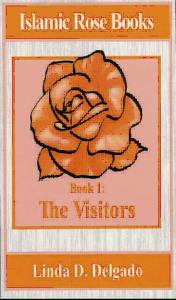
The Visitors by Linda Delgado (Book #1 of Islamic Rose Books)

Standard

Islamic Rose Books The Visitors

I first read this book in 2004 and it was pretty much my first introduction to what elementary aged/young adult Islamic fiction could and should be.  It set the standard and I think subconsciously I’ve held every other Islamic fiction book up to this series as a comparison.  I’ve taught it to 4th graders and 5th graders, I’ve purchased the series and left it for the students at every school I’ve ever been a part of, I’ve even exchanged emails with the author with students’ questions and been impressed by her responses.  So, after reading so many other books in putting this blog together, I thought it is finally time to revisit a book and series that is dear to my heart, and see if my memories are accurate.

Alhumdulillah, they are.

The book is a bit bumpy at first with the chattiness of the main character Rose, but either like real children, you grow accustomed to her and find her endearing, or the author pulls back as the story progresses and the book finds a more readable and engaging rhythm.  Either way, I still felt a pull to keep reading the book, and feel confident that those that read it, and the entire series (I haven’t read the latest book, “Reunion”) are better for it, alhumdulillah.

SUMMARY:

Nine-year-old Rose is excited that her grandparents, who live next door, are going to be hosting two Saudi Arabian Police Officers who are coming to America to learn English and train with the Arizona Police Department.  In anticipation of their arrival Rose and Grandma do what they can to learn about the food, culture and religion.  Rose’s dad however, is not comfortable with Abdul and Fahd being so close to his family, and for Rose to be so curious about Islam.  Rose works on PLAN after PLAN to try and help her dad and the officers connect, but will it be enough?

WHY I LIKE IT:

The book actually addresses some harsh realities of how Muslims are perceived, yet does so in a tender way.  When Rose wants to go to the Islamic Center and her father objects, or she talks about Muslims at school and her teachers get mad, it opens the discussion for why people may have negative views of Muslims, how to deal with such negativity and how to move past stereotypes.  The book also does a really good job of introducing Islam and Saudi culture to its readers in a fairly non preachy manner.  The inner workings of Rose’s family are also surprising raw and relatable.  Her Mom is not in the picture and Rose must deal with the stresses of a single parent home, luckily her grandparents are next door, but even then, there are stresses and issues that arise.  Rose also deals with a friend moving away, teasing at school, and disappointment.

FLAGS:

None, just some of the stereotypes from Rose’s Dad that may introduce some negative views non Muslims have of Muslims, such as: Muslims as terrorists, Muslim’s being abusive and controlling to women, etc.

TOOLS FOR LEADING THE DISCUSSION:

There are a few different versions of the book, mainly just cover changes depending on the publisher, but this version:
The Visitorshas appendixes in the back that include a glossary and recipes and facts about Islam as well as Arizona.  The newer version (as pictured at the top of the post) doesn’t include everything and refers those looking for more to see a website.  That website however and all other links to online study guides and reader guides are no longer available or now have different owners.  I’m not sure what happened to Linda Delgado, and if anyone knows how to contact her, I’m hoping you will let me know.

So as of now there are no links to suggest for teaching the book unfortunately.

The Great Race to Sycamore Street by J. Samia Mair

Standard

the great race to sycamore street

A fun book for elementary aged children looking for a fast paced, energetic read, with Islamic morals and lessons.  Overall a great book about character, being a good neighbor, and never giving up, The Great Race to Sycamore Street is not in the AR database, but I estimate it at about a 4.3 level and think even for higher readers there is plenty to learn about archery and peach trees, and plenty to enjoy as Amani and Hude take on bullies, grumpy neighbors, dogs, and making the most of a summer with their grandma in the country.  There are 180 pages followed by acknowledgements, references, and glossaries explaining archery terms, Islamic terms, and where the hadith and Quranic ayats come from, theoretically making the book accessible to Muslim and non Muslims alike.  I however, think the book would be a bit preachy to non Muslims or to those unfamiliar with Islam.

SUMMARY:

Siblings Amani and Hude arrive in Fairfax County, Maryland to spend the summer with their Grandma Hana in the quiet town of Cherry Hill, for what they think will be a slow laid back summer of reading, swimming in the lake, and preparing for the County Fair.  Grandma Hana has the undisputed best peach tree in the county and makes the best pies to enter in the pie competition at the fair, and this year Amani gets to help.  Hude is a budding archer and with his recently deceased grandfather’s journal and old archery regalia he is determined to compete and win the archery competition.  But their simple plans quickly meet twist after twist: from bullies on the train, to swarms of cicadas greeting them on arrival, to a new neighbor who discovers the beloved peach tree is actually on his property and he wants it gone, to the bullies on the train ruling over the lake and proving to be great archers themselves.  Can the  peach tree be saved? Can they be victorious at the fair? With lots of stories about Prophet Muhammad (Peace be upon Him) woven in, and ayats from the Quran used to emphasize points, not only is the book a quick action packed story, but it is also poignant, educational, and memorable as well.

WHY I LIKE IT:

I love that it is clean and requires the brother and sister duo to work together to do something that is bigger than themselves.  I also love the way that Islam is given practical uses for the children, it isn’t taught in the abstract they must pull on their understanding of their deen to decide what to do, how to act and what the next step should be.  I also like how the fast paced story is set in contrast to the slow thematic ideas of a peach tree, baking, archery, and a stereotypical summer with grandma.  Most readers I would assume don’t know that much about fruit trees and county fairs and archery, and I think the author does a good job of introducing the audience to these concepts and weaving Islam into it while keeping the story exciting and moving along.

FLAGS:

Clean, alhumdulillah.

TOOLS FOR LEADING THE DISCUSSION:

The plot is pretty linear, and a quick discussion of what every one liked and perhaps what surprised them would be a sufficient review of the story. From there I would probably go through the reference of hadith and ayats from the Quran to guide the discussion, you can get the online reference of that here:

http://www.kubepublishing.com/the-great-race-to-sycamore-street-free-reference-sheet/

scroll to the bottom and click on the link to download the text.

The Cat at the Wall by Deborah Ellis

Standard

The Cat at the Wall

 I had really high hopes for this book after reading and loving all of Deborah Ellis’s Parvana books and thoroughly respecting her ability to take highly complicated world events and presenting them in a compassionate palatable manner for elementary aged students to digest and benefit from.  The premise of the book intrigued me, a reincarnated 13 year-old-girl comes back as a cat in the middle of Bethlehem and is soon in the middle of a village conflict between Israeli soldiers in a Palestinian’s home.  I wanted to love it, but ended up just liking it and wishing there was more substance.  I was hoping for more understanding of the conflict and the history not just of an arrogant bratty girl, reflecting back on her life as a human now that she is a cat in a volatile region. The book is a fairly easy read as you really have only three main characters that you get to know, the others just transparently breeze through, and the book is only 144 pages and an AR level 4.8.

SUMMARY:

Clare is an incredibly abrasive teen that bullies students at school, lies to teachers and her parents, constantly berates her sister, steals, cheats, and who is not someone you would want to be around or be like in any way.  So while her dying is sad, in and of itself, when she comes back as a cat with the exact same characteristics, she is still hard to like and root for as a whole.  As a cat, Clare understands all languages and finds herself in a home that is being commandeered by two Israeli soldiers, Simcha and Aaron.  Simcha is an American who has come to Israel, joined the IDF, knows little about the Palestinians and is full of hostility.  Aaron is Israeli and speaks Arabic and has more compassion. Clearly Ellis was trying to show that while both are soldiers their attitudes are vastly different, even if their actions are more or less the same.  While scrounging for food, Clare realizes, with her heightened cat smell, that there are more than just the two soldiers in the small home, there is a boy hiding in a trap door in the floor.  The soldiers are at a loss what to do with this small terrified seven or eight year-old-child who recites the same poem over and over and rocks back and forth.  As the soldiers spy on the neighbors, their presence is uncovered and a stand-off between the angry villagers, the people inside the home and the Israeli army ensues.  What can be done to prevent the loss of life? What can Clare the cat do? What is she willing to do, if anything at all?

WHY I LIKE IT:

The words and sentences are simple, which balances out the flashbacks that could be confusing to students younger than fourth grade.  The story flows between the current situation, Clare’s life as a human, and Clare’s life as a cat before coming to the home with the soldiers and boy.  I like that it isn’t made a black and white issue, but I don’t know if based on the book alone the reader truly understands why the villagers would be upset, how much of a reality it is to be berated by soldiers, to have your home taken over, to have kids being beat by soldiers and the dehumanization of checkpoints.  Ultimately the story is about Clare and if she can change, if she wants to change and can she make a difference in the world, the backdrop is simply the Israel Palestine conflict.  Obviously I would be nervous to introduce the concept of reincarnation in an Islamic school setting, but I have recommended the book to certain students who are mature enough to respect that some people do believe this, that the book is fiction, and are aware of the daily oppression of the Palestinians, and the violence that is a reality for so many.   I think as a teaching tool the book offers a lot in terms of teaching point of view, personification, and organization.

FLAGS:

There is violence and the threat of violence, but it is handled respectfully.There is talk of Christianity and Jesus that most students would be fine with.  Reincarnation is present, but played down at the end leaving the door open for interpretation. The human Clare is rather despicable, but she is painted as such and her flaws are not celebrated.

TOOLS FOR LEADING THE DISCUSSION:

There is a nice question and answer section with the author at the end of the book.

The author’s website: http://deborahellis.com/books/#cat-at-the-wall

An educator’s guide: http://groundwoodbooks.com/wp-content/uploads/2015/01/9781554984916_guide.pdf

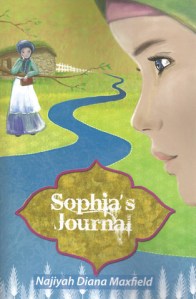
Sophia’s Journal by Najiyah Diana Maxfield

Standard

Sophia_s_Journal_Final_large

It is not terribly uncommon for my mind to remain stuck in books long after I have read the last page, but it has been a while since an Islamic young adult book has held me hostage.  This book was recommended to me by Anse Tamara Gray whose Daybreak Press published the book, and while I tried not to have any expectations, even if I had, the book would have blown them out of the water, mashaAllah.  The book is not in the Accelerated Reader database, but I added it to our school’s so that the students could read it, test on it, and then gather together during our next book club to discuss it.  I estimated it at about a sixth grade level fifth month, and would recommend it for middle school, high school students, and adults alike.

SUMMARY:

Sixteen year-old Sophia is on a family bike ride when she finds herself falling into the Missouri River and waking up in 1857 Kansas.  The acclamation of a 21st century Muslim girl in to what history will name Bleeding Kansas is both heart warming and inspiring in its details of every day life.  Sophia takes a hands-on active approach to helping the kind family, the Sampsons, that takes her in, and she learns everything from shooting to cooking to riding a horse.  As she learns the skills needed to survive, she truly becomes one of the family.  The beautiful way that Islam is woven in as such a seamless part of Sophia, whether she is in the present or the past, is inspirational for readers of all ages and made me at least question if I would be that strong.  Sophia’s relationships with the other characters is what makes the story so magical, getting to see the humanity and strength of people coupled with the same emotions of heartache, longing, and love we can relate to, in our own lives, draws the reader in and makes the story fascinating and hard to put down.  In addition to the story, the historical setting of slavery and relations with the native populations add depth that many students should already know about, and will enjoy seeing in a fictionalized account.  The twists and climax keep the reader engaged, and keep me from spoiling too many plot details in this admittedly vague summary.

WHY I LIKE IT:

I enjoy historical fiction and to blend that with a Muslim character is a great premise in my eyes.  Seeing a strong Muslimah lead in a quality entertaining book that is tactfully done is such a rare find.  Sophia’s strength is quiet, yet powerful, and the slower pace forces the reader to analyze themselves as they discover the characters.  It reminded me of Anne of Green Gables in its tone and style and I think that our middle schoolers need this change of pace and I can’t wait to see how Book Club goes.  I love how strong Sophia is with her deen, her convictions about slavery, her determination to help others, and to learn.  She easily could whine and complain that her cell phone is dead and she misses her family, but she doesn’t, she has a tenacity and attitude that elevates her to a status that you want the readers to look up to her and emulate her.

I also like that Sophia is respectful of other’s religions and they are respectful of hers, the author draws on similarities and discusses Islam in a way that shows it as a living breathing part of life, that is truly a breath of fresh air.  The climax and ending are not predictable and I appreciate that as well.

FLAGS:

There is referred to violence violence, slavery, racism, a tinge of  romance (in an 1857s kind of respectful way), but nothing overly graphic or sensationalized.  Overall nothing a middle school student and up could not handle.

TOOLS FOR LEADING THE DISCUSSION:

There are no reading guides or outlines to teach the book, however, I think there is PLENTY in the book to discuss and if you are like me and the few students I’ve already asked to read the book, not talking about it is harder than finding meaningful points to discuss.

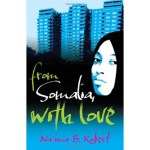
From Somalia With Love By Na’ima B. Robert

Standard
From Somalia With Love By Na’ima B. Robert

somalia

This book was a great glimpse into Somali Muslims in the UK, a world I admittedly know nothing about.  Whether accurate or not, I loved the incorporation of words, foods, culture, all of it.  And most of all I love that the main character Safia is a Muslima.  Yes, the point of the book is a coming of age story as she searches to find herself and define who she is, but in every sphere she is defining herself in, Islam is present.  Her home-life, her friendships, her poetry, all of it.  My only concern in recommending the book to my students. I think 7th and 8th graders, even in an Islamic School, can understand the temptation of going to the movies with someone of the opposite gender, of sneaking out, I think they can understand dealing with someone they love that is making bad decisions, in this case her brother experimenting with drugs and alcohol (the author doesn’t go into explicit detail).  But, truly one page (page 128) just goes too far for my students.  Had he tried to hold her hand, or kiss her even, I think the message would still come back to her conscience and her repentance, but the implied attempted rape pushes the issue over the line in my view, for my sheltered students.  High School students I think can handle it and I think lends itself well to a discussion on boundaries, respect, and sexual violence.  The AR level of the book is a 5.1 and it is a quick 159 page read.  There is a glossary of terms and phrases in the back and the font and book size make it very approachable and inviting to readers.

SUMMARY:

Safia Dirie is a 14 year-old-girl living in East London with her Mom, two brothers, and in close proximity to her large extended Somali family.  Safia is a good student, very close to her mother and very devout in her Islamic faith.  Like most teenagers she is defining who she is in a world that doesn’t seem to understand her.  Unlike most however, she has the added burden of being a religious and cultural minority.  In addition to handling friends, and temptation, she also learns that her father who has been missing in Somalia for the last 12 years has been found and is coming to live with them in London. The focus through the whole story is Safia and the reader is definitely drawn into her struggles of how to help her brother, who is rebelling, how to be a good daughter, and with her internal debates to drift closer to a less religious cousin who encourages her join in activities that Safia is hesitant to be a part of. Once her father arrives everything she has known is threatened and the issues and struggles intensify.  Despite efforts Safia can’t connect to her father and the changing dynamic of the family tests her in ways that while fiction and extreme, I think many can relate to and sympathize with.

WHY I LIKE IT:

The book does a good job of showing how people are not “good” or “bad” and how often mistakes, are just that, mistakes. It also provides hope that people can recover and improve.  The heart of this book is Safia’s and Safia’s heart is pure and has a strong connection to Allah (swt).  She sways and swerves, but never loses sight of who she is at her core, and i think for many young Muslim’s today that is an incredibly strong message.  That mistakes can be made, and Allah (swt) will forgive.  That intentions and repentance are real and valid, irregardless of where you are in life.  From friends Safia wrongs, to a brother who realizes what he is doing is wrong, to a cousin who is passed around without a permanent place to belong, to a mom trying to balance a returned husband, every character is fallible, yet not beyond hope.

FLAGS:

 The attempted sexual violence.  The implied drug abuse and lying of Ahmed, Safia’s brother.  The lying of Safia to her mom and parents about her whereabouts.

TOOLS FOR LEADING THE DISCUSSION:

The Author’s blog about the book: http://fromsomalia-withlove.blogspot.com/

Saving Kabul Corner by N.H. Senzai

Standard

kabul corner

For all of us waiting to see what happened to the characters from Shooting Kabul, N.H. Senzai answers that question in Saving Kabul Corner, while maintaining a stand alone story of mystery and family.  It is not necessary to read Shooting Kabul first, and if you have not recently read Shooting Kabul you may not even realize that some of the characters cross over into this book.  The books are drastically different in tone and style and purpose.

SYNOPSIS:

Saving Kabul Corner takes a while to get going, nearly 100 pages.  There are so many characters that I started reading this book months ago, put it down and forgot about it.  I picked it up two nights ago and resolving to just read it and not worry about who all the characters were, I finished it in two sittings and enjoyed it.  The buildup is important to set the stage, but young readers might have to be encouraged to get through all the pettiness of the characters, the numerous back stories and sub plots to get into the flow of the novel and the who-done-it aspect of the book.

Ariana is a 12-year-old Afghani-American girl with siblings, cousins, aunts, all living in their cramped townhouse.  The family owns Kabul Corner an Afghan grocery story in Freemont, California.  Things are going along fairly well, despite the recent arrival of Ariana’s cousin Laila who couldn’t be more different than Ariana, resulting in jealousy and disdain.  When a new Afghan store opens in the same plaza as Kabul Corner, tempers and old country feuds resurface.  Tribal concepts of badal, revenge, and honor start to make their way into their American lives.  When the feuding escalates to vandalism, theft, and arson, the kids of both families are convinced that a third party is pitting the stores against each other and set out to find the real culprit.

WHY I LIKE IT:

I like that the characters are American, but cultural too.  They are Muslim and mention going to the mosque, but their actions unfortunately don’t depict Islam in a consistent manner.  Most notably they do celebrate Halloween, and they lie a lot.  Because the book is a A.R. level 6.1 I haven’t completely ruled out using it as a book club book.  I think it might be a way to discuss with the students the purpose of literature.  How some books leave the reader with a moral, or something to ponder, while some are just entertainment.  The lying in this book is quite extensive and yet, both the kids and the adults have to lie to get the truth.  The author makes note of it, so at least it is identified as an anomaly, but still I’ve not yet resolved if I can explain to the kids that the ends don’t justify the means in real life.  I like that the book is a mystery, so many books with cultural twinges focus on all the “cultural” obstacles and injustices and hardships, it was nice to read a book where the characters and the store just happened to be ethnic in nature.  I think the characters’ culture adds depth, but won’t turn readers away as it is clearly written for the typical American young adult reader.  There is a glossary in the back, but it isn’t as daunting as other novels out there.  The book is 273 pages and also has an Author’s Note and a Further Reading Section.

FLAGS:

The lying for sure, and the theft.  There are no concerns with relationships, language, violence, or disrespect.

TOOLS FOR LEADING THE DISCUSSION:

Click to access 365.pdf

The Breadwinner By Deborah Ellis

Standard

breadwinner

The Breadwinner is the first book in Deborah Ellis’ four book series about 11 year-old-Parvana, her friends, and her family in Taliban controlled Afghanistan.  The remarkable thing about this book is that it is a compelling story, that has moments of intensity and reality, yet never falters from being on about a 4th grade reading and comprehension level.  The AR level is 4.5 and as a teacher I taught the book as a novel study to 4th graders, and now as a librarian I presented the book for my Jr. Book Club.  In both cases, after completion, the children are arguing and fighting for the next books in the series, Parvana’s Journey, and then Mud City, and finally My Name is Parvana.  It is not a tempting book on the shelf necessarily, but once you start, it is hard to put down.

SYNOPSIS:

The book gives readers a glimpse of how the Taliban changed the day-to-day lives of the Afghani people.  Young Parvana starts out helping her father, a  former History teacher, earn a meager living by reading and writing for the illiterate in the marketplace, and selling odds-and-ends that the family is willing to do without in order to survive.  As a young girl she is allowed to accompany her father into the marketplace, her older sister and mother, however, have not left their home in a year and a half.  When Parvana’s father is dragged off to prison, the family is in need of a provider, a breadwinner, and with some of her deceased brother’s clothes, a haircut and some courage, young Parvana becomes Kaseem.  She carries on her father’s work, digs up bones to earn more, and sells items from a tray to keep her family afloat.  In the process she meets an old classmate, Shauzia, who is also disguised as a boy, an old gym teacher, Mrs. Weera, determined to fight back through disseminating journals and magazines, and other characters that bring the horrors and hope of the Afghan people to life.

WHY I LIKE IT:

I like that it doesn’t get too political, which would bog down the story and turn off young readers, and while it presents unfair imprisonment, stadium style punishments, death and pain, it does so in a way that evokes empathy not fear.  It even at times finds a way to stay light-hearted and offer up hope as the reader sees the resilience and determination of these people.

“I’ve been thinking about starting up a little school here,” Mrs. Weera said to Parvana’s surprise.  “A secret school, for a small number of girls, a few hours a week.  you must attend.  Parvana will let you know when.””What about the Taliban?” “The Taliban will not be invited.”

FLAGS:

The book is intense at some moments, such as when the father is taken by the police, the girl’s nearly see prisoners having their hands chopped off, and the characters discuss landmines.  But it is on a child’s level, too much description is not offered and for most 3rd graders and up, I think the book is a great dialogue starter about what some people have to endure in the world.

TOOLS FOR LEADING THE DISCUSSION: (There are a lot of resources for this book)

Author’s website and study guide:   http://deborahellis.com/teacher-resources/

Unit study:  http://www.teacherspayteachers.com/Product/FREE-The-Breadwinner-Unit-Guide-for-Students-365169

Lesson plan:  http://coolkidlit-4-socialstudies.pbworks.com/w/page/27715927/The%20Breadwinner%20Lesson%20Plan

The Friendship Matchmaker Goes Undercover

Standard

friendship

I’m posting yet another Randa Abdel-Fattah book that my mom stumbled upon and sent me 10 copies to do for our Book Club. I didn’t love the book, but it is clean and brings up the issue of bullying, friendship and honesty.  So, I’ve decided to do a 3rd- 5th grade Jr. Book Club and use it as a starting point to discuss this critical social realms that they are facing.  The book is a 4.4 Accelerated Reader level and has no Muslim characters or themes.

SYNOPSIS:

This book is the second in the series, and, thankfully, having not read the first book, The Friendship Matchmaker, didn’t hinder my understanding.  Told from the perspective of Lara Zany, a former friendship matchmaker of Potts Middle School, the reader gets to know the major characters at the school and their problems.  Lara now has a best friend and has retired from the matchmaking business, but old habits are hard to kick, and as a new student from Somali out plays the school bully in soccer, Lara is forced to go undercover to help her classmates.

WHY I LIKE IT:

The book doesn’t stand out in the genre, but it is fun because I think 3rd through 5th graders deal with everything in the book, every day.  The book shows restraint where a lot of books over do it.  The characters show growth, they aren’t disrespectful and they aren’t all painted with a simplistic brush stroke.  The bully has redeeming qualities and no one is perfect or hopeless.

FLAGS:

The book is clean in regards to violence, relationships, and language.  The only concern I have is there are two major instances where the characters lie, and there are no consequences.  The smaller breaches of honesty the characters in some way or another must own up to, but there are two scenarios: a forged field trip signature, and an untruthful excuse given for being late to class, that rubbed me the wrong way.  Before allowing students to check it out for the purposes of Book Club, I sent a note to the parents with these two concerns and left it to them to encourage or discourage their student’s from checking it out.  My goal is to discuss why the author included these in the book, and realistic alternatives that would promote honesty, but still allow for a happy ending.

Where the Streets had a Name By Randa Abdel-Fattah

Standard

streets

This is the second book I have read by Randa Abdel-Fattah, and I still don’t know if I love her as an author, but I did enjoy the content of Where the Streets had a Name, much more so than I did with Does My Head Look Big in This?  The timeliness of this book is also as apparent as ever with the genocide and occupation occurring in Palestine, had I read it years ago I don’t know if it would have had the pull that it had on me, reading in now.  With all the images on social media and the news, this book really does a remarkable job of showing the daily struggles for Palestinians in terms of settlements and check points and just basic day-to-day living that is hard to imagine from anywhere outside of Palestine.  While some may find it slow moving I enjoyed the detail and childlike perspective of the world as seen through the 13 year-old characters in the book.  Despite all the material for it to be a preachy, political, and gruesome, it is not, it is undoubtedly told from a Palestinian Muslim perspective, but the supporting characters come from all backgrounds and focus on the humanity contained with in us all: Muslim, Christian, Jew, and even Israeli.

SYNOPSIS:

Hayaat’s family has been kicked out of their home by Israeli soldiers and are living cramped up in Bethlehem, struggling with no jobs, curfews, and the impending wedding of Hayaat’s sister to a boy on the other side of the checkpoint.  When Hayaat’s beloved, albeit farting, grandama, Sitti Zeynab, falls ill Hayaat believes that she needs to touch her ancestral land to recover.  With a curfew free day, her best friend Samy at her side, and an empty hummus jar, the kids sneak out from school to try and bring back a handful of dirt.  The journey is only a few miles, but with checkpoints, a protest, soldiers and documents, the chances that Hayaat and Samy will retrieve the dirt is minimal, as their priority becomes to make it out safe.  The book is fiction, but from all reviews that I’ve read, it very well could be real, it’s accuracy of the struggles endured and the hope that still remains are not completely fabricated.

WHY I LIKE IT:

I like that Hayaat is a Muslim Palestinian, Samy is a Christian Palestinian, along their journey they meet kind Israeli’s fighting for Palestine, they meet horrible people and soldier’s too, but it is never a black and white issue.  Zionism is what makes life so painstakingly difficult for Samy and Hayaat and all those around them, all the while tourists are flocking around as if walls and checkpoints are the norm.  The first 50 pages of the book are a mess, I don’t know if it is because it is translated from Arabic or if it is just the author’s style to overload and stuff everything in at the beginning that might possibly be interesting or funny to hook the reader. Either way, it doesn’t work and once you get through those 50 pages and the adventure with Samy and Haayat begins and Sitti Zeynab’s story starts to be woven through and we learn more about how Hayaat’s face was scarred, the story starts getting good.  Similarly the book is about 50 pages too long, after the adventure I was ready for the story to end, but I suppose the wedding of Hayaat’s sister, Jihan, has to take place.  Even though it is critical to see the logistical nightmare of having a West Bank girl marrying an Israeli Arab from Lod, the story gets muddled and loses its flow both at the beginning and end with the details of living in Ramallah and figuring out what roads to take to have the ceremony.  Adults may appreciate it, but with an AR reading level of 4.8, the target audience gains a better appreciation for the struggles of the Palestinians through the main story.  In total with the glossary and acknowledgement the book is 313 pages.

FLAGS:

The book is remarkably clean, there is a slight joke about birth control pills, but Hayaat doesn’t understand it, and her companions on the service (bus) don’t explain it to her, so I doubt the young readers will get it either.  (Hayaat thinks her sister shouldn’t get married if it is making her sick and she can’t understand why every day at the same time her mother makes her take a tiny pill.)

There is some violence, but it is not explicit, it is more emotional when Hayaat’s friend is killed and Hayaat’s face marred.  Similarly she blacks out during the protest, so there isn’t much description

TOOLS FOR LEADING THE DISCUSSION:

I do plan to do this as a book club book, I think the students are well aware of the situation and it might be a good place to let them voice their thoughts and emotions.  I may also have a Palestinian sit in on the discussion, to help keep it accurate.

Discussion questions:  www.panmacmillan.com.au/resources/RA-WhereTheStreetsHadAName.pdf

Author’s website: http://www.randaabdelfattah.com/

Words in the Dust by Trent Reedy

Standard

20140629-172415.jpg

I probably should not have read this so close to the book Wanting Mor, as it too is about a girl in Afghanistan, and with a cleft lip none the less.  The similarities fortunately pretty much end there.  Words in the Dust by Trent Reedy is a fictional story that sprung from his own military service in Farah, Afghanistan and brief encounter with a girl named Zulaikha, who he and his comrades pulled money together to fund her transport for surgery.  He clearly states in his Author’s Note that he had preconceived notions on Afghanis when he deployed and how those changed as he got to know the people, he also states his disadvantage in writing the book as he is neither an Afghan or a girl.  Such honesty and care with the subject matter shines through the pages and creates a glimpse at everyday life for the characters without being overshadowed by judgement.  The first 50 pages or so of the 264 total are a bit overwhelming, but if the reader plugs through, the rest is smooth sailing and hard to put down.  It has an AR level of 4.6 although there are a few items mentioned in passing that would make me nervous to let someone that young read it.  A main story plot is the marraige of Zulaikha’s sister Zeynab and preparations include her receiving marital advise that makes her blush, and following the wedding night, a cloth with Zeynab’s blood is brought to Zulaikha’s family.  No explanation is given and many readers may just brush over it, however, if asked, it could be awkward to explain to a fourth grader.  Additionally during a conversation between Zulaikha and Zeynab, Zeynab says about some of her marriage difficulties, “Every night. . .He wants me to have a son, but I don’t know, , ,”.  Definitely something to consider when recommending this book to someone younger. 

SYNOPSIS:

Thirteen-year-old Afghani girl, Zulaikha, has a tough life.  Born with a cleft lip and having lost her mother to the Taliban she spends her days with her older sister Zeynab caring for her two younger brothers, prepparing food for her father and older brother, and constantly being berrated by her step-mother.  Set in a post Taliban setting, Zulaikha stumbles across a woman in town that remembers her as a child and used to teach her mother.  Drawn to Meena, Zulaikha begins fullfilling her mother’s dream by meeting secretly with Meena to learn how to read and right and understand the poetry of her homeland.  Things really start to look up as the American army rolls in and hires her father, a welder, on some of their new buildings, and offers to fund reconstructive surgery for her lip.  Arrangements are also made for her sister to marry a prominent man in the community.  However, things don’t go exactly as planned, and Zulaikha and her family must evaluate what they want and how much they mean to each other.

WHY I LIKE IT: 

The story doesn’t assume anything about the characters or society, American and Afghan alike, which to me seems authentic.  It doesn’t feel as if stereotypes are perpetuated or intentionally broken down, there is simply diversity of thought, opportunity and action. The book doesn’t shy away from American arrogance (offering the Muslim character’s pork and shaking hands with those of the opposite gender), nor does it make them seem cold hearted (they are genuinely helping Zulaikha’s family), similarily the Afghan men are loving to their wives and children, but doemstic violence is also shown.  Some of the Afghan women are educated and independent others are illiterate and dependent.  I like that the characters are religious, and hopeful that Allah will provide what is best for them.  As the characters put their trust in Allah, and endure with sabr (patience), the reader too is relieved at the ending which is both cathartic and sweet.

FLAGS:

Reference to married life, domestic violence

TOOLS FOR LEADING THE DISCUSSION:

Depending on the audience this book could be a GREAT book club book, it would probably need parental consent for the few items mentioned regarding marital life, but I think middle school girls would gain appreciation for their own lives and opportunities after reading about Zulaikha.

The author’s website: http://www.trentreedy.com/book-witd.html

Interview with the Author and his Publisher http://www.wow-womenonwriting.com/downloads/printable/49-FE2-CaseStudyWritingMulticulturalFiction.html

The book includes an introdction by Katherine Paterson (Author of Bridge to Terabithia and numerous other books), a pronunciation guide, a glossary, an author’s note, acknowledgements, information about the poetry used in the book, and recommended reading about Afghanistan.