Category Archives: History

Never Say A Mean Word Again: A Tale from Medieval Spain by Jacqueline Jules illustrated by Durga Yael Bernhard

Standard

scan0019_487d580c-5aa9-45f2-b4c1-87e328c94b7e.jpg

I love when tales from the past provide timeless lessons in relevant ways.  Inspired by a medieval legend about the Jewish poet Samuel Ha-Nagid, a royal advisor in Muslim Grenada, Jules creates a story that works for children of all ages and backgrounds.

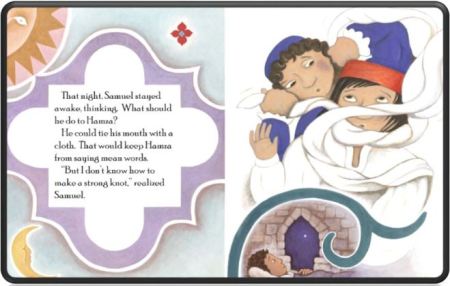
The Grand Vizier’s son, Samuel, bumps into the tax collector’s son, Hamza, and the boys don’t rub each other the right way.  Later that day, Samuel spills his drink on Hamza and can’t convince him both were accidents.  Hamza calls Samuel some mean names and storms off.  Samuel and his father think the name calling is uncalled for, but the vizier does not solve his son’s problem and instead assigns him to “make sure Hamza never says a mean word to you again.”  Samuel imagines ways to teach Hamza a lesson or punish him, but some ideas are too complicated and some just silly.  This is proving to be a hard task.  The next day Samuel shows up to Hamza’s house with a lemon.  He thinks forcing Hamza to eat it is a good punishment for a mean mouth, however Hamza thinks the lemon is to help with the stain that ruined his clothes, and tells him his mother already tried that.  Caught off guard by Hamza’s reaction, the two somehow end up playing catch with the lemon and enjoying the afternoon together.  The next day he shows up to Hamza’s house with ink and paper thinking he will make Hamza write him an apology.  Hamza however, thought Samuel showed up to draw, and once again the boys enjoy an afternoon together.  This carries on until the boys are so used to seeing each other and having fun together, they become friends.  Samuel fears that he disobeyed his father and did not handle Hamza only to realize that by befriending his “enemy” he did in fact make sure Hamza never said a mean word again.
idea

The book is 32 pages with an Author’s Note about the real life events that the story draws upon.  The book is not AR, but the large bold typeface and the warm simple pictures make this book work great for story time with young children.  It compliments themes about bullying and making friends as well as being silly.  It works well for third graders and older ones too, as they might understand people of different faiths struggling to get along or people of different socio-economic classes, or even just imaging how they would solve a problem without their parents doing it for them.  I was pleasantly surprised by the book and how it handled the Muslim/Jew staging of the characters.  Especially right now in today’s world, this story has a poignant lesson for us all. If we all spent time together having fun, we too could end up being friends, or at least getting along.  I think the story and its lessons have merit and relevance, and thus a place on the bookshelf.


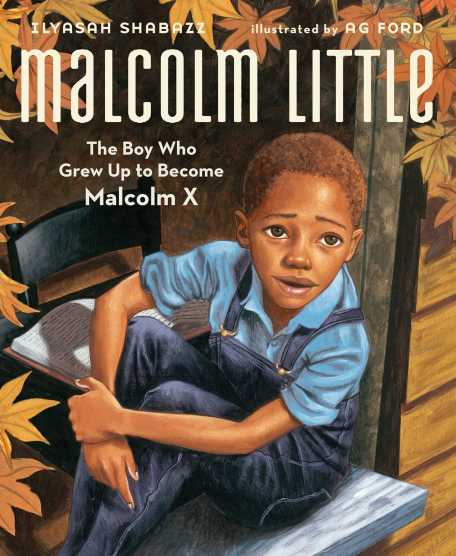
Malcolm Little: The Boy Who Grew Up to Become Malcolm X by Ilyasah Shabazz illustrated by AG Ford

Standard
Malcolm Little: The Boy Who Grew Up to Become Malcolm X by Ilyasah Shabazz illustrated by AG Ford

malcolm-little-9781442412163_hr.jpg

I had hoped to have a handful of selections to review for Black History Month, but alas I started too late in collecting titles, inshaAllah next year I will be better organized.  I did want to share this beautiful book though, as a great story of hope and love, that I don’t think is often included when we study Malcolm X or talk about him today.  This is the story of his parents and the philosophy of equality they tried to raise him in before hatred and bigotry destroyed his family, before he went to prison, before he became “Detroit Red,” a member of the Nation of Islam, before he became a civil rights leader, a Muslim, before he became Malcolm X.  This is a story, based on love, written by his daughter to give children of all ages something to think about.

malcolm-louise-300x300

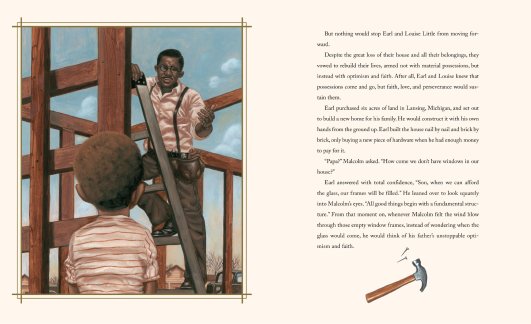
The story of Malcolm Little, is a story that I feel cannot be rushed, it is very heavy in text and at 48 pages, the warm beautiful pictures make it accessible in pieces to younger children, but it is written on an AR 6.5 level (sixth grade fifth month).  The book tells about how his mother and father met, believed in universal equality and justice, and started a family where these values took center stage.  The family suffered for their beliefs and their home was burnt down, but they rebuilt and the family continued to find strength and see the power of possibility.  The books shows the lessons taught in everyday activities such as raising a garden, doing laundry, reading books, doing homework, and even fishing.

When Malcolm’s father was killed, however, and his mother taken away, the family was forced to separate and Malcolm to deal with an unwelcoming world, more or less alone.  The book ends with Malcolm in 7th grade so, to young readers who have maybe only heard his name in passing the book is full of hope and roots for the man he would become.  It is almost a fairytale start to a man who would be cut down in his prime years later.  They will understand how unfair society treated his family, how warm and educated and strong his mother, Louise was, and how inspiring his father as a preacher was. The takeaway will be how Malcolm’s upbringing and personality allowed for him to rise up and refuse to stay down during horrific events in his life.

malcolmx.jpg

For older elementary and middle schoolers it is a story of possibility, of how quickly things can change, and the effect of hate.  They should also see how institutionalized and normative the oppression of African Americans was and how it really wasn’t that long ago.  When Malcolm’s English teacher Mr. Ostrowski tells Malcolm that he as an African American should not have such high expectations, readers should realize that the acts of the Ku Klux Klan may be viewed as “extreme” but society as a whole was systematically enabling such bigoted acts.  The lessons passed on to Malcolm by his parents are universal themes of hope and love and equality that still have to be stood up for today, and even young listeners can grasp that, and also grasp that because of their skin color alone they were seen as second class citizens.

The book shows depth to a historical character that gives some insight to what made him so dynamic.  Many young readers will be surprised at how quickly Malcolm’s world unraveled, and some of the reasons why, while empathizing with the injustice of it.  The Author’s Note at the end is also fascinating as it details the family members and their stories about the characters in the book.   I liked the softness of the book and the smaller lessons for children that it presented.  It didn’t shy away from the violence and prejudice that the Little family faced, but presented it through a lens of optimism to hopefully inspire children to carry on with the social activism that still needs to be done.


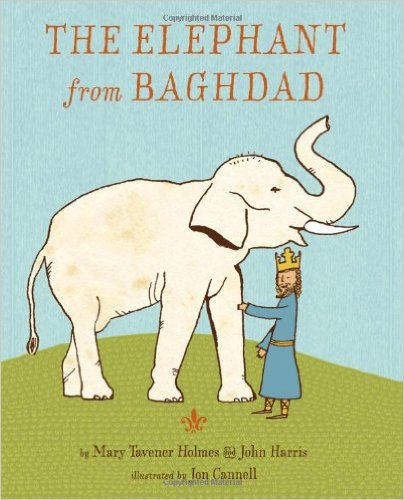
The Elephant from Baghdad by Mary Tavener Holmes and John Harris illustrated by Jon Cannell

Standard

the elephant from baghdad cover

This fun and informative picture book written on a 4th grade 8th month AR level retells a historical event through a fictionalized narrator.  A great retelling of a West meets East event with an albino elephant thrown in, makes for a story that is hard to believe is true.

Charlemagne, the medieval ruler of most of Europe, sent ambassadors to meet the Caliph of Baghdad, Harun al-Rashid.  Charlemagne was curious to learn more about the amazing ruler he had heard so much about.  When the Europeans arrived they were astounded at the buildings, libraries, organization and cleanliness of the city.  For months, Harun “introduced the men to artists, musicians, scholars, mathematicians, architects and poets” and taught them about “science, medicine, engineering, and art.”  Harun al-Rashid’s generosity however did not stop there.  “He loaded a caravan with presents fit for a fellow emperor.”  He sent a saber and scabbard, a precious water jug, and a magnificent clock that he had commissioned his artisans to create.  A mechanical water clock, that unfortunately, has been lost in history, but was detailed in the 807 CE Annles regain Francium, a journal that chronicled the daily life in Charlemagne’s court as well as in a book written 400 years after Harun by Al-Jazazi in Istanbul, Turkey.  Even this, however, was not enough for the great emperor of the West, and Harun gave Charlemagne the rarest treasure of his court, an albino Elephant named Abu.the elephant from baghdad

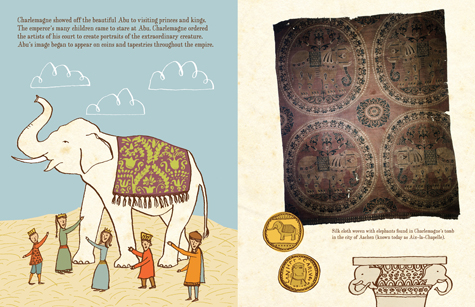
Abu even had his own keeper, a Jewish man named Isaac, and when they returned back to Europe both were invited to live in the palace.  “Once or twice a day Charlemagne would visit his immense guest.” Abu’s image was preserved in portraits and began to appear on coins and tapestries in the empire.  Even in Charlemagne’s tomb is a silk cloth woven with elephants.  Abu was taken into battle against the Danes and when he got old, Charlemagne had a house built for him and Isaac near a river.  In 810 Abu died and when Charlemagne learned of his death, “he wept.”

The story shows the amazing respect the two leaders had for one another, for animals, and the tolerance of people of different faiths.   At 40 pages it works for story time and for older students learning about the Middle Ages.  Obviously they would take away drastically  different points from the story, but both groups would enjoy it.  I learned a lot, so I recommend it to adults as well.  The pictures are beautiful water colors and pencil, supplemented with actual photos of artifacts, that all combine to make the story and book a wonderful addition to your library to be read and enjoyed again and again. elephant from baghdad 2


The Grand Mosque of Paris: A Story of How Muslims Rescued Jews During the Holocaust by Karen Gray Ruelle and Deborah Durland Desaix

Standard

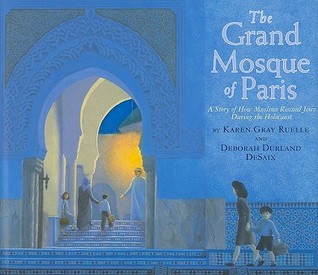
The Grand Mosque of ParisThis beautiful, beautiful book tells of a little and sparsely known event in history.  During the holocaust The Grand Mosque of Paris served as a place of refuge for many North African Jews.  Many who passed through the vast gardens and beautiful Mosque were given fake documents of conversion, tombstones with their family names inscribed, and access to truly underground passageways (subterranean mazes), as the Muslims of Paris offered assistance to keep their Jewish brother’s and sister’s safe from the Nazi regime. Many of the stories were recently uncovered and with the passage of time, so much of the information has been lost.  As a result the book is a bit choppy, each page tells what is known about the Muslims’ assistance in some capacity, but does not flow to the next page.  So there are generalized recountings of children being hidden with other families, the efforts of the Kabyle Ressistance (Berbers from Algeria) to smuggle Jews to safety, etc.. There are also a few specific examples of Salim Halali, a young Berber Jew from Algeria, two friends one a Muslim the other a Jew seeking shelter, a Tunisian Jew who stayed at the Mosque for over two years,and a few others, but with the exception of the use of the Grand Mosque and a Doctor Ahmed Somia very little flows throughout the book.  Thus making it more of a historical account than a story.

Truly the book would not work for story time, it is geared for children (and adults) ages 12 and up,  it has an AR level of 7.1.  I would imagine it would be an amazing addition to any class studying World War II and finding the humanity offered in one of the bleakest times of our world.  It should, in my opinion, be standard required reading in Islamic School curriculum to supplement WWII study.  The hope and pride one feels when reading this book, shows how rich our faith’s are in coming together.  It would also work in understanding how history is lost, and the importance of perserving it.  There is an Afterword on page 34 that is very informative and interesting.  It is followed by a Glossary, Acknowledgements, References, Bibliography, Recommended Book and Films, and an Index.

The book also sparked my interest to know more about, not just how Muslim’s helped Jews during the Holocaust, but also how Muslims were treated in France.  The book says, “The Grand Mosque shimmered like a mirage, the white domes and the glittering mosaics of the minaret in stark contrast to the muted colors of Paris.  When the mosque was built in 1926, the North African countries of Algeria, Morocco, and Tunisia were under French rule, and many Muslims had come to Paris from those countries.  The land for the mosque was given by the French government, in exchange for a symbolic payment of one franc, to thank the half-million Muslim soldiers who had fought for France during the First World War.”

The Grand Mosque of Paris1.jpg

I have already read the book more then once, and gone back and read passages multiple times.  It is as fascinating as it is informative, and a great addition on any book shelf.