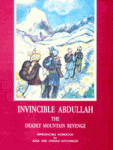

I’m pretty sure I’ve seen and handled this book hundreds of times in my involvement in four Islamic Schools, as a teacher, a librarian, and host of book fairs. So, it is a little embarrassing to admit that this is the first time I actually cracked open the cover and read the book. Written in 1992 with a less than attention grabbing cover, I had minimal expectations, but with a newborn and down time, I thought I needed to give it a chance, and I’m glad I did. The book is definitely geared to boys (there isn’t even a female character in it), and is pretty action packed and quick paced. You know the boys will get out of the predicament at hand, he is “Invincible” after all, and there are three more books in the series, but you don’t feel bad reading it anyway, because it is sufficiently entertaining. The book isn’t amazing, but it holds its own largely because it doesn’t talk down to the reader. The characters are independent and thoughtful and yes they are teenagers battling drug carriers in the tribal areas of Pakistan, and yes they are wielding guns and hiking over glaciers, but mind you they never miss their salat or fail to thank Allah (swt) for their success which kind of makes the book that much more fun. The book is 218 pages with a glossary at the back. It is not an AR book, but I probably will make it into one at about a fourth grade fifth month level (4.5). I also am considering doing it for book club, but might wait and read the rest of the series to see which one will have a wider appeal.
SUMMARY:
Abdullah travels to Pakistan from England to visit his cousin Hasan. At the airport Abdullah’s bag gets switched with someone else’s and the boys find themselves getting accosted by the rightful owners who have a half a million dollars in their suitcase. The boys talk to the police and learn that the money is part of a heroin operation going on in the tribal areas and that the inadvertent switch messed up the police’s sting to catch the criminals. The boys run in to the drug runners again in the bazaar, and after an all out brawl decide when an opportunity to go into the tribal areas presents itself, that they should take it and do what they can, to put a stop to the criminal’s drug ring.
WHY I LIKE IT:
There is drugs, violence, and guns, but it is all done for the right reasons, in an action filled manner. The “good” guys are all religious, and while the “bad” guys have religious sounding names, clearly are not, which lends it self to a decent discussion about what makes a good person and what makes one religious, clearly not just their name or culture. It also lends itself to a realistic conversation about drugs, their effects on the users, and on drug culture as well. The guns, well the guns are there to make threats, and to hurt people, at best it gives you a seg-way to discuss your views on guns with your children, but in the book, it is what it is, not a moral or religious issue as the drugs are made out to be. The boys, the heroes of the book, are all very devout mashaAllah, and their actions, manners, and thoughts reflect this. I like that this is consistent with their character. They are respectful to their families, to each other and are ever mindful of themselves as Muslims in all facets of their adventures.
FLAGS:
Just the content of drugs, violence, and death. Mild compared to most TV shows or movies, but present, none-the-less, nothing a third grade and up can’t handle. (Spoiler, only one person dies and it isn’t directly at the hands of anyone, nature steps in to save the day).
TOOLS FOR LEADING THE DISCUSSION:
There is a workbook that apparently can be purchased to accompany and teach the book: http://www.islamicbookstore.com/b9648.html
The author gives pause as the characters have to decide what to do next and to weigh the pros and cons and possible repercussions of their decisions. These moments would lend themselves well to a book club discussion to find out what the students would do, what they would be willing to risk, and at what cost.

 Islamic School Librarian