Tag Archives: Graphic Novel

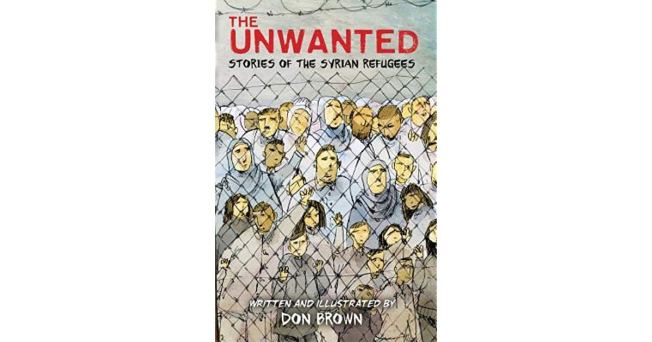
The Unwanted: Stories of the Syrian Refugees by Don Brown

Standard
The Unwanted: Stories of the Syrian Refugees by Don Brown

unwanted

I try and keep an eye on what is available at Scholastic regarding Muslim characters and Muslim authors since for many kids the Scholastic Book Orders might be the most interaction they have with seeing available books, and for others, they may see a book in a library or other book store that they have seen on a Scholastic flyer and pick it up for that reason of familiarity.  Granted I might be completely wrong in this assessment and just be trying to justify my review of a non fiction 103 page AR 5.7 graphic novel that talks about Muslims and refugees, but nonetheless I try and read the Scholastic books that feature Muslim representation to a very captive audience.
IMG_6981

SYNOPSIS:

The book takes facts about the plight and flight of the Syrians as they are forced to leave their homes due to war, and the horrors they face on their journeys to finding a new place to call home, and illustrates them.  The book focuses more on the exodus than on the politics that forced them to leave.  There are no characters or story lines, but rather illustrations to the headlines, articles, and facts that detail the truths about the collective experiences of many Syrians.  It seems every single sentence is referenced at the back of the book, which is probably a good thing as it is non fiction and this is a researched book, not a book of anecdotal stories or an OWN voice retelling.

IMG_6985

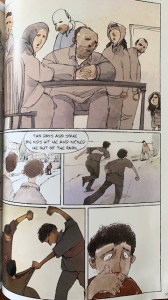
The book in muted tones tells how the young boys scrawling graffiti is what is attributed to the spark that set Syria ablaze with frustrated citizens standing up to an oppressive regime.  The pictures show different factions policing the people for trying to have pianos, to kicking people out of the homes and torturing them or killing them.  As the situation elevates and no end is in sight the book, then follows people leaving by foot into neighboring countries, and then fanning out as border countries refuse to let more people stay.  Eventually, many are forced on to rafts to countries further away, but as their resources deplete, many Syrians have no where to go and are unwanted.
IMG_6984

WHY I LIKE THE BOOK:

I like that it is real and graphic and violent, it doesn’t show everyone getting a happy ending.  I think many children’s books focus on the heroes trying to help or people having a happily ever after, but by upper elementary, readers need to know that the situation is dire and no resolution is in sight.  The author tries to explain the Sunni and Shia differences by using Christian divisions as examples, and he shows jihadists torturing people, and he does use statements about Islam and music, and I don’t know how a child would take these labels as they don’t come with much explanation.  On the other hand he does highlight that some countries would only take Christian Syrians, so I don’t think he is advocating one faith over another, but the details about Muslims for some reason seemed a little forced to me.
IMG_6983

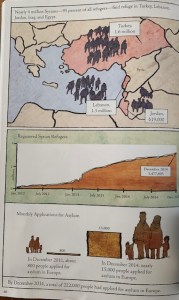
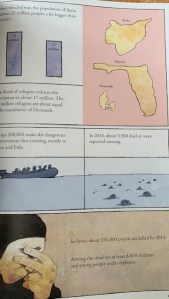
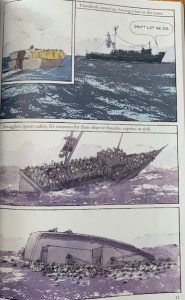
I think his agenda or purpose was to show how the world, with the exception of a few countries, have really turned their back on refugees.  It says in a footnote at the end “that in the first three months of 2018,” for example, “the United States has accepted 11 (refugees) for resettlement.” The facts, the maps, the diagrams, really drive home the point and do evoke an emotional response, which I think is needed.  A few of the pictures are also incredibly resonating, such as the one of the man stating he couldn’t save his family from drowning.

IMG_6992

FLAGS:

The book shows violence and death.
IMG_6982

TOOLS FOR LEADING THE DISCUSSION:

The shortness of the book, might not make it an ideal candidate for a Book Club, but the value in such a book makes it a great addition to any and every classroom.  I don’t know how many children will read this book on their own.  It isn’t fun or compelling, its factual and depressing.  But, I think it is important.  Nonfiction is often hard to convince children to read, so I like that it is a graphic novel and I like that the information can all be verified.  I think children need to be encouraged to read things that might not be easy and fun, and have a way to discuss how such readings make them feel.  Furthermore, If you are a teacher teaching references, this book is a great example.


Escape from Syria by Samya Kullab, Jackie Roche, and Mike Freiheit

Standard
Escape from Syria by Samya Kullab, Jackie Roche, and Mike Freiheit

9781770859821.jpg

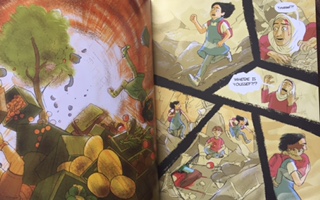
I have read a fair amount of fictionalized accounts of the war in Syria, the journey of refugees, and their resettling in various countries, but this was the first graphic novel on the subject that I have seen, and I was excited to wait my turn behind my kids to read it.  My 7th and 4th graders read it in about 20 minutes and said they really liked it, knowing that it was a quick read, I wanted to take it in slowly and examine each picture to grasp the full message that the author, a Lebanese journalist, was conveying.  Definitely meant, for ages 5th grade and up because of the content, I appreciated the book more than I loved it.  It seemed rather choppy and the fictionalized parts come across just as a front to convey facts.  The book definitely is a great introduction to the conflict, and the format will appeal to a broad range of individuals.  

SYNOPSIS:

Told from the voice of Amina, a bright young girl who rushes home to show off her latest A grade paper to her family, is met instead by a bomb striking the beautiful peaceful neighborhood.  The images on the first page are destroyed as her younger brother Youssef must be located in the rubble and debris.  Now in Canada, Amina tells the story of their journey from Aleppo.  The bouncing around of time, provides some context to how life became under the rule of Bashar al-Assad, how checkpoints and emergency rule changed everything about Amina’s life.  As war creeps in it isn’t just inconveniences and fear, but also death, as further shown through Amina’s uncle who has joined the rebel army.  The family decides they need to flee to Lebanon and truly believe it will be just for a little while. 

IMG_2082

They rent an apartment for a year, but when they cannot afford rent they relocate to a refugee camp, where they stay for two years.  Amina’s father is determined that Amina stays in school but as work remains scarce and Youssef’s health continues to deteriorate.  Amina is forced to take a break from school to try and find work.  Eventually her father arranges to go by raft to Europe to try and start a new life and bring his family there once he is settled.  The terms of the loan to pay the smugglers is steep and when the raft doesn’t make it too far before tossing its passengers, Amina’s father Walid is forced to return to Lebanon unsuccessful. 

It isn’t until Amina’s family considers, like many other families in the camp, to get her married to keep her safe.  That Amina upon picking up some aid at a UN reception center, spills everything to a worker there, and a week later the UNHCR contacts the family to help move them to Canada.  The readers at this point I would assume are relieved the family will be safe, and are surprised when the family isn’t sure if they want to leave.  Syria is there home, and before the mom will agree to anything, she wants to go back to Syria to see her newborn niece.  Once in Syria, she sees that her home is no more as she remembered it, and agrees to be resettled anywhere.  Through the same flashbacks and flash-forwards in time, we also see that life in Canada is not easy.  The family is welcomed and helped and grateful, but it isn’t yet home, and the ghosts of Syria are still present.

WHY I LIKE IT:

I kind of like how choppy it is upon further reflection.  At first it annoyed me, but as I thought about it more and more, I have decided I like that it isn’t easy and smooth and fleshed out, the tone of the unknown comes through by not over narrating the emotions and circumstances.  I also like that everything that happens to Amina and her family is anchored in reality and the footnotes, references, and facts are all in the Endnotes.  Having said that, I wish their was a little more character development, it reads like a bunch of facts strung together and connected by this fictional family.  There isn’t anything wrong with it, but a little more warmth for the characters would have added a beautiful level and would not have been hard to come by at all.  There are so many stories from this conflict out there, and the reason they resonate with so many isn’t from all the facts and numbers, but often from the individuals that make the numbers real and haunting.  I felt like this book fell short on the human element unfortunately.  The only character I really felt had some heart, was the dad, he was awesome, and his love for his family and determination for his daughter’s education was definitely felt.

The book does drop some acronyms and political alliances to add context but not overwhelm the reader.  It definitely hints that there are a lot of groups vying for power, and control: Assad, Russia, ISIS, US, rebels.

IMG_2084

I love that the flashbacks to pre-war Syria are so relatable.  Kids need to really understand that we are all so much more alike than different.  Not just in our hopes and dreams, but even in our daily lives.  The characters in the book are the same as us, their lives look great,  maybe even better.  They have friends, and families and jobs, and cell phones, they also unfortunately, have war.

There were a few surprises for me, for example that buses between Lebanon and ISIS held Syria took/take people back and forth.  Similarly,  I was surprised to see that the punishment of smuggling cigarettes was being beheaded, but maybe more surprised that the book included it.

IMG_2083

It is reassuring for readers to know that the family survives, but the harrowing journey of seeing body bags, cutting costs to survive, risking it all to trust smugglers with fake life jackets, paint pictures of a journey that will stay with the reader.  The book doesn’t talk down to anyone, if something seems too simplistic, it almost encourages the reader to go research more about it.  

There isn’t any mention of Islam or religion, the females wear hijab, that is the only indication along with their names that they are a Muslim family.

FLAGS:

The violence, is pretty haunting and while the images and text aren’t graphic, the splatter of blood and guns and death are very present.  There is also mention of cigarettes.  While not explicit and possibly over the heads of some readers, the book does show that the loan sharks would be willing to take Amina, “Something nice and sweet…like you,” to help pay off the family’s debts.  A former classmate of Amina also invites the family to her wedding.  At 13 Amina’s family is also considering getting her married as a way to help keep her safe.  

IMG_2085

TOOLS FOR LEADING THE DISCUSSION:

This book would be better in Social Studies class more than in a Language Arts one. It would be a great supplement to share even, when discussing current events.  Its a quick read, a factual account and a powerful one at that.  

Book Trailer: https://www.youtube.com/watch?v=AsZZwxM7YyQ

Publisher’s Synopsis: https://www.fireflybooks.com/index.php/catalogue/product/11566-escape-from-syria

Brave by Svetlana Chmakova

Standard
Brave by Svetlana Chmakova

bravecover.jpg

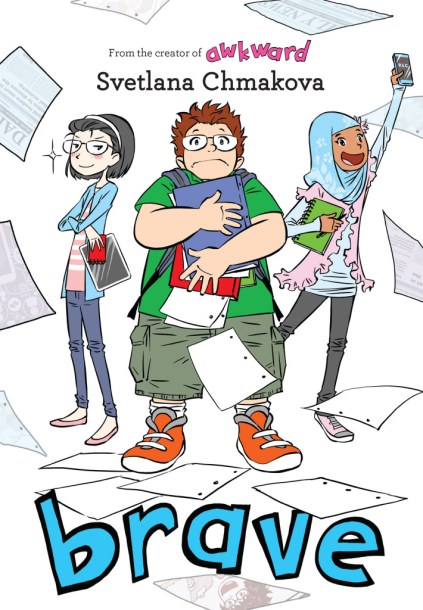
Often these days, minority groups are feeling more and more marginalized in a blaring world that is increasingly divisive and polarized.  So to see a book in my child’s Scholastic Magazine with a muhajaba on the cover, and not a main character, in a book about bullying, where she isn’t the instigator or recipient, made my minority heart swell with hope.  This 238 page graphic novel (AR 2.8) is a quick, quick read for middle schoolers, and one with a good message, that is more self empowering than preachy.  A companion book to Awkward (which I haven’t read, but hope to soon), the author takes us into Middle School through the eyes of Jensen, a kid who is struggling to find his place and escapes into his daydreams to conquer every day stresses.


SYNOPSIS:

Jensen wants to be a NASA scientist, but he isn’t good at math.  He loves to draw, but the Art Club is consumed with an upcoming event he knows nothing about, he is harassed by two bullies every chance they get, and occasionally he is asked by the newspaper staff to do menial work.  Yet, somehow despite having no friends, and a constant barrage of things going against him, he doesn’t see himself as a victim or as the recipient of bullying.  Rather, he falls into regular day dreams where he is the main character in a video game and all these battles have to be overcome to reach the end.  The surrounding characters have their own little stories, and you get to know a bit about them through Jensen, but the author doesn’t let any of them be painted with a singular stroke.  You see the athletes, being kind and sticking up for kids getting picked on, one being a math wiz.  The journalism staff of Jenny, Akila, and Felipe, run the school, but have their own stresses and internal struggles.  The circle of activity comes to a head when a student is expelled over the dress code, and all the various groups in Jensen’s world have to come together to make change.  In the process he realizes that he is being bullied, and that something needs to be done.  He also realizes nobody has it all together and he has a part to do to help others as well.

WHY I LIKE IT:

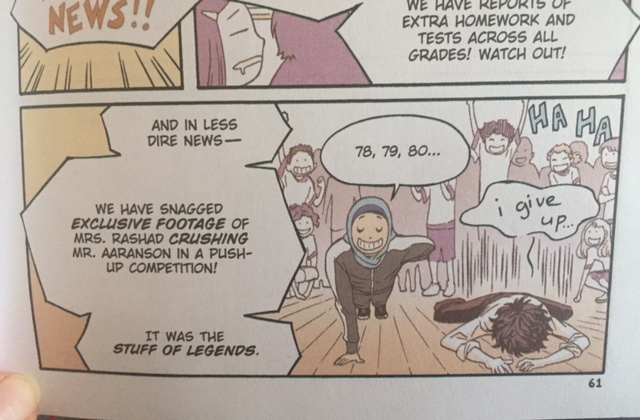
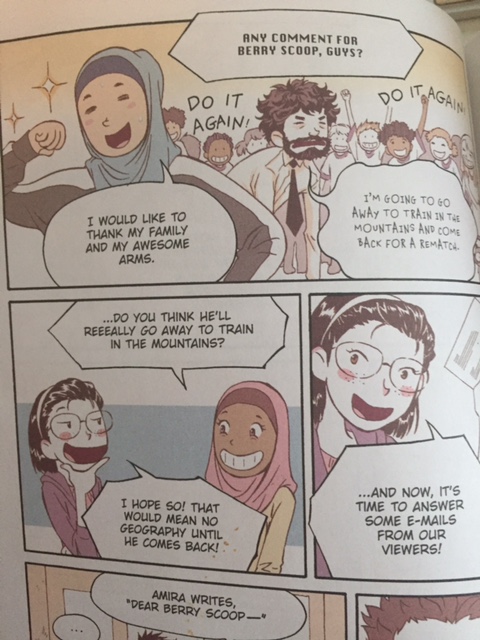
First I like it because there are Muslims in the book, that are just characters in the book.  They don’t represent all Muslims, they aren’t “different” or “other.”  Akila wants to be a journalist and she is smart, and she is kind, but she fights with her best friend, the bossy Jenny, and it is Jensen that has to help them see their errors.  I also like that the P.E. teacher, Mrs. Rashad, is a hijab wearing Muslim, that beats the social studies teacher in push-ups. I mean what an amazing way to break a hundred stereotypes, by not mentioning them, and just showing them as normal. A muslim woman, working, being physical fabulous, and being modest, ya we need more of this. There is no mention of their religion, their clothing, their hijabs, nothing.

FullSizeRender (27)FullSizeRender (28)

I also like that the students in some cases didn’t realize that they were bullying.  I think this happens a lot, where maybe someone won’t let you sit by them because they are saving a seat for someone else, but the second or third time it happens, the recipient feels alienated, where the aggressor may not even be aware.  The book explores lots of ways of bullying, but because it is filtered through the character, it leaves a lot of room for discussion about how people treat us, and how we treat others, and where a lot of pain can come from the misinterpretation on both ends.

There is a lot of diversity in the book, boys, girls, skin tones, body sizes, physical abilities, handicaps, intelligence, etc. that come up to varying degrees, but do at least offer the readers real ways to see themselves in the pages.  The book has a very tidy, happily ever after feel, which is ok I think for middle school. The book has a specific audience. Elementary will just find everyone mean, high schoolers will find it childish, but as social relationships get more challenging in middle school, I think this demographic will often have to find the courage to be brave to get through unscathed.

FLAGS:

None. One character has a boyfriend, maybe. But it is clean with pretty much everything, it even says for All Ages ont he back.

TOOLS FOR LEADING THE DISCUSSION:

I would love to do this as a book club book.  I don’t think it would need any prompting or guides. My 6th grade daughter said it was “ok” yet has brought it up at least ten times since she read it, and has come and sat by me to watch me read it.  I think, she has had some similar issues and to be able to talk about them through the characters, has been liberating for her, and furthered my conviction that fiction has power.

The Author’s website: https://svetlania.com/


The Complete Persepolis by Marjane Satrapi

Standard

Persepolis cover.jpg

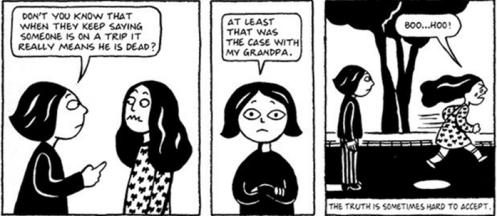
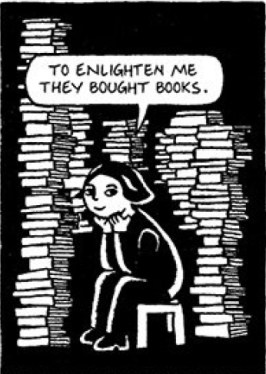
The Complete Persepolis is both Satrapi’s volume one and two of her memoir about growing up in Iran during the revolution.  At 341 pages of black and white graphic novel intense story telling I was fascinated by its 3.3 AR level for volume 1 and 3.9 for volume 2. Clearly this is once again a loophole in the AR system rating a book for word and sentence difficulty and not content.  The book is for high school and above, despite the simplistic style it is presented in.  The content of multiple wars and coming of age,  provides detailed political commentary not tempting to many elementary and middle school children, and her coming of age narrative is no way appropriate for third or fourth graders.

SYNOPSIS:

Marjane is an only child in Iran growing up with a loving liberal family in a time of change.  She comes across as being very entitled, very financially well off, and very deeply engaged even as a child.  As her society changes and becomes more religious with the revolution, she shows the contradiction in people and their attitudes as they use religion as a power and political tool.  Her retelling of the torture and horrors family and friends go through, is kept light by her universal coming of age musings and struggles.  She is encouraged to be vocal and outspoken about social issues, with her parents boundless support for whatever consequences her actions bring on.  In the second volume Marjane has gone to Austria for school to get away from the confinements of Iran.  Here she finds different struggles as she finds it hard to fit in, hard to conform, and hard to be away from home.  She experiments with drugs, and boys, and ideologies, but alas returns home after she finds herself homeless, friendless, and in poor health.  Back in Iran she finds she has now joined the contradictory world she left behind, and being back in school and married to a man she doesn’t love forces her once again to leave her homeland, and take all her life lessons to rebuild herself as someone she wants to be.

persepolis-1

WHY I LIKE IT:

I like that it is a graphic novel. In many ways it makes the political influence of her country on her life easier to understand.  Iran’s political history is complex and to take a reader unfamiliar with it and use it as a narrative in shaping her and her thought process, it works surprisingly well.

I primarily wanted to read the book to see how Islam is presented.  Obviously it would be a major factor in the book, and obviously the author is not a practicing Muslim in favor of the revolution.  So, I was equal parts nervous and curious to see how such a popular book would show such a religious society.  And to be honest, I feel like she handled it in a very secular way.  She never seemed to attack the doctrine of the faith, but more its presentation as a tool to oppress or control Iranians.  Her rebellion in clothing and alcohol and drugs and promiscuity is presented as a rebellion against a society that is using Islam and the contradictions people have with it in public as opposed as to behind closed doors. For example she doesn’t support the veil or hijab, but it didn’t seem that she was opposed to someone wanting to wear it, she was opposed to it being forced upon women, and she pointed out the hypocrisy of people not wearing it one day then wearing it and policing other woman’s manner of wearing it the next.  I felt this was made a bit clear when she meets a religious man, who passes her on her ideology test.  She refers to him as a “true religious man” who respects her honesty.  In my mind I saw this as her not being a religious person and not being surrounded by people who were religious for the sake of belief, but rather for their own personal gain and agenda.  When she critiques her country’s laws about boys and girls being together, or consumption of alcohol she doesn’t go into the verses in the Quran or hadith, but rather how she is able to skirt the law with a fine or deceit.  She doesn’t pray, but also makes clear she doesn’t know how to pray, she doesn’t know how to read Arabic, etc.. Thus the idea of being Muslim is foreign to her, she simply lives in a country that claims to enforce Islamic rules.  By her then going to Austria and having “freedom” but not finding happiness I also found it made the nuances of what is religion and what is culture and what is politics a little bit easier to see.  Ultimately it is a girl finding her self and defining her self irregardless of what country she is in and what religion that culture follows.  Whether people learning of Iran of Islam for the first time would see the shades of gray within the novel I don’t know, but I truly don’t believe Satrapi based on this book hates Islam or is trying to get others to view the faith as a whole negatively.  And even despite her feeling confined in Iran I think she has a deep love of her country and her people.

732c8f4f6e49237b963aee4bbe0faee3

FLAGS:

Violence, language (lots), sex, drugs, alcohol.

TOOLS FOR LEADING THE DISCUSSION:

I would never use this book as a book club book at an Islamic school.  The themes are just too mature to justify the coming of age story aspect of it, or even as a historical supplement to Iranian culture.  That being said, I personally as an adult would love to be in a book club with this book.  I know a lot of Iranian and Iranian Americans who are religious, but I have never inquired as to their personal political views, and vice versa. I know even more secular Persians, many with disdain for Islam, but again not for practicing Muslims, and never have dared ask how their political and socio-economic status may have influenced them and their views.  I think it would be fascinating, both to hear their stories and to solidify my own views on such a contentious issue.