Tag Archives: anthology

The Power of Du’a by Aliyah Umm Raiyaan

Standard
The Power of Du’a by Aliyah Umm Raiyaan

img_8062-1

Having not read the author’s first book, Ramadan Reflections, I wasn’t sure what to expect with this non- fiction/memoir/anthology/self help/spiritual focused book. Alhumdulilah the tone is easy to read, the chapters consistent in their format, the quotes and passages sourced, the personal stories relevant, and the information often moving and inspiring.  At times it did feel repetitive, but ultimately the book has staying power, and now that I have read it once cover to cover, I can see myself picking it up and reading a chapter or two at random and being again drawn in again.  While nothing in the book seemed “off” I did find myself wondering though, what qualifications are needed to write a book such as this, and did not find the author’s bio satisfying in providing that information.  Yes, there is a statement of praise by Mufti Menk on the cover, but similarly I don’t know if that means he “checked” and “approved” the book, or just liked the concept of it.  Ultimately, I don’t know that it matters, but I do feel it is worth disclosing, since it did linger in my mind, and I would have appreciated some transparency in the matter.  The 258 page book is meant for adults, but older teens will find it valuable too, even if a number of the stories are related to pregnancy.  I love that this book is traditionally published in the UK, it is for Muslims by a Muslim, but the glossary at the back and the way it is written, would allow even non Muslims to be drawn to the beauty of conversing with our creator, subhanAllah.

The book is divided into four parts: Du’a of Need and Want, Before Du’a, The Du’a, After Du’a, and each of the parts has multiple chapters that explore, develop, and illuminate the concept heading.  Each chapter starts with an ayat, or hadith, or quote, then gives a personal reflection of what the chapter sets out to do, and how the story about to be shared came to the author.  A personal du’a story from a real person is then shared.  The author then uses examples from the story, along with hadith, examples from the Qur’an, and/or guidance from scholars to build the case of the chapter’s intended goal.  Often there are then action items in a pull out box of suggestions the reader can do to “Develop Your Du’a” or strengthen one’s connection.  The final paragraph of the chapter is, “Allah, Transform My Du’a” where an example is given of a how to phrase your du’a.

I love that you can implement every single bit of knowledge into your du’a and your day, immediately.  If you read a chapter, you have something to ponder and act on, if you read multiple chapters you have more.  The implementation is easy and accessible, because of how it is presented.

Many of the stories, and the lessons from them are emotionally humbling.  I often found tears on my cheeks as I saw my own vulnerability, fears, worries, and hopes expressed on the pages.  And the passages that moved me today, I could see having a different effect on me if I reread them in the future.  Similarly, pages I skimmed, I have no doubt could truly grip me in the future as well.

I’m glad I own the book, glad I read it, and can see me recommending it, suggesting it, and gifting copies to others. The importance of du’a and the balm it provides is something we all know, but how to go about it to make the most of it, is often something we need assistance with and can be facilitated by this book, alhumdulillah.

The Door Is Open: Stories of Celebration and Community by 11 Desi Voices: Hena Khan (Editor), Sayantani DasGupta, Reem Faruqi, Veera Hiranandani, Simran Jeet Singh, Supriya Kelkar, Rajani LaRocca, Maulik Pancholy, Mitali Perkins, Aisha Saeed, N.H. Senzai

Standard
The Door Is Open: Stories of Celebration and Community by 11 Desi Voices: Hena Khan (Editor), Sayantani DasGupta, Reem Faruqi, Veera Hiranandani, Simran Jeet Singh, Supriya Kelkar, Rajani LaRocca, Maulik Pancholy, Mitali Perkins, Aisha Saeed, N.H. Senzai

img_5078-1

I cannot in good conscience at the current time support this book as a whole, as many of the contributing authors have not used their platform to speak up, spread awareness, and draw attention to the genocide occurring in Palestine. As recent South Asian history involves colonization, I find this silence deplorable, disappointing and shameful, we need to do better. That being said, I am reviewing the book none-the-less because a few of the authors have spoken out, some quite a lot, and I hope those that have remained silent, will speak out. Our voices have power, and while it feels like it might be too late to take a stand, it is not. Lives might yet be saved.

img_5079-1

The 328 page middle grade book is a collection of 11 Desi voices, four of which are Muslim (Hena Khan, Reem Faruqi, Aisha Saeed, and N.H. Senzai). All 11 are threaded together by a fictional community center that houses badminton games, ameens, cooking classes, dancing for Navratri, chess tournaments, spelling bees, celebrating an aqiqah, and everything in between. The majority of the stories are joyful with threads of overcoming stereotypes being a frequent mention in a book filled with different cultures, religions, and perspectives. Potential flags and triggers: there is mention in one story of domestic violence, there are a few hetero crushes and one same sex identifying boy who isn’t ready to discuss his attractions, there is ostracizing of a single woman choosing to adopt, and a few mentions of divorce. As with all anthologies some are better written than others, but as a whole the book is pretty consistent in spotlighting something specific to religion or Desi culture, and having a hobby or family conflict push the character to problem solve, find their voice, and then be supported in a happy ending.

My favorite story is N.H. Senzai’s piece, I might be bias seeing as I check her Instagram numerous times a day for Palestine updates, but her story, with the domestic violence mom and daughter surviving and flourishing, is powerful, on level, and memorable. Framed around a mom’s prayers, duaas, she named her daughter Duaa. Duaa is a gamer that tries to make her mom happy by helping with her catering business. When she helps set up for a domestic abuse banquet at the community center she faces what her and her mom overcame by leaving in the middle of the night, and starting over.

I’m not going to review each story, but I will highlight the remaining Muslim authored ones. Aisha Saeed’s story doesn’t have any Islam specific mentions, her story is set during a mehndi at the community center. Her khala is getting married to Brian and moving to Kenya, and she is not happy, throw in cousins who are still mad at her for ruining their furniture with chocolate last year, and Maha just wants to hide in the back and pout.

Reem Faruqi brings her characters together through old fashioned letter writing. Orchestrated by Rahma’s nani, second cousins who will be meeting for the first time at an aqiqah at the community center, start corresponding to get to know one another, and gripe about siblings. When they finally do meet, in matching outfits no less, the girls decide their siblings, like their favorite candy, can be both sweet and sour.

Hena Khan’s story brings everyone together for an ameen six years in the making. Halima has finally finished the Quran and the family is throwing a party. Halima wanted a carnival type party, mom wants a formal affair, but when the community center is on the brink of being closed down, the family decides to invite everyone to show what the center offers the community.

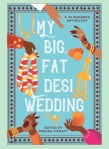
My Big Fat Desi Wedding by Prerna Pickett, Aamna Qureshi, Syed M. Masood, Tashie Bhuiyan, Noreen Mughees, Payal Doshi, Sarah Mughal Rana, Anahita Karthik

Standard
My Big Fat Desi Wedding by Prerna Pickett, Aamna Qureshi, Syed M. Masood, Tashie Bhuiyan, Noreen Mughees, Payal Doshi, Sarah Mughal Rana, Anahita Karthik

EDIT: I have been made aware that some/many of the included authors in this anthology have chosen to stay silent or “both side” the ongoing genocide in Palestine. Please be aware and be intentional and informed with your support

This 288 page YA short story anthology features eight stories of Desi weddings threaded together by an auntie with a bob haircut and a mole on her lip that appears and disappears into stories with magical realism, Tamil Brahman vampires, competing food dynasties, high school debate rivals, gorgeous clothes, delicious food, and sparks of romance.  Usually collections are hit or miss with writing quality and interest, but I found this collection enjoyable from start to finish.  My only real critique is that of the YA label and as a result some stories read more juvenile and at least one a bit more mature.  As a whole, the book, particularly for the genre, is fairly clean.  It is YA, it is romance, there are a lot of Muslim characters, with five of the authors being Muslim, but I would not classify any of the relationships or stories as halal.  That being said, I think mature teens 16 and up won’t find anything too alarming in the pages. There is music and dancing, close male female friends, secret relationships, a few kisses, some dances and hand holds, and a few that mention sex, condoms, and LGBTQ+ possibilities in passing, but most focus on weddings, culture, parental relationships, strong women, caste ideology, and hinting at happy every afters.  Many of the stories are simply set during a wedding or wedding prep, others are the bride or groom themselves, I don’t have a favorite or even a least favorite, as each has its own flavor, writing style, and focus.

SYNOPSIS:

Framed from an Auntie embarking on the wedding season, the short stories begin and follow one after another until the Auntie returns to conclude the book.

The Disaster Wedding by Prerna Pickett:  In a family where the words the females speak can come to fruition, an erroneous slip, claiming that her sister’s wedding will be a disaster brings on the challenges for the enemies to lovers side characters trying to not upset the marital couples multicultural Indian/American dream wedding.

A Cynic at a Shaadi by Aamna Qureshi follows a young Muslim girl nursing her broken heart from a recent breakup with her secret boyfriend.  Set during her cousins wedding, an upbeat optimistic boy makes her smile and gives her heart hope.

Sehra by Syed Masood involves a Muslim marrying a non Muslim girl that has the family refusing to attend.  The groom-to-be’s brother is torn and wants to attend, but he never goes against his parents.  His best friend who has grown up with the family and is facing her own community othering because of her “Mickey Mouse” hijab style, is planning to go, and together the two friends help wrap the groom’s turban.

Fates Favorites by Tashie Bhuiyan features magical realism with the words of soul mates appearing on skin.  The words appear and disappear sometimes unseen and possibly even as a result of one’s subconscious, thus the couples don’t always find one another, but when they do, the relationships can be magical.

The Wedding Biryani by Noreen Mughees is possibly the most religious of the short stories with high school debate rivals finding themselves cooking at the masjid for a couple that doesn’t have a family to celebrate the marriage.  Themes of losing a parent to death and simply leaving are present, as well as some internal reflection of boundaries, Allah swt, and body image.  The conclusion is the teens meeting up to dance.

A Confluence of Fates felt like the longest short story, and while many Zoroastrians it notes did come to India, the story focuses on Iranian Zoroastrian culture.  It is almost a story within a story as a couple gets a second chance at their relationship with the backdrop of a marriage play during the wedding unfolding in the background.

A Wedding Recipe for Disaster by Sarah Mughal Rana has competing family businesses: one Punjabi and the other of Pashtun culture, coming to a head when the offspring of the rival companies decide at the girl’s wedding to someone else, that they should be together.  With vibes of a Romeo and Juliet style family feud, the happy ending has readers craving achar and contemplating racism within the community.

And finally, A Very Bloody Kalyanam By Anahita Karthik goes gothic with a Tamil Brahmin vampire wedding occurring when offspring from two enemy cults imprint on each other.  This story is more mature with talk of sex, but has an emotional forgiving between the bride and her parents that makes the vampires lovable.

FLAGS:

It focuses on romance, and none of the stories are “halal.”  Music, relationships, boy girl friendships, Talk of sex, hints at LGBTQ+ identities, mention of condoms, vampires, magic, magical realism.

TOOLS FOR LEADING THE DISCUSSION:

Probably not a book to seek out for an Islamic school shelf, high school can probably handle it and understand it is not halal.

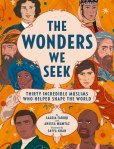
The Wonders We Seek: Thirty Incredible Muslims Who Helped Shape the World by Saadia Faruqi and Aneesa Mumtaz illustrated by Saffa Khan

Standard
The Wonders We Seek: Thirty Incredible Muslims Who Helped Shape the World by Saadia Faruqi and Aneesa Mumtaz illustrated by Saffa Khan

wonders we seek

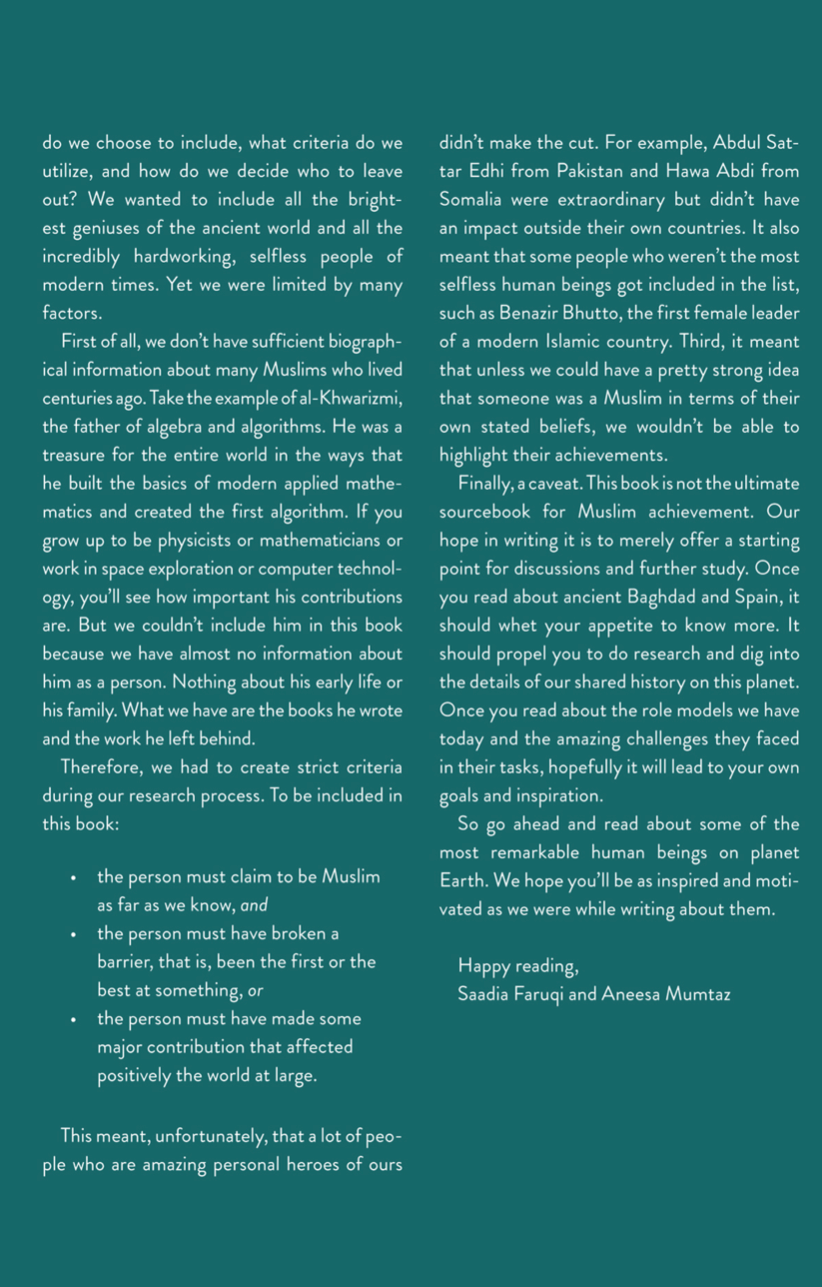
I’ve noted over the years how much I want to love these type of collections, but ultimately I just don’t.  The reason I gave this one a try was quite simply the reassuring introduction.  The book immediately detailed the checklist required to make it into the book, the criteria required, and acknowledged the limitations that the book overall, and personalities included, would have in the presentation. There are sources at the end for each of the 30 people included as well.  Unlike most books in the genre, this book got out in front of my most common complaints: the lack of transparency for how the people were selected, where the primary source information was obtained from, how the order is organized, and the Eurocentric and pop culture framing that is both pandering and renders the book cumbersome a few years after it is published.  For the most part, this book is the best I’ve seen yet, but that isn’t to say I loved it.  While the requirements to be included were made apparent, there is still a lot of opinionated statements about how “religious” or “conservative” or “devout” or “mainstream” or “strict” a person is or was, that rubbed me the wrong way.  Also knowing that the person had to identify as Muslim to be eligible seems like a black and white issue, but a few of the personalities are very controversial (some noted and some not), and I am not an expert at all.  One of the problems with books like this is they present as non fiction, and no matter the transparency, just the mere fact of who is included and who is not is a judgement call and wrought with bias.  It is nice to thumb through, but I don’t know that it would get repeated use, or that it could really be used as a reference.  It is informative and I recognize that I went in to it very skeptical, but only a few text passages connected faith to the person’s accomplishments, and so while they identify as Muslim, it doesn’t necessarily radiate pride or admiration for Muslims as a whole.  For better or worse, if anything, it made me want to conduct my own research on many that were featured. 

img_9998

The 30 included in the book:


A few I was concerned by, which made me question the ones that I learned something new about. Clearly there are reasons that I shy away from non-fiction.  I wish the book would have had Muslim beta readers, I am willing to assume that it did not.  Take for example the section on Saladin, I absolutely get why his name is shown as both Saladin and Salah al-Din, the book is in English presumably for western readers and that is how he is known.  But why when it says that his real name is Yusuf, is Joseph in the parenthesis? No one else’s names in the book are given the English equivalents of their Arabic or Persian or other native language. Similarly so few tied back to Islam or an Islamic perspective being credited for having a role in their noteworthy accomplishments.  Even Muhammad Yunus when it discusses how interest was not a part of the micro loan process- it didn’t add even one more sentence explaining that interest is not allowed in Islam, why leave that out?  

I liked that the parameters required that the person was influential more globally than just to their own country, but Rebiya Kadeer seemed to be more localized in her work with Muslims in China even when she moved out of China, blurring the rigid standards of who was to be included and who was to be left out.  

img_9968

I do like that it mentions Rumi’s religion is often conveniently ignored as the west has made him a hero and chosen to forget his faith.  Similarly, I like that it tries to correct when Ibn Battuta is called the Marco Polo of Islam, for in reality Marco Polo was the Ibn Battuta of Europe.  And I appreciated that Benazir Bhutto was noted as being controversial and not well liked. 

If this type of book appeals to you, you can purchase it here.