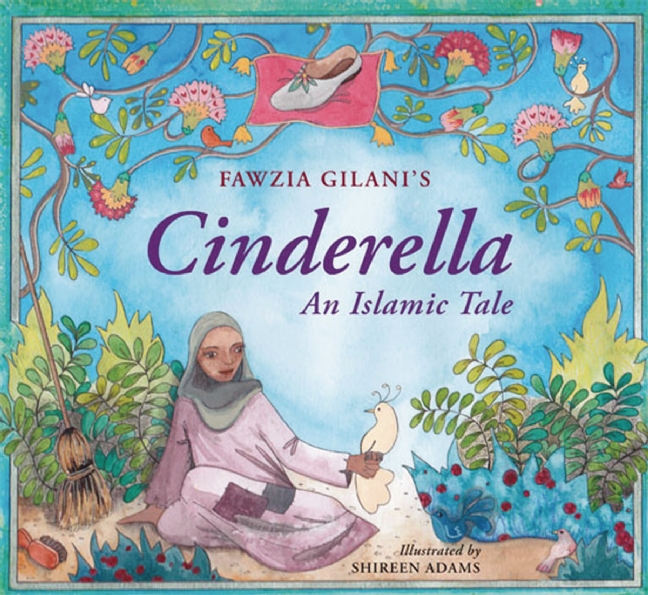
I’ve seen this book countless times online and honestly have never given it a second glance. I mean Cinderella is a classic fairytale and I have a few different versions from around the world, but an Islamic one? It seemed like it would be awkward or overly preachy and forced. I should have given Fawzia Gilani’s version a chance though, she has surprised me with her other re-tellings of Eid Kareem Ameer Saab and Nabeel’s New Pants. And, mashaAllah, to her credit she manages to weave a decent story full of Islamic tenants, void of magic, and more feminist than the Disney or Grimm versions.
I’m not going to summarize such a familiar tale, but I will point out major twists. Zahra is a practicing Muslim who is very devout in her prayers, fasting, and reading of the Quran. Her step-sisters nickname her Cinderella after some cinders from the fire burn holes in her clothes. A bit of a stretch, from Zahra, but I think even the youngest readers will know the original Cinderella story and be ok with it.
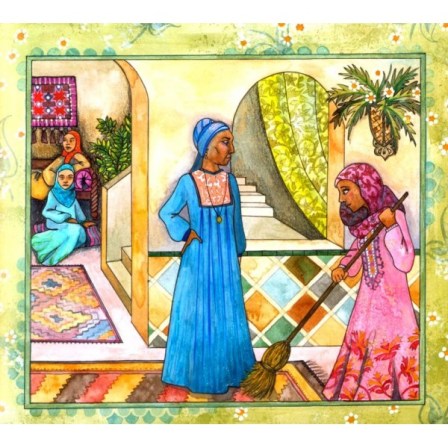
Cinderella is constantly remembering to be patient despite the treatment of her step family through various duaas, ayats in the quran, and fasting on the day of Arafah. When an invitation to an Eid Party at the palace comes, she naturally is forbidden from going unless she completes all her chores. Luckily her Grandmother returns from Hajj with servants to help clean the house and a new abaya to wear to the party. At the palace the women and men are in different rooms, but Cinderella catches the King, the Queen, and Prince Bilal’s attention when passing in the hallway for being in full hijab. She continues to impress the Queen, when she remains quiet during the athan, prays in jammat, and shows grace in her manners and speech. After winning over the mom, the slipper and happily ever after follow the traditional script, however, like the story of Yusuf (as) and how he forgives his brothers, Zahra forgives her step-family as well.

The 41 page story is heavy on the text and is not AR. I would imagine that it would be on a third grade level for Muslim children familiar with the vocabulary, and fourth grade for those that are not. There is a glossary at the back, but not all of the Arabic words are included, and I’m not sure that the context would allow for them in some cases to be understood. This book would be hard to do in a story time setting because of the length, at bedtime, however, the pictures are detailed and rich enough that one-on-one could hold a five or six year olds’ attention.
Overall the story doesn’t feel forced, and you’ll find your self smiling at some of the “islamicifaction” of the plot. Most of it flows really well. I love that it isn’t focused on her appearance alone. I also like that she isn’t helplessly waiting to be saved or alleviated from her burdens. By and large it doesn’t feel like a love story, Prince Bilal is pretty much a minor story point. The book works for Muslims and non-Muslims alike. It isn’t preachy, but it definitely is strong in it’s moral messages. I think non Muslims will find the Islamic version just as fun as the hundreds of other “twists” on Cinderella and Muslim children will love to see someone like them living happily ever after as well, inshaAllah.


 Islamic School Librarian